 Add to Chrome
 Add to Firefox
 Add to Edge
Can LLMs Reason Like Automated Theorem Provers for Rust Verification? VCoT-Bench: Evaluating via Verification Chain of Thought
Mar 18, 2026
As Large Language Models (LLMs) increasingly assist secure software development, their ability to meet the rigorous demands of Rust program verification remains unclear. Existing evaluations treat Rust verification as a black box, assessing models only by binary pass or fail outcomes for proof hints. This obscures whether models truly understand the logical deductions required for verifying nontrivial Rust code. To bridge this gap, we introduce VCoT-Lift, a framework that lifts low-level solver reasoning into high-level, human-readable verification steps. By exposing solver-level reasoning as an explicit Verification Chain-of-Thought, VCoT-Lift provides a concrete ground truth for fine-grained evaluation. Leveraging VCoT-Lift, we introduce VCoT-Bench, a comprehensive benchmark of 1,988 VCoT completion tasks for rigorously evaluating LLMs' understanding of the entire verification process. VCoT-Bench measures performance along three orthogonal dimensions: robustness to varying degrees of missing proofs, competence across different proof types, and sensitivity to the proof locations. Evaluation of ten state-of-the-art models reveals severe fragility, indicating that current LLMs fall well short of the reasoning capabilities exhibited by automated theorem provers.

KNighter: Transforming Static Analysis with LLM-Synthesized Checkers
Mar 12, 2025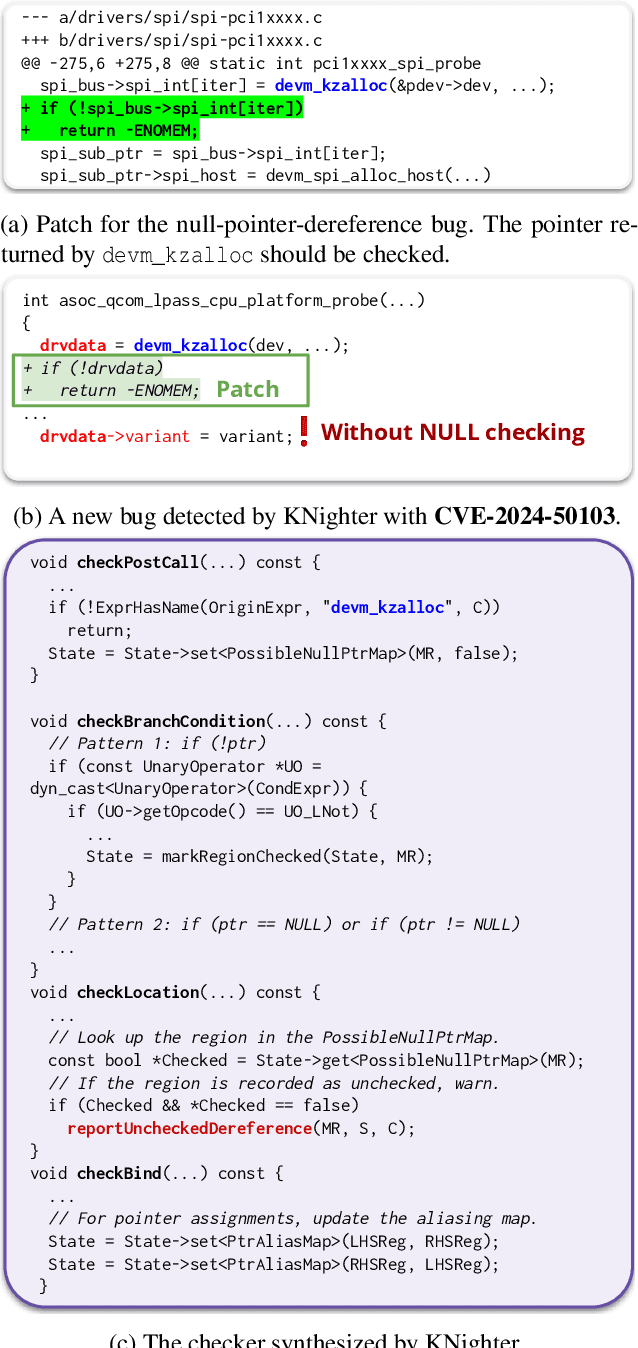
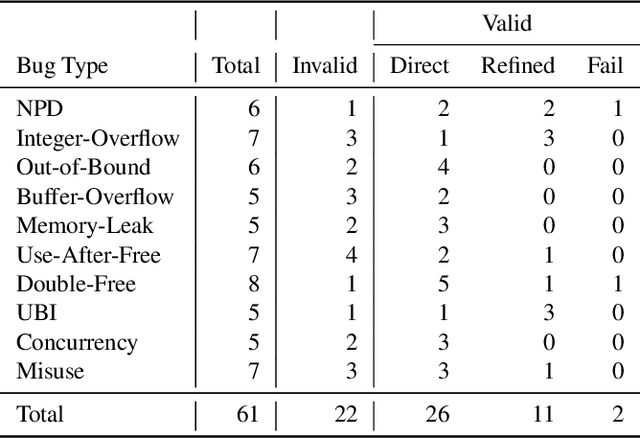
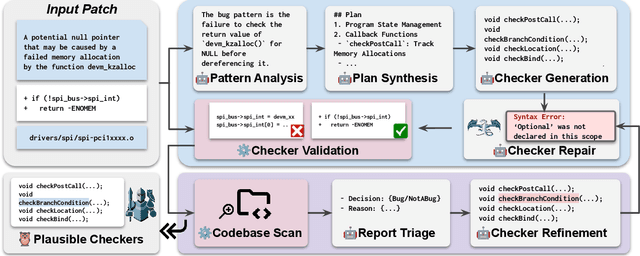

Static analysis is a powerful technique for bug detection in critical systems like operating system kernels. However, designing and implementing static analyzers is challenging, time-consuming, and typically limited to predefined bug patterns. While large language models (LLMs) have shown promise for static analysis, directly applying them to scan large codebases remains impractical due to computational constraints and contextual limitations. We present KNighter, the first approach that unlocks practical LLM-based static analysis by automatically synthesizing static analyzers from historical bug patterns. Rather than using LLMs to directly analyze massive codebases, our key insight is leveraging LLMs to generate specialized static analyzers guided by historical patch knowledge. KNighter implements this vision through a multi-stage synthesis pipeline that validates checker correctness against original patches and employs an automated refinement process to iteratively reduce false positives. Our evaluation on the Linux kernel demonstrates that KNighter generates high-precision checkers capable of detecting diverse bug patterns overlooked by existing human-written analyzers. To date, KNighter-synthesized checkers have discovered 70 new bugs/vulnerabilities in the Linux kernel, with 56 confirmed and 41 already fixed. 11 of these findings have been assigned CVE numbers. This work establishes an entirely new paradigm for scalable, reliable, and traceable LLM-based static analysis for real-world systems via checker synthesis.