 Add to Chrome
 Add to Firefox
 Add to Edge
UCOB: Learning to Utilize and Evolve Agentic Skills via Credit-Aware On-Policy Bidirectional Self-Distillation
Jun 28, 2026
Skill memories can improve agentic reinforcement learning by reusing past experience as textual guidance, but retrieved skills are not oracular: they may help in one state while misleading the same policy in another. This makes the common privileged-teacher assumption fragile, namely that a skill-conditioned prompt can be treated as a fixed teacher for the no-skill prompt. We introduce UCOB, a framework for learning to utilize and evolve agentic skills via credit-aware on-policy bidirectional self-distillation. UCOB treats skill-conditioned and no-skill prompts as two on-policy context views of the same model, compares their return-to-go within the same task and anchor state, and uses the higher-return view as the local teacher. This local credit signal internalizes useful skill-conditioned behavior, corrects misleading skill usage, and guides task/state skill memory updates, utility-aware retrieval, and reflection self-training. Experiments on agentic tasks, including ALFWorld, WebShop, and Search-QA, show that UCOB outperforms skill-free RL, skill-memory baselines, and self-distillation methods across model scales, with up to 23.5 and 18.0 point gains over SOTA baselines on ALFWorld and WebShop. Ablations and analyses further validate its core mechanisms and efficiency.

Are Full Rollouts Necessary for On-Policy Distillation?
Jun 01, 2026On-policy distillation (OPD) provides dense teacher feedback along student-generated rollouts rather than fixed teacher traces and has emerged as a promising post-training paradigm. However, standard OPD typically generates full rollouts during training, which is computationally expensive and may expose the student to unreliable teacher feedback at late rollout positions, especially during early training. We identify the rollout horizon as a key bottleneck in OPD that substantially impacts training efficiency. Unlike Reinforcement Learning with Verifiable Rewards (RLVR), OPD does not require a final answer reward to provide learning signals. Therefore, full rollouts may not always be necessary for OPD. Motivated by this insight, we propose two simple horizon-control strategies: Progressive OPD (POPD), which gradually expands the rollout horizon during training, and Truncated OPD (TOPD), which permanently performs distillation on reliable truncated rollouts. Experiments on mathematical reasoning show that POPD improves the training efficiency of OPD by up to 3$\times$, while TOPD matches OPD performance using only 10\% of the rollout horizon, leading to substantial wall-clock and memory reductions. These results demonstrate that controlling the rollout horizon offers a simple and practical path to more efficient OPD.
$π$-Play: Multi-Agent Self-Play via Privileged Self-Distillation without External Data
Apr 15, 2026Deep search agents have emerged as a promising paradigm for addressing complex information-seeking tasks, but their training remains challenging due to sparse rewards, weak credit assignment, and limited labeled data. Self-play offers a scalable route to reduce data dependence, but conventional self-play optimizes students only through sparse outcome rewards, leading to low learning efficiency. In this work, we observe that self-play naturally produces a question construction path (QCP) during task generation, an intermediate artifact that captures the reverse solution process. This reveals a new source of privileged information for self-distillation: self-play can itself provide high-quality privileged context for the teacher model in a low-cost and scalable manner, without relying on human feedback or curated privileged information. Leveraging this insight, we propose Privileged Information Self-Play ($π$-Play), a multi-agent self-evolution framework. In $π$-Play, an examiner generates tasks together with their QCPs, and a teacher model leverages QCP as privileged context to densely supervise a student via self-distillation. This design transforms conventional sparse-reward self-play into a dense-feedback self-evolution loop. Extensive experiments show that data-free $π$-Play surpasses fully supervised search agents and improves evolutionary efficiency by 2-3$\times$ over conventional self-play.
Dynamic Dual-Granularity Skill Bank for Agentic RL
Mar 30, 2026Agentic reinforcement learning (RL) can benefit substantially from reusable experience, yet existing skill-based methods mainly extract trajectory-level guidance and often lack principled mechanisms for maintaining an evolving skill memory. We propose D2Skill, a dynamic dual-granularity skill bank for agentic RL that organizes reusable experience into task skills for high-level guidance and step skills for fine-grained decision support and error correction. D2Skill jointly trains the policy and skill bank through paired baseline and skill-injected rollouts under the same policy, using their performance gap to derive hindsight utility signals for both skill updating and policy optimization. Built entirely from training-time experience, the skill bank is continuously expanded through reflection and maintained with utility-aware retrieval and pruning. Experiments on ALFWorld and WebShop with Qwen2.5-7B-Instruct and Qwen3-4B-Instruct-2507 show that D2Skill consistently improves success rates over skill-free baselines by 10-20 points. Further ablations and analyses show that both dual-granularity skill modeling and dynamic skill maintenance are critical to these gains, while the learned skills exhibit higher utility, transfer across evaluation settings, and introduce only modest training overhead.
CriticSearch: Fine-Grained Credit Assignment for Search Agents via a Retrospective Critic
Nov 15, 2025Tool-Integrated Reasoning (TIR) with search engines enables large language models to iteratively retrieve up-to-date external knowledge, enhancing adaptability and generalization in complex question-answering tasks. However, existing search agent pipelines typically depend on reinforcement learning based optimization, which often suffers from sparse outcome rewards, leading to inefficient exploration and unstable training. We introduce CriticSearch, a fine-grained credit-assignment framework that supplies dense, turn-level feedback via a retrospective critic mechanism. During training, a frozen, asymmetric critique LLM retrospectively evaluates each turn using privileged information from the full trajectory and gold answers, converting these assessments into stable, dense rewards that guide policy improvement. Experimental results across diverse multi-hop reasoning benchmarks demonstrate that CriticSearch consistently outperforms existing baselines, achieving faster convergence, improved training stability, and higher performance.
In-Dataset Trajectory Return Regularization for Offline Preference-based Reinforcement Learning
Dec 12, 2024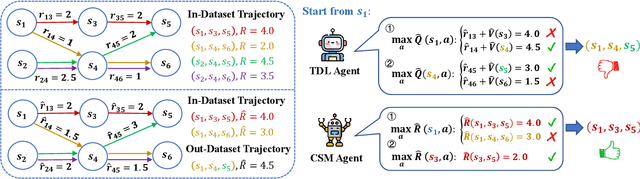
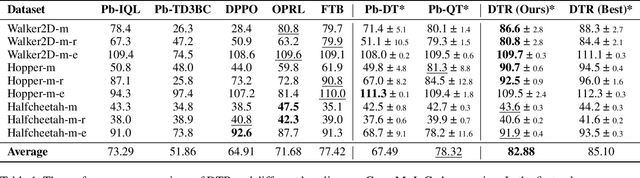
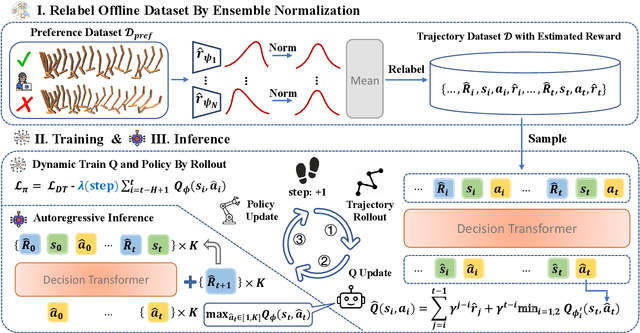

Offline preference-based reinforcement learning (PbRL) typically operates in two phases: first, use human preferences to learn a reward model and annotate rewards for a reward-free offline dataset; second, learn a policy by optimizing the learned reward via offline RL. However, accurately modeling step-wise rewards from trajectory-level preference feedback presents inherent challenges. The reward bias introduced, particularly the overestimation of predicted rewards, leads to optimistic trajectory stitching, which undermines the pessimism mechanism critical to the offline RL phase. To address this challenge, we propose In-Dataset Trajectory Return Regularization (DTR) for offline PbRL, which leverages conditional sequence modeling to mitigate the risk of learning inaccurate trajectory stitching under reward bias. Specifically, DTR employs Decision Transformer and TD-Learning to strike a balance between maintaining fidelity to the behavior policy with high in-dataset trajectory returns and selecting optimal actions based on high reward labels. Additionally, we introduce an ensemble normalization technique that effectively integrates multiple reward models, balancing the tradeoff between reward differentiation and accuracy. Empirical evaluations on various benchmarks demonstrate the superiority of DTR over other state-of-the-art baselines
* 7 pages, Proceedings of the 39th AAAI Conference on Artificial Intelligence (AAAI-25)