 Add to Chrome
 Add to Firefox
 Add to Edge
Learning Whom to Trust: Market-Feedback Adaptive Retrieval for Frozen LLMs in Event-Driven Financial RAG
May 29, 2026
Financial retrieval-augmented generation (RAG) systems typically rank evidence by textual relevance, but in financial markets the useful evidence source depends on event type, forecast horizon, and market context. We study news-triggered event-impact prediction as a point-in-time financial RAG problem. For each company-news anchor, the system retrieves related financial news and SEC filing passages, appends a pre-decision market-context card, and predicts multi-horizon residual-return signals. Our method keeps the large language model (LLM) reader frozen and adapts the retrieval layer through an external Bayesian source memory updated from matured residual-return feedback. On a fixed 89-stock Nasdaq-oriented universe derived from the FinRL-DeepSeek/FNSPID task, using original FNSPID news and point-in-time EDGAR filing passages, Frozen Reader with Source Memory improves held-out macro-F1 from 0.438 to 0.471 and downstream portfolio Sharpe from 0.52 to 0.84 relative to Frozen Reader with No Memory. A supervised LoRA reader improves static RAG modestly, but does not improve over the frozen source-memory reader. These results suggest that, for financial RAG, learning where to retrieve from can be as important as learning how to read, offering a simple, modular route to market-feedback adaptation.

FlagGAM: Rule-Based Generalized Additive Modeling for Explainable Tabular Prediction
May 29, 2026Tabular prediction in high-stakes domains requires models that are accurate, transparent, and robust to imperfect inputs. We propose FlagGAM, a rule-defined basis framework that separates feature-level rule construction from prediction. A Flag Core Module converts numerical and categorical variables into sparse, human-readable univariate bases, including threshold flags, category-level flags, tail-deviation bases, and categorical step functions; a default additive head then combines these bases as a restricted GAM-style predictor. Rather than reducing triggered rules to compact count summaries, FlagGAM retains a sparse rule-basis matrix that supports mixed-type classification and regression, feature-specific weighting, and optional flexible prediction heads. Across tabular benchmarks, default FlagGAM remains close to EBM in transparent additive mode, improves substantially over ridge regression on mixed-type regression, and shows smaller AUROC degradation than common baselines under missing and noisy perturbations. Flexible heads further improve accuracy and approach strong tree-based baselines, with the caveat that the resulting model should be interpreted as a rule-basis representation followed by a nonlinear predictor rather than as a fully additive GAM. Overall, FlagGAM provides a practical middle ground for tabular settings that require competitive accuracy, communicable rules, and robustness to imperfect inputs.
Hierarchical Reinforced Trader (HRT): A Bi-Level Approach for Optimizing Stock Selection and Execution
Oct 19, 2024

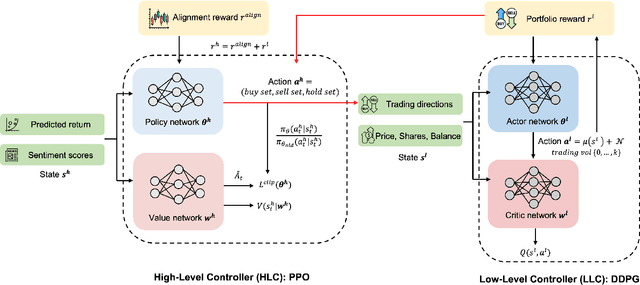
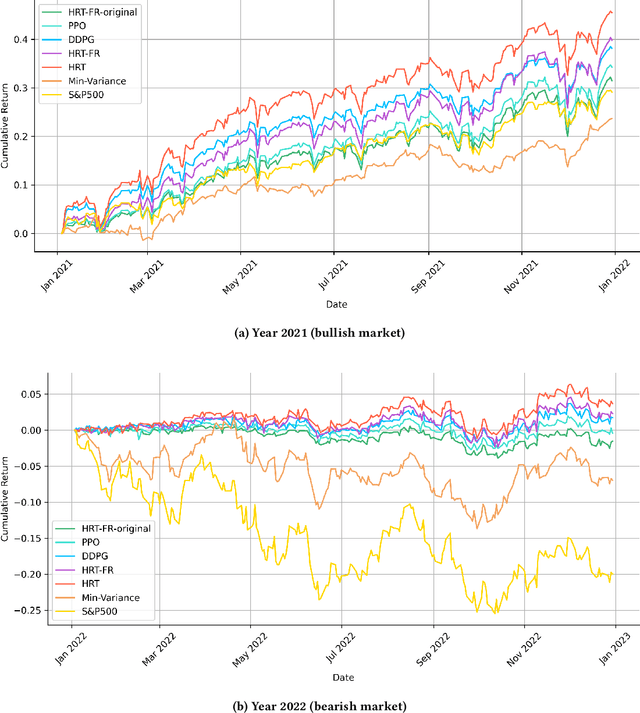
Leveraging Deep Reinforcement Learning (DRL) in automated stock trading has shown promising results, yet its application faces significant challenges, including the curse of dimensionality, inertia in trading actions, and insufficient portfolio diversification. Addressing these challenges, we introduce the Hierarchical Reinforced Trader (HRT), a novel trading strategy employing a bi-level Hierarchical Reinforcement Learning framework. The HRT integrates a Proximal Policy Optimization (PPO)-based High-Level Controller (HLC) for strategic stock selection with a Deep Deterministic Policy Gradient (DDPG)-based Low-Level Controller (LLC) tasked with optimizing trade executions to enhance portfolio value. In our empirical analysis, comparing the HRT agent with standalone DRL models and the S&P 500 benchmark during both bullish and bearish market conditions, we achieve a positive and higher Sharpe ratio. This advancement not only underscores the efficacy of incorporating hierarchical structures into DRL strategies but also mitigates the aforementioned challenges, paving the way for designing more profitable and robust trading algorithms in complex markets.
Estimating heterogeneous treatment effect from survival outcomes via (orthogonal) censoring unbiased learning
Jan 20, 2024Methods for estimating heterogeneous treatment effects (HTE) from observational data have largely focused on continuous or binary outcomes, with less attention paid to survival outcomes and almost none to settings with competing risks. In this work, we develop censoring unbiased transformations (CUTs) for survival outcomes both with and without competing risks.After converting time-to-event outcomes using these CUTs, direct application of HTE learners for continuous outcomes yields consistent estimates of heterogeneous cumulative incidence effects, total effects, and separable direct effects. Our CUTs enable application of a much larger set of state of the art HTE learners for censored outcomes than had previously been available, especially in competing risks settings. We provide generic model-free learner-specific oracle inequalities bounding the finite-sample excess risk. The oracle efficiency results depend on the oracle selector and estimated nuisance functions from all steps involved in the transformation. We demonstrate the empirical performance of the proposed methods in simulation studies.