 Add to Chrome
 Add to Firefox
 Add to Edge
How Vulnerable Are Edge LLMs?
Mar 25, 2026
Large language models (LLMs) are increasingly deployed on edge devices under strict computation and quantization constraints, yet their security implications remain unclear. We study query-based knowledge extraction from quantized edge-deployed LLMs under realistic query budgets and show that, although quantization introduces noise, it does not remove the underlying semantic knowledge, allowing substantial behavioral recovery through carefully designed queries. To systematically analyze this risk, we propose \textbf{CLIQ} (\textbf{Cl}ustered \textbf{I}nstruction \textbf{Q}uerying), a structured query construction framework that improves semantic coverage while reducing redundancy. Experiments on quantized Qwen models (INT8/INT4) demonstrate that CLIQ consistently outperforms original queries across BERTScore, BLEU, and ROUGE, enabling more efficient extraction under limited budgets. These results indicate that quantization alone does not provide effective protection against query-based extraction, highlighting a previously underexplored security risk in edge-deployed LLMs.

How Much Information Can a Vision Token Hold? A Scaling Law for Recognition Limits in VLMs
Jan 28, 2026Recent vision-centric approaches have made significant strides in long-context modeling. Represented by DeepSeek-OCR, these models encode rendered text into continuous vision tokens, achieving high compression rates without sacrificing recognition precision. However, viewing the vision encoder as a lossy channel with finite representational capacity raises a fundamental question: what is the information upper bound of visual tokens? To investigate this limit, we conduct controlled stress tests by progressively increasing the information quantity (character count) within an image. We observe a distinct phase-transition phenomenon characterized by three regimes: a near-perfect Stable Phase, an Instability Phase marked by increased error variance, and a total Collapse Phase. We analyze the mechanical origins of these transitions and identify key factors. Furthermore, we formulate a probabilistic scaling law that unifies average vision token load and visual density into a latent difficulty metric. Extensive experiments across various Vision-Language Models demonstrate the universality of this scaling law, providing critical empirical guidance for optimizing the efficiency-accuracy trade-off in visual context compression.
Tree-Based Stochastic Optimization for Solving Large-Scale Urban Network Security Games
Nov 13, 2025Urban Network Security Games (UNSGs), which model the strategic allocation of limited security resources on city road networks, are critical for urban safety. However, finding a Nash Equilibrium (NE) in large-scale UNSGs is challenging due to their massive and combinatorial action spaces. One common approach to addressing these games is the Policy-Space Response Oracle (PSRO) framework, which requires computing best responses (BR) at each iteration. However, precisely computing exact BRs is impractical in large-scale games, and employing reinforcement learning to approximate BRs inevitably introduces errors, which limits the overall effectiveness of the PSRO methods. Recent advancements in leveraging non-convex stochastic optimization to approximate an NE offer a promising alternative to the burdensome BR computation. However, utilizing existing stochastic optimization techniques with an unbiased loss function for UNSGs remains challenging because the action spaces are too vast to be effectively represented by neural networks. To address these issues, we introduce Tree-based Stochastic Optimization (TSO), a framework that bridges the gap between the stochastic optimization paradigm for NE-finding and the demands of UNSGs. Specifically, we employ the tree-based action representation that maps the whole action space onto a tree structure, addressing the challenge faced by neural networks in representing actions when the action space cannot be enumerated. We then incorporate this representation into the loss function and theoretically demonstrate its equivalence to the unbiased loss function. To further enhance the quality of the converged solution, we introduce a sample-and-prune mechanism that reduces the risk of being trapped in suboptimal local optima. Extensive experimental results indicate the superiority of TSO over other baseline algorithms in addressing the UNSGs.
Solving Urban Network Security Games: Learning Platform, Benchmark, and Challenge for AI Research
Jan 29, 2025

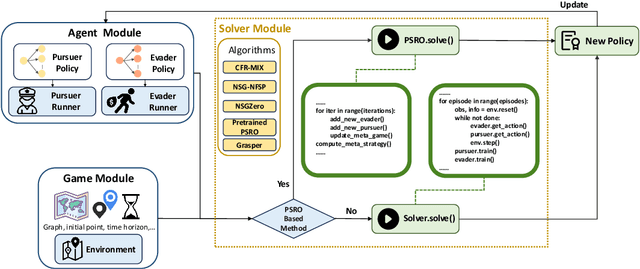

After the great achievement of solving two-player zero-sum games, more and more AI researchers focus on solving multiplayer games. To facilitate the development of designing efficient learning algorithms for solving multiplayer games, we propose a multiplayer game platform for solving Urban Network Security Games (\textbf{UNSG}) that model real-world scenarios. That is, preventing criminal activity is a highly significant responsibility assigned to police officers in cities, and police officers have to allocate their limited security resources to interdict the escaping criminal when a crime takes place in a city. This interaction between multiple police officers and the escaping criminal can be modeled as a UNSG. The variants of UNSGs can model different real-world settings, e.g., whether real-time information is available or not, and whether police officers can communicate or not. The main challenges of solving this game include the large size of the game and the co-existence of cooperation and competition. While previous efforts have been made to tackle UNSGs, they have been hampered by performance and scalability issues. Therefore, we propose an open-source UNSG platform (\textbf{GraphChase}) for designing efficient learning algorithms for solving UNSGs. Specifically, GraphChase offers a unified and flexible game environment for modeling various variants of UNSGs, supporting the development, testing, and benchmarking of algorithms. We believe that GraphChase not only facilitates the development of efficient algorithms for solving real-world problems but also paves the way for significant advancements in algorithmic development for solving general multiplayer games.
MSW-Transformer: Multi-Scale Shifted Windows Transformer Networks for 12-Lead ECG Classification
Jun 21, 2023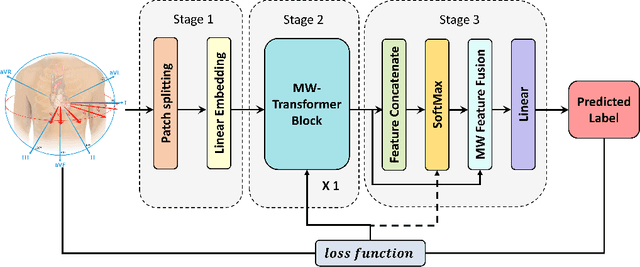
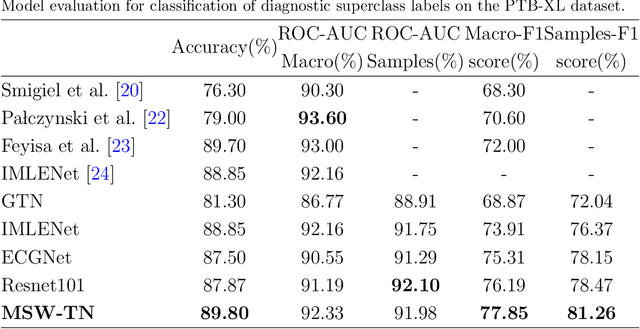
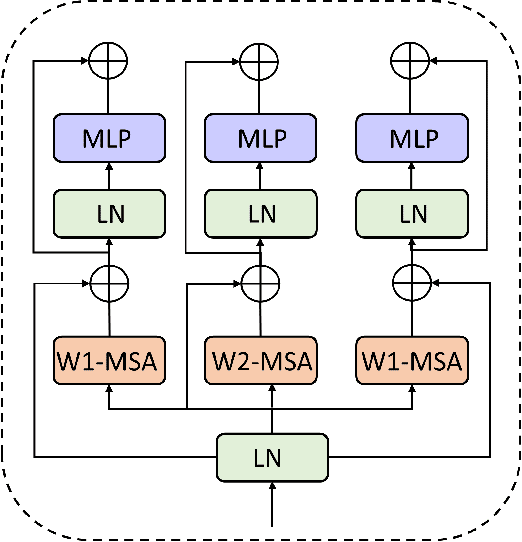
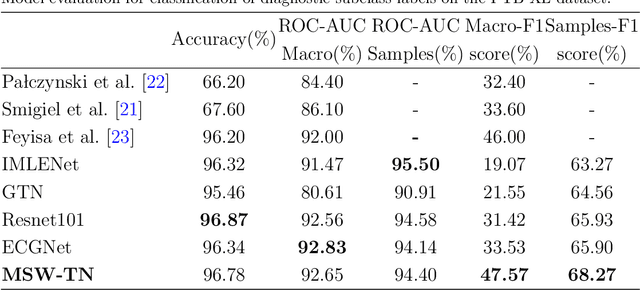
Automatic classification of electrocardiogram (ECG) signals plays a crucial role in the early prevention and diagnosis of cardiovascular diseases. While ECG signals can be used for the diagnosis of various diseases, their pathological characteristics exhibit minimal variations, posing a challenge to automatic classification models. Existing methods primarily utilize convolutional neural networks to extract ECG signal features for classification, which may not fully capture the pathological feature differences of different diseases. Transformer networks have advantages in feature extraction for sequence data, but the complete network is complex and relies on large-scale datasets. To address these challenges, we propose a single-layer Transformer network called Multi-Scale Shifted Windows Transformer Networks (MSW-Transformer), which uses a multi-window sliding attention mechanism at different scales to capture features in different dimensions. The self-attention is restricted to non-overlapping local windows via shifted windows, and different window scales have different receptive fields. A learnable feature fusion method is then proposed to integrate features from different windows to further enhance model performance. Furthermore, we visualize the attention mechanism of the multi-window shifted mechanism to achieve better clinical interpretation in the ECG classification task. The proposed model achieves state-of-the-art performance on five classification tasks of the PTBXL-2020 12-lead ECG dataset, which includes 5 diagnostic superclasses, 23 diagnostic subclasses, 12 rhythm classes, 17 morphology classes, and 44 diagnosis classes, with average macro-F1 scores of 77.85%, 47.57%, 66.13%, 34.60%, and 34.29%, and average sample-F1 scores of 81.26%, 68.27%, 91.32%, 50.07%, and 63.19%, respectively.
SearchMorph:Multi-scale Correlation Iterative Network for Deformable Registration
Jul 04, 2022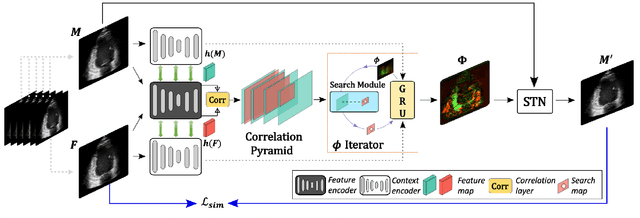
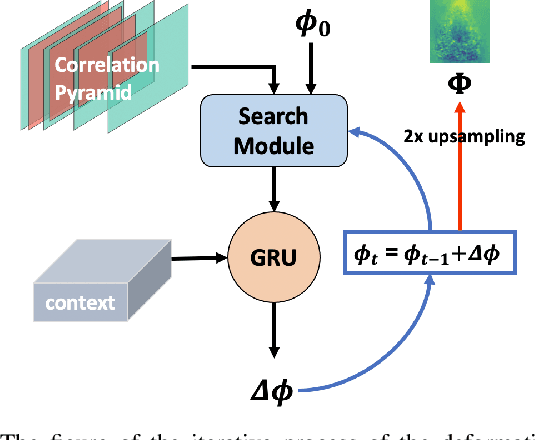
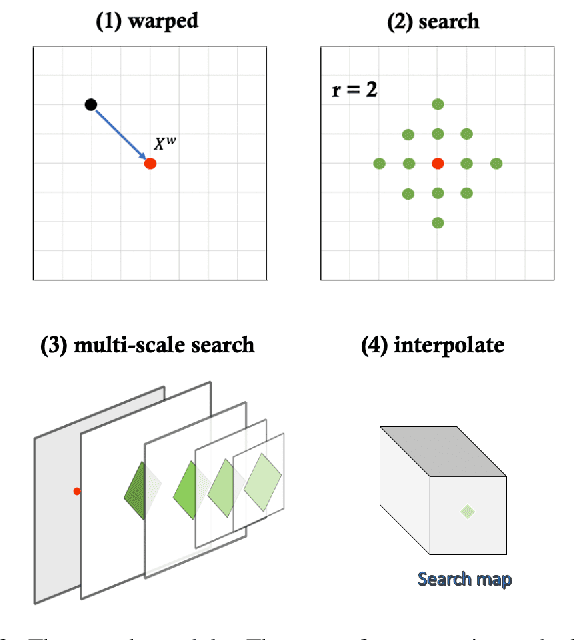
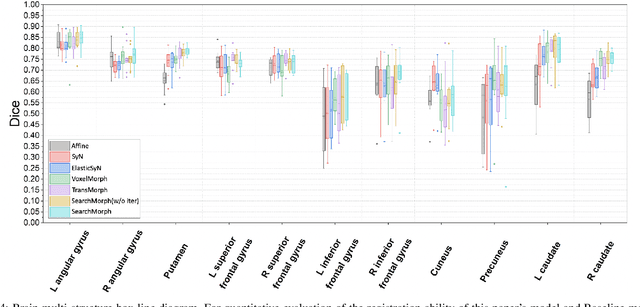
Deformable image registration provides dynamic information about the image and is essential in medical image analysis. However, due to the different characteristics of single-temporal brain MR images and multi-temporal echocardiograms, it is difficult to accurately register them using the same algorithm or model. We propose an unsupervised multi-scale correlation iterative registration network (SearchMorph), and the model has three highlights. (1)We introduced cost volumes to strengthen feature correlations and constructed correlation pyramids to complement multi-scale correlation information. (2) We designed the search module to search for the registration of features in multi-scale pyramids. (3) We use the GRU module for iterative refinement of the deformation field. The proposed network in this paper shows leadership in common single-temporal registration tasks and solves multi-temporal motion estimation tasks. The experimental results show that our proposed method achieves higher registration accuracy and a lower folding point ratio than the state-of-the-art methods.