 Add to Chrome
 Add to Firefox
 Add to Edge
Efficient Online Lexicographic Generalized Low-Rank Matrix Bandits
Aug 05, 2026
This paper studies generalized low-rank matrix bandits with multiple prioritized objectives. At each round, the learner selects a matrix-valued arm and observes a vector-valued reward, whose components correspond to multiple objectives with different priority levels. Each objective is governed by an objective-specific generalized low-rank matrix model, and the learner evaluates arms according to a lexicographic preference order, prioritizing higher-level objectives before lower-level ones. We propose \textsc{Lexi-LowGLM}, an efficient online algorithm that first estimates objective-specific low-rank subspaces and then performs lexicographic learning in the reduced feature spaces. Unlike existing single-objective algorithms that repeatedly solve a batch generalized linear estimator using all historical observations, \textsc{Lexi-LowGLM} updates each objective-specific estimator via an online Newton step, reducing the estimator-update complexity over $T$ rounds from $O(T^2)$ to $O(T)$. We establish a regret bound of $\widetilde O\left(W_i^{\rm lex}\sqrt{m}\,(d_1+d_2)r\sqrt{T}\right)$ for each objective $i\in[m]$, where $r$ is an upper bound on the ranks of the objective-specific parameter matrices and $W_i^{\rm lex}$ characterizes the lexicographic trade-off effect. This bound depends on the effective low-rank dimension $(d_1+d_2)r$ rather than the ambient dimension $d_1d_2$. Numerical experiments further validate the effectiveness and computational efficiency of the proposed method.

How Vulnerable Are Edge LLMs?
Mar 25, 2026Large language models (LLMs) are increasingly deployed on edge devices under strict computation and quantization constraints, yet their security implications remain unclear. We study query-based knowledge extraction from quantized edge-deployed LLMs under realistic query budgets and show that, although quantization introduces noise, it does not remove the underlying semantic knowledge, allowing substantial behavioral recovery through carefully designed queries. To systematically analyze this risk, we propose \textbf{CLIQ} (\textbf{Cl}ustered \textbf{I}nstruction \textbf{Q}uerying), a structured query construction framework that improves semantic coverage while reducing redundancy. Experiments on quantized Qwen models (INT8/INT4) demonstrate that CLIQ consistently outperforms original queries across BERTScore, BLEU, and ROUGE, enabling more efficient extraction under limited budgets. These results indicate that quantization alone does not provide effective protection against query-based extraction, highlighting a previously underexplored security risk in edge-deployed LLMs.
How Much Information Can a Vision Token Hold? A Scaling Law for Recognition Limits in VLMs
Jan 28, 2026Recent vision-centric approaches have made significant strides in long-context modeling. Represented by DeepSeek-OCR, these models encode rendered text into continuous vision tokens, achieving high compression rates without sacrificing recognition precision. However, viewing the vision encoder as a lossy channel with finite representational capacity raises a fundamental question: what is the information upper bound of visual tokens? To investigate this limit, we conduct controlled stress tests by progressively increasing the information quantity (character count) within an image. We observe a distinct phase-transition phenomenon characterized by three regimes: a near-perfect Stable Phase, an Instability Phase marked by increased error variance, and a total Collapse Phase. We analyze the mechanical origins of these transitions and identify key factors. Furthermore, we formulate a probabilistic scaling law that unifies average vision token load and visual density into a latent difficulty metric. Extensive experiments across various Vision-Language Models demonstrate the universality of this scaling law, providing critical empirical guidance for optimizing the efficiency-accuracy trade-off in visual context compression.
Catch Causal Signals from Edges for Label Imbalance in Graph Classification
Jan 07, 2025

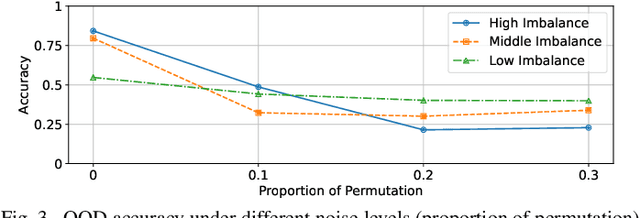

Despite significant advancements in causal research on graphs and its application to cracking label imbalance, the role of edge features in detecting the causal effects within graphs has been largely overlooked, leaving existing methods with untapped potential for further performance gains. In this paper, we enhance the causal attention mechanism through effectively leveraging edge information to disentangle the causal subgraph from the original graph, as well as further utilizing edge features to reshape graph representations. Capturing more comprehensive causal signals, our design leads to improved performance on graph classification tasks with label imbalance issues. We evaluate our approach on real-word datasets PTC, Tox21, and ogbg-molhiv, observing improvements over baselines. Overall, we highlight the importance of edge features in graph causal detection and provide a promising direction for addressing label imbalance challenges in graph-level tasks. The model implementation details and the codes are available on https://github.com/fengrui-z/ECAL