 Add to Chrome
 Add to Firefox
 Add to Edge
Timer-S1: A Billion-Scale Time Series Foundation Model with Serial Scaling
Mar 05, 2026
We introduce Timer-S1, a strong Mixture-of-Experts (MoE) time series foundation model with 8.3B total parameters, 0.75B activated parameters for each token, and a context length of 11.5K. To overcome the scalability bottleneck in existing pre-trained time series foundation models, we perform Serial Scaling in three dimensions: model architecture, dataset, and training pipeline. Timer-S1 integrates sparse TimeMoE blocks and generic TimeSTP blocks for Serial-Token Prediction (STP), a generic training objective that adheres to the serial nature of forecasting. The proposed paradigm introduces serial computations to improve long-term predictions while avoiding costly rolling-style inference and pronounced error accumulation in the standard next-token prediction. Pursuing a high-quality and unbiased training dataset, we curate TimeBench, a corpus with one trillion time points, and apply meticulous data augmentation to mitigate predictive bias. We further pioneer a post-training stage, including continued pre-training and long-context extension, to enhance short-term and long-context performance. Evaluated on the large-scale GIFT-Eval leaderboard, Timer-S1 achieves state-of-the-art forecasting performance, attaining the best MASE and CRPS scores as a pre-trained model. Timer-S1 will be released to facilitate further research.

EventCast: Hybrid Demand Forecasting in E-Commerce with LLM-Based Event Knowledge
Feb 07, 2026Demand forecasting is a cornerstone of e-commerce operations, directly impacting inventory planning and fulfillment scheduling. However, existing forecasting systems often fail during high-impact periods such as flash sales, holiday campaigns, and sudden policy interventions, where demand patterns shift abruptly and unpredictably. In this paper, we introduce EventCast, a modular forecasting framework that integrates future event knowledge into time-series prediction. Unlike prior approaches that ignore future interventions or directly use large language models (LLMs) for numerical forecasting, EventCast leverages LLMs solely for event-driven reasoning. Unstructured business data, which covers campaigns, holiday schedules, and seller incentives, from existing operational databases, is processed by an LLM that converts it into interpretable textual summaries leveraging world knowledge for cultural nuances and novel event combinations. These summaries are fused with historical demand features within a dual-tower architecture, enabling accurate, explainable, and scalable forecasts. Deployed on real-world e-commerce scenarios spanning 4 countries of 160 regions over 10 months, EventCast achieves up to 86.9% and 97.7% improvement on MAE and MSE compared to the variant without event knowledge, and reduces MAE by up to 57.0% and MSE by 83.3% versus the best industrial baseline during event-driven periods. EventCast has deployed into real-world industrial pipelines since March 2025, offering a practical solution for improving operational decision-making in dynamic e-commerce environments.
Online Linear Programming with Replenishment
Jan 21, 2026We study an online linear programming (OLP) model in which inventory is not provided upfront but instead arrives gradually through an exogenous stochastic replenishment process. This replenishment-based formulation captures operational settings, such as e-commerce fulfillment, perishable supply chains, and renewable-powered systems, where resources are accumulated gradually and initial inventories are small or zero. The introduction of dispersed, uncertain replenishment fundamentally alters the structure of classical OLPs, creating persistent stockout risk and eliminating advance knowledge of the total budget. We develop new algorithms and regret analyses for three major distributional regimes studied in the OLP literature: bounded distributions, finite-support distributions, and continuous-support distributions with a non-degeneracy condition. For bounded distributions, we design an algorithm that achieves $\widetilde{\mathcal{O}}(\sqrt{T})$ regret. For finite-support distributions with a non-degenerate induced LP, we obtain $\mathcal{O}(\log T)$ regret, and we establish an $Ω(\sqrt{T})$ lower bound for degenerate instances, demonstrating a sharp separation from the classical setting where $\mathcal{O}(1)$ regret is achievable. For continuous-support, non-degenerate distributions, we develop a two-stage accumulate-then-convert algorithm that achieves $\mathcal{O}(\log^2 T)$ regret, comparable to the $\mathcal{O}(\log T)$ regret in classical OLPs. Together, these results provide a near-complete characterization of the optimal regret achievable in OLP with replenishment. Finally, we empirically evaluate our algorithms and demonstrate their advantages over natural adaptations of classical OLP methods in the replenishment setting.
TimeMixer++: A General Time Series Pattern Machine for Universal Predictive Analysis
Oct 21, 2024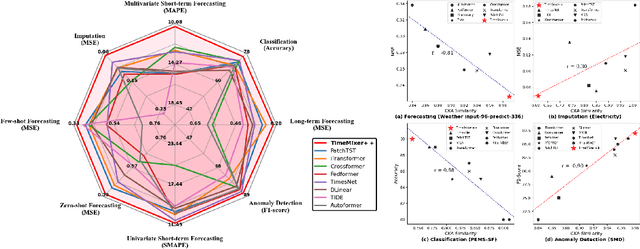
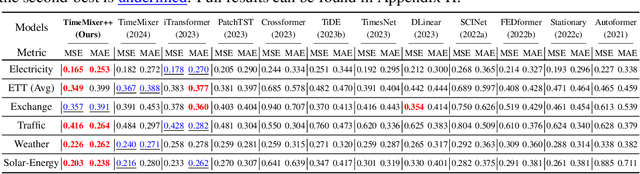
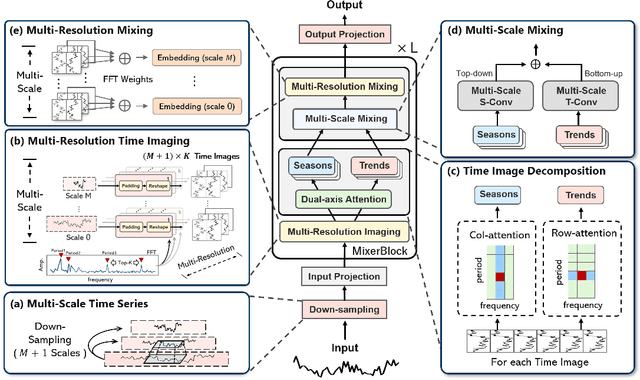

Time series analysis plays a critical role in numerous applications, supporting tasks such as forecasting, classification, anomaly detection, and imputation. In this work, we present the time series pattern machine (TSPM), a model designed to excel in a broad range of time series tasks through powerful representation and pattern extraction capabilities. Traditional time series models often struggle to capture universal patterns, limiting their effectiveness across diverse tasks. To address this, we define multiple scales in the time domain and various resolutions in the frequency domain, employing various mixing strategies to extract intricate, task-adaptive time series patterns. Specifically, we introduce a general-purpose TSPM that processes multi-scale time series using (1) multi-resolution time imaging (MRTI), (2) time image decomposition (TID), (3) multi-scale mixing (MCM), and (4) multi-resolution mixing (MRM) to extract comprehensive temporal patterns. MRTI transforms multi-scale time series into multi-resolution time images, capturing patterns across both temporal and frequency domains. TID leverages dual-axis attention to extract seasonal and trend patterns, while MCM hierarchically aggregates these patterns across scales. MRM adaptively integrates all representations across resolutions. This method achieves state-of-the-art performance across 8 time series analytical tasks, consistently surpassing both general-purpose and task-specific models. Our work marks a promising step toward the next generation of TSPMs, paving the way for further advancements in time series analysis.
Time-MoE: Billion-Scale Time Series Foundation Models with Mixture of Experts
Sep 24, 2024



Deep learning for time series forecasting has seen significant advancements over the past decades. However, despite the success of large-scale pre-training in language and vision domains, pre-trained time series models remain limited in scale and operate at a high cost, hindering the development of larger capable forecasting models in real-world applications. In response, we introduce Time-MoE, a scalable and unified architecture designed to pre-train larger, more capable forecasting foundation models while reducing inference costs. By leveraging a sparse mixture-of-experts (MoE) design, Time-MoE enhances computational efficiency by activating only a subset of networks for each prediction, reducing computational load while maintaining high model capacity. This allows Time-MoE to scale effectively without a corresponding increase in inference costs. Time-MoE comprises a family of decoder-only transformer models that operate in an auto-regressive manner and support flexible forecasting horizons with varying input context lengths. We pre-trained these models on our newly introduced large-scale data Time-300B, which spans over 9 domains and encompassing over 300 billion time points. For the first time, we scaled a time series foundation model up to 2.4 billion parameters, achieving significantly improved forecasting precision. Our results validate the applicability of scaling laws for training tokens and model size in the context of time series forecasting. Compared to dense models with the same number of activated parameters or equivalent computation budgets, our models consistently outperform them by large margin. These advancements position Time-MoE as a state-of-the-art solution for tackling real-world time series forecasting challenges with superior capability, efficiency, and flexibility.