 Add to Chrome
 Add to Firefox
 Add to Edge
InsightVQA: High-Dimensional Emotion-Cognitive Visual Question Answering Benchmark
Jun 01, 2026
Visual emotion understanding requires models not only to recognize emotional states, but also to why they arise and perform higher-level cognitive reasoning. However, existing benchmarks mainly focus on emotion recognition, offering limited support for grounded understanding and response-oriented analysis. To address this gap, we introduce \textbf{InsightVQA}, a large-scale dataset for hierarchical visual question answering on emotion understanding and cognitive reasoning. Building from 351K images collected from six public sources, we apply a rigorous multi-stage filtering pipeline to curate 138K high-confidence images. Each image is annotated at three hierarchical levels: perception QA for emotion and valence recognition, grounded understanding QA constructed from visual trigger extraction through constraint-guided generation, and cognition QA centered on response intent prediction and sequential insight reasoning. In total, InsightVQA contains 725K QA pairs. We further present \textbf{InsightVQA-Bench}, a high-quality evaluation benchmark comprising 30K samples for fine-grained evaluation. To support evaluation, we introduce \textbf{InsightNet}, an emotion-tuned baseline for MLLMs. Results demonstrate that InsightVQA poses significant challenges for grounded emotion understanding and reasoning.

The Fourth Challenge on Image Super-Resolution ($\times$4) at NTIRE 2026: Benchmark Results and Method Overview
Apr 16, 2026This paper presents the NTIRE 2026 image super-resolution ($\times$4) challenge, one of the associated competitions of the NTIRE 2026 Workshop at CVPR 2026. The challenge aims to reconstruct high-resolution (HR) images from low-resolution (LR) inputs generated through bicubic downsampling with a $\times$4 scaling factor. The objective is to develop effective super-resolution solutions and analyze recent advances in the field. To reflect the evolving objectives of image super-resolution, the challenge includes two tracks: (1) a restoration track, which emphasizes pixel-wise fidelity and ranks submissions based on PSNR; and (2) a perceptual track, which focuses on visual realism and evaluates results using a perceptual score. A total of 194 participants registered for the challenge, with 31 teams submitting valid entries. This report summarizes the challenge design, datasets, evaluation protocol, main results, and methods of participating teams. The challenge provides a unified benchmark and offers insights into current progress and future directions in image super-resolution.
Timer-S1: A Billion-Scale Time Series Foundation Model with Serial Scaling
Mar 05, 2026We introduce Timer-S1, a strong Mixture-of-Experts (MoE) time series foundation model with 8.3B total parameters, 0.75B activated parameters for each token, and a context length of 11.5K. To overcome the scalability bottleneck in existing pre-trained time series foundation models, we perform Serial Scaling in three dimensions: model architecture, dataset, and training pipeline. Timer-S1 integrates sparse TimeMoE blocks and generic TimeSTP blocks for Serial-Token Prediction (STP), a generic training objective that adheres to the serial nature of forecasting. The proposed paradigm introduces serial computations to improve long-term predictions while avoiding costly rolling-style inference and pronounced error accumulation in the standard next-token prediction. Pursuing a high-quality and unbiased training dataset, we curate TimeBench, a corpus with one trillion time points, and apply meticulous data augmentation to mitigate predictive bias. We further pioneer a post-training stage, including continued pre-training and long-context extension, to enhance short-term and long-context performance. Evaluated on the large-scale GIFT-Eval leaderboard, Timer-S1 achieves state-of-the-art forecasting performance, attaining the best MASE and CRPS scores as a pre-trained model. Timer-S1 will be released to facilitate further research.
Position: Vector Prompt Interfaces Should Be Exposed to Enable Customization of Large Language Models
Mar 04, 2026As large language models (LLMs) transition from research prototypes to real-world systems, customization has emerged as a central bottleneck. While text prompts can already customize LLM behavior, we argue that text-only prompting does not constitute a suitable control interface for scalable, stable, and inference-only customization. This position paper argues that model providers should expose \emph{vector prompt inputs} as part of the public interface for customizing LLMs. We support this position with diagnostic evidence showing that vector prompt tuning continues to improve with increasing supervision whereas text-based prompt optimization saturates early, and that vector prompts exhibit dense, global attention patterns indicative of a distinct control mechanism. We further discuss why inference-only customization is increasingly important under realistic deployment constraints, and why exposing vector prompts need not fundamentally increase model leakage risk under a standard black-box threat model. We conclude with a call to action for the community to rethink prompt interfaces as a core component of LLM customization.
Sonar-TS: Search-Then-Verify Natural Language Querying for Time Series Databases
Feb 19, 2026Natural Language Querying for Time Series Databases (NLQ4TSDB) aims to assist non-expert users retrieve meaningful events, intervals, and summaries from massive temporal records. However, existing Text-to-SQL methods are not designed for continuous morphological intents such as shapes or anomalies, while time series models struggle to handle ultra-long histories. To address these challenges, we propose Sonar-TS, a neuro-symbolic framework that tackles NLQ4TSDB via a Search-Then-Verify pipeline. Analogous to active sonar, it utilizes a feature index to ping candidate windows via SQL, followed by generated Python programs to lock on and verify candidates against raw signals. To enable effective evaluation, we introduce NLQTSBench, the first large-scale benchmark designed for NLQ over TSDB-scale histories. Our experiments highlight the unique challenges within this domain and demonstrate that Sonar-TS effectively navigates complex temporal queries where traditional methods fail. This work presents the first systematic study of NLQ4TSDB, offering a general framework and evaluation standard to facilitate future research.
EventCast: Hybrid Demand Forecasting in E-Commerce with LLM-Based Event Knowledge
Feb 07, 2026Demand forecasting is a cornerstone of e-commerce operations, directly impacting inventory planning and fulfillment scheduling. However, existing forecasting systems often fail during high-impact periods such as flash sales, holiday campaigns, and sudden policy interventions, where demand patterns shift abruptly and unpredictably. In this paper, we introduce EventCast, a modular forecasting framework that integrates future event knowledge into time-series prediction. Unlike prior approaches that ignore future interventions or directly use large language models (LLMs) for numerical forecasting, EventCast leverages LLMs solely for event-driven reasoning. Unstructured business data, which covers campaigns, holiday schedules, and seller incentives, from existing operational databases, is processed by an LLM that converts it into interpretable textual summaries leveraging world knowledge for cultural nuances and novel event combinations. These summaries are fused with historical demand features within a dual-tower architecture, enabling accurate, explainable, and scalable forecasts. Deployed on real-world e-commerce scenarios spanning 4 countries of 160 regions over 10 months, EventCast achieves up to 86.9% and 97.7% improvement on MAE and MSE compared to the variant without event knowledge, and reduces MAE by up to 57.0% and MSE by 83.3% versus the best industrial baseline during event-driven periods. EventCast has deployed into real-world industrial pipelines since March 2025, offering a practical solution for improving operational decision-making in dynamic e-commerce environments.
SOON: Symmetric Orthogonal Operator Network for Global Subseasonal-to-Seasonal Climate Forecasting
Feb 04, 2026Accurate global Subseasonal-to-Seasonal (S2S) climate forecasting is critical for disaster preparedness and resource management, yet it remains challenging due to chaotic atmospheric dynamics. Existing models predominantly treat atmospheric fields as isotropic images, conflating the distinct physical processes of zonal wave propagation and meridional transport, and leading to suboptimal modeling of anisotropic dynamics. In this paper, we propose the Symmetric Orthogonal Operator Network (SOON) for global S2S climate forecasting. It couples: (1) an Anisotropic Embedding strategy that tokenizes the global grid into latitudinal rings, preserving the integrity of zonal periodic structures; and (2) a stack of SOON Blocks that models the alternating interaction of Zonal and Meridional Operators via a symmetric decomposition, structurally mitigating discretization errors inherent in long-term integration. Extensive experiments on the Earth Reanalysis 5 dataset demonstrate that SOON establishes a new state-of-the-art, significantly outperforming existing methods in both forecasting accuracy and computational efficiency.
SEDformer: Event-Synchronous Spiking Transformers for Irregular Telemetry Time Series Forecasting
Feb 03, 2026Telemetry streams from large-scale Internet-connected systems (e.g., IoT deployments and online platforms) naturally form an irregular multivariate time series (IMTS) whose accurate forecasting is operationally vital. A closer examination reveals a defining Sparsity-Event Duality (SED) property of IMTS, i.e., long stretches with sparse or no observations are punctuated by short, dense bursts where most semantic events (observations) occur. However, existing Graph- and Transformer-based forecasters ignore SED: pre-alignment to uniform grids with heavy padding violates sparsity by inflating sequences and forcing computation at non-informative steps, while relational recasting weakens event semantics by disrupting local temporal continuity. These limitations motivate a more faithful and natural modeling paradigm for IMTS that aligns with its SED property. We find that Spiking Neural Networks meet this requirement, as they communicate via sparse binary spikes and update in an event-driven manner, aligning naturally with the SED nature of IMTS. Therefore, we present SEDformer, an SED-enhanced Spiking Transformer for telemetry IMTS forecasting that couples: (1) a SED-based Spike Encoder converts raw observations into event synchronous spikes using an Event-Aligned LIF neuron, (2) an Event-Preserving Temporal Downsampling module compresses long gaps while retaining salient firings and (3) a stack of SED-based Spike Transformer blocks enable intra-series dependency modeling with a membrane-based linear attention driven by EA-LIF spiking features. Experiments on public telemetry IMTS datasets show that SEDformer attains state-of-the-art forecasting accuracy while reducing energy and memory usage, providing a natural and efficient path for modeling IMTS.
STReasoner: Empowering LLMs for Spatio-Temporal Reasoning in Time Series via Spatial-Aware Reinforcement Learning
Jan 06, 2026Spatio-temporal reasoning in time series involves the explicit synthesis of temporal dynamics, spatial dependencies, and textual context. This capability is vital for high-stakes decision-making in systems such as traffic networks, power grids, and disease propagation. However, the field remains underdeveloped because most existing works prioritize predictive accuracy over reasoning. To address the gap, we introduce ST-Bench, a benchmark consisting of four core tasks, including etiological reasoning, entity identification, correlation reasoning, and in-context forecasting, developed via a network SDE-based multi-agent data synthesis pipeline. We then propose STReasoner, which empowers LLM to integrate time series, graph structure, and text for explicit reasoning. To promote spatially grounded logic, we introduce S-GRPO, a reinforcement learning algorithm that rewards performance gains specifically attributable to spatial information. Experiments show that STReasoner achieves average accuracy gains between 17% and 135% at only 0.004X the cost of proprietary models and generalizes robustly to real-world data.
LoCoBench-Agent: An Interactive Benchmark for LLM Agents in Long-Context Software Engineering
Nov 17, 2025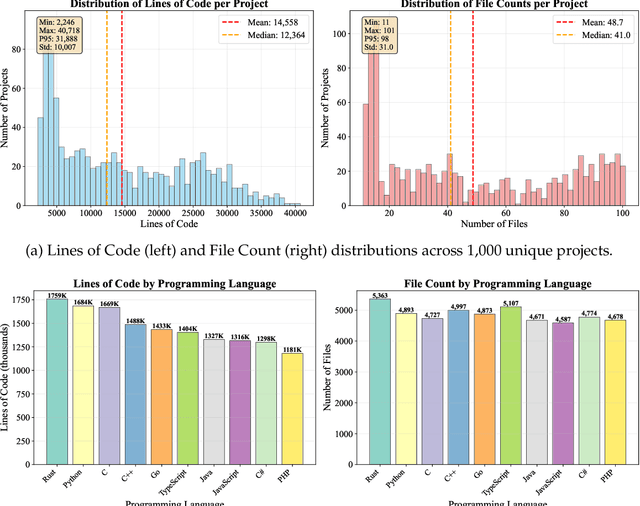
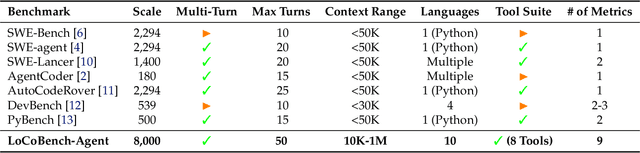
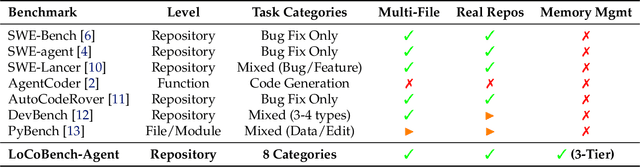
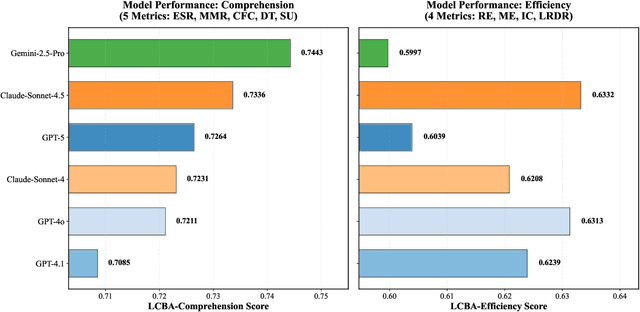
As large language models (LLMs) evolve into sophisticated autonomous agents capable of complex software development tasks, evaluating their real-world capabilities becomes critical. While existing benchmarks like LoCoBench~\cite{qiu2025locobench} assess long-context code understanding, they focus on single-turn evaluation and cannot capture the multi-turn interactive nature, tool usage patterns, and adaptive reasoning required by real-world coding agents. We introduce \textbf{LoCoBench-Agent}, a comprehensive evaluation framework specifically designed to assess LLM agents in realistic, long-context software engineering workflows. Our framework extends LoCoBench's 8,000 scenarios into interactive agent environments, enabling systematic evaluation of multi-turn conversations, tool usage efficiency, error recovery, and architectural consistency across extended development sessions. We also introduce an evaluation methodology with 9 metrics across comprehension and efficiency dimensions. Our framework provides agents with 8 specialized tools (file operations, search, code analysis) and evaluates them across context lengths ranging from 10K to 1M tokens, enabling precise assessment of long-context performance. Through systematic evaluation of state-of-the-art models, we reveal several key findings: (1) agents exhibit remarkable long-context robustness; (2) comprehension-efficiency trade-off exists with negative correlation, where thorough exploration increases comprehension but reduces efficiency; and (3) conversation efficiency varies dramatically across models, with strategic tool usage patterns differentiating high-performing agents. As the first long-context LLM agent benchmark for software engineering, LoCoBench-Agent establishes a rigorous foundation for measuring agent capabilities, identifying performance gaps, and advancing autonomous software development at scale.