 Add to Chrome
 Add to Firefox
 Add to Edge
EvoGS: Constructing Continuous-Layered Gaussian Splatting with Evolution Tree for Scalable 3D Streaming
Jun 05, 2026
Streaming 3D Gaussian Splatting requires highly scalable, progressive representations. Existing progressive methods rely on \textit{discrete layering}, accumulating separate splat sets for each level of detail. This structural independence between layers inherently leads to error accumulation, severe splat redundancy, and uncontrolled quality transitions. We propose EvoGS, the first \textit{continuous-layering} representation. Organized as an Evolution Tree, EvoGS generates finer details via an explicit, wavelet-inspired parent-child refinement. This empowers child nodes to structurally correct ancestral errors, yield inherently sparse and highly compressible inter-layer signals. Extensive experiments show EvoGS eliminates splat redundancy from over 65\% to under 25\%. Compared to state-of-the-art baselines, it reduces transmission payload and GPU VRAM footprint by up to 2.4$\times$ and 5.5$\times$, respectively, and achieves smooth quality transitions optimal for real-time adaptive streaming. Project page: https://yuang-ian.github.io/evogs/

MoonAnything: A Vision Benchmark with Large-Scale Lunar Supervised Data
Apr 01, 2026Accurate perception of lunar surfaces is critical for modern lunar exploration missions. However, developing robust learning-based perception systems is hindered by the lack of datasets that provide both geometric and photometric supervision. Existing lunar datasets typically lack either geometric ground truth, photometric realism, illumination diversity, or large-scale coverage. In this paper, we introduce MoonAnything, a unified benchmark built on real lunar topography with physically-based rendering, providing the first comprehensive geometric and photometric supervision under diverse illumination with large scale. The benchmark comprises two complementary sub-datasets : i) LunarGeo provides stereo images with corresponding dense depth maps and camera calibration enabling 3D reconstruction and pose estimation; ii) LunarPhoto provides photorealistic images using a spatially-varying BRDF model, along with multi-illumination renderings under real solar configurations, enabling reflectance estimation and illumination-robust perception. Together, these datasets offer over 130K samples with comprehensive supervision. Beyond lunar applications, MoonAnything offers a unique setting and challenging testbed for algorithms under low-textured, high-contrast conditions and applies to other airless celestial bodies and could generalize beyond. We establish baselines using state-of-the-art methods and release the complete dataset along with generation tools to support community extension: https://github.com/clementinegrethen/MoonAnything.
P-GSVC: Layered Progressive 2D Gaussian Splatting for Scalable Image and Video
Mar 11, 2026Gaussian splatting has emerged as a competitive explicit representation for image and video reconstruction. In this work, we present P-GSVC, the first layered progressive 2D Gaussian splatting framework that provides a unified solution for scalable Gaussian representation in both images and videos. P-GSVC organizes 2D Gaussian splats into a base layer and successive enhancement layers, enabling coarse-to-fine reconstructions. To effectively optimize this layered representation, we propose a joint training strategy that simultaneously updates Gaussians across layers, aligning their optimization trajectories to ensure inter-layer compatibility and a stable progressive reconstruction. P-GSVC supports scalability in terms of both quality and resolution. Our experiments show that the joint training strategy can gain up to 1.9 dB improvement in PSNR for video and 2.6 dB improvement in PSNR for image when compared to methods that perform sequential layer-wise training. Project page: https://longanwang-cs.github.io/PGSVC-webpage/
EventCast: Hybrid Demand Forecasting in E-Commerce with LLM-Based Event Knowledge
Feb 07, 2026Demand forecasting is a cornerstone of e-commerce operations, directly impacting inventory planning and fulfillment scheduling. However, existing forecasting systems often fail during high-impact periods such as flash sales, holiday campaigns, and sudden policy interventions, where demand patterns shift abruptly and unpredictably. In this paper, we introduce EventCast, a modular forecasting framework that integrates future event knowledge into time-series prediction. Unlike prior approaches that ignore future interventions or directly use large language models (LLMs) for numerical forecasting, EventCast leverages LLMs solely for event-driven reasoning. Unstructured business data, which covers campaigns, holiday schedules, and seller incentives, from existing operational databases, is processed by an LLM that converts it into interpretable textual summaries leveraging world knowledge for cultural nuances and novel event combinations. These summaries are fused with historical demand features within a dual-tower architecture, enabling accurate, explainable, and scalable forecasts. Deployed on real-world e-commerce scenarios spanning 4 countries of 160 regions over 10 months, EventCast achieves up to 86.9% and 97.7% improvement on MAE and MSE compared to the variant without event knowledge, and reduces MAE by up to 57.0% and MSE by 83.3% versus the best industrial baseline during event-driven periods. EventCast has deployed into real-world industrial pipelines since March 2025, offering a practical solution for improving operational decision-making in dynamic e-commerce environments.
LineGS : 3D Line Segment Representation on 3D Gaussian Splatting
Nov 30, 2024Abstract representations of 3D scenes are essential in computer vision, supporting tasks like mapping, localization, and surface reconstruction. Line segments are commonly used to capture scene structure, but existing 3D reconstruction methods often face limitations, either from instability in 2D projections or noise in direct 3D data. This paper introduces LineGS, a method that integrates geometry-guided 3D line reconstruction with a 3D Gaussian splatting model to improve accuracy. By leveraging Gaussian point densities along scene edges, LineGS refines initial line segments, aligning them more closely with the scene's geometric features. Experiments confirm that this approach enhances the fit to 3D structures, providing an efficient and reliable abstract representation of 3D scenes.
LapisGS: Layered Progressive 3D Gaussian Splatting for Adaptive Streaming
Aug 27, 2024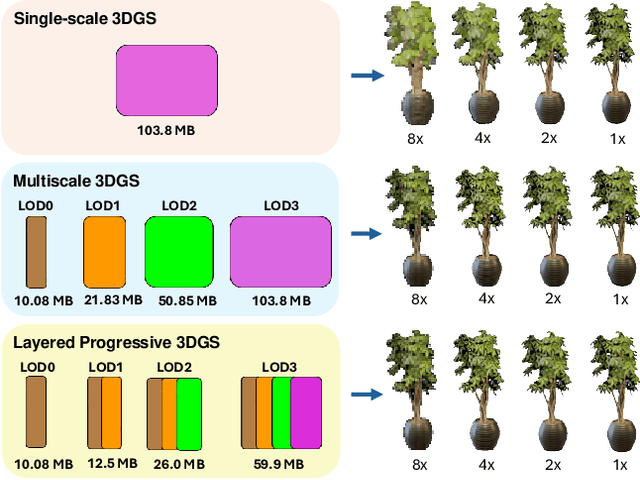
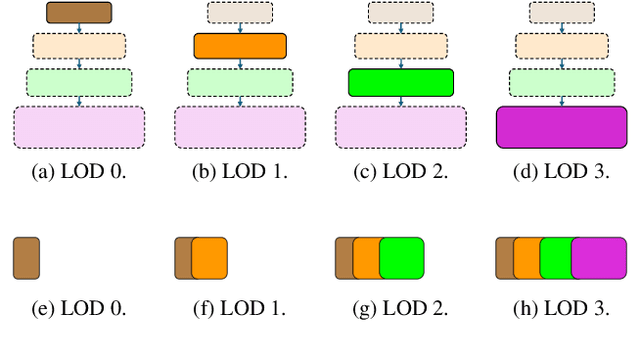
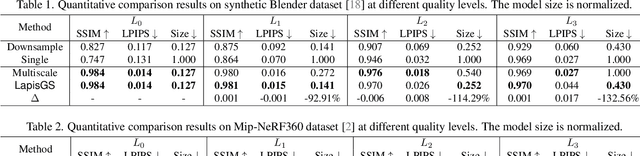
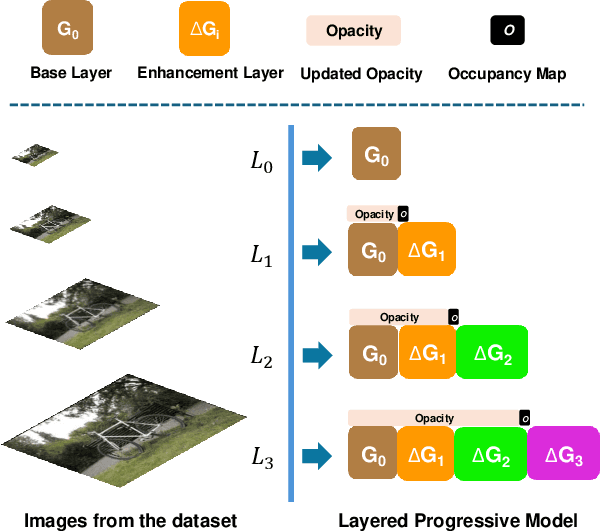
The rise of Extended Reality (XR) requires efficient streaming of 3D online worlds, challenging current 3DGS representations to adapt to bandwidth-constrained environments. This paper proposes LapisGS, a layered 3DGS that supports adaptive streaming and progressive rendering. Our method constructs a layered structure for cumulative representation, incorporates dynamic opacity optimization to maintain visual fidelity, and utilizes occupancy maps to efficiently manage Gaussian splats. This proposed model offers a progressive representation supporting a continuous rendering quality adapted for bandwidth-aware streaming. Extensive experiments validate the effectiveness of our approach in balancing visual fidelity with the compactness of the model, with up to 50.71% improvement in SSIM, 286.53% improvement in LPIPS, and 318.41% reduction in model size, and shows its potential for bandwidth-adapted 3D streaming and rendering applications.
ASMFS: Adaptive-Similarity-based Multi-modality Feature Selection for Classification of Alzheimer's Disease
Oct 16, 2020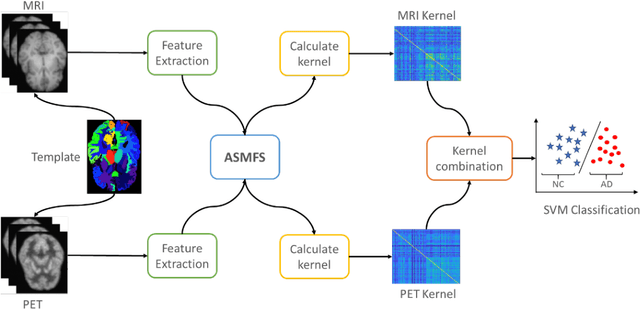
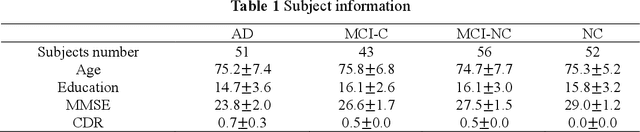
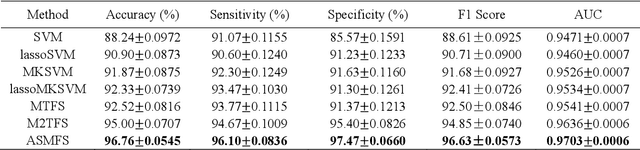
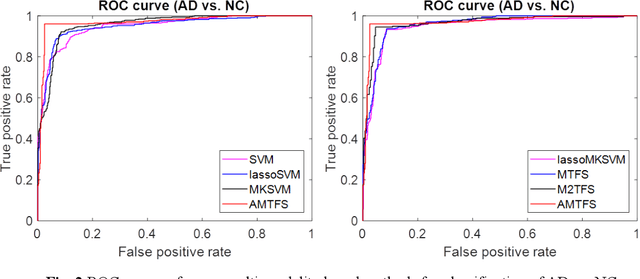
With the increasing amounts of high-dimensional heterogeneous data to be processed, multi-modality feature selection has become an important research direction in medical image analysis. Traditional methods usually depict the data structure using fixed and predefined similarity matrix for each modality separately, without considering the potential relationship structure across different modalities. In this paper, we propose a novel multi-modality feature selection method, which performs feature selection and local similarity learning simultaniously. Specially, a similarity matrix is learned by jointly considering different imaging modalities. And at the same time, feature selection is conducted by imposing sparse l_{2, 1} norm constraint. The effectiveness of our proposed joint learning method can be well demonstrated by the experimental results on Alzheimer's Disease Neuroimaging Initiative (ADNI) dataset, which outperforms existing the state-of-the-art multi-modality approaches.
Recognizing Chinese Judicial Named Entity using BiLSTM-CRF
May 31, 2020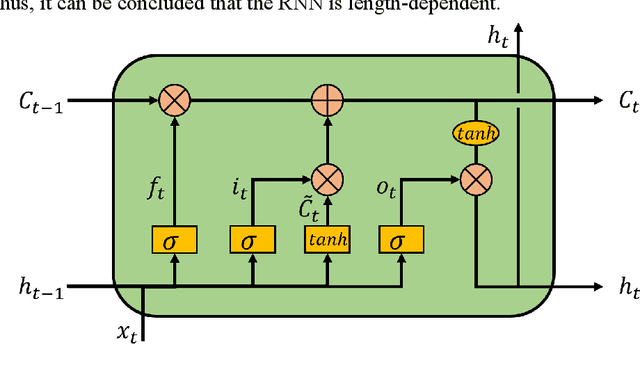
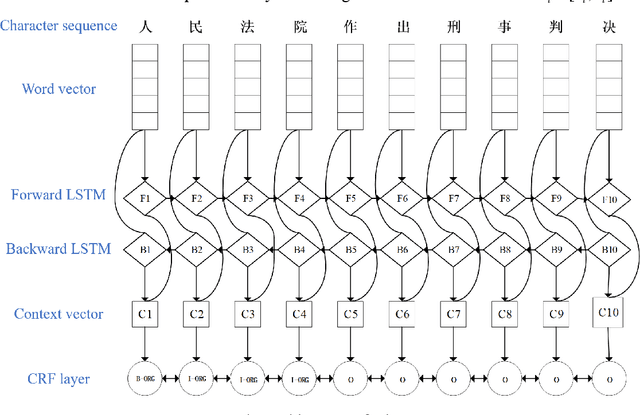
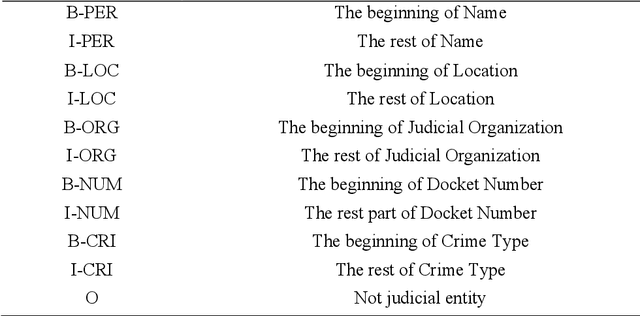
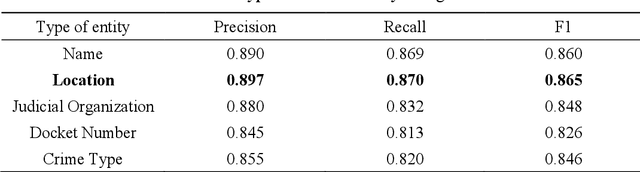
Named entity recognition (NER) plays an essential role in natural language processing systems. Judicial NER is a fundamental component of judicial information retrieval, entity relation extraction, and knowledge map building. However, Chinese judicial NER remains to be more challenging due to the characteristics of Chinese and high accuracy requirements in the judicial filed. Thus, in this paper, we propose a deep learning-based method named BiLSTM-CRF which consists of bi-directional long short-term memory (BiLSTM) and conditional random fields (CRF). For further accuracy promotion, we propose to use Adaptive moment estimation (Adam) for optimization of the model. To validate our method, we perform experiments on judgment documents including commutation, parole and temporary service outside prison, which is acquired from China Judgments Online. Experimental results achieve the accuracy of 0.876, recall of 0.856 and F1 score of 0.855, which suggests the superiority of the proposed BiLSTM-CRF with Adam optimizer.