 Add to Chrome
 Add to Firefox
 Add to Edge
From Reasoning Chains to Verifiable Subproblems: Curriculum Reinforcement Learning Enables Credit Assignment for LLM Reasoning
May 21, 2026
Reinforcement learning from verifiable rewards (RLVR) has shown strong promise for LLM reasoning, but outcome-based RLVR remains inefficient on hard problems because correct final-answer rollouts are rare and sample-level credit assignment cannot use partial progress in failed attempts. We introduce SCRL (Subproblem Curriculum Reinforcement Learning), a curriculum RL framework that derives verifiable subproblems from reference reasoning chains and fixes the final subproblem as the original problem. This turns partial progress on hard problems into verifiable learning signals. Algorithmically, SCRL uses subproblem-level normalization, which normalizes rewards independently at each subproblem position and assigns the resulting advantages to the corresponding answer spans, enabling finer-grained credit assignment without external rubrics or reward models. Our analysis shows that subproblem curricula lift hard problems out of gradient dead zones, with larger relative gains as the original problem becomes harder. Across seven mathematical reasoning benchmarks, SCRL outperforms strong curriculum-learning baselines, improving average accuracy over GRPO by +4.1 points on Qwen3-4B-Base and +1.9 points on Qwen3-14B-Base. On AIME24, AIME25, and IMO-Bench, SCRL further improves pass@1 by +3.7 points and pass@64 by +4.6 points on Qwen3-4B-Base, indicating better exploration on hard reasoning problems.

Explainable Token-level Noise Filtering for LLM Fine-tuning Datasets
Feb 16, 2026Large Language Models (LLMs) have seen remarkable advancements, achieving state-of-the-art results in diverse applications. Fine-tuning, an important step for adapting LLMs to specific downstream tasks, typically involves further training on corresponding datasets. However, a fundamental discrepancy exists between current fine-tuning datasets and the token-level optimization mechanism of LLMs: most datasets are designed at the sentence-level, which introduces token-level noise, causing negative influence to final performance. In this paper, we propose XTF, an explainable token-level noise filtering framework. XTF decomposes the complex and subtle contributions of token-level data to the fine-tuning process into three distinct and explicit attributes (reasoning importance, knowledge novelty, and task relevance), which can be assessed using scoring methods, and then masks the gradients of selected noisy tokens accordingly to optimize the performance of fine-tuned LLMs. We conduct extensive experiments on three representative downstream tasks (math, code and medicine) across 7 mainstream LLMs. The results demonstrate that XTF can significantly improve downstream performance by up to 13.7% compared to regular fine-tuning. Our work highlights the importance of token-level dataset optimization, and demonstrates the potential of strategies based on attribute decomposition for explaining complex training mechanisms.
Thickening-to-Thinning: Reward Shaping via Human-Inspired Learning Dynamics for LLM Reasoning
Feb 04, 2026Reinforcement Learning with Verifiable Rewards (RLVR) has emerged as a promising paradigm for enhancing reasoning in Large Language Models (LLMs). However, it frequently encounters challenges such as entropy collapse, excessive verbosity, and insufficient exploration for hard problems. Crucially, existing reward schemes fail to distinguish between the need for extensive search during problem-solving and the efficiency required for mastered knowledge. In this work, we introduce T2T(Thickening-to-Thinning), a dynamic reward framework inspired by human learning processes. Specifically, it implements a dual-phase mechanism: (1) On incorrect attempts, T2T incentivizes "thickening" (longer trajectories) to broaden the search space and explore novel solution paths; (2) Upon achieving correctness, it shifts to "thinning", imposing length penalties to discourage redundancy, thereby fostering model confidence and crystallizing reasoning capabilities. Extensive experiments on mathematical benchmarks (MATH-500, AIME, AMC) across Qwen-series and Deepseek models demonstrate that T2T significantly outperforms standard GRPO and recent baselines, achieving superior performance.
TimeMixer++: A General Time Series Pattern Machine for Universal Predictive Analysis
Oct 21, 2024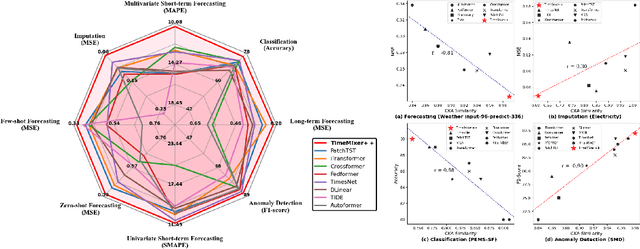
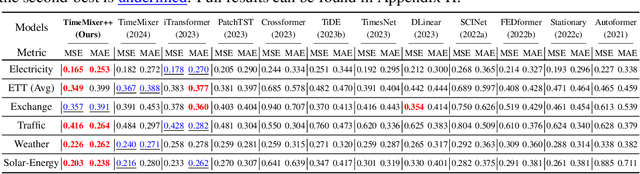
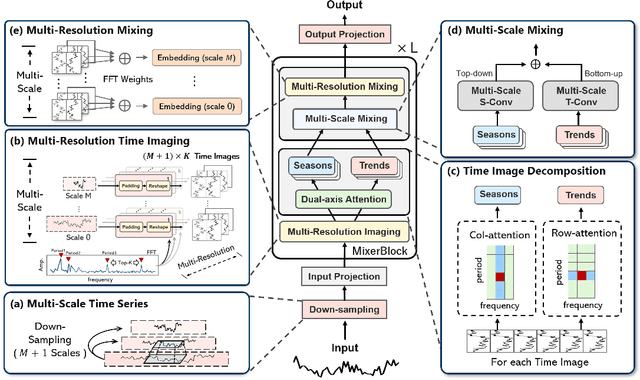

Time series analysis plays a critical role in numerous applications, supporting tasks such as forecasting, classification, anomaly detection, and imputation. In this work, we present the time series pattern machine (TSPM), a model designed to excel in a broad range of time series tasks through powerful representation and pattern extraction capabilities. Traditional time series models often struggle to capture universal patterns, limiting their effectiveness across diverse tasks. To address this, we define multiple scales in the time domain and various resolutions in the frequency domain, employing various mixing strategies to extract intricate, task-adaptive time series patterns. Specifically, we introduce a general-purpose TSPM that processes multi-scale time series using (1) multi-resolution time imaging (MRTI), (2) time image decomposition (TID), (3) multi-scale mixing (MCM), and (4) multi-resolution mixing (MRM) to extract comprehensive temporal patterns. MRTI transforms multi-scale time series into multi-resolution time images, capturing patterns across both temporal and frequency domains. TID leverages dual-axis attention to extract seasonal and trend patterns, while MCM hierarchically aggregates these patterns across scales. MRM adaptively integrates all representations across resolutions. This method achieves state-of-the-art performance across 8 time series analytical tasks, consistently surpassing both general-purpose and task-specific models. Our work marks a promising step toward the next generation of TSPMs, paving the way for further advancements in time series analysis.