 Add to Chrome
 Add to Firefox
 Add to Edge
TUDSR: Twice Upsampling-Diffusion for Higher Super-Resolution
Jun 08, 2026
Diffusion-based generative models have achieved remarkable success in real-world image super-resolution (SR). With tiled diffusion techniques, these models can produce high-resolution images that exceed their native-supported resolution. However, the quality of such high-resolution (e.g $2048^2$) outputs often remains extremely poor, primarily due to two factors we consider: the image upsampling ratio (e.g $\times8$) exceeding the model's native-supported upsampling ratio (e.g $\times4$), and the model's native-supported resolution. In practice, training a native high-resolution model requires larger architectures, which incur significant computational overhead and GPU memory costs, making it hard on limited-resource equipment. Thus, we present TUDSR, a Twice Upsampling-Diffusion framework for higher SR. The TUDSR framework mainly consists of two stages: the first involves training at $R$-resolution, and the second introduces a looped chunk-based training strategy at $NR$-resolution. Each stage adapts a one-step GAN architecture comprising a generator and a discriminator. Based on SD2.1-base, we develop TUDSR-S, which achieves state-of-the-art performance across multiple benchmarks. Extensive experiments further demonstrate that TUDSR-S generates high-quality images at the resolutions of $1024^2$ and even $2048^2$, significantly outperforming existing approaches. Code is available at https://github.com/wuer5/TUDSR.

Robust Deepfake Detection, NTIRE 2026 Challenge: Report
Apr 27, 2026Robustness is a long-overlooked problem in deepfake detection. However, detection performance is nearly worthless in the real world if it suffers under exposure to even slight image degradation. In addition to weaker degradations that can accidentally occur in the image processing pipeline, there is another risk of malicious deepfakes that specifically introduce degradations, purposefully exploiting the detector's weaknesses in that regard. Here, we present an overview of the NTIRE 2026 Robust Deepfake Detection Challenge, which specifically addresses that problem. Participants were tasked with building a detector that would later be tested on an unknown test-set, which included both common and uncommon degradations of various strengths. With a total number of 337 participants and 57 submissions to the final leaderboard, the first edition of the challenge was well received. To ensure the reliability of the results, participants were given only 24h to complete the test run with no labels provided, limiting the possibility of training on the test data. Furthermore, the top solutions were scored on a private test-set to detect any such overfitting. This report presents the competition setting, dataset preparation, as well as details and performance of methods. Top methods rely on large foundation models, ensembles, and degradation training to combine generality and robustness.
NTIRE 2026 Challenge on Robust AI-Generated Image Detection in the Wild
Apr 13, 2026This paper presents an overview of the NTIRE 2026 Challenge on Robust AI-Generated Image Detection in the Wild, held in conjunction with the NTIRE workshop at CVPR 2026. The goal of this challenge was to develop detection models capable of distinguishing real images from generated ones in realistic scenarios: the images are often transformed (cropped, resized, compressed, blurred) for practical usage, and therefore, the detection models should be robust to such transformations. The challenge is based on a novel dataset consisting of 108,750 real and 185,750 AI-generated images from 42 generators comprising a large variety of open-source and closed-source models of various architectures, augmented with 36 image transformations. Methods were evaluated using ROC AUC on the full test set, including both transformed and untransformed images. A total of 511 participants registered, with 20 teams submitting valid final solutions. This report provides a comprehensive overview of the challenge, describes the proposed solutions, and can be used as a valuable reference for researchers and practitioners in increasing the robustness of the detection models to real-world transformations.
Context-Value-Action Architecture for Value-Driven Large Language Model Agents
Apr 07, 2026Large Language Models (LLMs) have shown promise in simulating human behavior, yet existing agents often exhibit behavioral rigidity, a flaw frequently masked by the self-referential bias of current "LLM-as-a-judge" evaluations. By evaluating against empirical ground truth, we reveal a counter-intuitive phenomenon: increasing the intensity of prompt-driven reasoning does not enhance fidelity but rather exacerbates value polarization, collapsing population diversity. To address this, we propose the Context-Value-Action (CVA) architecture, grounded in the Stimulus-Organism-Response (S-O-R) model and Schwartz's Theory of Basic Human Values. Unlike methods relying on self-verification, CVA decouples action generation from cognitive reasoning via a novel Value Verifier trained on authentic human data to explicitly model dynamic value activation. Experiments on CVABench, which comprises over 1.1 million real-world interaction traces, demonstrate that CVA significantly outperforms baselines. Our approach effectively mitigates polarization while offering superior behavioral fidelity and interpretability.
One-Shot Refiner: Boosting Feed-forward Novel View Synthesis via One-Step Diffusion
Jan 20, 2026We present a novel framework for high-fidelity novel view synthesis (NVS) from sparse images, addressing key limitations in recent feed-forward 3D Gaussian Splatting (3DGS) methods built on Vision Transformer (ViT) backbones. While ViT-based pipelines offer strong geometric priors, they are often constrained by low-resolution inputs due to computational costs. Moreover, existing generative enhancement methods tend to be 3D-agnostic, resulting in inconsistent structures across views, especially in unseen regions. To overcome these challenges, we design a Dual-Domain Detail Perception Module, which enables handling high-resolution images without being limited by the ViT backbone, and endows Gaussians with additional features to store high-frequency details. We develop a feature-guided diffusion network, which can preserve high-frequency details during the restoration process. We introduce a unified training strategy that enables joint optimization of the ViT-based geometric backbone and the diffusion-based refinement module. Experiments demonstrate that our method can maintain superior generation quality across multiple datasets.
OMGSR: You Only Need One Mid-timestep Guidance for Real-World Image Super-Resolution
Aug 11, 2025Denoising Diffusion Probabilistic Models (DDPM) and Flow Matching (FM) generative models show promising potential for one-step Real-World Image Super-Resolution (Real-ISR). Recent one-step Real-ISR models typically inject a Low-Quality (LQ) image latent distribution at the initial timestep. However, a fundamental gap exists between the LQ image latent distribution and the Gaussian noisy latent distribution, limiting the effective utilization of generative priors. We observe that the noisy latent distribution at DDPM/FM mid-timesteps aligns more closely with the LQ image latent distribution. Based on this insight, we present One Mid-timestep Guidance Real-ISR (OMGSR), a universal framework applicable to DDPM/FM-based generative models. OMGSR injects the LQ image latent distribution at a pre-computed mid-timestep, incorporating the proposed Latent Distribution Refinement loss to alleviate the latent distribution gap. We also design the Overlap-Chunked LPIPS/GAN loss to eliminate checkerboard artifacts in image generation. Within this framework, we instantiate OMGSR for DDPM/FM-based generative models with two variants: OMGSR-S (SD-Turbo) and OMGSR-F (FLUX.1-dev). Experimental results demonstrate that OMGSR-S/F achieves balanced/excellent performance across quantitative and qualitative metrics at 512-resolution. Notably, OMGSR-F establishes overwhelming dominance in all reference metrics. We further train a 1k-resolution OMGSR-F to match the default resolution of FLUX.1-dev, which yields excellent results, especially in the details of the image generation. We also generate 2k-resolution images by the 1k-resolution OMGSR-F using our two-stage Tiled VAE & Diffusion.
Relaxed Rotational Equivariance via $G$-Biases in Vision
Aug 25, 2024


Group Equivariant Convolution (GConv) can effectively handle rotational symmetry data. They assume uniform and strict rotational symmetry across all features, as the transformations under the specific group. However, real-world data rarely conforms to strict rotational symmetry commonly referred to as Rotational Symmetry-Breaking in the system or dataset, making GConv unable to adapt effectively to this phenomenon. Motivated by this, we propose a simple but highly effective method to address this problem, which utilizes a set of learnable biases called the $G$-Biases under the group order to break strict group constraints and achieve \textbf{R}elaxed \textbf{R}otational \textbf{E}quivarant \textbf{Conv}olution (RREConv). We conduct extensive experiments to validate Relaxed Rotational Equivariance on rotational symmetry groups $\mathcal{C}_n$ (e.g. $\mathcal{C}_2$, $\mathcal{C}_4$, and $\mathcal{C}_6$ groups). Further experiments demonstrate that our proposed RREConv-based methods achieve excellent performance, compared to existing GConv-based methods in classification and detection tasks on natural image datasets.
SBDet: A Symmetry-Breaking Object Detector via Relaxed Rotation-Equivariance
Aug 21, 2024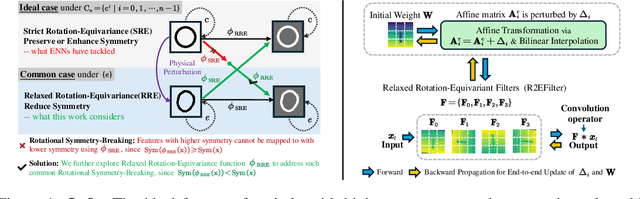
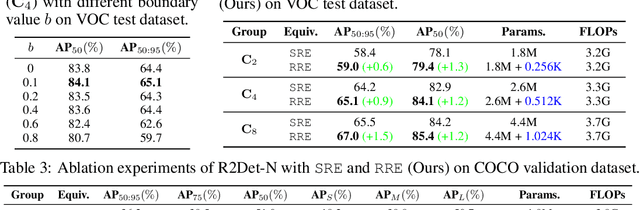
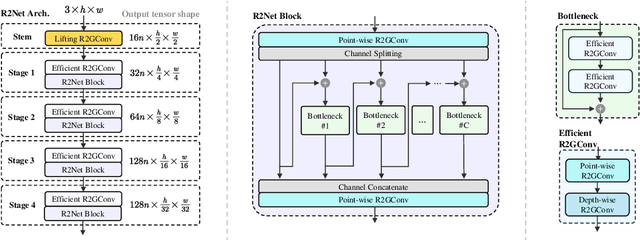
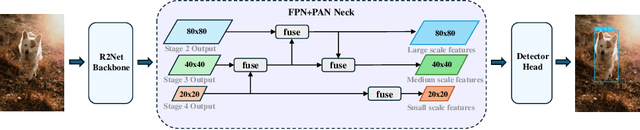
Introducing Group Equivariant Convolution (GConv) empowers models to explore symmetries hidden in visual data, improving their performance. However, in real-world scenarios, objects or scenes often exhibit perturbations of a symmetric system, specifically a deviation from a symmetric architecture, which can be characterized by a non-trivial action of a symmetry group, known as Symmetry-Breaking. Traditional GConv methods are limited by the strict operation rules in the group space, only ensuring features remain strictly equivariant under limited group transformations, making it difficult to adapt to Symmetry-Breaking or non-rigid transformations. Motivated by this, we introduce a novel Relaxed Rotation GConv (R2GConv) with our defined Relaxed Rotation-Equivariant group $\mathbf{R}_4$. Furthermore, we propose a Relaxed Rotation-Equivariant Network (R2Net) as the backbone and further develop the Symmetry-Breaking Object Detector (SBDet) for 2D object detection built upon it. Experiments demonstrate the effectiveness of our proposed R2GConv in natural image classification tasks, and SBDet achieves excellent performance in object detection tasks with improved generalization capabilities and robustness.
UC-NeRF: Neural Radiance Field for Under-Calibrated multi-view cameras in autonomous driving
Nov 28, 2023Multi-camera setups find widespread use across various applications, such as autonomous driving, as they greatly expand sensing capabilities. Despite the fast development of Neural radiance field (NeRF) techniques and their wide applications in both indoor and outdoor scenes, applying NeRF to multi-camera systems remains very challenging. This is primarily due to the inherent under-calibration issues in multi-camera setup, including inconsistent imaging effects stemming from separately calibrated image signal processing units in diverse cameras, and system errors arising from mechanical vibrations during driving that affect relative camera poses. In this paper, we present UC-NeRF, a novel method tailored for novel view synthesis in under-calibrated multi-view camera systems. Firstly, we propose a layer-based color correction to rectify the color inconsistency in different image regions. Second, we propose virtual warping to generate more viewpoint-diverse but color-consistent virtual views for color correction and 3D recovery. Finally, a spatiotemporally constrained pose refinement is designed for more robust and accurate pose calibration in multi-camera systems. Our method not only achieves state-of-the-art performance of novel view synthesis in multi-camera setups, but also effectively facilitates depth estimation in large-scale outdoor scenes with the synthesized novel views.
Synthetic Pseudo Anomalies for Unsupervised Video Anomaly Detection: A Simple yet Efficient Framework based on Masked Autoencoder
Mar 09, 2023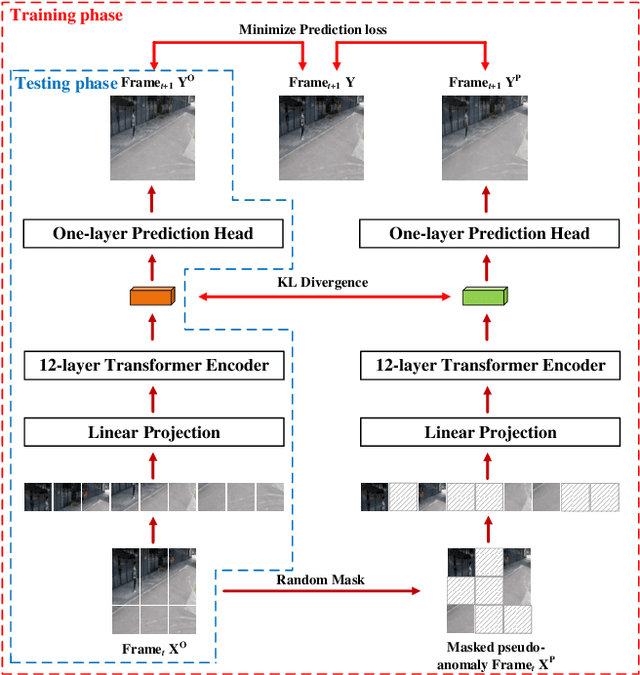

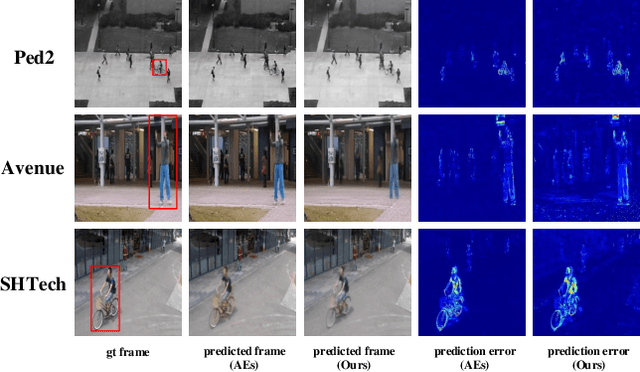
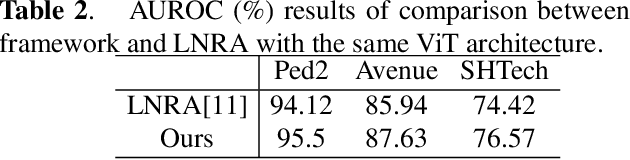
Due to the limited availability of anomalous samples for training, video anomaly detection is commonly viewed as a one-class classification problem. Many prevalent methods investigate the reconstruction difference produced by AutoEncoders (AEs) under the assumption that the AEs would reconstruct the normal data well while reconstructing anomalies poorly. However, even with only normal data training, the AEs often reconstruct anomalies well, which depletes their anomaly detection performance. To alleviate this issue, we propose a simple yet efficient framework for video anomaly detection. The pseudo anomaly samples are introduced, which are synthesized from only normal data by embedding random mask tokens without extra data processing. We also propose a normalcy consistency training strategy that encourages the AEs to better learn the regular knowledge from normal and corresponding pseudo anomaly data. This way, the AEs learn more distinct reconstruction boundaries between normal and abnormal data, resulting in superior anomaly discrimination capability. Experimental results demonstrate the effectiveness of the proposed method.