 Add to Chrome
 Add to Firefox
 Add to Edge
FlowTrain: Flow-Based Decoupled Training for Industrial-Grade Vision-Language Models
Jun 22, 2026
Industrial-grade distributed training of vision-language models (VLMs) remains far less efficient than that of unimodal LLMs. Existing solutions either follow a monolithic design that assigns uniform parallelism to heterogeneous modules or adopt a disaggregated deployment that separates modules while executing them as a batch-synchronized pipeline. In this paper, we highlight that the above solutions are still not sufficient, and VLM training can be further decoupled. To this end, we present FlowTrain, a flow-based decoupled training framework that reformulates VLM training as a producer-consumer dataflow coordinated through a unified memory pool. The encoder and backbone can progress independently over a global virtual address space. Since this execution decoupling fundamentally changes the optimization objective of allocation and scheduling, FlowTrain further introduces a heterogeneous parallel allocator that assigns module-specific parallelism strategies by solving a throughput matching problem. The dynamic packing scheduler is used to construct balanced microbatches at runtime according to the actual LLM-side computation cost. Extensive experiments on real-world workloads show that FlowTrain achieves over 50% MFU and up to 1.7x throughput improvement, narrowing the efficiency gap to LLM-only training.

The Hidden Power of Scaling Factor in LoRA Optimization
Jun 11, 2026In Low-Rank Adaptation (LoRA), the scaling factor $α$ is often treated as a mere complement to the learning rate, yet its role in optimization remains poorly understood. In this paper, we reveal that the scaling factor $α$ and the learning rate function differently, with $α$ emerging as the dominant driver of effective optimization, delivering gains that cannot be replicated by learning rate scaling alone. Through the synergy of extensive empirical analysis and a theoretical Signal-Drift framework, we uncover three findings into LoRA's scaling mechanism: First, LoRA's spectral suppression smooths the optimization landscape, rendering standard hyperparameters overly conservative and creating an optimization gap. Second, when leveraging this smoothness to accelerate convergence, $α$ outperforms the learning rate by amplifying the task signal without increasing the drift ratio. Third, the optimal scaling factor follows a sublinear relationship with the rank, well characterized by a square-root law with an unexpectedly large coefficient, revealing the insufficient scaling of existing rank-tied heuristics. Based on these insights, we propose LoRA-$α$, a minimalist framework that restores $α$ to its principled regime, making LoRA compatible with standard small learning rates. Extensive evaluations across diverse tasks demonstrate that LoRA-$α$ consistently improves performance while streamlining hyperparameter search, unleashing the learning potential of LoRA.
Calibration Data Trade-offs Across Capability Dimensions: Why Multi-Source Mixing Matters for High-Sparsity LLM Pruning
Jun 02, 2026Post-training pruning compresses large language models to high sparsity using a small unlabelled calibration set, and recent work has concluded that the choice of calibration source has only modest impact on averaged post-pruning accuracy. We ask whether this conclusion survives once calibration impact is evaluated separately across distinct capability dimensions rather than aggregated. Decomposing post-pruning capability into General, Commonsense, Code, and Math, and analysing $n{=}15$ calibration sources via Spearman correlations between OIT information metrics and per-dimension retention, we uncover an opposite-sign trade-off: calibration perplexity correlates positively with General retention ($ρ{=}{+}0.71$) but negatively with Math and Code retention ($ρ{=}{-}0.53,\,{-}0.59$; $p{<}0.05$), so no single source can preserve all capabilities. We respond with multi-source calibration mixing, and propose IGSP, an information-guided self-calibration protocol that automates multi-source construction without capability-aligned corpora by minimising 4-gram aggregation and balancing perplexity across dimensions. On LLaMA-3.1-8B at SparseGPT 60% sparsity, a uniform multi-source mix reaches 58.8% total retention, outperforming the best single source (MetaMath, 50.0%) by $+8.8$ and the C4 default (40.0%) by $+18.8$; IGSP improves over Self-Cal by $+2.4$ and SGS by $+4.8$.
NestPipe: Large-Scale Recommendation Training on 1,500+ Accelerators via Nested Pipelining
Apr 08, 2026Modern recommendation models have increased to trillions of parameters. As cluster scales expand to O(1k), distributed training bottlenecks shift from computation and memory to data movement, especially lookup and communication latency associated with embeddings. Existing solutions either optimize only one bottleneck or improve throughput by sacrificing training consistency. This paper presents NestPipe, a large-scale decentralized embedding training framework that tackles both bottlenecks while preserving synchronous training semantics. NestPipe exploits two hierarchical sparse parallelism opportunities through nested pipelining. At the inter-batch level, Dual-Buffer Pipelining (DBP) constructs a staleness-free five-stage pipeline through dual-buffer synchronization, mitigating lookup bottlenecks without embedding staleness. At the intra-batch level, we identify the embedding freezing phenomenon, which inspires Frozen-Window Pipelining (FWP) to overlap All2All communication with dense computation via coordinated stream scheduling and key-centric sample clustering. Experiments on production GPU and NPU clusters with 1,536 workers demonstrate that NestPipe achieves up to 3.06x speedup and 94.07% scaling efficiency.
Rollout-Training Co-Design for Efficient LLM-Based Multi-Agent Reinforcement Learning
Feb 10, 2026Despite algorithm-level innovations for multi-agent reinforcement learning (MARL), the underlying networked infrastructure for large-scale MARL training remains underexplored. Existing training frameworks primarily optimize for single-agent scenarios and fail to address the unique system-level challenges of MARL, including rollout-training synchronization barriers, rollout load imbalance, and training resource underutilization. To bridge this gap, we propose FlexMARL, the first end-to-end training framework that holistically optimizes rollout, training, and their orchestration for large-scale LLM-based MARL. Specifically, FlexMARL introduces the joint orchestrator to manage data flow under the rollout-training disaggregated architecture. Building upon the experience store, a novel micro-batch driven asynchronous pipeline eliminates the synchronization barriers while providing strong consistency guarantees. Rollout engine adopts a parallel sampling scheme combined with hierarchical load balancing, which adapts to skewed inter/intra-agent request patterns. Training engine achieves on-demand hardware binding through agent-centric resource allocation. The training states of different agents are swapped via unified and location-agnostic communication. Empirical results on a large-scale production cluster demonstrate that FlexMARL achieves up to 7.3x speedup and improves hardware utilization by up to 5.6x compared to existing frameworks.
OxygenREC: An Instruction-Following Generative Framework for E-commerce Recommendation
Dec 31, 2025Traditional recommendation systems suffer from inconsistency in multi-stage optimization objectives. Generative Recommendation (GR) mitigates them through an end-to-end framework; however, existing methods still rely on matching mechanisms based on inductive patterns. Although responsive, they lack the ability to uncover complex user intents that require deductive reasoning based on world knowledge. Meanwhile, LLMs show strong deep reasoning capabilities, but their latency and computational costs remain challenging for industrial applications. More critically, there are performance bottlenecks in multi-scenario scalability: as shown in Figure 1, existing solutions require independent training and deployment for each scenario, leading to low resource utilization and high maintenance costs-a challenge unaddressed in GR literature. To address these, we present OxygenREC, an industrial recommendation system that leverages Fast-Slow Thinking to deliver deep reasoning with strict latency and multi-scenario requirements of real-world environments. First, we adopt a Fast-Slow Thinking architecture. Slow thinking uses a near-line LLM pipeline to synthesize Contextual Reasoning Instructions, while fast thinking employs a high-efficiency encoder-decoder backbone for real-time generation. Second, to ensure reasoning instructions effectively enhance recommendation generation, we introduce a semantic alignment mechanism with Instruction-Guided Retrieval (IGR) to filter intent-relevant historical behaviors and use a Query-to-Item (Q2I) loss for instruction-item consistency. Finally, to resolve multi-scenario scalability, we transform scenario information into controllable instructions, using unified reward mapping and Soft Adaptive Group Clip Policy Optimization (SA-GCPO) to align policies with diverse business objectives, realizing a train-once-deploy-everywhere paradigm.
Adaptive Control of Client Selection and Gradient Compression for Efficient Federated Learning
Dec 19, 2022


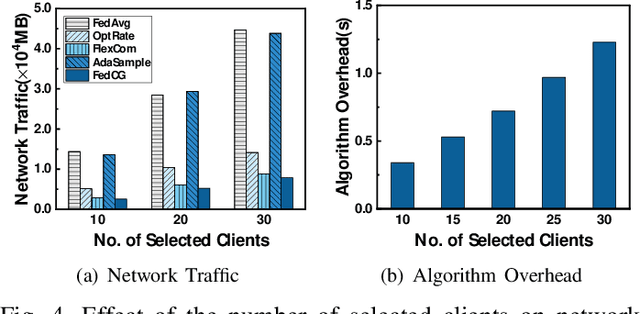
Federated learning (FL) allows multiple clients cooperatively train models without disclosing local data. However, the existing works fail to address all these practical concerns in FL: limited communication resources, dynamic network conditions and heterogeneous client properties, which slow down the convergence of FL. To tackle the above challenges, we propose a heterogeneity-aware FL framework, called FedCG, with adaptive client selection and gradient compression. Specifically, the parameter server (PS) selects a representative client subset considering statistical heterogeneity and sends the global model to them. After local training, these selected clients upload compressed model updates matching their capabilities to the PS for aggregation, which significantly alleviates the communication load and mitigates the straggler effect. We theoretically analyze the impact of both client selection and gradient compression on convergence performance. Guided by the derived convergence rate, we develop an iteration-based algorithm to jointly optimize client selection and compression ratio decision using submodular maximization and linear programming. Extensive experiments on both real-world prototypes and simulations show that FedCG can provide up to 5.3$\times$ speedup compared to other methods.