 Add to Chrome
 Add to Firefox
 Add to Edge
Unified Generalization for Frequency-Domain Channel Extrapolation Across Near-Field and Far-Field Scenarios
Jun 27, 2026
As antenna arrays grow, near-field effects become non-negligible in large-scale MIMO, making accurate low-overhead channel acquisition crucial in both far-field and near-field regimes. Deep-learning-based frequency-domain channel extrapolation can reduce pilot overhead, but existing extrapolators generalize poorly to unseen distances and environments, especially across near-field and far-field channels. We propose a physically interpretable framework to unify generalization across both regimes. Our key insight is that angular profiles are regime-dependent, while delay profiles share a sparsity structure that can be aligned. Based on this, we develop a physics-guided disentanglement and alignment pipeline with multi-cluster decoupling, angle-delay feature disentanglement, and delay-domain alignment, enabling the model to learn distribution-stable delay features while reusing heterogeneous angular features. We further design a unified near/far-field DL extrapolator (UNiFi-DLE) and detail its dataset preparation, training, and inference. Simulations and sim-to-real experiments show that UNiFi-DLE generalizes robustly to unseen near-field and far-field scenarios and consistently outperforms state-of-the-art methods.

Physics Equivariance for Robust Generalization in Wireless Foundation Model
Jun 27, 2026Wireless foundation models (WFMs) have recently emerged as a promising paradigm for learning multiple channel state information (CSI) acquisition tasks. However, unlike natural language tokens governed by statistical co-occurrence, wireless channels are generated by electromagnetic propagation laws, and current WFM training is constrained by limited data scale, narrow distribution coverage dominated by simulations, and a pronounced sim-to-real gap. As a result, simply scaling model parameters and CSI samples does not necessarily yield robust and generalizable models. In this paper, we advocate enabling physics equivariance as a principled and explainable inductive bias for WFMs. Specifically, we focus on a universal propagation property for electromagnetic waves, termed wave equivariance: when the input CSI is modulated along time-frequency-space dimensions, the output channel response should exhibit the corresponding transformation. Empirical studies show that the vanilla-WFM fails to reliably acquire such equivariance even with a large number of model parameters and training samples. To address this, we design the physics-intrinsic WFM (phys-WFM) with wave equivariance, which explicitly aligns model behaviors with an interpretable wave propagation structure. Results demonstrate that the proposed design effectively captures wave equivariance and substantially improves robustness and generalization to unseen environments under distribution shift, offering a physics-grounded and testable route toward explainable wireless foundation models.
Hyperbolic Frequency Multicarrier Modulation for Wideband Linear Time-Varying Channels
May 19, 2026Numerous multicarrier modulation schemes have been proposed recently to enhance the performance in narrowband doubly dispersive channels for emerging high-mobility applications. However, the ultra-reliable modulation framework in wideband linear time-varying (LTV) channels remains an open problem, where the time dilations and contractions brought by the high mobility cannot be ignored for the baseband signal to obtain the constant Doppler shift across the whole transmission band. To solve this problem, we propose the hyperbolic frequency multicarrier (HFMC) waveform in this paper based on the inspiration from affine frequency division multiplexing (AFDM) modulation, where the delay and Doppler shift are absorbed into a 1D shift in the affine domain to provide a compact characterization of doubly dispersive discrete-time channels. By adopting the passband representation of wideband LTV channels and hyperbolic frequency modulated (HFM) signals, we reveal that the Doppler scaling factor brought by the relative mobility can be absorbed into an equivalent delay. The basic principle of HFMC modulation is established by investigating the approximate orthogonality among HFMC subcarriers, which are generated from a basic HFM signal by utilizing uniformly spaced equivalent delay. The spectrum of HFMC subcarriers is also analyzed to evaluate the system capacity, where the overlapping nature in the frequency domain can be observed. The input-output characterization in wideband LTV channels is then executed to confirm the 1D integration of time delay and Doppler scaling factor for each path, which demonstrates the ability to exploit potential multipath diversity. The parameter optimization based on the input-output relation and spectrum analysis is finally developed to balance the efficiency and reliability.
KARMA: Knowledge-Action Regularized Multimodal Alignment for Personalized Search at Taobao
Mar 24, 2026Large Language Models (LLMs) are equipped with profound semantic knowledge, making them a natural choice for injecting semantic generalization into personalized search systems. However, in practice we find that directly fine-tuning LLMs on industrial personalized tasks (e.g. next item prediction) often yields suboptimal results. We attribute this bottleneck to a critical Knowledge--Action Gap: the inherent conflict between preserving pre-trained semantic knowledge and aligning with specific personalized actions by discriminative objectives. Empirically, action-only training objectives induce Semantic Collapse, such as attention ``sinks''. This degradation severely cripples the LLM's generalization, failing to bring improvements to personalized search systems. We propose KARMA (Knowledge--Action Regularized Multimodal Alignment), a unified framework that treats semantic reconstruction as a train-only regularizer. KARMA optimizes a next-interest embedding for retrieval (Action) while enforcing semantic decodability (Knowledge) through two complementary objectives: (i) history-conditioned semantic generation, which anchors optimization to the LLM's native next-token distribution, and (ii) embedding-conditioned semantic reconstruction, which constrains the interest embedding to remain semantically recoverable. On Taobao search system, KARMA mitigates semantic collapse (attention-sink analysis) and improves both action metrics and semantic fidelity. In ablations, semantic decodability yields up to +22.5 HR@200. With KARMA, we achieve +0.25 CTR AUC in ranking, +1.86 HR in pre-ranking and +2.51 HR in recalling. Deployed online with low inference overhead at ranking stage, KARMA drives +0.5% increase in Item Click.
Generalizable Learning for Massive MIMO CSI Feedback in Unseen Environments
Dec 28, 2025Deep learning is promising to enhance the accuracy and reduce the overhead of channel state information (CSI) feedback, which can boost the capacity of frequency division duplex (FDD) massive multiple-input multiple-output (MIMO) systems. Nevertheless, the generalizability of current deep learning-based CSI feedback algorithms cannot be guaranteed in unseen environments, which induces a high deployment cost. In this paper, the generalizability of deep learning-based CSI feedback is promoted with physics interpretation. Firstly, the distribution shift of the cluster-based channel is modeled, which comprises the multi-cluster structure and single-cluster response. Secondly, the physics-based distribution alignment is proposed to effectively address the distribution shift of the cluster-based channel, which comprises multi-cluster decoupling and fine-grained alignment. Thirdly, the efficiency and robustness of physics-based distribution alignment are enhanced. Explicitly, an efficient multi-cluster decoupling algorithm is proposed based on the Eckart-Young-Mirsky (EYM) theorem to support real-time CSI feedback. Meanwhile, a hybrid criterion to estimate the number of decoupled clusters is designed, which enhances the robustness against channel estimation error. Fourthly, environment-generalizable neural network for CSI feedback (EG-CsiNet) is proposed as a novel learning framework with physics-based distribution alignment. Based on extensive simulations and sim-to-real experiments in various conditions, the proposed EG-CsiNet can robustly reduce the generalization error by more than 3 dB compared to the state-of-the-arts.
Enhancing Environment Generalizability for Deep Learning-Based CSI Feedback
Jul 09, 2025Accurate and low-overhead channel state information (CSI) feedback is essential to boost the capacity of frequency division duplex (FDD) massive multiple-input multiple-output (MIMO) systems. Deep learning-based CSI feedback significantly outperforms conventional approaches. Nevertheless, current deep learning-based CSI feedback algorithms exhibit limited generalizability to unseen environments, which obviously increases the deployment cost. In this paper, we first model the distribution shift of CSI across different environments, which is composed of the distribution shift of multipath structure and a single-path. Then, EG-CsiNet is proposed as a novel CSI feedback learning framework to enhance environment-generalizability. Explicitly, EG-CsiNet comprises the modules of multipath decoupling and fine-grained alignment, which can address the distribution shift of multipath structure and a single path. Based on extensive simulations, the proposed EG-CsiNet can robustly enhance the generalizability in unseen environments compared to the state-of-the-art, especially in challenging conditions with a single source environment.
Generalizable Learning for Frequency-Domain Channel Extrapolation under Distribution Shift
May 20, 2025Frequency-domain channel extrapolation is effective in reducing pilot overhead for massive multiple-input multiple-output (MIMO) systems. Recently, Deep learning (DL) based channel extrapolator has become a promising candidate for modeling complex frequency-domain dependency. Nevertheless, current DL extrapolators fail to operate in unseen environments under distribution shift, which poses challenges for large-scale deployment. In this paper, environment generalizable learning for channel extrapolation is achieved by realizing distribution alignment from a physics perspective. Firstly, the distribution shift of wireless channels is rigorously analyzed, which comprises the distribution shift of multipath structure and single-path response. Secondly, a physics-based progressive distribution alignment strategy is proposed to address the distribution shift, which includes successive path-oriented design and path alignment. Path-oriented DL extrapolator decomposes multipath channel extrapolation into parallel extrapolations of the extracted path, which can mitigate the distribution shift of multipath structure. Path alignment is proposed to address the distribution shift of single-path response in path-oriented DL extrapolators, which eventually enables generalizable learning for channel extrapolation. In the simulation, distinct wireless environments are generated using the precise ray-tracing tool. Based on extensive evaluations, the proposed path-oriented DL extrapolator with path alignment can reduce extrapolation error by more than 6 dB in unseen environments compared to the state-of-the-arts.
Path Evolution Model for Endogenous Channel Digital Twin towards 6G Wireless Networks
Jan 25, 2025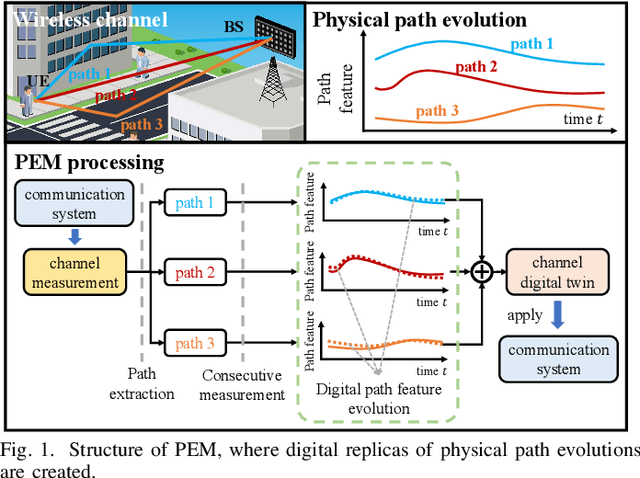
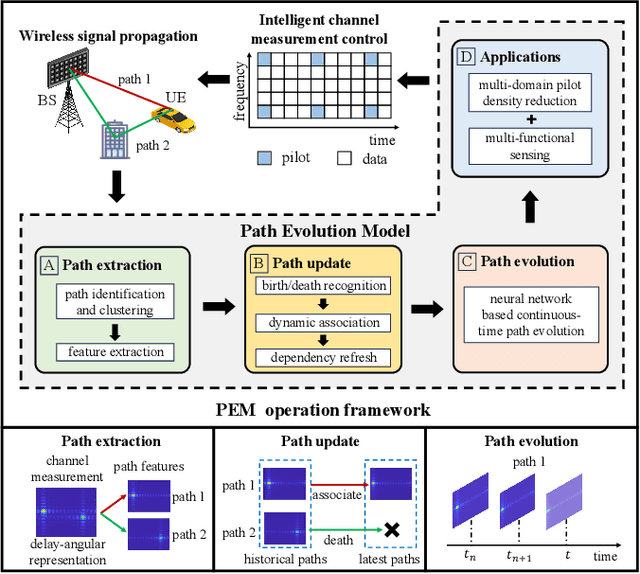
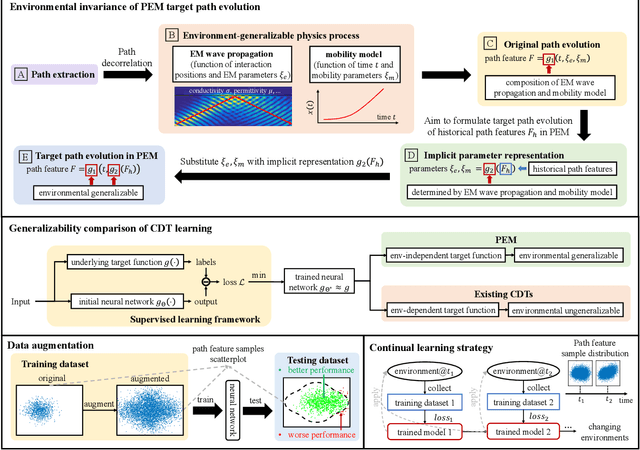
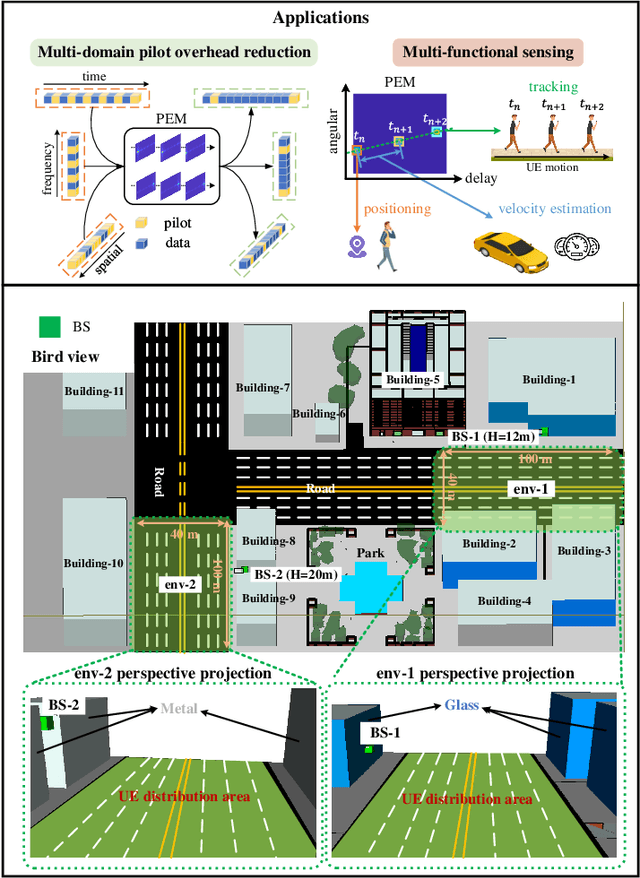
Massive Multiple Input Multiple Output (MIMO) is critical for boosting 6G wireless network capacity. Nevertheless, high dimensional Channel State Information (CSI) acquisition becomes the bottleneck of 6G massive MIMO system. Recently, Channel Digital Twin (CDT), which replicates physical entities in wireless channels, has been proposed, providing site-specific prior knowledge for CSI acquisition. However, external devices (e.g., cameras and GPS devices) cannot always be integrated into existing communication systems, nor are they universally available across all scenarios. Moreover, the trained CDT model cannot be directly applied in new environments, which lacks environmental generalizability. To this end, Path Evolution Model (PEM) is proposed as an alternative CDT to reflect physical path evolutions from consecutive channel measurements. Compared to existing CDTs, PEM demonstrates virtues of full endogeneity, self-sustainability and environmental generalizability. Firstly, PEM only requires existing channel measurements, which is free of other hardware devices and can be readily deployed. Secondly, self-sustaining maintenance of PEM can be achieved in dynamic channel by progressive updates. Thirdly, environmental generalizability can greatly reduce deployment costs in dynamic environments. To facilitate the implementation of PEM, an intelligent and light-weighted operation framework is firstly designed. Then, the environmental generalizability of PEM is rigorously analyzed. Next, efficient learning approaches are proposed to reduce the amount of training data practically. Extensive simulation results reveal that PEM can simultaneously achieve high-precision and low-overhead CSI acquisition, which can serve as a fundamental CDT for 6G wireless networks.
Analysis and Optimization of Multiple-STAR-RIS Assisted MIMO-NOMA with GSVD Precoding: An Operator-Valued Free Probability Approach
Nov 14, 2024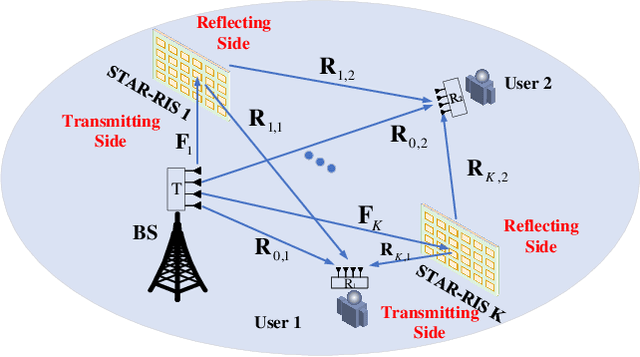
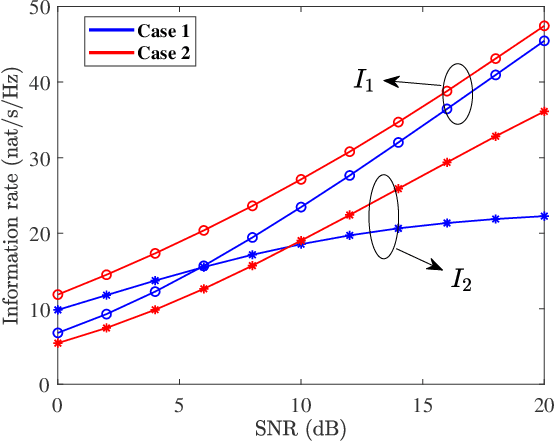
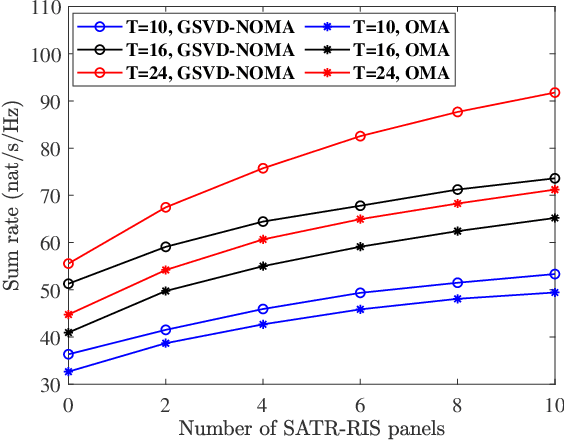
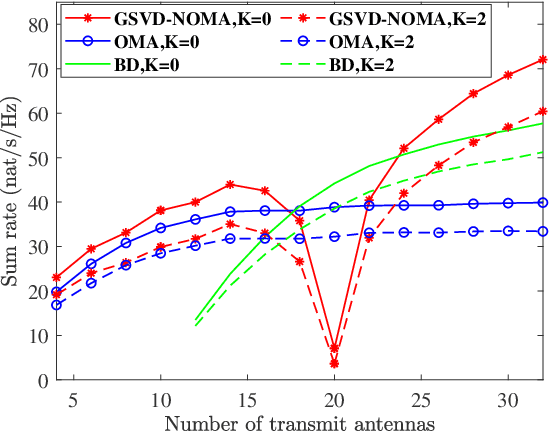
Among the key enabling 6G techniques, multiple-input multiple-output (MIMO) and non-orthogonal multiple-access (NOMA) play an important role in enhancing the spectral efficiency of the wireless communication systems. To further extend the coverage and the capacity, the simultaneously transmitting and reflecting reconfigurable intelligent surface (STAR-RIS) has recently emerged out as a cost-effective technology. To exploit the benefit of STAR-RIS in the MIMO-NOMA systems, in this paper, we investigate the analysis and optimization of the downlink dual-user MIMO-NOMA systems assisted by multiple STAR-RISs under the generalized singular value decomposition (GSVD) precoding scheme, in which the channel is assumed to be Rician faded with the Weichselberger's correlation structure. To analyze the asymptotic information rate of the users, we apply the operator-valued free probability theory to obtain the Cauchy transform of the generalized singular values (GSVs) of the MIMO-NOMA channel matrices, which can be used to obtain the information rate by Riemann integral. Then, considering the special case when the channels between the BS and the STAR-RISs are deterministic, we obtain the closed-form expression for the asymptotic information rates of the users. Furthermore, a projected gradient ascent method (PGAM) is proposed with the derived closed-form expression to design the STAR-RISs thereby maximizing the sum rate based on the statistical channel state information. The numerical results show the accuracy of the asymptotic expression compared to the Monte Carlo simulations and the superiority of the proposed PGAM algorithm.
Augmenting Channel Simulator and Semi- Supervised Learning for Efficient Indoor Positioning
Aug 01, 2024


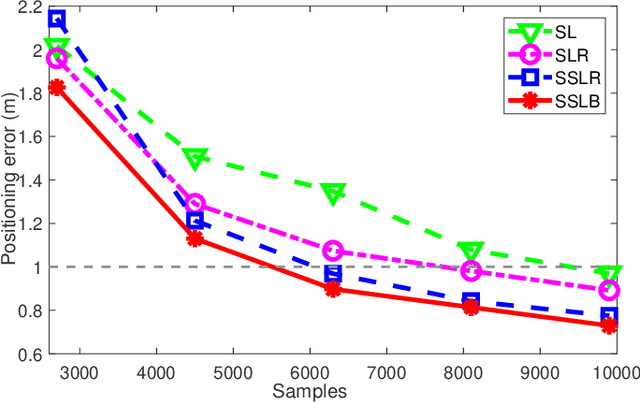
This work aims to tackle the labor-intensive and resource-consuming task of indoor positioning by proposing an efficient approach. The proposed approach involves the introduction of a semi-supervised learning (SSL) with a biased teacher (SSLB) algorithm, which effectively utilizes both labeled and unlabeled channel data. To reduce measurement expenses, unlabeled data is generated using an updated channel simulator (UCHS), and then weighted by adaptive confidence values to simplify the tuning of hyperparameters. Simulation results demonstrate that the proposed strategy achieves superior performance while minimizing measurement overhead and training expense compared to existing benchmarks, offering a valuable and practical solution for indoor positioning.