 Add to Chrome
 Add to Firefox
 Add to Edge
TempAct: Advancing Temporal Plausibility in Autoregressive Video Generation via Planner-Executor RL
Jun 26, 2026
Autoregressive (AR) video diffusion models enable low-latency streaming generation by synthesizing videos chunk by chunk with cached visual context, but this chunk-wise formulation makes temporal instruction following ambiguous. A single global prompt does not specify which sub-event should be realized in each chunk, while naively switching to step-wise prompts often leads to delayed reactions, blended step semantics, and error propagation across prompt transitions. These failures are difficult to address with supervised fine-tuning or distillation alone: SFT suffers from exposure bias, while rollout-based distillation still optimizes low-level denoising or teacher-distribution matching rather than directly enforcing action ordering and prompt-transition correctness. We address these challenges with TempAct, a planner--executor reinforcement learning framework that jointly optimizes temporal decomposition and step-conditioned execution for temporally plausible AR video generation. TempAct uses an LLM planner to explore span-aware step prompts that are executable by the video model, and trains an AR diffusion executor to follow these prompts under its own generated histories. Its key mechanism is hierarchical group exploration: candidate plans form planning groups, and each plan induces an execution group of multiple continuations from a shared visual context, enabling plan-level credit assignment for long-horizon temporal outcomes and executor-level credit assignment for prompt-switch behavior. We further design hierarchical rewards that combine plan-quality and full-video temporal feedback for the planner with local transition-level step-following rewards, aesthetic regularization, and KL constraints for the executor. Experiments on Self-Forcing and LongLive show that TempAct improves temporal consistency while preserving overall visual quality.

Efficient Generative Retrieval for E-commerce Search with Semantic Cluster IDs and Expert-Guided RL
May 14, 2026Generative retrieval offers a promising alternative by unifying the fragmented multi-stage retrieval process into a single end-to-end model. However, its practical adoption in industrial e-commerce search remains challenging, given the massive and dynamic product catalogs, strict latency requirements, and the need to align retrieval with downstream ranking goals. In this work, we propose a retrieval framework tailored for real-world recall scenarios, positioning generative retrieval as a recall-stage supplement rather than an end-to-end replacement. Our method, CQ-SID (Category-and-Query constrained Semantic ID), employs category-aware and query-item contrastive learning along with Residual Quantized VAEs to encode items into hierarchical semantic cluster identifiers, significantly reducing beam search complexity. Additionally, we develop EG-GRPO (Expert-Guided Group Relative Policy Optimization), a reinforcement learning approach that aligns generative recall with downstream ranking under sparse rewards by injecting ground-truth samples to stabilize training. Offline experiments on TmallAPP search logs show that CQ-SID achieves up to 26.76% and 11.11% relative gains in semantic and personalized click hitrate over RQ-VAE baselines, while halving beam search size. EG-GRPO further improves multi-objective performance. Online A/B tests confirm gains in GMV (+1.15%) and UCTCVR (+0.40%). The generative recall channel now contributes substantially in production, accounting for over 50.25% of exposures, 58.96% of clicks, and 72.63% of purchases, demonstrating a viable path for deploying generative retrieval in real-world e-commerce systems.
HairOrbit: Multi-view Aware 3D Hair Modeling from Single Portraits
Apr 03, 2026Reconstructing strand-level 3D hair from a single-view image is highly challenging, especially when preserving consistent and realistic attributes in unseen regions. Existing methods rely on limited frontal-view cues and small-scale/style-restricted synthetic data, often failing to produce satisfactory results in invisible regions. In this work, we propose a novel framework that leverages the strong 3D priors of video generation models to transform single-view hair reconstruction into a calibrated multi-view reconstruction task. To balance reconstruction quality and efficiency for the reformulated multi-view task, we further introduce a neural orientation extractor trained on sparse real-image annotations for better full-view orientation estimation. In addition, we design a two-stage strand-growing algorithm based on a hybrid implicit field to synthesize the 3D strand curves with fine-grained details at a relatively fast speed. Extensive experiments demonstrate that our method achieves state-of-the-art performance on single-view 3D hair strand reconstruction on a diverse range of hair portraits in both visible and invisible regions.
Steering Video Diffusion Transformers with Massive Activations
Mar 18, 2026Despite rapid progress in video diffusion transformers, how their internal model signals can be leveraged with minimal overhead to enhance video generation quality remains underexplored. In this work, we study the role of Massive Activations (MAs), which are rare, high-magnitude hidden state spikes in video diffusion transformers. We observed that MAs emerge consistently across all visual tokens, with a clear magnitude hierarchy: first-frame tokens exhibit the largest MA magnitudes, latent-frame boundary tokens (the head and tail portions of each temporal chunk in the latent space) show elevated but slightly lower MA magnitudes than the first frame, and interior tokens within each latent frame remain elevated, yet are comparatively moderate in magnitude. This structured pattern suggests that the model implicitly prioritizes token positions aligned with the temporal chunking in the latent space. Based on this observation, we propose Structured Activation Steering (STAS), a training-free self-guidance-like method that steers MA values at first-frame and boundary tokens toward a scaled global maximum reference magnitude. STAS achieves consistent improvements in terms of video quality and temporal coherence across different text-to-video models, while introducing negligible computational overhead.
AnyCrowd: Instance-Isolated Identity-Pose Binding for Arbitrary Multi-Character Animation
Mar 16, 2026Controllable character animation has advanced rapidly in recent years, yet multi-character animation remains underexplored. As the number of characters grows, multi-character reference encoding becomes more susceptible to latent identity entanglement, resulting in identity bleeding and reduced controllability. Moreover, learning precise and spatio-temporally consistent correspondences between reference identities and driving pose sequences becomes increasingly challenging, often leading to identity-pose mis-binding and inconsistency in generated videos. To address these challenges, we propose AnyCrowd, a Diffusion Transformer (DiT)-based video generation framework capable of scaling to an arbitrary number of characters. Specifically, we first introduce an Instance-Isolated Latent Representation (IILR), which encodes character instances independently prior to DiT processing to prevent latent identity entanglement. Building on this disentangled representation, we further propose Tri-Stage Decoupled Attention (TSDA) to bind identities to driving poses by decomposing self-attention into: (i) instance-aware foreground attention, (ii) background-centric interaction, and (iii) global foreground-background coordination. Furthermore, to mitigate token ambiguity in overlapping regions, an Adaptive Gated Fusion (AGF) module is integrated within TSDA to predict identity-aware weights, effectively fusing competing token groups into identity-consistent representations...
ERGO: Excess-Risk-Guided Optimization for High-Fidelity Monocular 3D Gaussian Splatting
Feb 10, 2026Generating 3D content from a single image remains a fundamentally challenging and ill-posed problem due to the inherent absence of geometric and textural information in occluded regions. While state-of-the-art generative models can synthesize auxiliary views to provide additional supervision, these views inevitably contain geometric inconsistencies and textural misalignments that propagate and amplify artifacts during 3D reconstruction. To effectively harness these imperfect supervisory signals, we propose an adaptive optimization framework guided by excess risk decomposition, termed ERGO. Specifically, ERGO decomposes the optimization losses in 3D Gaussian splatting into two components, i.e., excess risk that quantifies the suboptimality gap between current and optimal parameters, and Bayes error that models the irreducible noise inherent in synthesized views. This decomposition enables ERGO to dynamically estimate the view-specific excess risk and adaptively adjust loss weights during optimization. Furthermore, we introduce geometry-aware and texture-aware objectives that complement the excess-risk-derived weighting mechanism, establishing a synergistic global-local optimization paradigm. Consequently, ERGO demonstrates robustness against supervision noise while consistently enhancing both geometric fidelity and textural quality of the reconstructed 3D content. Extensive experiments on the Google Scanned Objects dataset and the OmniObject3D dataset demonstrate the superiority of ERGO over existing state-of-the-art methods.
GRPO-Guard: Mitigating Implicit Over-Optimization in Flow Matching via Regulated Clipping
Oct 25, 2025Recently, GRPO-based reinforcement learning has shown remarkable progress in optimizing flow-matching models, effectively improving their alignment with task-specific rewards. Within these frameworks, the policy update relies on importance-ratio clipping to constrain overconfident positive and negative gradients. However, in practice, we observe a systematic shift in the importance-ratio distribution-its mean falls below 1 and its variance differs substantially across timesteps. This left-shifted and inconsistent distribution prevents positive-advantage samples from entering the clipped region, causing the mechanism to fail in constraining overconfident positive updates. As a result, the policy model inevitably enters an implicit over-optimization stage-while the proxy reward continues to increase, essential metrics such as image quality and text-prompt alignment deteriorate sharply, ultimately making the learned policy impractical for real-world use. To address this issue, we introduce GRPO-Guard, a simple yet effective enhancement to existing GRPO frameworks. Our method incorporates ratio normalization, which restores a balanced and step-consistent importance ratio, ensuring that PPO clipping properly constrains harmful updates across denoising timesteps. In addition, a gradient reweighting strategy equalizes policy gradients over noise conditions, preventing excessive updates from particular timestep regions. Together, these designs act as a regulated clipping mechanism, stabilizing optimization and substantially mitigating implicit over-optimization without relying on heavy KL regularization. Extensive experiments on multiple diffusion backbones (e.g., SD3.5M, Flux.1-dev) and diverse proxy tasks demonstrate that GRPO-Guard significantly reduces over-optimization while maintaining or even improving generation quality.
DreamVTON: Customizing 3D Virtual Try-on with Personalized Diffusion Models
Jul 23, 2024
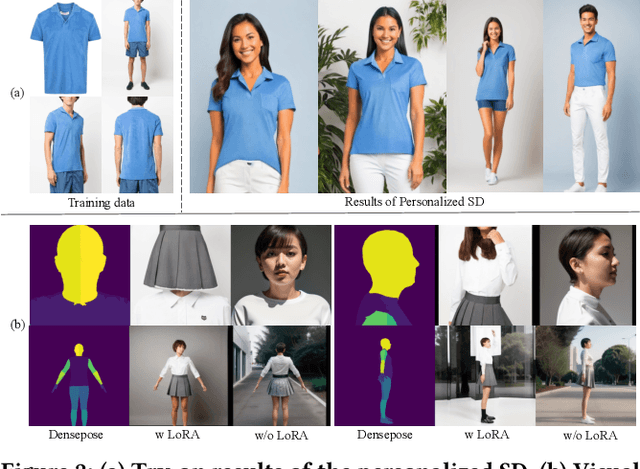

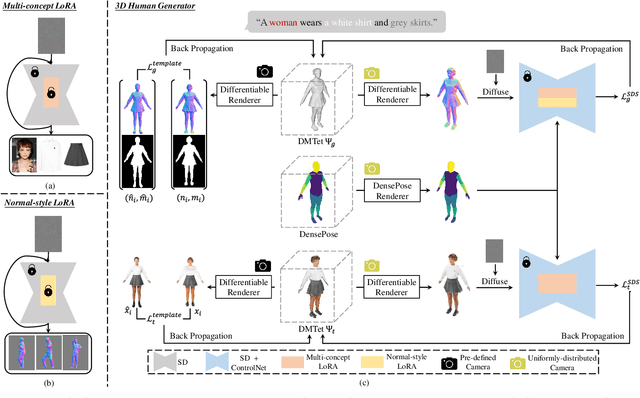
Image-based 3D Virtual Try-ON (VTON) aims to sculpt the 3D human according to person and clothes images, which is data-efficient (i.e., getting rid of expensive 3D data) but challenging. Recent text-to-3D methods achieve remarkable improvement in high-fidelity 3D human generation, demonstrating its potential for 3D virtual try-on. Inspired by the impressive success of personalized diffusion models (e.g., Dreambooth and LoRA) for 2D VTON, it is straightforward to achieve 3D VTON by integrating the personalization technique into the diffusion-based text-to-3D framework. However, employing the personalized module in a pre-trained diffusion model (e.g., StableDiffusion (SD)) would degrade the model's capability for multi-view or multi-domain synthesis, which is detrimental to the geometry and texture optimization guided by Score Distillation Sampling (SDS) loss. In this work, we propose a novel customizing 3D human try-on model, named \textbf{DreamVTON}, to separately optimize the geometry and texture of the 3D human. Specifically, a personalized SD with multi-concept LoRA is proposed to provide the generative prior about the specific person and clothes, while a Densepose-guided ControlNet is exploited to guarantee consistent prior about body pose across various camera views. Besides, to avoid the inconsistent multi-view priors from the personalized SD dominating the optimization, DreamVTON introduces a template-based optimization mechanism, which employs mask templates for geometry shape learning and normal/RGB templates for geometry/texture details learning. Furthermore, for the geometry optimization phase, DreamVTON integrates a normal-style LoRA into personalized SD to enhance normal map generative prior, facilitating smooth geometry modeling.
GUESS:GradUally Enriching SyntheSis for Text-Driven Human Motion Generation
Jan 06, 2024In this paper, we propose a novel cascaded diffusion-based generative framework for text-driven human motion synthesis, which exploits a strategy named GradUally Enriching SyntheSis (GUESS as its abbreviation). The strategy sets up generation objectives by grouping body joints of detailed skeletons in close semantic proximity together and then replacing each of such joint group with a single body-part node. Such an operation recursively abstracts a human pose to coarser and coarser skeletons at multiple granularity levels. With gradually increasing the abstraction level, human motion becomes more and more concise and stable, significantly benefiting the cross-modal motion synthesis task. The whole text-driven human motion synthesis problem is then divided into multiple abstraction levels and solved with a multi-stage generation framework with a cascaded latent diffusion model: an initial generator first generates the coarsest human motion guess from a given text description; then, a series of successive generators gradually enrich the motion details based on the textual description and the previous synthesized results. Notably, we further integrate GUESS with the proposed dynamic multi-condition fusion mechanism to dynamically balance the cooperative effects of the given textual condition and synthesized coarse motion prompt in different generation stages. Extensive experiments on large-scale datasets verify that GUESS outperforms existing state-of-the-art methods by large margins in terms of accuracy, realisticness, and diversity. Code is available at https://github.com/Xuehao-Gao/GUESS.
Towards Detailed Text-to-Motion Synthesis via Basic-to-Advanced Hierarchical Diffusion Model
Dec 18, 2023
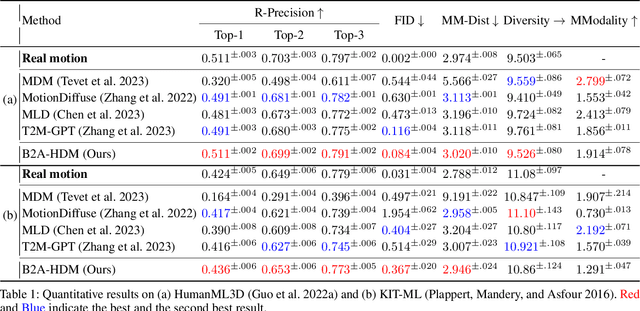
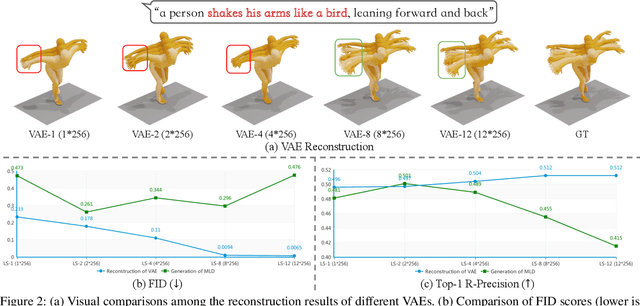
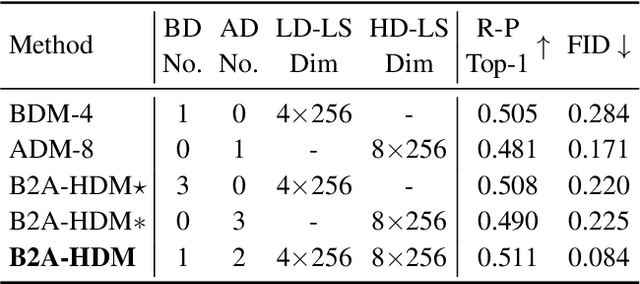
Text-guided motion synthesis aims to generate 3D human motion that not only precisely reflects the textual description but reveals the motion details as much as possible. Pioneering methods explore the diffusion model for text-to-motion synthesis and obtain significant superiority. However, these methods conduct diffusion processes either on the raw data distribution or the low-dimensional latent space, which typically suffer from the problem of modality inconsistency or detail-scarce. To tackle this problem, we propose a novel Basic-to-Advanced Hierarchical Diffusion Model, named B2A-HDM, to collaboratively exploit low-dimensional and high-dimensional diffusion models for high quality detailed motion synthesis. Specifically, the basic diffusion model in low-dimensional latent space provides the intermediate denoising result that to be consistent with the textual description, while the advanced diffusion model in high-dimensional latent space focuses on the following detail-enhancing denoising process. Besides, we introduce a multi-denoiser framework for the advanced diffusion model to ease the learning of high-dimensional model and fully explore the generative potential of the diffusion model. Quantitative and qualitative experiment results on two text-to-motion benchmarks (HumanML3D and KIT-ML) demonstrate that B2A-HDM can outperform existing state-of-the-art methods in terms of fidelity, modality consistency, and diversity.