 Add to Chrome
 Add to Firefox
 Add to Edge
Temporal Concentration from Rollout Errors: Implicit Preference Optimization for Text-to-Video Diffusion
Jul 30, 2026
Recent advances in preference alignment for diffusion-based video generation, particularly via Direct Preference Optimization (DPO), have significantly improved visual quality. However, temporally sparse artifacts such as motion collapse, object flickering, and color oversaturation remain a major barrier to perceptual realism. Existing methods struggle with these issues due to two key limitations: (1) the preference attribution bottleneck, where offline human annotations are costly and fail to accurately capture learning dynamics, while online reward signals are rollout-aware but often unstable and biased; and (2) temporal credit misallocation, where uniformly applied supervision cannot effectively target the brief segments in which artifacts occur. To address these challenges, we propose concentrated Implicit Preference Optimization (cIPO), a post-training framework for video diffusion models. cIPO derives implicit preference signals directly from the denoising process: given a real video, the model adds forward noise and reconstructs it via iterative denoising, treating the original as the preferred sample and the reconstruction as the dispreferred one. This formulation captures inference-time errors without requiring human annotations or external reward models. Moreover, frame-level discrepancies between original and reconstructed videos reveal when failures occur. cIPO leverages this by computing temporal reconstruction errors and concentrating optimization on high-error segments, enabling more precise correction of failure-prone regions. Extensive experiments demonstrate that cIPO consistently enhances video authenticity and temporal coherence across multiple datasets, highlighting the effectiveness and efficiency of implicit preference with temporally concentrated optimization.

Bridging Cognitive Gap: Hierarchical Description Learning for Artistic Image Aesthetics Assessment
Dec 29, 2025The aesthetic quality assessment task is crucial for developing a human-aligned quantitative evaluation system for AIGC. However, its inherently complex nature, spanning visual perception, cognition, and emotion, poses fundamental challenges. Although aesthetic descriptions offer a viable representation of this complexity, two critical challenges persist: (1) data scarcity and imbalance: existing dataset overly focuses on visual perception and neglects deeper dimensions due to the expensive manual annotation; and (2) model fragmentation: current visual networks isolate aesthetic attributes with multi-branch encoder, while multimodal methods represented by contrastive learning struggle to effectively process long-form textual descriptions. To resolve challenge (1), we first present the Refined Aesthetic Description (RAD) dataset, a large-scale (70k), multi-dimensional structured dataset, generated via an iterative pipeline without heavy annotation costs and easy to scale. To address challenge (2), we propose ArtQuant, an aesthetics assessment framework for artistic images which not only couples isolated aesthetic dimensions through joint description generation, but also better models long-text semantics with the help of LLM decoders. Besides, theoretical analysis confirms this symbiosis: RAD's semantic adequacy (data) and generation paradigm (model) collectively minimize prediction entropy, providing mathematical grounding for the framework. Our approach achieves state-of-the-art performance on several datasets while requiring only 33% of conventional training epochs, narrowing the cognitive gap between artistic images and aesthetic judgment. We will release both code and dataset to support future research.
DiverseGRPO: Mitigating Mode Collapse in Image Generation via Diversity-Aware GRPO
Dec 25, 2025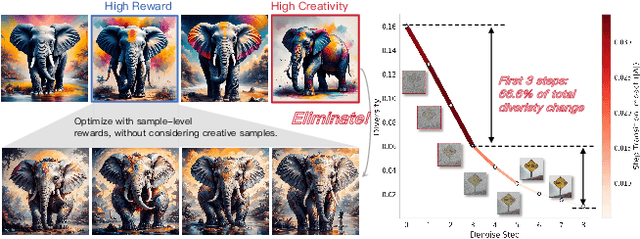
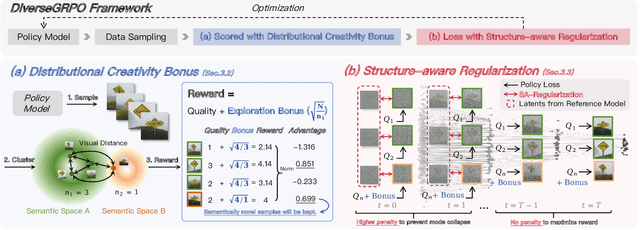
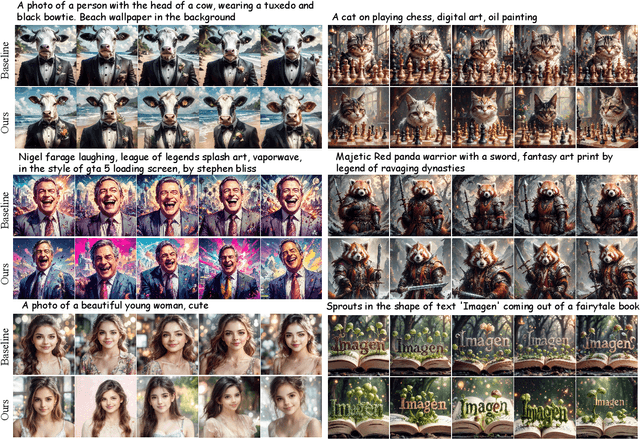
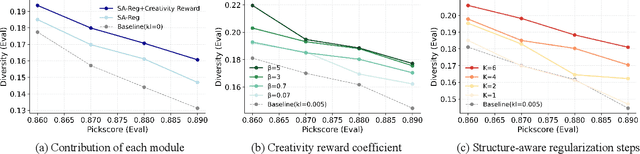
Reinforcement learning (RL), particularly GRPO, improves image generation quality significantly by comparing the relative performance of images generated within the same group. However, in the later stages of training, the model tends to produce homogenized outputs, lacking creativity and visual diversity, which restricts its application scenarios. This issue can be analyzed from both reward modeling and generation dynamics perspectives. First, traditional GRPO relies on single-sample quality as the reward signal, driving the model to converge toward a few high-reward generation modes while neglecting distribution-level diversity. Second, conventional GRPO regularization neglects the dominant role of early-stage denoising in preserving diversity, causing a misaligned regularization budget that limits the achievable quality--diversity trade-off. Motivated by these insights, we revisit the diversity degradation problem from both reward modeling and generation dynamics. At the reward level, we propose a distributional creativity bonus based on semantic grouping. Specifically, we construct a distribution-level representation via spectral clustering over samples generated from the same caption, and adaptively allocate exploratory rewards according to group sizes to encourage the discovery of novel visual modes. At the generation level, we introduce a structure-aware regularization, which enforces stronger early-stage constraints to preserve diversity without compromising reward optimization efficiency. Experiments demonstrate that our method achieves a 13\%--18\% improvement in semantic diversity under matched quality scores, establishing a new Pareto frontier between image quality and diversity for GRPO-based image generation.
GRPO-Guard: Mitigating Implicit Over-Optimization in Flow Matching via Regulated Clipping
Oct 25, 2025Recently, GRPO-based reinforcement learning has shown remarkable progress in optimizing flow-matching models, effectively improving their alignment with task-specific rewards. Within these frameworks, the policy update relies on importance-ratio clipping to constrain overconfident positive and negative gradients. However, in practice, we observe a systematic shift in the importance-ratio distribution-its mean falls below 1 and its variance differs substantially across timesteps. This left-shifted and inconsistent distribution prevents positive-advantage samples from entering the clipped region, causing the mechanism to fail in constraining overconfident positive updates. As a result, the policy model inevitably enters an implicit over-optimization stage-while the proxy reward continues to increase, essential metrics such as image quality and text-prompt alignment deteriorate sharply, ultimately making the learned policy impractical for real-world use. To address this issue, we introduce GRPO-Guard, a simple yet effective enhancement to existing GRPO frameworks. Our method incorporates ratio normalization, which restores a balanced and step-consistent importance ratio, ensuring that PPO clipping properly constrains harmful updates across denoising timesteps. In addition, a gradient reweighting strategy equalizes policy gradients over noise conditions, preventing excessive updates from particular timestep regions. Together, these designs act as a regulated clipping mechanism, stabilizing optimization and substantially mitigating implicit over-optimization without relying on heavy KL regularization. Extensive experiments on multiple diffusion backbones (e.g., SD3.5M, Flux.1-dev) and diverse proxy tasks demonstrate that GRPO-Guard significantly reduces over-optimization while maintaining or even improving generation quality.