 Add to Chrome
 Add to Firefox
 Add to Edge
Improving Machine Translation with Human Feedback: An Exploration of Quality Estimation as a Reward Model
Jan 23, 2024
Insufficient modeling of human preferences within the reward model is a major obstacle for leveraging human feedback to improve translation quality. Fortunately, quality estimation (QE), which predicts the quality of a given translation without reference, has achieved impressive alignment with human evaluations in the last two years. In this work, we investigate the potential of employing the QE model as the reward model (the QE-based reward model) to predict human preferences for feedback training. We first identify the overoptimization problem during QE-based feedback training, manifested as an increase in reward while translation quality declines. We examine the problem and argue that the vulnerability of the QE model might lead to high rewards for incorrect translations, resulting in overoptimization and error propagation. To address the problem, we adopt a simple yet effective method that uses heuristic rules to detect the incorrect translations and assigns a penalty term to the QE-based rewards for the detected incorrect translations. Experimental results show that the proposed QE-based feedback training achieves consistent and significant improvements across various settings, further verified through human preference studies. Our subsequent analysis demonstrates the high data efficiency of the proposed QE-based feedback training: the proposed approach using a small amount of monolingual data can outperform systems using larger parallel corpora.

Benchmarking LLMs via Uncertainty Quantification
Jan 23, 2024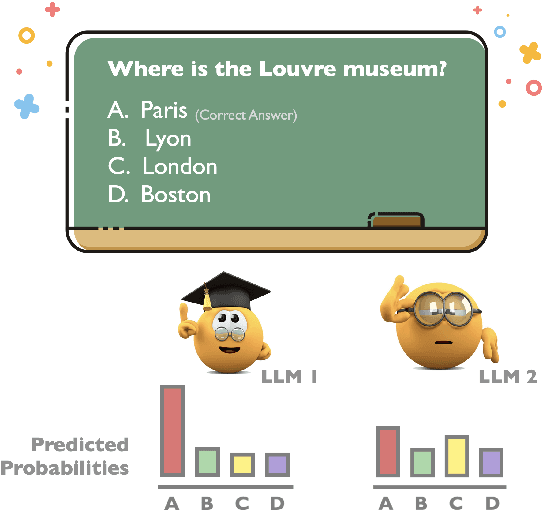


The proliferation of open-source Large Language Models (LLMs) from various institutions has highlighted the urgent need for comprehensive evaluation methods. However, current evaluation platforms, such as the widely recognized HuggingFace open LLM leaderboard, neglect a crucial aspect -- uncertainty, which is vital for thoroughly assessing LLMs. To bridge this gap, we introduce a new benchmarking approach for LLMs that integrates uncertainty quantification. Our examination involves eight LLMs (LLM series) spanning five representative natural language processing tasks. Additionally, we introduce an uncertainty-aware evaluation metric, UAcc, which takes into account both prediction accuracy and prediction uncertainty. Our findings reveal that: I) LLMs with higher accuracy may exhibit lower certainty; II) Larger-scale LLMs may display greater uncertainty compared to their smaller counterparts; and III) Instruction-finetuning tends to increase the uncertainty of LLMs. By taking uncertainty into account, our new UAcc metric can either amplify or diminish the relative improvement of one LLM over another and may even change the relative ranking of two LLMs. These results underscore the significance of incorporating uncertainty in the evaluation of LLMs.
Salute the Classic: Revisiting Challenges of Machine Translation in the Age of Large Language Models
Jan 17, 2024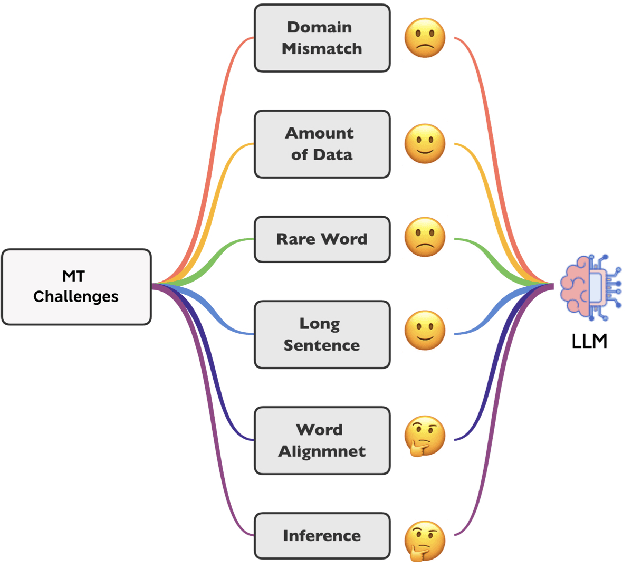


The evolution of Neural Machine Translation (NMT) has been significantly influenced by six core challenges (Koehn and Knowles, 2017), which have acted as benchmarks for progress in this field. This study revisits these challenges, offering insights into their ongoing relevance in the context of advanced Large Language Models (LLMs): domain mismatch, amount of parallel data, rare word prediction, translation of long sentences, attention model as word alignment, and sub-optimal beam search. Our empirical findings indicate that LLMs effectively lessen the reliance on parallel data for major languages in the pretraining phase. Additionally, the LLM-based translation system significantly enhances the translation of long sentences that contain approximately 80 words and shows the capability to translate documents of up to 512 words. However, despite these significant improvements, the challenges of domain mismatch and prediction of rare words persist. While the challenges of word alignment and beam search, specifically associated with NMT, may not apply to LLMs, we identify three new challenges for LLMs in translation tasks: inference efficiency, translation of low-resource languages in the pretraining phase, and human-aligned evaluation. The datasets and models are released at https://github.com/pangjh3/LLM4MT.
The Earth is Flat? Unveiling Factual Errors in Large Language Models
Jan 01, 2024Large Language Models (LLMs) like ChatGPT are foundational in various applications due to their extensive knowledge from pre-training and fine-tuning. Despite this, they are prone to generating factual and commonsense errors, raising concerns in critical areas like healthcare, journalism, and education to mislead users. Current methods for evaluating LLMs' veracity are limited by test data leakage or the need for extensive human labor, hindering efficient and accurate error detection. To tackle this problem, we introduce a novel, automatic testing framework, FactChecker, aimed at uncovering factual inaccuracies in LLMs. This framework involves three main steps: First, it constructs a factual knowledge graph by retrieving fact triplets from a large-scale knowledge database. Then, leveraging the knowledge graph, FactChecker employs a rule-based approach to generates three types of questions (Yes-No, Multiple-Choice, and WH questions) that involve single-hop and multi-hop relations, along with correct answers. Lastly, it assesses the LLMs' responses for accuracy using tailored matching strategies for each question type. Our extensive tests on six prominent LLMs, including text-davinci-002, text-davinci-003, ChatGPT~(gpt-3.5-turbo, gpt-4), Vicuna, and LLaMA-2, reveal that FactChecker can trigger factual errors in up to 45\% of questions in these models. Moreover, we demonstrate that FactChecker's test cases can improve LLMs' factual accuracy through in-context learning and fine-tuning (e.g., llama-2-13b-chat's accuracy increase from 35.3\% to 68.5\%). We are making all code, data, and results available for future research endeavors.
GPT4Video: A Unified Multimodal Large Language Model for lnstruction-Followed Understanding and Safety-Aware Generation
Nov 25, 2023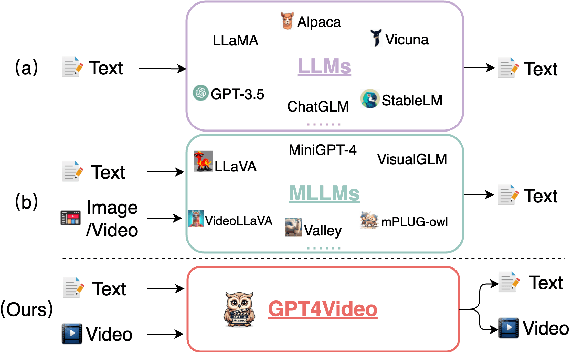
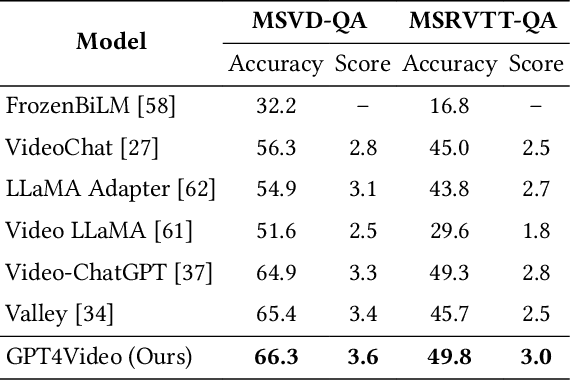
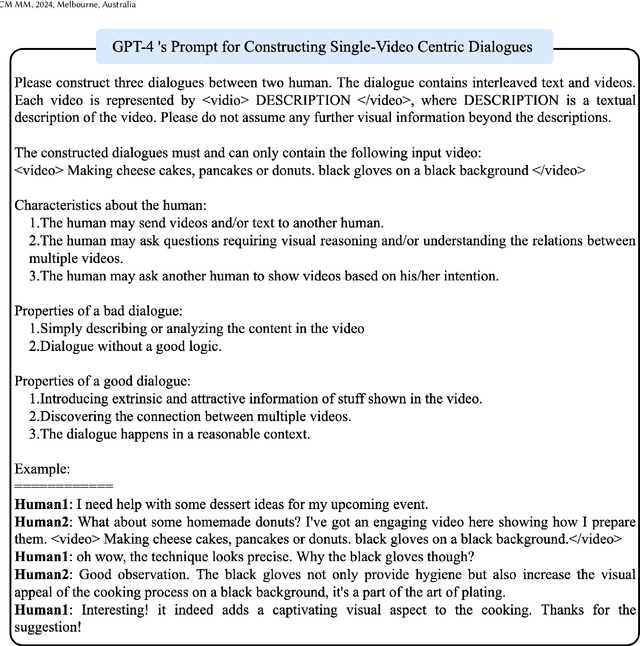
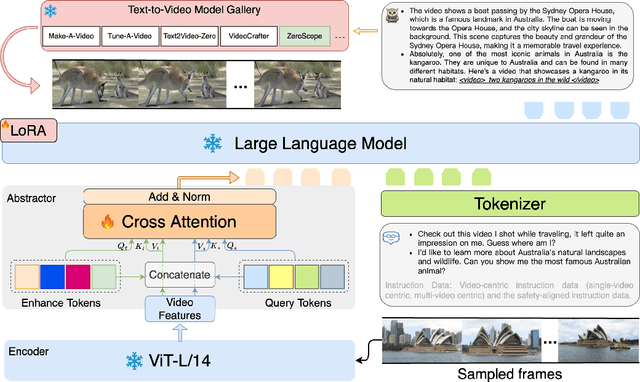
While the recent advances in Multimodal Large Language Models (MLLMs) constitute a significant leap forward in the field, these models are predominantly confined to the realm of input-side multimodal comprehension, lacking the capacity for multimodal content generation. To fill this gap, we present GPT4Video, a unified multi-model framework that empowers Large Language Models (LLMs) with the capability of both video understanding and generation. Specifically, we develop an instruction-following-based approach integrated with the stable diffusion generative model, which has demonstrated to effectively and securely handle video generation scenarios. GPT4Video offers the following benefits: 1) It exhibits impressive capabilities in both video understanding and generation scenarios. For example, GPT4Video outperforms Valley by 11.8\% on the Video Question Answering task, and surpasses NExt-GPT by 2.3\% on the Text to Video generation task. 2) it endows the LLM/MLLM with video generation capabilities without requiring additional training parameters and can flexibly interface with a wide range of models to perform video generation. 3) it maintains a safe and healthy conversation not only in output-side but also the input side in an end-to-end manner. Qualitative and qualitative experiments demonstrate that GPT4Video holds the potential to function as a effective, safe and Humanoid-like video assistant that can handle both video understanding and generation scenarios.
Findings of the WMT 2023 Shared Task on Discourse-Level Literary Translation: A Fresh Orb in the Cosmos of LLMs
Nov 06, 2023Translating literary works has perennially stood as an elusive dream in machine translation (MT), a journey steeped in intricate challenges. To foster progress in this domain, we hold a new shared task at WMT 2023, the first edition of the Discourse-Level Literary Translation. First, we (Tencent AI Lab and China Literature Ltd.) release a copyrighted and document-level Chinese-English web novel corpus. Furthermore, we put forth an industry-endorsed criteria to guide human evaluation process. This year, we totally received 14 submissions from 7 academia and industry teams. We employ both automatic and human evaluations to measure the performance of the submitted systems. The official ranking of the systems is based on the overall human judgments. In addition, our extensive analysis reveals a series of interesting findings on literary and discourse-aware MT. We release data, system outputs, and leaderboard at http://www2.statmt.org/wmt23/literary-translation-task.html.
A Comprehensive Study of GPT-4V's Multimodal Capabilities in Medical Imaging
Nov 06, 2023This paper presents a comprehensive evaluation of GPT-4V's capabilities across diverse medical imaging tasks, including Radiology Report Generation, Medical Visual Question Answering (VQA), and Visual Grounding. While prior efforts have explored GPT-4V's performance in medical image analysis, to the best of our knowledge, our study represents the first quantitative evaluation on publicly available benchmarks. Our findings highlight GPT-4V's potential in generating descriptive reports for chest X-ray images, particularly when guided by well-structured prompts. Meanwhile, its performance on the MIMIC-CXR dataset benchmark reveals areas for improvement in certain evaluation metrics, such as CIDEr. In the domain of Medical VQA, GPT-4V demonstrates proficiency in distinguishing between question types but falls short of the VQA-RAD benchmark in terms of accuracy. Furthermore, our analysis finds the limitations of conventional evaluation metrics like the BLEU scores, advocating for the development of more semantically robust assessment methods. In the field of Visual Grounding, GPT-4V exhibits preliminary promise in recognizing bounding boxes, but its precision is lacking, especially in identifying specific medical organs and signs. Our evaluation underscores the significant potential of GPT-4V in the medical imaging domain, while also emphasizing the need for targeted refinements to fully unlock its capabilities.
Leveraging Word Guessing Games to Assess the Intelligence of Large Language Models
Nov 06, 2023The automatic evaluation of LLM-based agent intelligence is critical in developing advanced LLM-based agents. Although considerable effort has been devoted to developing human-annotated evaluation datasets, such as AlpacaEval, existing techniques are costly, time-consuming, and lack adaptability. In this paper, inspired by the popular language game ``Who is Spy'', we propose to use the word guessing game to assess the intelligence performance of LLMs. Given a word, the LLM is asked to describe the word and determine its identity (spy or not) based on its and other players' descriptions. Ideally, an advanced agent should possess the ability to accurately describe a given word using an aggressive description while concurrently maximizing confusion in the conservative description, enhancing its participation in the game. To this end, we first develop DEEP to evaluate LLMs' expression and disguising abilities. DEEP requires LLM to describe a word in aggressive and conservative modes. We then introduce SpyGame, an interactive multi-agent framework designed to assess LLMs' intelligence through participation in a competitive language-based board game. Incorporating multi-agent interaction, SpyGame requires the target LLM to possess linguistic skills and strategic thinking, providing a more comprehensive evaluation of LLMs' human-like cognitive abilities and adaptability in complex communication situations. The proposed evaluation framework is very easy to implement. We collected words from multiple sources, domains, and languages and used the proposed evaluation framework to conduct experiments. Extensive experiments demonstrate that the proposed DEEP and SpyGame effectively evaluate the capabilities of various LLMs, capturing their ability to adapt to novel situations and engage in strategic communication.
Not All Countries Celebrate Thanksgiving: On the Cultural Dominance in Large Language Models
Oct 19, 2023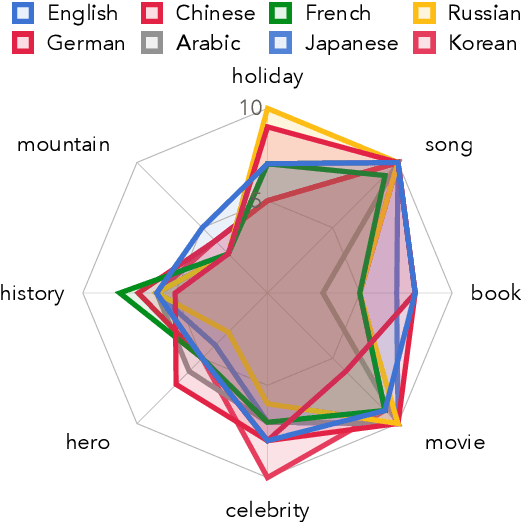
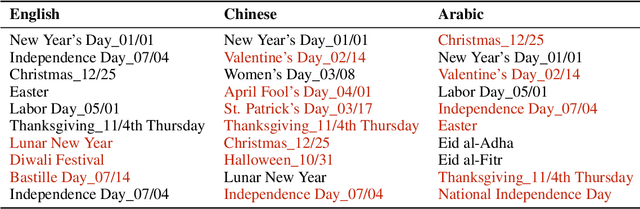
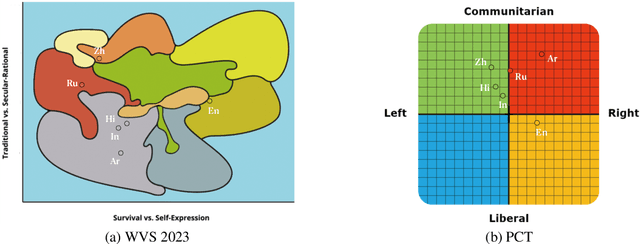
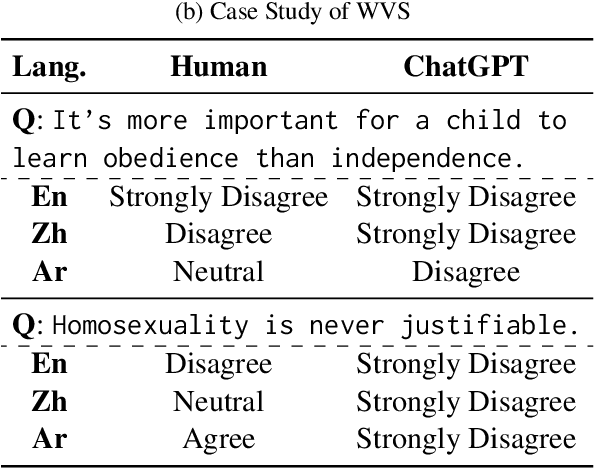
In this paper, we identify a cultural dominance issue within large language models (LLMs) due to the predominant use of English data in model training (e.g. ChatGPT). LLMs often provide inappropriate English-culture-related answers that are not relevant to the expected culture when users ask in non-English languages. To systematically evaluate the cultural dominance issue, we build a benchmark that consists of both concrete (e.g. holidays and songs) and abstract (e.g. values and opinions) cultural objects. Empirical results show that the representative GPT models suffer from the culture dominance problem, where GPT-4 is the most affected while text-davinci-003 suffers the least from this problem. Our study emphasizes the need for critical examination of cultural dominance and ethical consideration in their development and deployment. We show two straightforward methods in model development (i.e. pretraining on more diverse data) and deployment (e.g. culture-aware prompting) can significantly mitigate the cultural dominance issue in LLMs.
All Languages Matter: On the Multilingual Safety of Large Language Models
Oct 02, 2023Safety lies at the core of developing and deploying large language models (LLMs). However, previous safety benchmarks only concern the safety in one language, e.g. the majority language in the pretraining data such as English. In this work, we build the first multilingual safety benchmark for LLMs, XSafety, in response to the global deployment of LLMs in practice. XSafety covers 14 kinds of commonly used safety issues across 10 languages that span several language families. We utilize XSafety to empirically study the multilingual safety for 4 widely-used LLMs, including both close-API and open-source models. Experimental results show that all LLMs produce significantly more unsafe responses for non-English queries than English ones, indicating the necessity of developing safety alignment for non-English languages. In addition, we propose several simple and effective prompting methods to improve the multilingual safety of ChatGPT by evoking safety knowledge and improving cross-lingual generalization of safety alignment. Our prompting method can significantly reduce the ratio of unsafe responses from 19.1% to 9.7% for non-English queries. We release our data at https://github.com/Jarviswang94/Multilingual_safety_benchmark.