 Add to Chrome
 Add to Firefox
 Add to Edge
DSPrompt: Dynamic Soft Prompt Defense Against M-RAG Corruption
Aug 17, 2026
Multimodal Retrieval Augmented Generation (M-RAG) is increasingly vulnerable to adversarial attacks where malicious data are crafted to produce embeddings that align with benign entries in the vector space, deceiving retrieval and inducing harmful outputs. Existing defenses primarily operate at query time, relying on auxiliary detectors, similarity re-ranking, or feature-consistency checks. However, these approaches suffer from non-trivial inference overhead, generalize poorly to unseen attack strategies, and often assume specific attack distributions. To address this, we propose DSPrompt, a Dynamic Soft Prompt defense framework that directly reshapes the retriever's embedding semantics, without modifying the retrieval pipeline. It inserts few learnable soft prompts into each layer of the visual and textual encoders of a frozen retriever, utilizing a shallow-to-deep length schedule that is adaptive to the capacity in the model layers. These prompts are trained under a dynamic min-max scheme: an online multimodal attacker continually crafts hard adversarial documents against the current retriever, while the defender is updated to push such documents out of the top-k while preserving the ranking and diversity of benign evidence. Because the defended encoder can be pre-computed and indexed exactly as in standard dense retrieval, DSPrompt incurs no additional per-query optimization and introduces fewer than 1% additional parameters. Extensive experiments across four benchmarks and three representative poisoning attacks show that DSPrompt substantially reduces the attack success rate and poison retrieval rate while maintaining near-lossless retrieval utility and generation fidelity, consistently outperforming existing defense baselines at a fraction of their computational cost.

Orca: The World is in Your Mind
Jun 30, 2026We introduce Orca, an initial instantiation of a general world foundation model. Orca learns a unified world latent space from multimodal world signals and exposes it through multimodal readout interfaces. Rather than optimizing isolated next-token, next-frame, or next-action prediction, we are centered on Next-State-Prediction modeling, offering a unified state-transition modeling route toward understanding, predicting, and acting upon the world. Orca learns through two complementary paradigms: unconscious learning captures dense natural state transitions from continuous videos, and conscious learning models sparse meaningful state transitions by language-described events and VQA supervision. For pre-training, we construct a large-scale world-learning inventory data, including 125K hours of video data and 160M event annotations. After pre-training, Orca learns a unified world latent space. To examine whether the learned latent supports downstream, we evaluate it by three representative downstream readouts: text generation, image prediction, and embodied action generation. Orca's backbone is frozen, and only the lightweight modality-specific decoders are trainable. Experiments show the scalability of the proposed paradigm and verify that stronger world latent enables stronger downstream readouts. Orca outperforms similar-sized specialized baselines. These results show that Orca, as a general world foundation model, presents a promising approach to understanding, predicting, and acting upon the world. Finally, we discuss the current limitations, aiming to provide useful insights and inspiration for the community.
CSS: A Large-scale Cross-schema Chinese Text-to-SQL Medical Dataset
May 25, 2023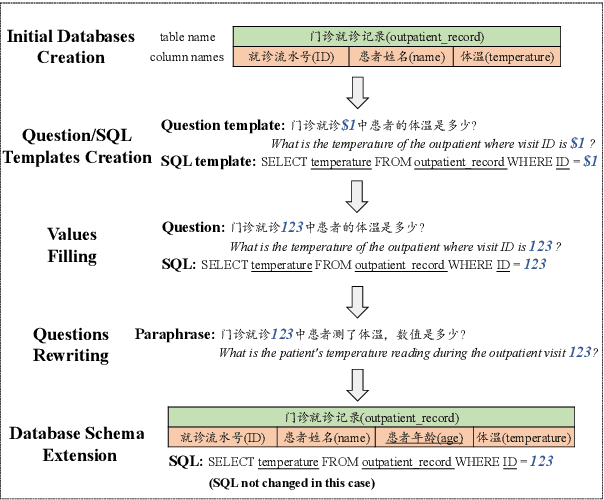
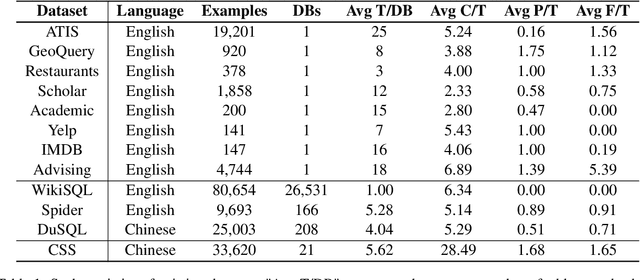
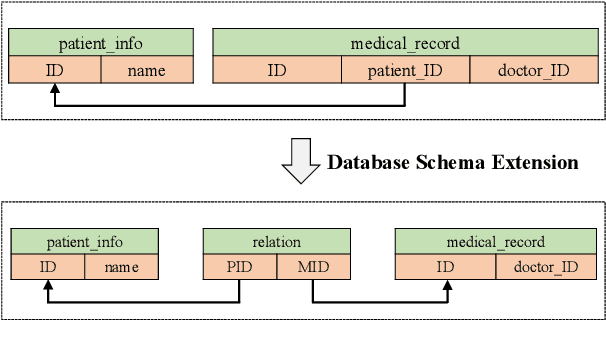
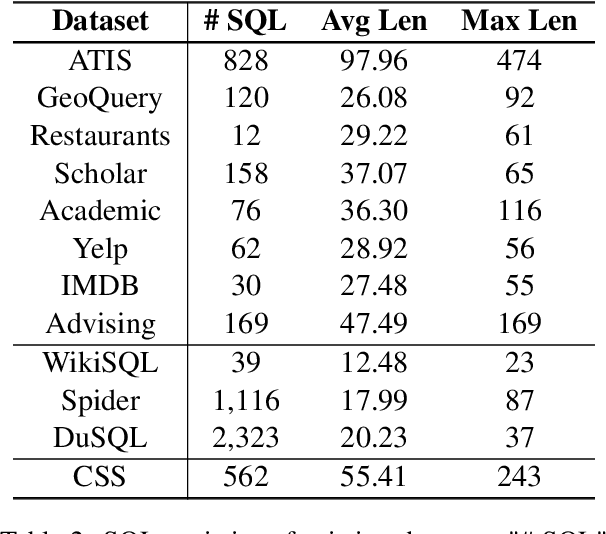
The cross-domain text-to-SQL task aims to build a system that can parse user questions into SQL on complete unseen databases, and the single-domain text-to-SQL task evaluates the performance on identical databases. Both of these setups confront unavoidable difficulties in real-world applications. To this end, we introduce the cross-schema text-to-SQL task, where the databases of evaluation data are different from that in the training data but come from the same domain. Furthermore, we present CSS, a large-scale CrosS-Schema Chinese text-to-SQL dataset, to carry on corresponding studies. CSS originally consisted of 4,340 question/SQL pairs across 2 databases. In order to generalize models to different medical systems, we extend CSS and create 19 new databases along with 29,280 corresponding dataset examples. Moreover, CSS is also a large corpus for single-domain Chinese text-to-SQL studies. We present the data collection approach and a series of analyses of the data statistics. To show the potential and usefulness of CSS, benchmarking baselines have been conducted and reported. Our dataset is publicly available at \url{https://huggingface.co/datasets/zhanghanchong/css}.
PRGC: Potential Relation and Global Correspondence Based Joint Relational Triple Extraction
Jun 18, 2021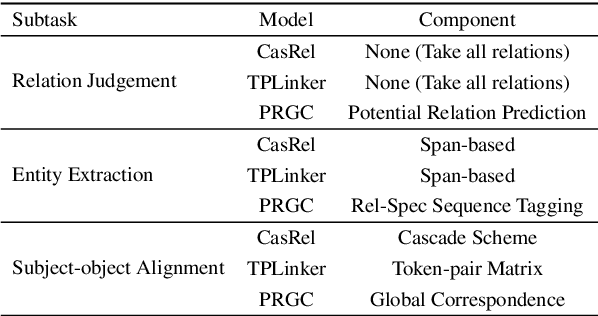
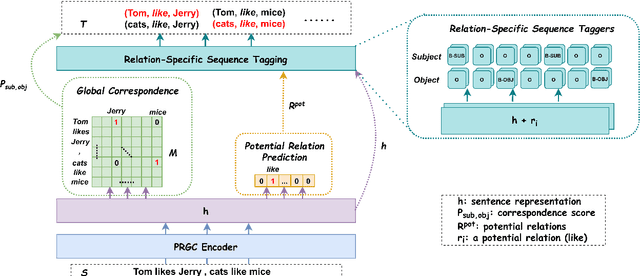
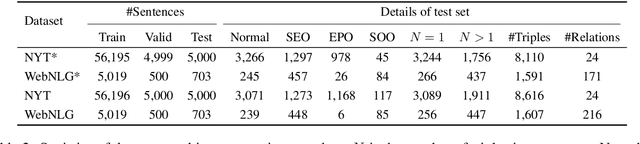
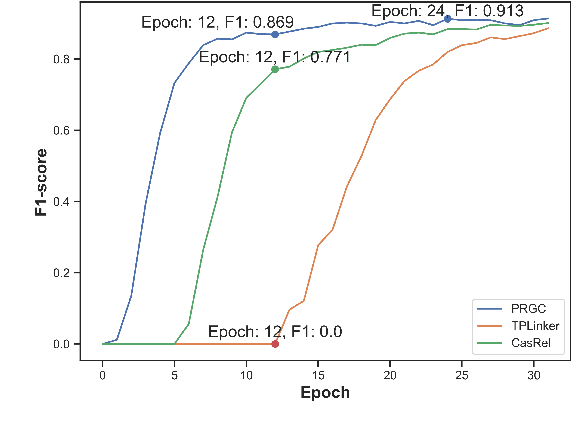
Joint extraction of entities and relations from unstructured texts is a crucial task in information extraction. Recent methods achieve considerable performance but still suffer from some inherent limitations, such as redundancy of relation prediction, poor generalization of span-based extraction and inefficiency. In this paper, we decompose this task into three subtasks, Relation Judgement, Entity Extraction and Subject-object Alignment from a novel perspective and then propose a joint relational triple extraction framework based on Potential Relation and Global Correspondence (PRGC). Specifically, we design a component to predict potential relations, which constrains the following entity extraction to the predicted relation subset rather than all relations; then a relation-specific sequence tagging component is applied to handle the overlapping problem between subjects and objects; finally, a global correspondence component is designed to align the subject and object into a triple with low-complexity. Extensive experiments show that PRGC achieves state-of-the-art performance on public benchmarks with higher efficiency and delivers consistent performance gain on complex scenarios of overlapping triples.
Phase Congruency Parameter Optimization for Enhanced Detection of Image Features for both Natural and Medical Applications
May 05, 2017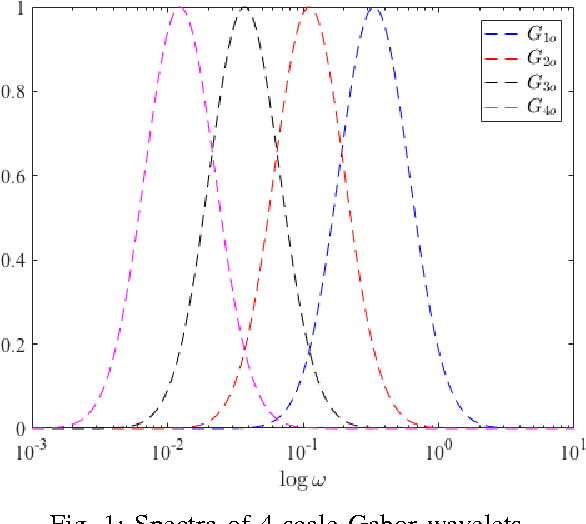
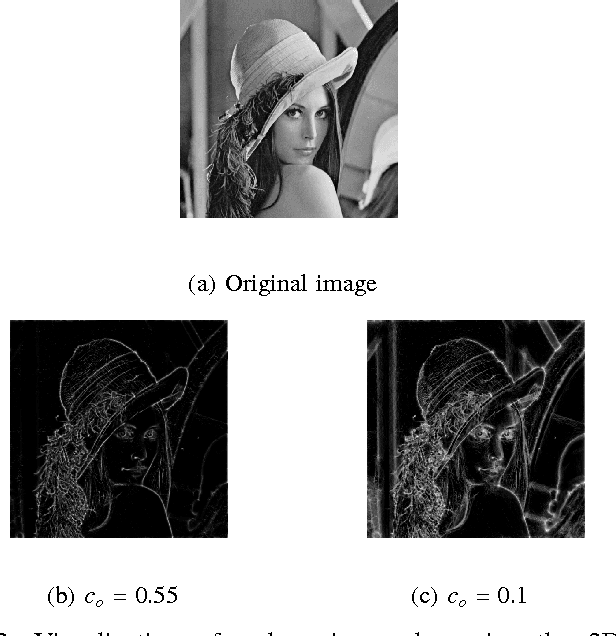
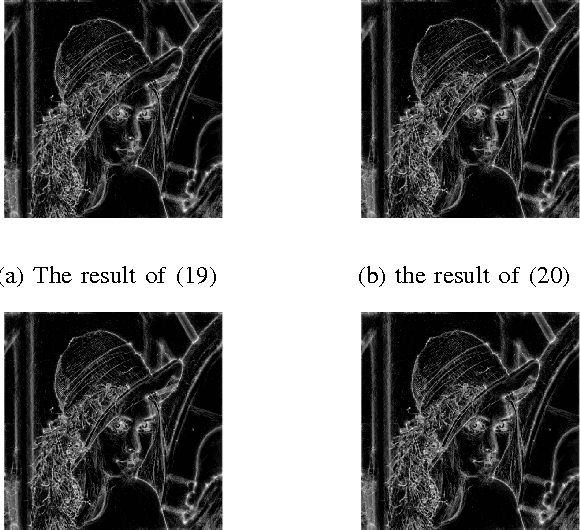
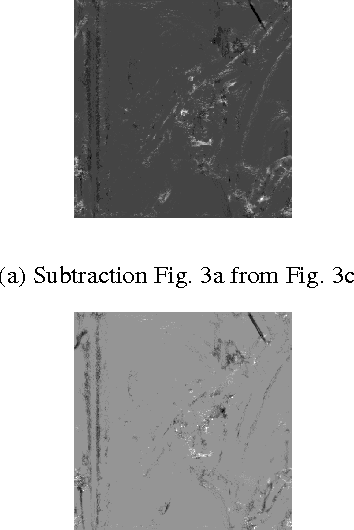
Following the presentation and proof of the hypothesis that image features are particularly perceived at points where the Fourier components are maximally in phase, the concept of phase congruency (PC) is introduced. Subsequently, a two-dimensional multi-scale phase congruency (2D-MSPC) is developed, which has been an important tool for detecting and evaluation of image features. However, the 2D-MSPC requires many parameters to be appropriately tuned for optimal image features detection. In this paper, we defined a criterion for parameter optimization of the 2D-MSPC, which is a function of its maximum and minimum moments. We formulated the problem in various optimal and suboptimal frameworks, and discussed the conditions and features of the suboptimal solutions. The effectiveness of the proposed method was verified through several examples, ranging from natural objects to medical images from patients with a neurological disease, multiple sclerosis.