 Add to Chrome
 Add to Firefox
 Add to Edge
Orca: The World is in Your Mind
Jun 30, 2026
We introduce Orca, an initial instantiation of a general world foundation model. Orca learns a unified world latent space from multimodal world signals and exposes it through multimodal readout interfaces. Rather than optimizing isolated next-token, next-frame, or next-action prediction, we are centered on Next-State-Prediction modeling, offering a unified state-transition modeling route toward understanding, predicting, and acting upon the world. Orca learns through two complementary paradigms: unconscious learning captures dense natural state transitions from continuous videos, and conscious learning models sparse meaningful state transitions by language-described events and VQA supervision. For pre-training, we construct a large-scale world-learning inventory data, including 125K hours of video data and 160M event annotations. After pre-training, Orca learns a unified world latent space. To examine whether the learned latent supports downstream, we evaluate it by three representative downstream readouts: text generation, image prediction, and embodied action generation. Orca's backbone is frozen, and only the lightweight modality-specific decoders are trainable. Experiments show the scalability of the proposed paradigm and verify that stronger world latent enables stronger downstream readouts. Orca outperforms similar-sized specialized baselines. These results show that Orca, as a general world foundation model, presents a promising approach to understanding, predicting, and acting upon the world. Finally, we discuss the current limitations, aiming to provide useful insights and inspiration for the community.

Uni-Skill: Building Self-Evolving Skill Repository for Generalizable Robotic Manipulation
Mar 03, 2026While skill-centric approaches leverage foundation models to enhance generalization in compositional tasks, they often rely on fixed skill libraries, limiting adaptability to new tasks without manual intervention. To address this, we propose Uni-Skill, a Unified Skill-centric framework that supports skill-aware planning and facilitates automatic skill evolution. Unlike prior methods that restrict planning to predefined skills, Uni-Skill requests for new skill implementations when existing ones are insufficient, ensuring adaptable planning with self-augmented skill library. To support automatic implementation of diverse skills requested by the planning module, we construct SkillFolder, a VerbNet-inspired repository derived from large-scale unstructured robotic videos. SkillFolder introduces a hierarchical skill taxonomy that captures diverse skill descriptions at multiple levels of abstraction. By populating this taxonomy with large-scale, automatically annotated demonstrations, Uni-Skill shifts the paradigm of skill acquisition from inefficient manual annotation to efficient offline structural retrieval. Retrieved examples provide semantic supervision over behavior patterns and fine-grained references for spatial trajectories, enabling few-shot skill inference without deployment-time demonstrations. Comprehensive experiments in both simulation and real-world settings verify the state-of-the-art performance of Uni-Skill over existing VLM-based skill-centric approaches, highlighting its advanced reasoning capabilities and strong zero-shot generalization across a wide range of novel tasks.
Robotic Programmer: Video Instructed Policy Code Generation for Robotic Manipulation
Jan 08, 2025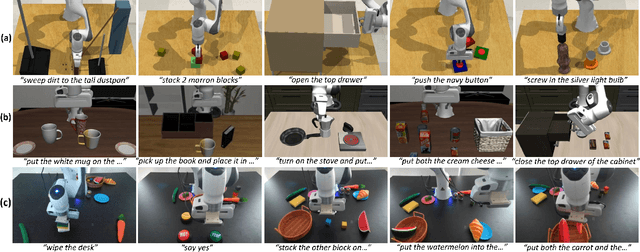
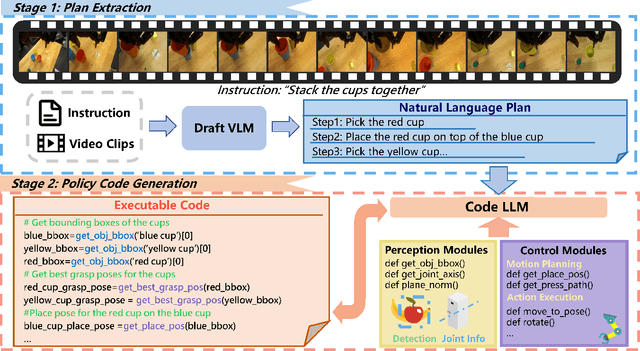
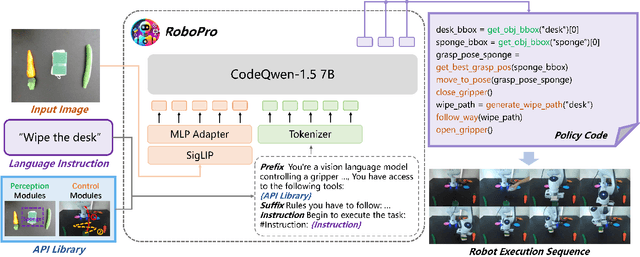
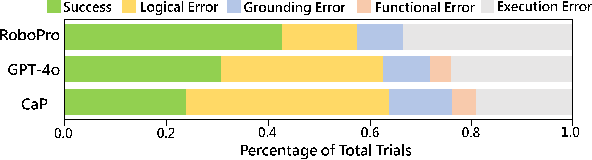
Zero-shot generalization across various robots, tasks and environments remains a significant challenge in robotic manipulation. Policy code generation methods use executable code to connect high-level task descriptions and low-level action sequences, leveraging the generalization capabilities of large language models and atomic skill libraries. In this work, we propose Robotic Programmer (RoboPro), a robotic foundation model, enabling the capability of perceiving visual information and following free-form instructions to perform robotic manipulation with policy code in a zero-shot manner. To address low efficiency and high cost in collecting runtime code data for robotic tasks, we devise Video2Code to synthesize executable code from extensive videos in-the-wild with off-the-shelf vision-language model and code-domain large language model. Extensive experiments show that RoboPro achieves the state-of-the-art zero-shot performance on robotic manipulation in both simulators and real-world environments. Specifically, the zero-shot success rate of RoboPro on RLBench surpasses the state-of-the-art model GPT-4o by 11.6%, which is even comparable to a strong supervised training baseline. Furthermore, RoboPro is robust to variations on API formats and skill sets.
M4U: Evaluating Multilingual Understanding and Reasoning for Large Multimodal Models
May 24, 2024Multilingual multimodal reasoning is a core component in achieving human-level intelligence. However, most existing benchmarks for multilingual multimodal reasoning struggle to differentiate between models of varying performance; even language models without visual capabilities can easily achieve high scores. This leaves a comprehensive evaluation of leading multilingual multimodal models largely unexplored. In this work, we introduce M4U, a novel and challenging benchmark for assessing the capability of multi-discipline multilingual multimodal understanding and reasoning. M4U contains 8,931 samples covering 64 disciplines across 16 subfields in Science, Engineering, and Healthcare in Chinese, English, and German. Using M4U, we conduct extensive evaluations of 21 leading Large Multimodal Models (LMMs) and Large Language Models (LLMs) with external tools. The evaluation results show that the state-of-the-art model, GPT-4o, achieves only 47.6% average accuracy on M4U. Additionally, we observe that the leading LMMs exhibit significant language preferences. Our in-depth analysis indicates that leading LMMs, including GPT-4o, suffer performance degradation when prompted with cross-lingual multimodal questions, such as images with key textual information in Chinese while the question is in German. We believe that M4U can serve as a crucial tool for systematically evaluating LMMs based on their multilingual multimodal reasoning capabilities and monitoring their development. The homepage, codes and data are public available.