 Add to Chrome
 Add to Firefox
 Add to Edge
DiffuReason: Bridging Latent Reasoning and Generative Refinement for Sequential Recommendation
Feb 12, 2026
Latent reasoning has emerged as a promising paradigm for sequential recommendation, enabling models to capture complex user intent through multi-step deliberation. Yet existing approaches often rely on deterministic latent chains that accumulate noise and overlook the uncertainty inherent in user intent, and they are typically trained in staged pipelines that hinder joint optimization and exploration. To address these challenges, we propose DiffuReason, a unified "Think-then-Diffuse" framework for sequential recommendation. It integrates multi-step Thinking Tokens for latent reasoning, diffusion-based refinement for denoising intermediate representations, and end-to-end Group Relative Policy Optimization (GRPO) alignment to optimize for ranking performance. In the Think stage, the model generates Thinking Tokens that reason over user history to form an initial intent hypothesis. In the Diffuse stage, rather than treating this hypothesis as the final output, we refine it through a diffusion process that models user intent as a probabilistic distribution, providing iterative denoising against reasoning noise. Finally, GRPO-based reinforcement learning enables the reasoning and refinement modules to co-evolve throughout training, without the constraints of staged optimization. Extensive experiments on four benchmarks demonstrate that DiffuReason consistently improves diverse backbone architectures. Online A/B tests on a large-scale industrial platform further validate its practical effectiveness.

RadFabric: Agentic AI System with Reasoning Capability for Radiology
Jun 17, 2025Chest X ray (CXR) imaging remains a critical diagnostic tool for thoracic conditions, but current automated systems face limitations in pathology coverage, diagnostic accuracy, and integration of visual and textual reasoning. To address these gaps, we propose RadFabric, a multi agent, multimodal reasoning framework that unifies visual and textual analysis for comprehensive CXR interpretation. RadFabric is built on the Model Context Protocol (MCP), enabling modularity, interoperability, and scalability for seamless integration of new diagnostic agents. The system employs specialized CXR agents for pathology detection, an Anatomical Interpretation Agent to map visual findings to precise anatomical structures, and a Reasoning Agent powered by large multimodal reasoning models to synthesize visual, anatomical, and clinical data into transparent and evidence based diagnoses. RadFabric achieves significant performance improvements, with near-perfect detection of challenging pathologies like fractures (1.000 accuracy) and superior overall diagnostic accuracy (0.799) compared to traditional systems (0.229 to 0.527). By integrating cross modal feature alignment and preference-driven reasoning, RadFabric advances AI-driven radiology toward transparent, anatomically precise, and clinically actionable CXR analysis.
Asclepius: A Spectrum Evaluation Benchmark for Medical Multi-Modal Large Language Models
Feb 17, 2024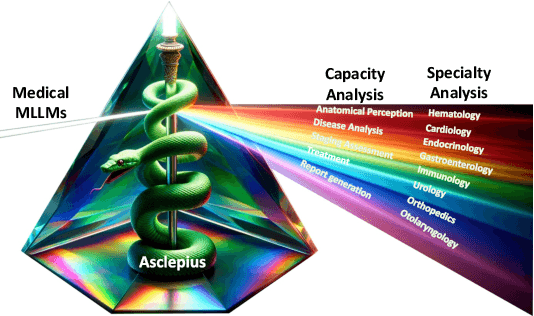
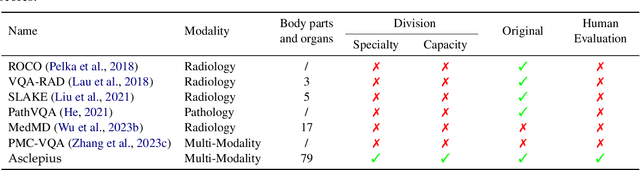
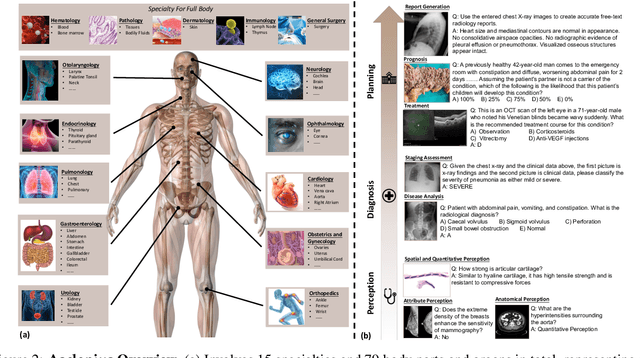
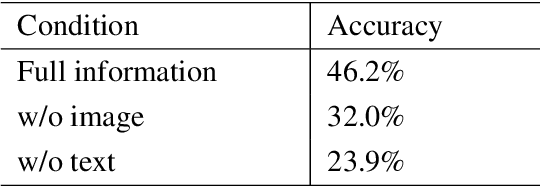
The significant breakthroughs of Medical Multi-Modal Large Language Models (Med-MLLMs) renovate modern healthcare with robust information synthesis and medical decision support. However, these models are often evaluated on benchmarks that are unsuitable for the Med-MLLMs due to the intricate nature of the real-world diagnostic frameworks, which encompass diverse medical specialties and involve complex clinical decisions. Moreover, these benchmarks are susceptible to data leakage, since Med-MLLMs are trained on large assemblies of publicly available data. Thus, an isolated and clinically representative benchmark is highly desirable for credible Med-MLLMs evaluation. To this end, we introduce Asclepius, a novel Med-MLLM benchmark that rigorously and comprehensively assesses model capability in terms of: distinct medical specialties (cardiovascular, gastroenterology, etc.) and different diagnostic capacities (perception, disease analysis, etc.). Grounded in 3 proposed core principles, Asclepius ensures a comprehensive evaluation by encompassing 15 medical specialties, stratifying into 3 main categories and 8 sub-categories of clinical tasks, and exempting from train-validate contamination. We further provide an in-depth analysis of 6 Med-MLLMs and compare them with 5 human specialists, providing insights into their competencies and limitations in various medical contexts. Our work not only advances the understanding of Med-MLLMs' capabilities but also sets a precedent for future evaluations and the safe deployment of these models in clinical environments. We launch and maintain a leaderboard for community assessment of Med-MLLM capabilities (https://asclepius-med.github.io/).