 Add to Chrome
 Add to Firefox
 Add to Edge
An evaluation framework for sparse 4D (3D + time) imaging reconstruction via bootstrapped cross-validation
May 18, 2026
Four-dimensional (4D; 3D + time) microscopic imaging has emerged as a powerful technique for investigating dynamic phenomena in complex systems, enabling direct visualization of structural evolution in space and time. However, when pushing the limits of spatiotemporal resolution, most time-resolved imaging techniques yield inherently sparse 4D datasets. While deep learning-based reconstruction methods have shown promise in reconstructing 4D from sparse spatiotemporal measurements, a practical approach for evaluating their performance in the absence of a 4D reference has, to the best of our knowledge, been lacking. Here, we present a bootstrapped cross-validation framework that estimates reconstruction performance by quantifying correlations between reconstructions generated from independently sampled subsets of the acquired data, as inspired by the 3D validation strategy in cryo-electron microscopy, where reconstructions from split datasets are compared to assess resolutions. This enables both qualitative and quantitative assessment in the absence of ground truth. We investigate two representative scenarios with sparse and ultra-sparse X-ray datasets and validate this approach using 4D-ONIX, a 4D deep-learning reconstruction method, on simulated water droplet collision experiments. The proposed approach provides a reference-free framework for performance estimation and support for better-informed experimental strategies across a wide range of ultrafast imaging applications.

One Shot Learning for Edge Detection on Point Clouds
Apr 24, 2026Each scanner possesses its unique characteristics and exhibits its distinct sampling error distribution. Training a network on a dataset that includes data collected from different scanners is less effective than training it on data specific to a single scanner. Therefore, we present a novel one-shot learning method allowing for edge extraction on point clouds, by learning the specific data distribution of the target point cloud, and thus achieve superior results compared to networks that were trained on general data distributions. More specifically, we present how to train a lightweight network named OSFENet (One-Shot edge Feature Extraction Network), by designing a filtered-KNN-based surface patch representation that supports a one-shot learning framework. Additionally, we introduce an RBF_DoS module, which integrates Radial Basis Function-based Descriptor of the Surface patch, highly beneficial for the edge extraction on point clouds. The advantage of the proposed OSFENet is demonstrated through comparative analyses against 7 baselines on the ABC dataset, and its practical utility is validated by results across diverse real-scanned datasets, including indoor scenes like S3DIS dataset, and outdoor scenes such as the Semantic3D dataset and UrbanBIS dataset.
* 17 pages, 14 figures. Published in IEEE Transactions on Visualization and Computer Graphics
Gmd: Gaussian mixture descriptor for pair matching of 3D fragments
Apr 23, 2026In the automatic reassembly of fragments acquired using laser scanners to reconstruct objects, a crucial step is the matching of fractured surfaces. In this paper, we propose a novel local descriptor that uses the Gaussian Mixture Model (GMM) to fit the distribution of points, allowing for the description and matching of fractured surfaces of fragments. Our method involves dividing a local surface patch into concave and convex regions for estimating the k value of GMM. Then the final Gaussian Mixture Descriptor (GMD) of the fractured surface is formed by merging the regional GMDs. To measure the similarities between GMDs for determining adjacent fragments, we employ the L2 distance and align the fragments using Random Sample Consensus (RANSAC) and Iterative Closest Point (ICP). The extensive experiments on real-scanned public datasets and Terracotta datasets demonstrate the effectiveness of our approach; furthermore, the comparisons with several existing methods also validate the advantage of the proposed method.
* 24 pages, 10 figures. Published in Multimedia Systems
EdgeFormer: local patch-based edge detection transformer on point clouds
Apr 23, 2026Edge points on 3D point clouds can clearly convey 3D geometry and surface characteristics, therefore, edge detection is widely used in many vision applications with high industrial and commercial demands. However, the fine-grained edge features are difficult to detect effectively as they are generally densely distributed or exhibit small-scale surface gradients. To address this issue, we present a learning-based edge detection network, named EdgeFormer, which mainly consists of two stages. Based on the observation that spatially neighboring points tend to exhibit high correlation, forming the local underlying surface, we convert the edge detection of the entire point cloud into a point classification based on local patches. Therefore, in the first stage, we construct local patch feature descriptors that describe the local neighborhood around each point. In the second stage, we classify each point by analyzing the local patch feature descriptors generated in the first stage. Due to the conversion of the point cloud into local patches, the proposed method can effectively extract the finer details. The experimental results show that our model demonstrates competitive performance compared to six baselines.
* 22 pages, 9 figures. Published in Pattern Analysis and Applications
2L-LSH: A Locality-Sensitive Hash Function-Based Method For Rapid Point Cloud Indexing
Apr 23, 2026The development of 3D scanning technology has enabled the acquisition of massive point cloud models with diverse structures and large scales, thereby presenting significant challenges in point cloud processing. Fast neighboring points search is one of the most common problems, which is frequently used in model reconstruction, classification, retrieval and feature visualization. Hash function is well known for its high-speed and accurate performance in searching high-dimensional data, which is also the core of the proposed 2L-LSH. Specifically, the 2L-LSH algorithm adopts a two-step hash function strategy, in which the popular step divides the bounding box of the point cloud model and the second step constructs a generalized table-based data structure. The proposed 2L-LSH offers a highly efficient and accurate solution for fast neighboring points search in large-scale 3D point cloud models, making it a promising technique for various applications in the field. The proposed algorithm is compared with the well-known methods including Kd-tree and Octree; the obtained results demonstrated that the proposed method outperforms Kd-tree and Octree in terms of speed, i.e. the time consumption of kNN search can be 51.111% and 94.159% lower than Kd-tree and Octree, respectively. And the RN search time can be 54.519% and 41.840% lower than Kd-tree and Octree, respectively.
* 13 pages, 13 figures. Published in The Computer Journal
Random Walk on Point Clouds for Feature Detection
Apr 22, 2026The points on the point clouds that can entirely outline the shape of the model are of critical importance, as they serve as the foundation for numerous point cloud processing tasks and are widely utilized in computer graphics and computer-aided design. This study introduces a novel method, RWoDSN, for extracting such feature points, incorporating considerations of sharp-to-smooth transitions, large-to-small scales, and textural-to-detailed features. We approach feature extraction as a two-stage context-dependent analysis problem. In the first stage, we propose a novel neighborhood descriptor, termed the Disk Sampling Neighborhood (DSN), which, unlike traditional spatially and geometrically invariant approaches, preserves a matrix structure while maintaining normal neighborhood relationships. In the second stage, a random walk is performed on the DSN (RWoDSN), yielding a graph-based DSN that simultaneously accounts for the spatial distribution, topological properties, and geometric characteristics of the local surface surrounding each point. This enables the effective extraction of feature points. Experimental results demonstrate that the proposed RWoDSN method achieves a recall of 0.769-22% higher than the current state-of-the-art-alongside a precision of 0.784. Furthermore, it significantly outperforms several traditional and deep-learning techniques across eight evaluation metrics.
* 20 pages, 11 figures. Published in Information Sciences
RailVQA: A Benchmark and Framework for Efficient Interpretable Visual Cognition in Automatic Train Operation
Mar 28, 2026Automatic Train Operation (ATO) relies on low-latency, reliable cab-view visual perception and decision-oriented inference to ensure safe operation in complex and dynamic railway environments. However, existing approaches focus primarily on basic perception and often generalize poorly to rare yet safety-critical corner cases. They also lack the high-level reasoning and planning capabilities required for operational decision-making. Although recent Large Multi-modal Models (LMMs) show strong generalization and cognitive capabilities, their use in safety-critical ATO is hindered by high computational cost and hallucination risk. Meanwhile, reliable domain-specific benchmarks for systematically evaluating cognitive capabilities are still lacking. To address these gaps, we introduce RailVQA-bench, the first VQA benchmark for cab-view visual cognition in ATO, comprising 20,000 single-frame and 1,168 video based QA pairs to evaluate cognitive generalization and interpretability in both static and dynamic scenarios. Furthermore, we propose RailVQA-CoM, a collaborative large-small model framework that combines small-model efficiency with large-model cognition via a transparent three-module architecture and adaptive temporal sampling, improving perceptual generalization and enabling efficient reasoning and planning. Experiments demonstrate that the proposed approach substantially improves performance, enhances interpretability, reduces inference latency, and strengthens cross-domain generalization, while enabling plug-and-play deployment in autonomous driving systems. Code and datasets will be available at https://github.com/Cybereye-bjtu/RailVQA.
4D reconstruction of alumina laser melt pools at 25 kHz via operando X-ray multi-projection imaging
Mar 15, 2026Advancing additive manufacturing, e.g., laser powder-bed fusion (LPBF), requires resolving rapid processes such as melt-pool dynamics and keyhole evolution in 4D (3D + time). Operando X-ray tomography is a state-of-the-art approach for 4D characterization, but its temporal resolution is fundamentally constrained by the sample rotation speed, limiting achievable 4D imaging rates and preventing the resolution of these fast phenomena. Here we present rotation-enabled X-ray Multi-Projection Imaging (rotation-XMPI), which captures three angularly resolved projections per time step and thereby decouples temporal resolution from the sample rotation speed. Combined with a self-supervised deep-learning reconstruction framework for multi-angle inputs, rotation-XMPI enables high-fidelity 4D imaging at unprecedented speed. We demonstrate the approach in an operando alumina laser-remelting experiment at MAX IV using three beamlets combined with 25 Hz sample rotation. Rotation-XMPI resolves melt-pool morphology and keyhole evolution; in contrast, conventional and limited-angle tomography remain rotation-limited, and motion blur prevents resolving these dynamics. Overall, rotation-XMPI delivers a 250-fold increase relative to state-of-the-art melt-pool imaging, effectively achieving 25,000 reconstructed volumes per second. This method establishes a practical route to scalable ultrafast 4D imaging for additive manufacturing and other materials processes.
StoryTailor:A Zero-Shot Pipeline for Action-Rich Multi-Subject Visual Narratives
Feb 24, 2026Generating multi-frame, action-rich visual narratives without fine-tuning faces a threefold tension: action text faithfulness, subject identity fidelity, and cross-frame background continuity. We propose StoryTailor, a zero-shot pipeline that runs on a single RTX 4090 (24 GB) and produces temporally coherent, identity-preserving image sequences from a long narrative prompt, per-subject references, and grounding boxes. Three synergistic modules drive the system: Gaussian-Centered Attention (GCA) to dynamically focus on each subject core and ease grounding-box overlaps; Action-Boost Singular Value Reweighting (AB-SVR) to amplify action-related directions in the text embedding space; and Selective Forgetting Cache (SFC) that retains transferable background cues, forgets nonessential history, and selectively surfaces retained cues to build cross-scene semantic ties. Compared with baseline methods, experiments show that CLIP-T improves by up to 10-15%, with DreamSim lower than strong baselines, while CLIP-I stays in a visually acceptable, competitive range. With matched resolution and steps on a 24 GB GPU, inference is faster than FluxKontext. Qualitatively, StoryTailor delivers expressive interactions and evolving yet stable scenes.
Physics-informed 4D X-ray image reconstruction from ultra-sparse spatiotemporal data
Apr 04, 2025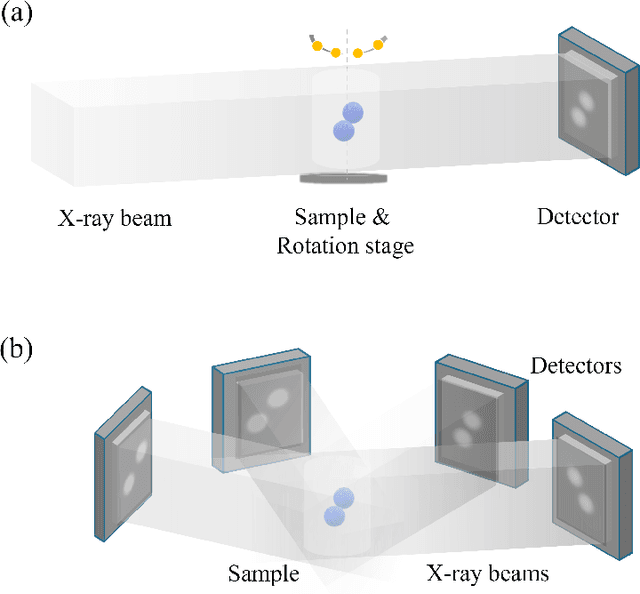
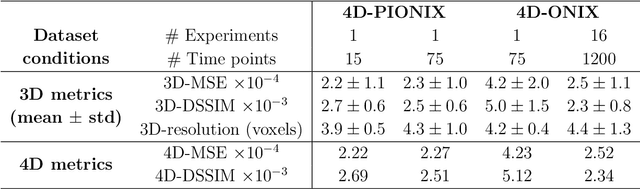
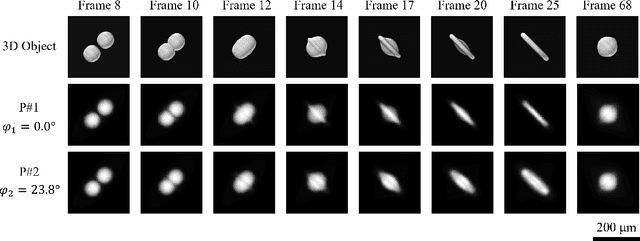
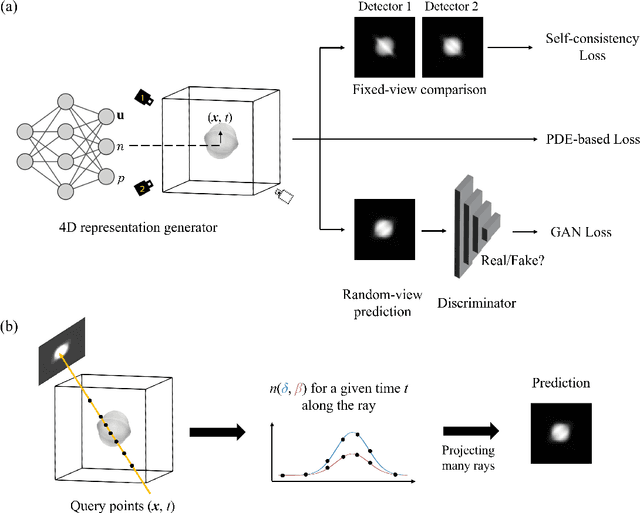
The unprecedented X-ray flux density provided by modern X-ray sources offers new spatiotemporal possibilities for X-ray imaging of fast dynamic processes. Approaches to exploit such possibilities often result in either i) a limited number of projections or spatial information due to limited scanning speed, as in time-resolved tomography, or ii) a limited number of time points, as in stroboscopic imaging, making the reconstruction problem ill-posed and unlikely to be solved by classical reconstruction approaches. 4D reconstruction from such data requires sample priors, which can be included via deep learning (DL). State-of-the-art 4D reconstruction methods for X-ray imaging combine the power of AI and the physics of X-ray propagation to tackle the challenge of sparse views. However, most approaches do not constrain the physics of the studied process, i.e., a full physical model. Here we present 4D physics-informed optimized neural implicit X-ray imaging (4D-PIONIX), a novel physics-informed 4D X-ray image reconstruction method combining the full physical model and a state-of-the-art DL-based reconstruction method for 4D X-ray imaging from sparse views. We demonstrate and evaluate the potential of our approach by retrieving 4D information from ultra-sparse spatiotemporal acquisitions of simulated binary droplet collisions, a relevant fluid dynamic process. We envision that this work will open new spatiotemporal possibilities for various 4D X-ray imaging modalities, such as time-resolved X-ray tomography and more novel sparse acquisition approaches like X-ray multi-projection imaging, which will pave the way for investigations of various rapid 4D dynamics, such as fluid dynamics and composite testing.