 Add to Chrome
 Add to Firefox
 Add to Edge
FairForensics: Seeing Expressions and Parsing Demographics via Vision-Language Modeling for Generalizable Fair Deepfake Detection
Aug 03, 2026
The challenge of fair deepfake detection (FDD) has attracted increasing attention. Existing fairness-enhanced detectors often suffer from suboptimal generalization to unseen manipulations and fairness across demographic groups. They are typically developed and evaluated on demographically imbalanced distributions, resulting in biased predictions toward minority groups. In this paper, we construct a novel demographically balanced FDD benchmark to train and evaluate the fairness of detectors under both balanced and imbalanced population scenarios. Additionally, we introduce a novel expression and demographic perceptual vision-language model, termed FairForensics, for generalizable fair deepfake detection. FairForensics conducts face forgery generalization enhancement and demographic-aware fairness regularization. During face forgery generalization enhancement, built upon the novel observation of significant distribution differences between pristine and forged expression vectors, we design an expression encoder to capture high-level expression-guided forgery patterns, and an expression-perceptual visual encoder that integrates global appearance and expression forgery features while mitigating identity bias using an identity-aware patch perturbation module. Under demographic-aware fairness regularization, we propose a demographic-guided language encoder to extract population-aware global language embeddings, which boosts the decoupling of forgery features from demographic information via vision-language alignment. We devise a population-aware prototype fairness objective to enforce both inter-class separability and intra-class alignment across demographic subgroups. Extensive experiments on our balanced demographic benchmark show that our method achieves the state-of-the-art in terms of generalization and fairness.

MFVLR: Multi-domain Fine-grained Vision-Language Reconstruction for Generalizable Diffusion Face Forgery Detection and Localization
May 11, 2026The swift advancement in photo-realistic face generation technology has sparked considerable concerns across society and academia, emphasizing the requirement of generalizable face forgery detection and localization methods. Prior works tend to capture face forgery patterns across multiple domains using image modality, other modalities like fine-grained texts are not comprehensively investigated, which restricts the generalization capability of models. Besides, they usually analyze facial images created by GAN, but struggle to identify and localize those synthesized by diffusion. To solve the problems, in this paper, we devise a novel multi-domain fine-grained vision-language reconstruction (MFVLR) model, which explores comprehensive and diverse visual forgery traces via language-guided face forgery representation learning, to achieve generalizable diffusion-synthesized face forgery detection and localization (DFFDL). Specifically, we devise a fine-grained language transformer that studies general fine-grained language embeddings using language reconstruction. We propose a multi-domain vision encoder to capture general and complementary visual forgery patterns across the image and residual domains. A vision decoder is designed to reconstruct image appearance and achieve forgery localization. Besides, we propose an innovative plug-and-play vision injection module to enhance the interaction between the vision and language embeddings. Extensive experiments and visualizations demonstrate that our network outperforms the state of the art on different settings like cross-generator, cross-forgery, and cross-dataset evaluations.
2L-LSH: A Locality-Sensitive Hash Function-Based Method For Rapid Point Cloud Indexing
Apr 23, 2026The development of 3D scanning technology has enabled the acquisition of massive point cloud models with diverse structures and large scales, thereby presenting significant challenges in point cloud processing. Fast neighboring points search is one of the most common problems, which is frequently used in model reconstruction, classification, retrieval and feature visualization. Hash function is well known for its high-speed and accurate performance in searching high-dimensional data, which is also the core of the proposed 2L-LSH. Specifically, the 2L-LSH algorithm adopts a two-step hash function strategy, in which the popular step divides the bounding box of the point cloud model and the second step constructs a generalized table-based data structure. The proposed 2L-LSH offers a highly efficient and accurate solution for fast neighboring points search in large-scale 3D point cloud models, making it a promising technique for various applications in the field. The proposed algorithm is compared with the well-known methods including Kd-tree and Octree; the obtained results demonstrated that the proposed method outperforms Kd-tree and Octree in terms of speed, i.e. the time consumption of kNN search can be 51.111% and 94.159% lower than Kd-tree and Octree, respectively. And the RN search time can be 54.519% and 41.840% lower than Kd-tree and Octree, respectively.
* 13 pages, 13 figures. Published in The Computer Journal
GazeCLIP: Gaze-Guided CLIP with Adaptive-Enhanced Fine-Grained Language Prompt for Deepfake Attribution and Detection
Mar 31, 2026Current deepfake attribution or deepfake detection works tend to exhibit poor generalization to novel generative methods due to the limited exploration in visual modalities alone. They tend to assess the attribution or detection performance of models on unseen advanced generators, coarsely, and fail to consider the synergy of the two tasks. To this end, we propose a novel gaze-guided CLIP with adaptive-enhanced fine-grained language prompts for fine-grained deepfake attribution and detection (DFAD). Specifically, we conduct a novel and fine-grained benchmark to evaluate the DFAD performance of networks on novel generators like diffusion and flow models. Additionally, we introduce a gaze-aware model based on CLIP, which is devised to enhance the generalization to unseen face forgery attacks. Built upon the novel observation that there are significant distribution differences between pristine and forged gaze vectors, and the preservation of the target gaze in facial images generated by GAN and diffusion varies significantly, we design a visual perception encoder to employ the inherent gaze differences to mine global forgery embeddings across appearance and gaze domains. We propose a gaze-aware image encoder (GIE) that fuses forgery gaze prompts extracted via a gaze encoder with common forged image embeddings to capture general attribution patterns, allowing features to be transformed into a more stable and common DFAD feature space. We build a language refinement encoder (LRE) to generate dynamically enhanced language embeddings via an adaptive-enhanced word selector for precise vision-language matching. Extensive experiments on our benchmark show that our model outperforms the state-of-the-art by 6.56% ACC and 5.32% AUC in average performance under the attribution and detection settings, respectively. Codes will be available on GitHub.
A Cognitive Distribution and Behavior-Consistent Framework for Black-Box Attacks on Recommender Systems
Feb 12, 2026With the growing deployment of sequential recommender systems in e-commerce and other fields, their black-box interfaces raise security concerns: models are vulnerable to extraction and subsequent adversarial manipulation. Existing black-box extraction attacks primarily rely on hard labels or pairwise learning, often ignoring the importance of ranking positions, which results in incomplete knowledge transfer. Moreover, adversarial sequences generated via pure gradient methods lack semantic consistency with real user behavior, making them easily detectable. To overcome these limitations, this paper proposes a dual-enhanced attack framework. First, drawing on primacy effects and position bias, we introduce a cognitive distribution-driven extraction mechanism that maps discrete rankings into continuous value distributions with position-aware decay, thereby advancing from order alignment to cognitive distribution alignment. Second, we design a behavior-aware noisy item generation strategy that jointly optimizes collaborative signals and gradient signals. This ensures both semantic coherence and statistical stealth while effectively promoting target item rankings. Extensive experiments on multiple datasets demonstrate that our approach significantly outperforms existing methods in both attack success rate and evasion rate, validating the value of integrating cognitive modeling and behavioral consistency for secure recommender systems.
BMRL: Bi-Modal Guided Multi-Perspective Representation Learning for Zero-Shot Deepfake Attribution
Apr 19, 2025The challenge of tracing the source attribution of forged faces has gained significant attention due to the rapid advancement of generative models. However, existing deepfake attribution (DFA) works primarily focus on the interaction among various domains in vision modality, and other modalities such as texts and face parsing are not fully explored. Besides, they tend to fail to assess the generalization performance of deepfake attributors to unseen generators in a fine-grained manner. In this paper, we propose a novel bi-modal guided multi-perspective representation learning (BMRL) framework for zero-shot deepfake attribution (ZS-DFA), which facilitates effective traceability to unseen generators. Specifically, we design a multi-perspective visual encoder (MPVE) to explore general deepfake attribution visual characteristics across three views (i.e., image, noise, and edge). We devise a novel parsing encoder to focus on global face attribute embeddings, enabling parsing-guided DFA representation learning via vision-parsing matching. A language encoder is proposed to capture fine-grained language embeddings, facilitating language-guided general visual forgery representation learning through vision-language alignment. Additionally, we present a novel deepfake attribution contrastive center (DFACC) loss, to pull relevant generators closer and push irrelevant ones away, which can be introduced into DFA models to enhance traceability. Experimental results demonstrate that our method outperforms the state-of-the-art on the ZS-DFA task through various protocols evaluation.
Distilled Transformers with Locally Enhanced Global Representations for Face Forgery Detection
Dec 28, 2024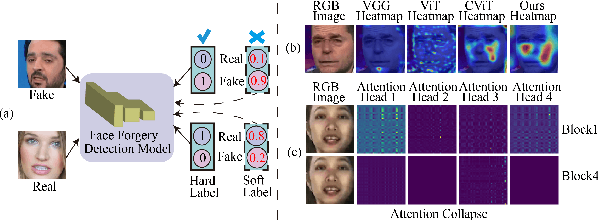
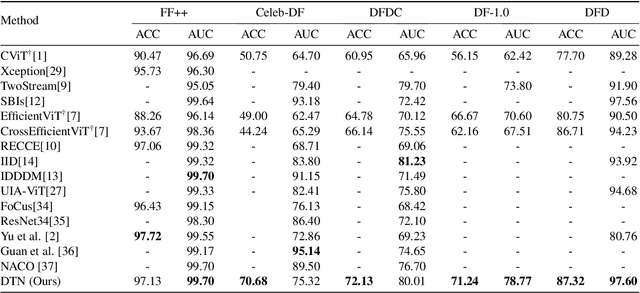
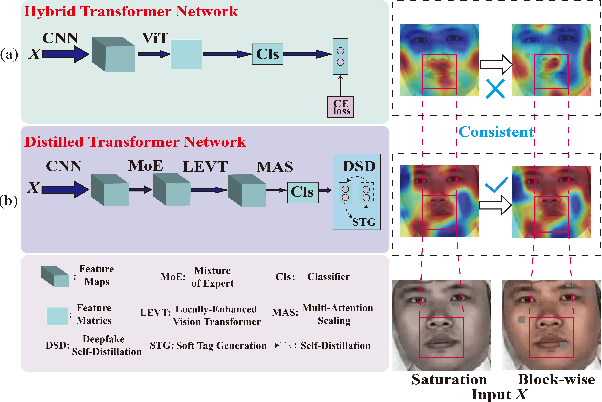
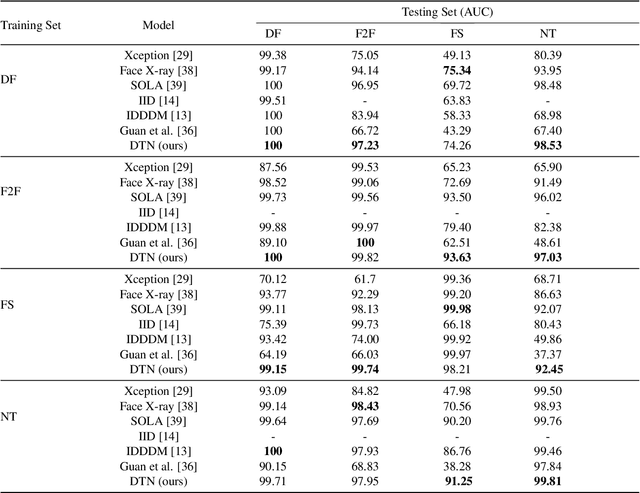
Face forgery detection (FFD) is devoted to detecting the authenticity of face images. Although current CNN-based works achieve outstanding performance in FFD, they are susceptible to capturing local forgery patterns generated by various manipulation methods. Though transformer-based detectors exhibit improvements in modeling global dependencies, they are not good at exploring local forgery artifacts. Hybrid transformer-based networks are designed to capture local and global manipulated traces, but they tend to suffer from the attention collapse issue as the transformer block goes deeper. Besides, soft labels are rarely available. In this paper, we propose a distilled transformer network (DTN) to capture both rich local and global forgery traces and learn general and common representations for different forgery faces. Specifically, we design a mixture of expert (MoE) module to mine various robust forgery embeddings. Moreover, a locally-enhanced vision transformer (LEVT) module is proposed to learn locally-enhanced global representations. We design a lightweight multi-attention scaling (MAS) module to avoid attention collapse, which can be plugged and played in any transformer-based models with only a slight increase in computational costs. In addition, we propose a deepfake self-distillation (DSD) scheme to provide the model with abundant soft label information. Extensive experiments show that the proposed method surpasses the state of the arts on five deepfake datasets.
MFCLIP: Multi-modal Fine-grained CLIP for Generalizable Diffusion Face Forgery Detection
Sep 15, 2024The rapid development of photo-realistic face generation methods has raised significant concerns in society and academia, highlighting the urgent need for robust and generalizable face forgery detection (FFD) techniques. Although existing approaches mainly capture face forgery patterns using image modality, other modalities like fine-grained noises and texts are not fully explored, which limits the generalization capability of the model. In addition, most FFD methods tend to identify facial images generated by GAN, but struggle to detect unseen diffusion-synthesized ones. To address the limitations, we aim to leverage the cutting-edge foundation model, contrastive language-image pre-training (CLIP), to achieve generalizable diffusion face forgery detection (DFFD). In this paper, we propose a novel multi-modal fine-grained CLIP (MFCLIP) model, which mines comprehensive and fine-grained forgery traces across image-noise modalities via language-guided face forgery representation learning, to facilitate the advancement of DFFD. Specifically, we devise a fine-grained language encoder (FLE) that extracts fine global language features from hierarchical text prompts. We design a multi-modal vision encoder (MVE) to capture global image forgery embeddings as well as fine-grained noise forgery patterns extracted from the richest patch, and integrate them to mine general visual forgery traces. Moreover, we build an innovative plug-and-play sample pair attention (SPA) method to emphasize relevant negative pairs and suppress irrelevant ones, allowing cross-modality sample pairs to conduct more flexible alignment. Extensive experiments and visualizations show that our model outperforms the state of the arts on different settings like cross-generator, cross-forgery, and cross-dataset evaluations.
GenFace: A Large-Scale Fine-Grained Face Forgery Benchmark and Cross Appearance-Edge Learning
Feb 03, 2024


The rapid advancement of photorealistic generators has reached a critical juncture where the discrepancy between authentic and manipulated images is increasingly indistinguishable. Thus, benchmarking and advancing techniques detecting digital manipulation become an urgent issue. Although there have been a number of publicly available face forgery datasets, the forgery faces are mostly generated using GAN-based synthesis technology, which does not involve the most recent technologies like diffusion. The diversity and quality of images generated by diffusion models have been significantly improved and thus a much more challenging face forgery dataset shall be used to evaluate SOTA forgery detection literature. In this paper, we propose a large-scale, diverse, and fine-grained high-fidelity dataset, namely GenFace, to facilitate the advancement of deepfake detection, which contains a large number of forgery faces generated by advanced generators such as the diffusion-based model and more detailed labels about the manipulation approaches and adopted generators. In addition to evaluating SOTA approaches on our benchmark, we design an innovative cross appearance-edge learning (CAEL) detector to capture multi-grained appearance and edge global representations, and detect discriminative and general forgery traces. Moreover, we devise an appearance-edge cross-attention (AECA) module to explore the various integrations across two domains. Extensive experiment results and visualizations show that our detection model outperforms the state of the arts on different settings like cross-generator, cross-forgery, and cross-dataset evaluations. Code and datasets will be available at \url{https://github.com/Jenine-321/GenFace
AerialVLN: Vision-and-Language Navigation for UAVs
Aug 13, 2023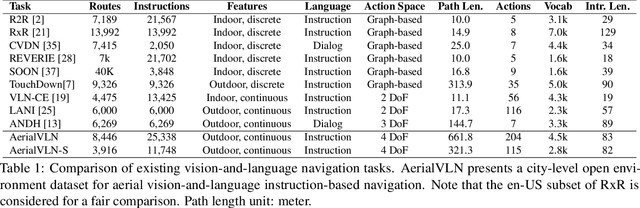
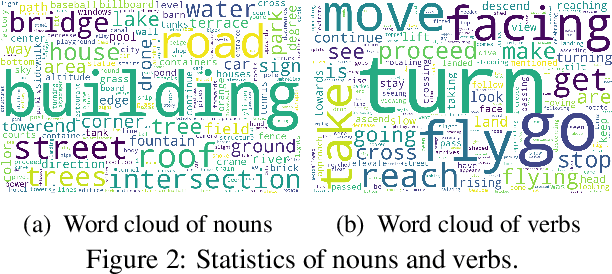
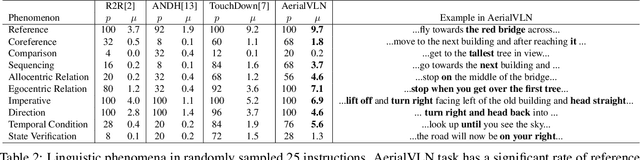
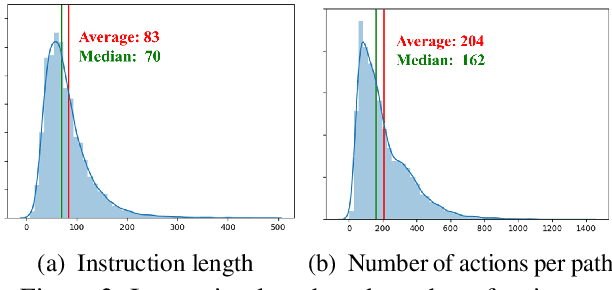
Recently emerged Vision-and-Language Navigation (VLN) tasks have drawn significant attention in both computer vision and natural language processing communities. Existing VLN tasks are built for agents that navigate on the ground, either indoors or outdoors. However, many tasks require intelligent agents to carry out in the sky, such as UAV-based goods delivery, traffic/security patrol, and scenery tour, to name a few. Navigating in the sky is more complicated than on the ground because agents need to consider the flying height and more complex spatial relationship reasoning. To fill this gap and facilitate research in this field, we propose a new task named AerialVLN, which is UAV-based and towards outdoor environments. We develop a 3D simulator rendered by near-realistic pictures of 25 city-level scenarios. Our simulator supports continuous navigation, environment extension and configuration. We also proposed an extended baseline model based on the widely-used cross-modal-alignment (CMA) navigation methods. We find that there is still a significant gap between the baseline model and human performance, which suggests AerialVLN is a new challenging task. Dataset and code is available at https://github.com/AirVLN/AirVLN.