 Add to Chrome
 Add to Firefox
 Add to Edge
Cosmos 3: Omnimodal World Models for Physical AI
Jun 01, 2026
We introduce Cosmos 3, a family of omnimodal world models designed to jointly process and generate language, image, video, audio, and action sequences within a unified mixture-of-transformers architecture. By supporting highly flexible input-output configurations, Cosmos 3 seamlessly unifies critical modalities for Physical AI -- effectively subsuming vision-language models, video generators, world simulators, and world-action models into a single framework. Our evaluation demonstrates that Cosmos 3 establishes a new state-of-the-art across a diverse suite of understanding and generation tasks, demonstrating omnimodal world models as scalable, general-purpose backbones for embodied agents. Our post-trained Cosmos 3 models were ranked as the best open-source Text-to-Image and Image-to-Video models by Artificial Analysis, and the best policy model by RoboArena at the time the technical report was written. To accelerate open research and deployment in Physical AI, we make our code, model checkpoints, curated synthetic datasets, and evaluation benchmark available under the Linux Foundation's OpenMDW-1.1 https://openmdw.ai/license/1-1/ License at https://github.com/nvidia/cosmos}{github.com/nvidia/cosmos and https://huggingface.co/collections/nvidia/cosmos3 . The project website is available at https://research.nvidia.com/labs/cosmos-lab/cosmos3 .

Terminus-4B: Can a Smaller Model Replace Frontier LLMs at Agentic Execution Tasks?
May 04, 2026Modern coding agents increasingly delegate specialized subtasks to subagents, which are smaller, focused agentic loops that handle narrow responsibilities like search, debugging or terminal execution. This architectural pattern keeps the main agent's context window clean by isolating verbose outputs (e.g. build logs, test results, etc.) within the subagent context. Typically when agents employ subagents for such tasks, they use frontier models as these subagents. In this paper, we investigate whether a finetuned small language model (SLM) can achieve comparable performance to frontier models in the task of agentic terminal execution. We present Terminus-4B, which is a post-trained Qwen3-4B model via Supervised Finetuning (SFT) and Reinforcement Learning (RL) using rubric-based LLM-as-judge reward, specifically for this task. In our extensive evaluation spanning various frontier models, training ablations and main agent configurations, we find that Terminus-4B is able to reduce the token usage of the main agent by up to ~30% compared to the No Subagent baseline with no impact to agent performance on benchmarks like SWE-Bench Pro and our internal SWE-Bench C# benchmark, which tends to be heavy in verbose execution tasks. Furthermore, Terminus-4B improves key metrics showing the main agent relying on the outputs of the subagent and doing fewer terminal execution tasks by itself. We see that our model not only closes the gap between the Vanilla Qwen model and frontier models like Claude Sonnet / Opus / GPT-5.3-Codex, but often even exceeds their performance.
ORACLE-SWE: Quantifying the Contribution of Oracle Information Signals on SWE Agents
Apr 09, 2026Recent advances in language model (LM) agents have significantly improved automated software engineering (SWE). Prior work has proposed various agentic workflows and training strategies as well as analyzed failure modes of agentic systems on SWE tasks, focusing on several contextual information signals: Reproduction Test, Regression Test, Edit Location, Execution Context, and API Usage. However, the individual contribution of each signal to overall success remains underexplored, particularly their ideal contribution when intermediate information is perfectly obtained. To address this gap, we introduce Oracle-SWE, a unified method to isolate and extract oracle information signals from SWE benchmarks and quantify the impact of each signal on agent performance. To further validate the pattern, we evaluate the performance gain of signals extracted by strong LMs when provided to a base agent, approximating real-world task-resolution settings. These evaluations aim to guide research prioritization for autonomous coding systems.
VLM-AutoDrive: Post-Training Vision-Language Models for Safety-Critical Autonomous Driving Events
Mar 18, 2026The rapid growth of ego-centric dashcam footage presents a major challenge for detecting safety-critical events such as collisions and near-collisions, scenarios that are brief, rare, and difficult for generic vision models to capture. While multimodal large language models (MLLMs) demonstrate strong general reasoning ability, they underperform in driving contexts due to domain and temporal misalignment. We introduce VLM-AutoDrive, a modular post-training framework for adapting pretrained Vision-Language Models (VLMs) to high-fidelity anomaly detection. The framework integrates metadata-derived captions, LLM-generated descriptions, visual question answering (VQA) pairs, and chain-of-thought (CoT) reasoning supervision to enable domain-aligned and interpretable learning. Off-the-shelf VLMs such as NVIDIA's Cosmos-Reason1 7B (CR1) exhibit near-zero Collision recall in zero-shot settings; fine-tuning with VLM-AutoDrive improves Collision F1 from 0.00 to 0.69 and overall accuracy from 35.35% to 77.27%. VLM-AutoDrive offers a scalable recipe for adapting general-purpose VLMs to safety-critical, temporally localized perception tasks. Evaluated on real-world Nexar dashcam videos, it achieves substantial gains in Collision and Near-Collision detection while producing interpretable reasoning traces, bridging the gap between perception, causality, and decision reasoning in autonomous driving.
RepoLaunch: Automating Build&Test Pipeline of Code Repositories on ANY Language and ANY Platform
Mar 05, 2026Building software repositories typically requires significant manual effort. Recent advances in large language model (LLM) agents have accelerated automation in software engineering (SWE). We introduce RepoLaunch, the first agent capable of automatically resolving dependencies, compiling source code, and extracting test results for repositories across arbitrary programming languages and operating systems. To demonstrate its utility, we further propose a fully automated pipeline for SWE dataset creation, where task design is the only human intervention. RepoLaunch automates the remaining steps, enabling scalable benchmarking and training of coding agents and LLMs. Notably, several works on agentic benchmarking and training have recently adopted RepoLaunch for automated task generation.
SWE-bench Goes Live!
May 29, 2025The issue-resolving task, where a model generates patches to fix real-world bugs, has emerged as a critical benchmark for evaluating the capabilities of large language models (LLMs). While SWE-bench and its variants have become standard in this domain, they suffer from key limitations: they have not been updated since their initial releases, cover a narrow set of repositories, and depend heavily on manual effort for instance construction and environment setup. These factors hinder scalability and introduce risks of overfitting and data contamination. In this work, we present \textbf{SWE-bench-Live}, a \textit{live-updatable} benchmark designed to overcome these challenges. Our initial release consists of 1,319 tasks derived from real GitHub issues created since 2024, spanning 93 repositories. Each task is accompanied by a dedicated Docker image to ensure reproducible execution. Central to our benchmark is \method, an automated curation pipeline that streamlines the entire process from instance creation to environment setup, removing manual bottlenecks and enabling scalability and continuous updates. We evaluate a range of state-of-the-art agent frameworks and LLMs on SWE-bench-Live, revealing a substantial performance gap compared to static benchmarks like SWE-bench, even under controlled evaluation conditions. To better understand this discrepancy, we perform detailed analyses across repository origin, issue recency, and task difficulty. By providing a fresh, diverse, and executable benchmark grounded in live repository activity, SWE-bench-Live facilitates rigorous, contamination-resistant evaluation of LLMs and agents in dynamic, real-world software development settings.
Skeleton-Guided-Translation: A Benchmarking Framework for Code Repository Translation with Fine-Grained Quality Evaluation
Jan 27, 2025


The advancement of large language models has intensified the need to modernize enterprise applications and migrate legacy systems to secure, versatile languages. However, existing code translation benchmarks primarily focus on individual functions, overlooking the complexities involved in translating entire repositories, such as maintaining inter-module coherence and managing dependencies. While some recent repository-level translation benchmarks attempt to address these challenges, they still face limitations, including poor maintainability and overly coarse evaluation granularity, which make them less developer-friendly. We introduce Skeleton-Guided-Translation, a framework for repository-level Java to C# code translation with fine-grained quality evaluation. It uses a two-step process: first translating the repository's structural "skeletons", then translating the full repository guided by these skeletons. Building on this, we present TRANSREPO-BENCH, a benchmark of high quality open-source Java repositories and their corresponding C# skeletons, including matching unit tests and build configurations. Our unit tests are fixed and can be applied across multiple or incremental translations without manual adjustments, enhancing automation and scalability in evaluations. Additionally, we develop fine-grained evaluation metrics that assess translation quality at the individual test case level, addressing traditional binary metrics' inability to distinguish when build failures cause all tests to fail. Evaluations using TRANSREPO-BENCH highlight key challenges and advance more accurate repository level code translation.
DI-BENCH: Benchmarking Large Language Models on Dependency Inference with Testable Repositories at Scale
Jan 23, 2025Large Language Models have advanced automated software development, however, it remains a challenge to correctly infer dependencies, namely, identifying the internal components and external packages required for a repository to successfully run. Existing studies highlight that dependency-related issues cause over 40\% of observed runtime errors on the generated repository. To address this, we introduce DI-BENCH, a large-scale benchmark and evaluation framework specifically designed to assess LLMs' capability on dependency inference. The benchmark features 581 repositories with testing environments across Python, C#, Rust, and JavaScript. Extensive experiments with textual and execution-based metrics reveal that the current best-performing model achieves only a 42.9% execution pass rate, indicating significant room for improvement. DI-BENCH establishes a new viewpoint for evaluating LLM performance on repositories, paving the way for more robust end-to-end software synthesis.
Suboptimality bounds for trace-bounded SDPs enable a faster and scalable low-rank SDP solver SDPLR+
Jun 14, 2024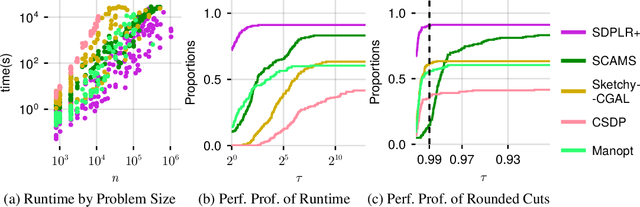
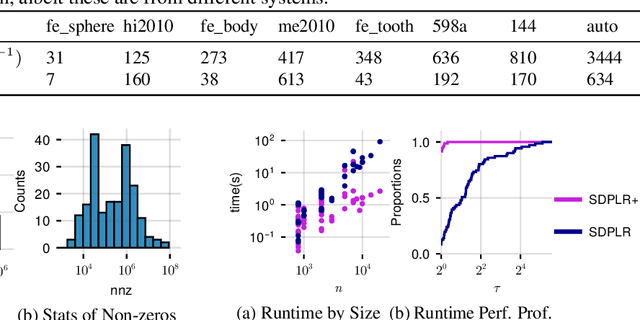
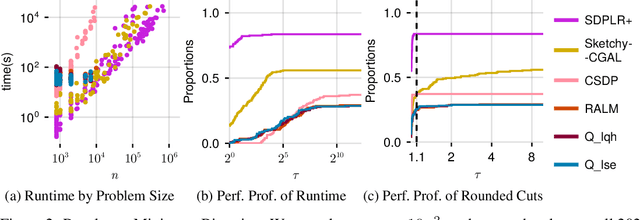
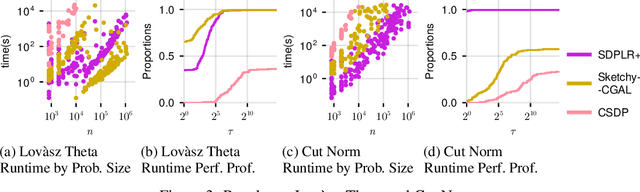
Semidefinite programs (SDPs) and their solvers are powerful tools with many applications in machine learning and data science. Designing scalable SDP solvers is challenging because by standard the positive semidefinite decision variable is an $n \times n$ dense matrix, even though the input is often an $n \times n$ sparse matrix. However, the information in the solution may not correspond to a full-rank dense matrix as shown by Bavinok and Pataki. Two decades ago, Burer and Monterio developed an SDP solver $\texttt{SDPLR}$ that optimizes over a low-rank factorization instead of the full matrix. This greatly decreases the storage cost and works well for many problems. The original solver $\texttt{SDPLR}$ tracks only the primal infeasibility of the solution, limiting the technique's flexibility to produce moderate accuracy solutions. We use a suboptimality bound for trace-bounded SDP problems that enables us to track the progress better and perform early termination. We then develop $\texttt{SDPLR+}$, which starts the optimization with an extremely low-rank factorization and dynamically updates the rank based on the primal infeasibility and suboptimality. This further speeds up the computation and saves the storage cost. Numerical experiments on Max Cut, Minimum Bisection, Cut Norm, and Lov\'{a}sz Theta problems with many recent memory-efficient scalable SDP solvers demonstrate its scalability up to problems with million-by-million decision variables and it is often the fastest solver to a moderate accuracy of $10^{-2}$.
Is Next Token Prediction Sufficient for GPT? Exploration on Code Logic Comprehension
Apr 13, 2024


Large language models (LLMs) has experienced exponential growth, they demonstrate remarkable performance across various tasks. Notwithstanding, contemporary research primarily centers on enhancing the size and quality of pretraining data, still utilizing the next token prediction task on autoregressive transformer model structure. The efficacy of this task in truly facilitating the model's comprehension of code logic remains questionable, we speculate that it still interprets code as mere text, while human emphasizes the underlying logical knowledge. In order to prove it, we introduce a new task, "Logically Equivalent Code Selection," which necessitates the selection of logically equivalent code from a candidate set, given a query code. Our experimental findings indicate that current LLMs underperform in this task, since they understand code by unordered bag of keywords. To ameliorate their performance, we propose an advanced pretraining task, "Next Token Prediction+". This task aims to modify the sentence embedding distribution of the LLM without sacrificing its generative capabilities. Our experimental results reveal that following this pretraining, both Code Llama and StarCoder, the prevalent code domain pretraining models, display significant improvements on our logically equivalent code selection task and the code completion task.