 Add to Chrome
 Add to Firefox
 Add to Edge
NeuronMoE: Neuron-Guided Mixture-of-Experts for Efficient Multilingual LLM Extension
Mar 05, 2026
Extending large language models to low-resource languages is essential for global accessibility, but training separate models per language is prohibitively expensive. Mixture-of-Experts (MoE) architectures address this by adding sparse language-specific parameters, but determining how many experts each layer needs remains an open question. Current approaches allocate experts based on layer-level similarity, yet language processing exhibits fine-grained specialization at individual neurons. We propose $\textbf{NeuronMoE}$, a method that analyzes language-specific neurons across all transformer components to guide expert allocation per layer based on empirically measured cross-lingual neuron diversity. Applied to Llama-3.2-3B for low-resource languages (Greek, Turkish, and Hungarian), this approach achieves approximately 40% average parameter reduction while matching the performance of the LayerMoE baseline. We find that low-resource language experts independently develop neuron specialization patterns mirroring the high-resource language, which are concentrated in early and late layers. This reveals potential universal architectural principles in how multilingual models organize linguistic knowledge.

RepoLaunch: Automating Build&Test Pipeline of Code Repositories on ANY Language and ANY Platform
Mar 05, 2026Building software repositories typically requires significant manual effort. Recent advances in large language model (LLM) agents have accelerated automation in software engineering (SWE). We introduce RepoLaunch, the first agent capable of automatically resolving dependencies, compiling source code, and extracting test results for repositories across arbitrary programming languages and operating systems. To demonstrate its utility, we further propose a fully automated pipeline for SWE dataset creation, where task design is the only human intervention. RepoLaunch automates the remaining steps, enabling scalable benchmarking and training of coding agents and LLMs. Notably, several works on agentic benchmarking and training have recently adopted RepoLaunch for automated task generation.
Taming the Chaos: Coordinated Autoscaling for Heterogeneous and Disaggregated LLM Inference
Aug 27, 2025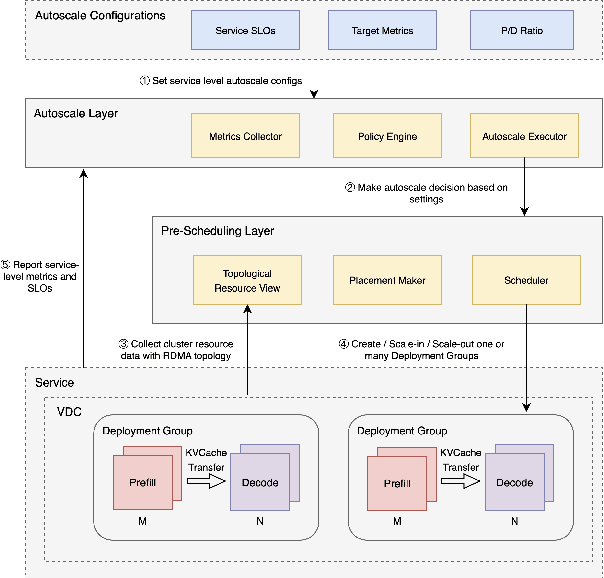

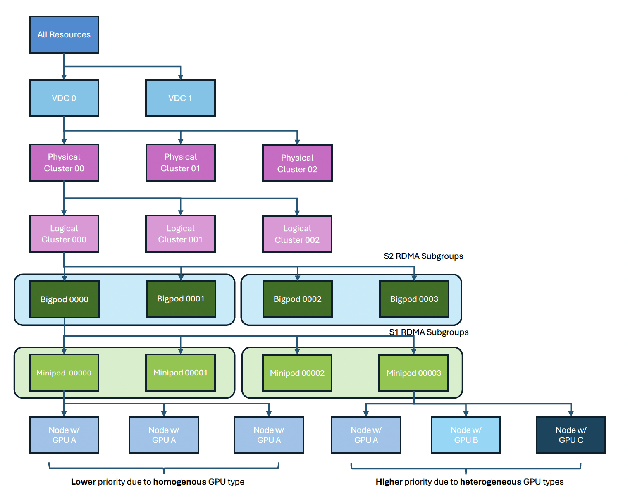
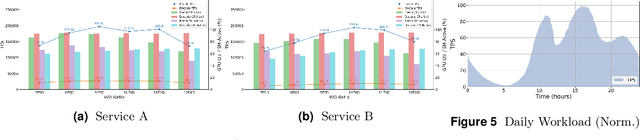
Serving Large Language Models (LLMs) is a GPU-intensive task where traditional autoscalers fall short, particularly for modern Prefill-Decode (P/D) disaggregated architectures. This architectural shift, while powerful, introduces significant operational challenges, including inefficient use of heterogeneous hardware, network bottlenecks, and critical imbalances between prefill and decode stages. We introduce HeteroScale, a coordinated autoscaling framework that addresses the core challenges of P/D disaggregated serving. HeteroScale combines a topology-aware scheduler that adapts to heterogeneous hardware and network constraints with a novel metric-driven policy derived from the first large-scale empirical study of autoscaling signals in production. By leveraging a single, robust metric to jointly scale prefill and decode pools, HeteroScale maintains architectural balance while ensuring efficient, adaptive resource management. Deployed in a massive production environment on tens of thousands of GPUs, HeteroScale has proven its effectiveness, increasing average GPU utilization by a significant 26.6 percentage points and saving hundreds of thousands of GPU-hours daily, all while upholding stringent service level objectives.
Exploring Intra and Inter-language Consistency in Embeddings with ICA
Jun 18, 2024Word embeddings represent words as multidimensional real vectors, facilitating data analysis and processing, but are often challenging to interpret. Independent Component Analysis (ICA) creates clearer semantic axes by identifying independent key features. Previous research has shown ICA's potential to reveal universal semantic axes across languages. However, it lacked verification of the consistency of independent components within and across languages. We investigated the consistency of semantic axes in two ways: both within a single language and across multiple languages. We first probed into intra-language consistency, focusing on the reproducibility of axes by performing ICA multiple times and clustering the outcomes. Then, we statistically examined inter-language consistency by verifying those axes' correspondences using statistical tests. We newly applied statistical methods to establish a robust framework that ensures the reliability and universality of semantic axes.