 Add to Chrome
 Add to Firefox
 Add to Edge
Staypoint Detection from Noisy Trajectory Data [Experiment Paper]
Jul 21, 2026
Detecting staypoints from raw trajectory data is fundamental to numerous spatial computing applications. This process transforms raw numeric sequences of geolocations into semantically meaningful locations, such as homes, workplaces, or restaurants. Despite its importance for semantic trajectory analysis, staypoint detection lacks standard benchmarks, and existing algorithms have never been systematically evaluated. This gap persists because no publicly available datasets provide both raw individual trajectories and ground-truth staypoint annotations. This benchmark paper addresses this limitation with two key contributions: (1) we introduce 16 large-scale simulated datasets capturing thousands of agents with annotated staypoints across varying trajectory noise levels, and (2) we evaluate nine staypoint detection algorithms-including both state-of-the-art and novel methods-to analyze their robustness to noise. Our evaluation reveals that existing state-of-the-art algorithms perform poorly under realistic noise conditions. Conversely, our proposed unsupervised methods yield substantial improvements, while supervised approaches drastically outperform existing baselines. While these results are very promising, these datasets and methods are only meant as starting points for future research in staypoint detection.

Neural Collaborative Filtering to Detect Anomalies in Human Semantic Trajectories
Sep 27, 2024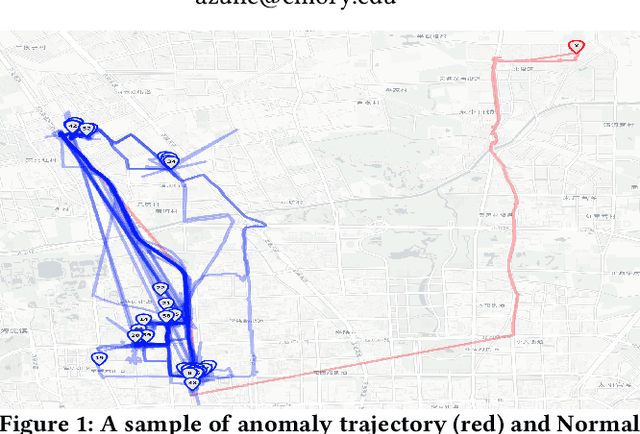
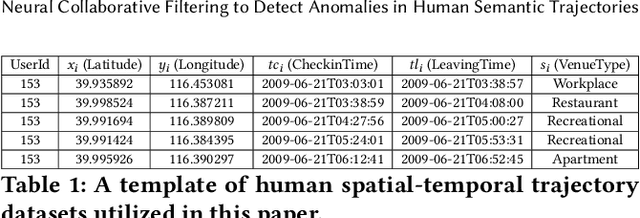
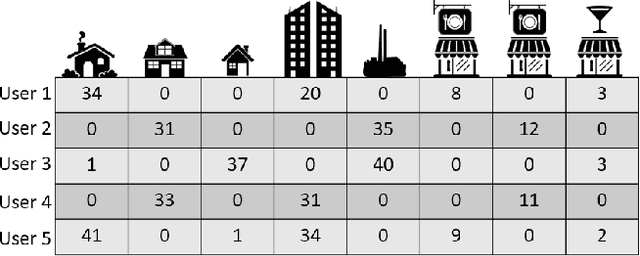
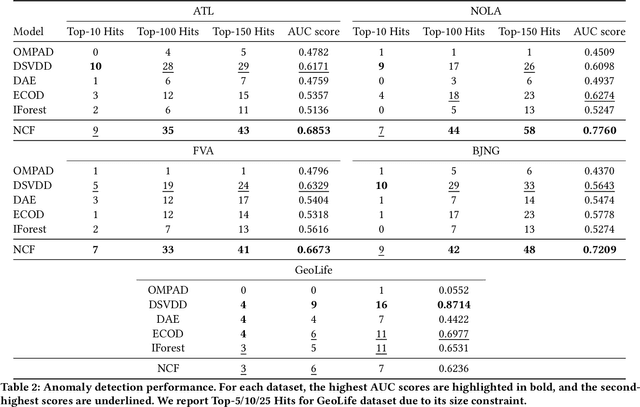
Human trajectory anomaly detection has become increasingly important across a wide range of applications, including security surveillance and public health. However, existing trajectory anomaly detection methods are primarily focused on vehicle-level traffic, while human-level trajectory anomaly detection remains under-explored. Since human trajectory data is often very sparse, machine learning methods have become the preferred approach for identifying complex patterns. However, concerns regarding potential biases and the robustness of these models have intensified the demand for more transparent and explainable alternatives. In response to these challenges, our research focuses on developing a lightweight anomaly detection model specifically designed to detect anomalies in human trajectories. We propose a Neural Collaborative Filtering approach to model and predict normal mobility. Our method is designed to model users' daily patterns of life without requiring prior knowledge, thereby enhancing performance in scenarios where data is sparse or incomplete, such as in cold start situations. Our algorithm consists of two main modules. The first is the collaborative filtering module, which applies collaborative filtering to model normal mobility of individual humans to places of interest. The second is the neural module, responsible for interpreting the complex spatio-temporal relationships inherent in human trajectory data. To validate our approach, we conducted extensive experiments using simulated and real-world datasets comparing to numerous state-of-the-art trajectory anomaly detection approaches.
Kinematic Detection of Anomalies in Human Trajectory Data
Sep 27, 2024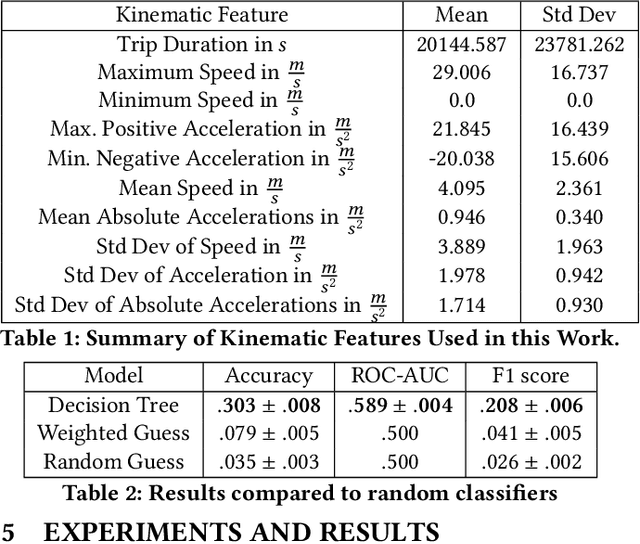
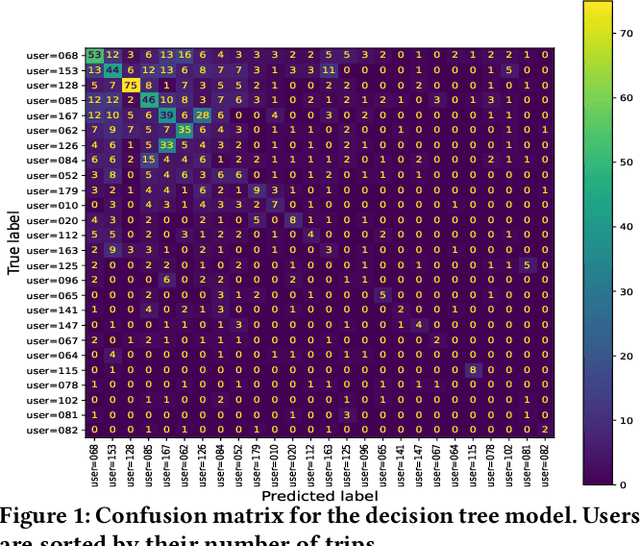
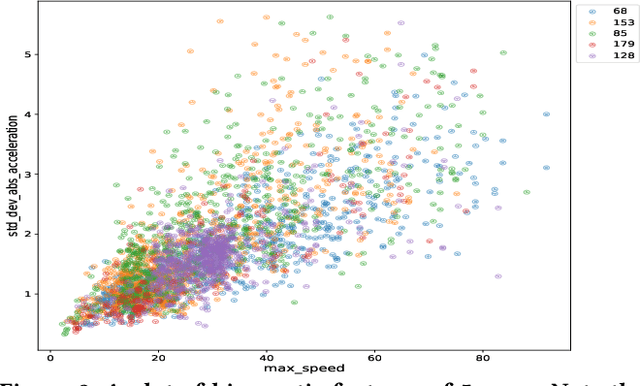
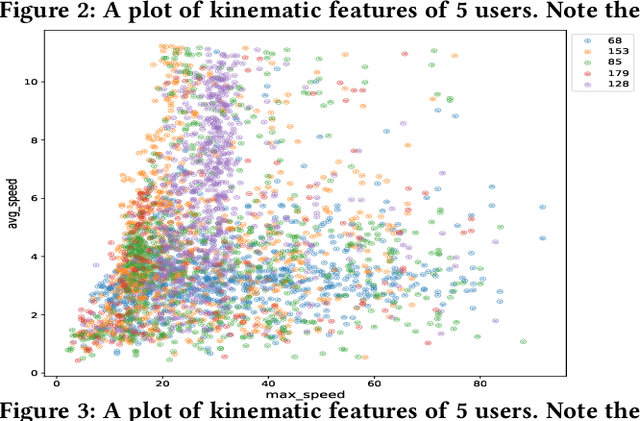
Historically, much of the research in understanding, modeling, and mining human trajectory data has focused on where an individual stays. Thus, the focus of existing research has been on where a user goes. On the other hand, the study of how a user moves between locations has great potential for new research opportunities. Kinematic features describe how an individual moves between locations and can be used for tasks such as identification of individuals or anomaly detection. Unfortunately, data availability and quality challenges make kinematic trajectory mining difficult. In this paper, we leverage the Geolife dataset of human trajectories to investigate the viability of using kinematic features to identify individuals and detect anomalies. We show that humans have an individual "kinematic profile" which can be used as a strong signal to identify individual humans. We experimentally show that, for the two use-cases of individual identification and anomaly detection, simple kinematic features fed to standard classification and anomaly detection algorithms significantly improve results.