 Add to Chrome
 Add to Firefox
 Add to Edge
Recent Advances on Machine Learning for Computational Fluid Dynamics: A Survey
Aug 22, 2024
This paper explores the recent advancements in enhancing Computational Fluid Dynamics (CFD) tasks through Machine Learning (ML) techniques. We begin by introducing fundamental concepts, traditional methods, and benchmark datasets, then examine the various roles ML plays in improving CFD. The literature systematically reviews papers in recent five years and introduces a novel classification for forward modeling: Data-driven Surrogates, Physics-Informed Surrogates, and ML-assisted Numerical Solutions. Furthermore, we also review the latest ML methods in inverse design and control, offering a novel classification and providing an in-depth discussion. Then we highlight real-world applications of ML for CFD in critical scientific and engineering disciplines, including aerodynamics, combustion, atmosphere & ocean science, biology fluid, plasma, symbolic regression, and reduced order modeling. Besides, we identify key challenges and advocate for future research directions to address these challenges, such as multi-scale representation, physical knowledge encoding, scientific foundation model and automatic scientific discovery. This review serves as a guide for the rapidly expanding ML for CFD community, aiming to inspire insights for future advancements. We draw the conclusion that ML is poised to significantly transform CFD research by enhancing simulation accuracy, reducing computational time, and enabling more complex analyses of fluid dynamics. The paper resources can be viewed at https://github.com/WillDreamer/Awesome-AI4CFD.

MambaCapsule: Towards Transparent Cardiac Disease Diagnosis with Electrocardiography Using Mamba Capsule Network
Jul 30, 2024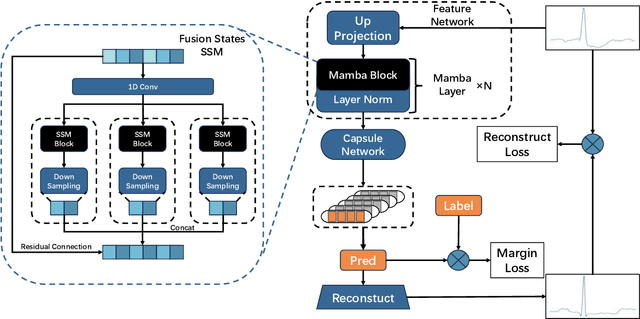


Cardiac arrhythmia, a condition characterized by irregular heartbeats, often serves as an early indication of various heart ailments. With the advent of deep learning, numerous innovative models have been introduced for diagnosing arrhythmias using Electrocardiogram (ECG) signals. However, recent studies solely focus on the performance of models, neglecting the interpretation of their results. This leads to a considerable lack of transparency, posing a significant risk in the actual diagnostic process. To solve this problem, this paper introduces MambaCapsule, a deep neural networks for ECG arrhythmias classification, which increases the explainability of the model while enhancing the accuracy.Our model utilizes Mamba for feature extraction and Capsule networks for prediction, providing not only a confidence score but also signal features. Akin to the processing mechanism of human brain, the model learns signal features and their relationship between them by reconstructing ECG signals in the predicted selection. The model evaluation was conducted on MIT-BIH and PTB dataset, following the AAMI standard. MambaCapsule has achieved a total accuracy of 99.54% and 99.59% on the test sets respectively. These results demonstrate the promising performance of under the standard test protocol.
Gene Regulatory Network Inference from Pre-trained Single-Cell Transcriptomics Transformer with Joint Graph Learning
Jul 25, 2024Inferring gene regulatory networks (GRNs) from single-cell RNA sequencing (scRNA-seq) data is a complex challenge that requires capturing the intricate relationships between genes and their regulatory interactions. In this study, we tackle this challenge by leveraging the single-cell BERT-based pre-trained transformer model (scBERT), trained on extensive unlabeled scRNA-seq data, to augment structured biological knowledge from existing GRNs. We introduce a novel joint graph learning approach that combines the rich contextual representations learned by pre-trained single-cell language models with the structured knowledge encoded in GRNs using graph neural networks (GNNs). By integrating these two modalities, our approach effectively reasons over boththe gene expression level constraints provided by the scRNA-seq data and the structured biological knowledge inherent in GRNs. We evaluate our method on human cell benchmark datasets from the BEELINE study with cell type-specific ground truth networks. The results demonstrate superior performance over current state-of-the-art baselines, offering a deeper understanding of cellular regulatory mechanisms.
Scale Disparity of Instances in Interactive Point Cloud Segmentation
Jul 19, 2024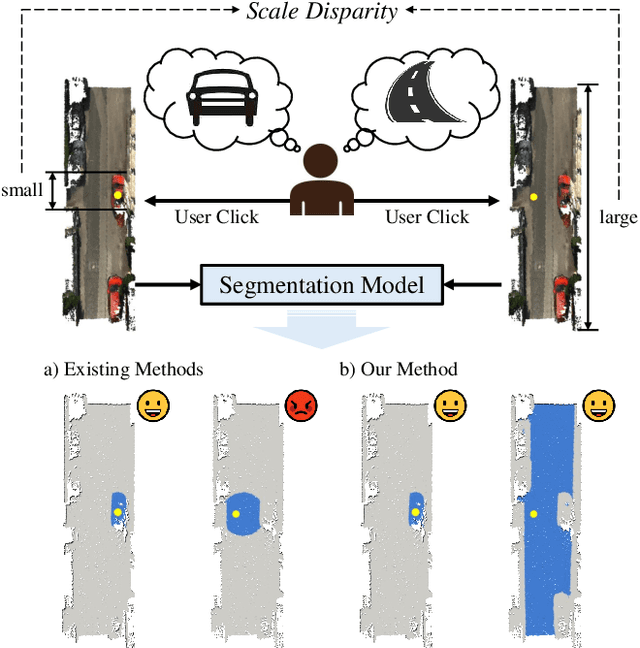

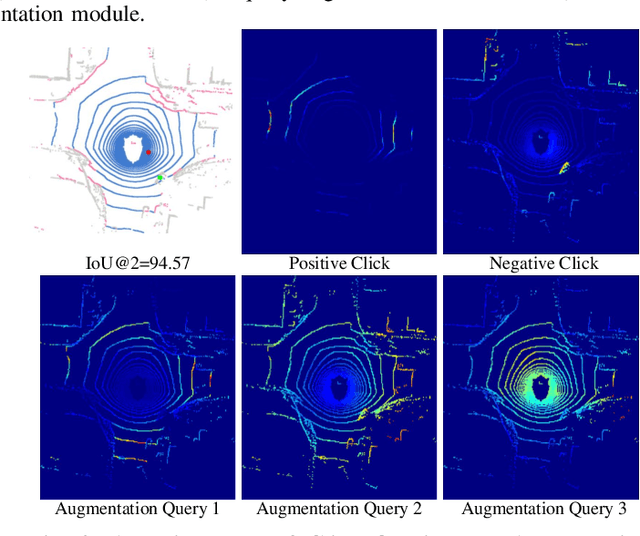
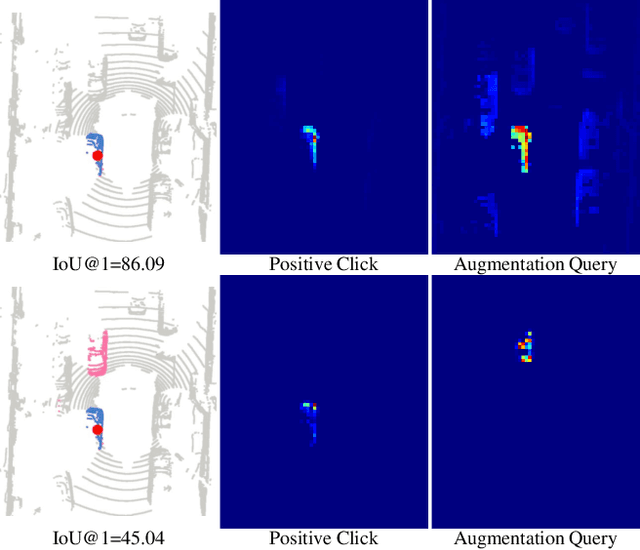
Interactive point cloud segmentation has become a pivotal task for understanding 3D scenes, enabling users to guide segmentation models with simple interactions such as clicks, therefore significantly reducing the effort required to tailor models to diverse scenarios and new categories. However, in the realm of interactive segmentation, the meaning of instance diverges from that in instance segmentation, because users might desire to segment instances of both thing and stuff categories that vary greatly in scale. Existing methods have focused on thing categories, neglecting the segmentation of stuff categories and the difficulties arising from scale disparity. To bridge this gap, we propose ClickFormer, an innovative interactive point cloud segmentation model that accurately segments instances of both thing and stuff categories. We propose a query augmentation module to augment click queries by a global query sampling strategy, thus maintaining consistent performance across different instance scales. Additionally, we employ global attention in the query-voxel transformer to mitigate the risk of generating false positives, along with several other network structure improvements to further enhance the model's segmentation performance. Experiments demonstrate that ClickFormer outperforms existing interactive point cloud segmentation methods across both indoor and outdoor datasets, providing more accurate segmentation results with fewer user clicks in an open-world setting.
Let Occ Flow: Self-Supervised 3D Occupancy Flow Prediction
Jul 10, 2024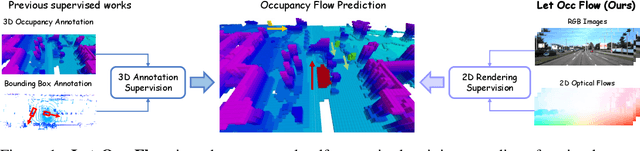
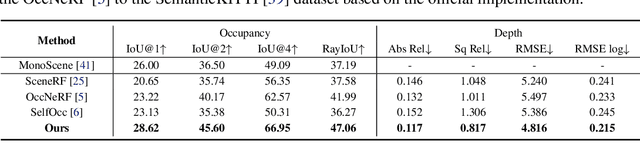
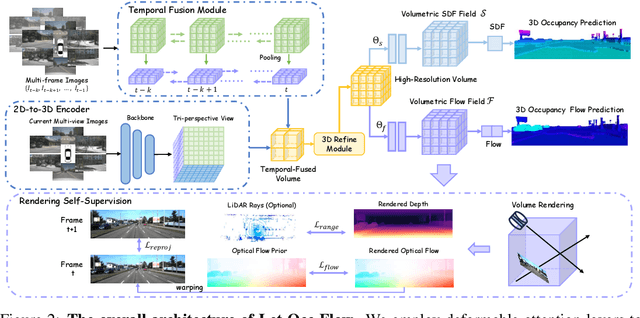

Accurate perception of the dynamic environment is a fundamental task for autonomous driving and robot systems. This paper introduces Let Occ Flow, the first self-supervised work for joint 3D occupancy and occupancy flow prediction using only camera inputs, eliminating the need for 3D annotations. Utilizing TPV for unified scene representation and deformable attention layers for feature aggregation, our approach incorporates a backward-forward temporal attention module to capture dynamic object dependencies, followed by a 3D refine module for fine-gained volumetric representation. Besides, our method extends differentiable rendering to 3D volumetric flow fields, leveraging zero-shot 2D segmentation and optical flow cues for dynamic decomposition and motion optimization. Extensive experiments on nuScenes and KITTI datasets demonstrate the competitive performance of our approach over prior state-of-the-art methods.
Pretraining-finetuning Framework for Efficient Co-design: A Case Study on Quadruped Robot Parkour
Jul 09, 2024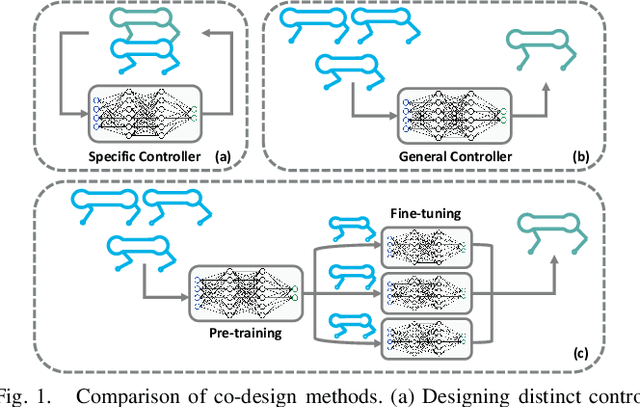
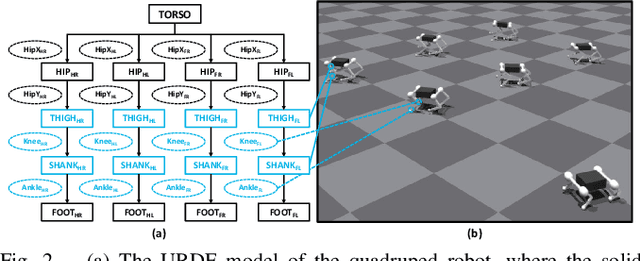
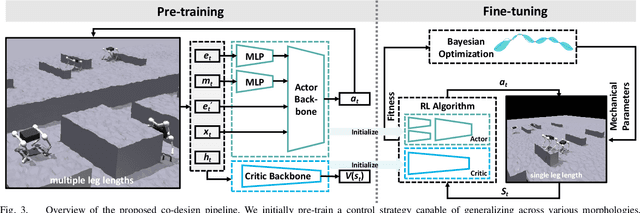
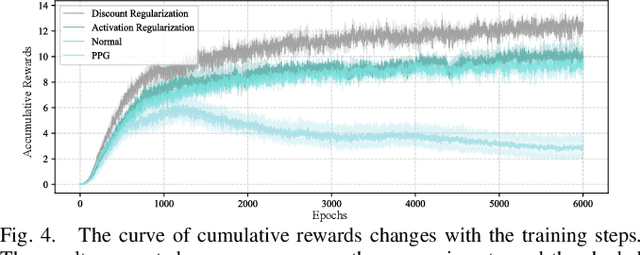
In nature, animals with exceptional locomotion abilities, such as cougars, often possess asymmetric fore and hind legs, with their powerful hind legs acting as reservoirs of energy for leaps. This observation inspired us: could optimize the leg length of quadruped robots endow them with similar locomotive capabilities? In this paper, we propose an approach that co-optimizes the mechanical structure and control policy to boost the locomotive prowess of quadruped robots. Specifically, we introduce a novel pretraining-finetuning framework, which not only guarantees optimal control strategies for each mechanical candidate but also ensures time efficiency. Additionally, we have devised an innovative training method for our pretraining network, integrating spatial domain randomization with regularization methods, markedly improving the network's generalizability. Our experimental results indicate that the proposed pretraining-finetuning framework significantly enhances the overall co-design performance with less time consumption. Moreover, the co-design strategy substantially exceeds the conventional method of independently optimizing control strategies, further improving the robot's locomotive performance and providing an innovative approach to enhancing the extreme parkour capabilities of quadruped robots.
A Generative Approach to Control Complex Physical Systems
Jul 09, 2024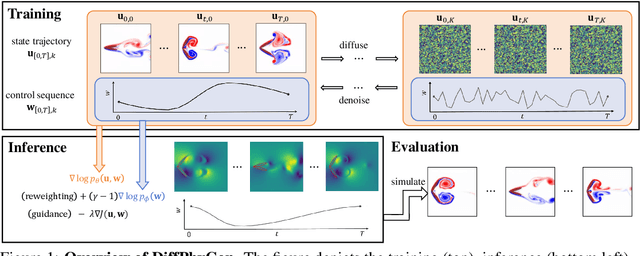
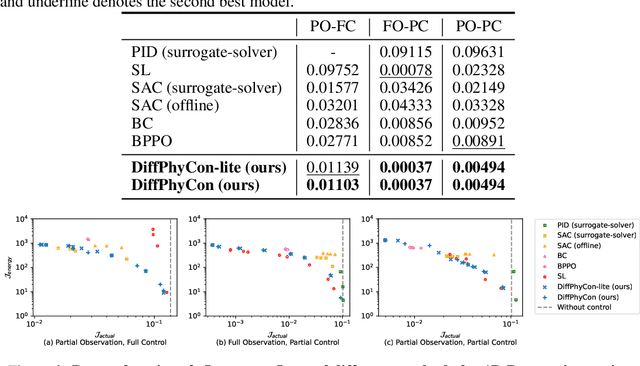
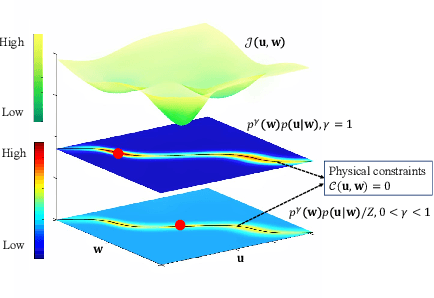

Controlling the evolution of complex physical systems is a fundamental task across science and engineering. Classical techniques suffer from limited applicability or huge computational costs. On the other hand, recent deep learning and reinforcement learning-based approaches often struggle to optimize long-term control sequences under the constraints of system dynamics. In this work, we introduce Diffusion Physical systems Control (DiffPhyCon), a new class of method to address the physical systems control problem. DiffPhyCon excels by simultaneously minimizing both the learned generative energy function and the predefined control objectives across the entire trajectory and control sequence. Thus, it can explore globally and identify near-optimal control sequences. Moreover, we enhance DiffPhyCon with prior reweighting, enabling the discovery of control sequences that significantly deviate from the training distribution. We test our method in 1D Burgers' equation and 2D jellyfish movement control in a fluid environment. Our method outperforms widely applied classical approaches and state-of-the-art deep learning and reinforcement learning methods. Notably, DiffPhyCon unveils an intriguing fast-close-slow-open pattern observed in the jellyfish, aligning with established findings in the field of fluid dynamics.
RAM: Retrieval-Based Affordance Transfer for Generalizable Zero-Shot Robotic Manipulation
Jul 05, 2024

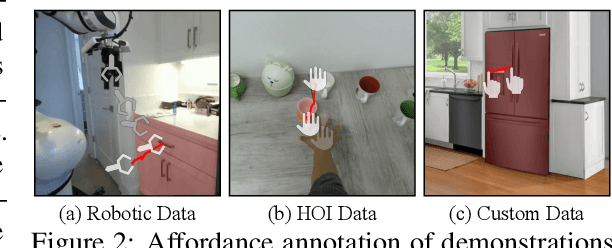

This work proposes a retrieve-and-transfer framework for zero-shot robotic manipulation, dubbed RAM, featuring generalizability across various objects, environments, and embodiments. Unlike existing approaches that learn manipulation from expensive in-domain demonstrations, RAM capitalizes on a retrieval-based affordance transfer paradigm to acquire versatile manipulation capabilities from abundant out-of-domain data. First, RAM extracts unified affordance at scale from diverse sources of demonstrations including robotic data, human-object interaction (HOI) data, and custom data to construct a comprehensive affordance memory. Then given a language instruction, RAM hierarchically retrieves the most similar demonstration from the affordance memory and transfers such out-of-domain 2D affordance to in-domain 3D executable affordance in a zero-shot and embodiment-agnostic manner. Extensive simulation and real-world evaluations demonstrate that our RAM consistently outperforms existing works in diverse daily tasks. Additionally, RAM shows significant potential for downstream applications such as automatic and efficient data collection, one-shot visual imitation, and LLM/VLM-integrated long-horizon manipulation. For more details, please check our website at https://yxkryptonite.github.io/RAM/.
Tokenize the World into Object-level Knowledge to Address Long-tail Events in Autonomous Driving
Jul 01, 2024The autonomous driving industry is increasingly adopting end-to-end learning from sensory inputs to minimize human biases in system design. Traditional end-to-end driving models, however, suffer from long-tail events due to rare or unseen inputs within their training distributions. To address this, we propose TOKEN, a novel Multi-Modal Large Language Model (MM-LLM) that tokenizes the world into object-level knowledge, enabling better utilization of LLM's reasoning capabilities to enhance autonomous vehicle planning in long-tail scenarios. TOKEN effectively alleviates data scarcity and inefficient tokenization by leveraging a traditional end-to-end driving model to produce condensed and semantically enriched representations of the scene, which are optimized for LLM planning compatibility through deliberate representation and reasoning alignment training stages. Our results demonstrate that TOKEN excels in grounding, reasoning, and planning capabilities, outperforming existing frameworks with a 27% reduction in trajectory L2 error and a 39% decrease in collision rates in long-tail scenarios. Additionally, our work highlights the importance of representation alignment and structured reasoning in sparking the common-sense reasoning capabilities of MM-LLMs for effective planning.
PanopticRecon: Leverage Open-vocabulary Instance Segmentation for Zero-shot Panoptic Reconstruction
Jul 01, 2024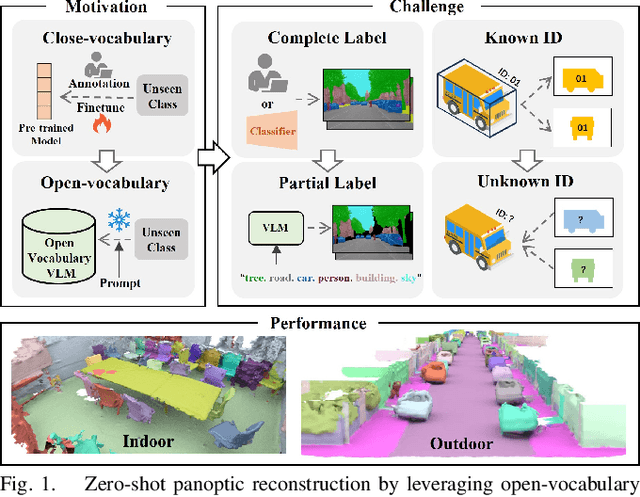
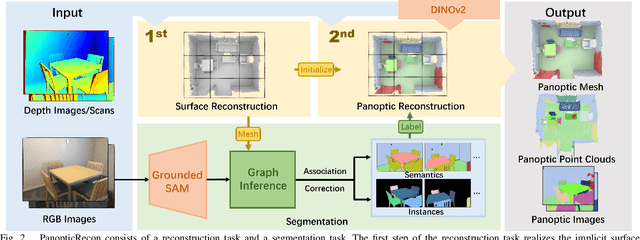
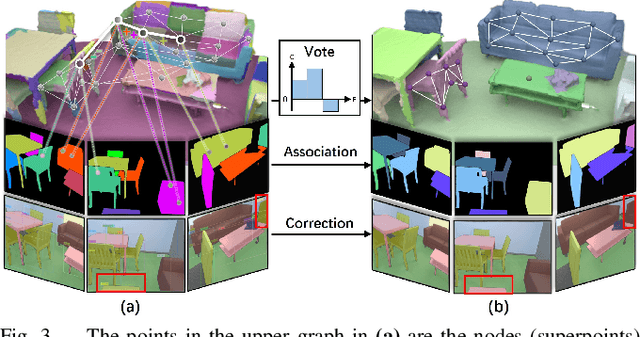
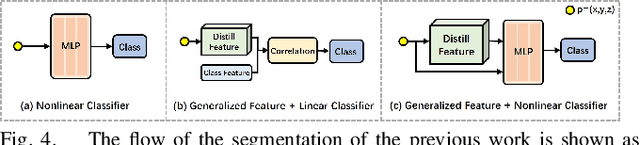
Panoptic reconstruction is a challenging task in 3D scene understanding. However, most existing methods heavily rely on pre-trained semantic segmentation models and known 3D object bounding boxes for 3D panoptic segmentation, which is not available for in-the-wild scenes. In this paper, we propose a novel zero-shot panoptic reconstruction method from RGB-D images of scenes. For zero-shot segmentation, we leverage open-vocabulary instance segmentation, but it has to face partial labeling and instance association challenges. We tackle both challenges by propagating partial labels with the aid of dense generalized features and building a 3D instance graph for associating 2D instance IDs. Specifically, we exploit partial labels to learn a classifier for generalized semantic features to provide complete labels for scenes with dense distilled features. Moreover, we formulate instance association as a 3D instance graph segmentation problem, allowing us to fully utilize the scene geometry prior and all 2D instance masks to infer global unique pseudo 3D instance ID. Our method outperforms state-of-the-art methods on the indoor dataset ScanNet V2 and the outdoor dataset KITTI-360, demonstrating the effectiveness of our graph segmentation method and reconstruction network.