 Add to Chrome
 Add to Firefox
 Add to Edge
Is It Time for the Renaissance of Salient Object Detection in the Era of MLLMs?
Jul 31, 2026
The zero-shot capabilities of multimodal large language models (MLLMs) are pushing salient object detection (SOD) beyond task-specific supervision. To disentangle MLLMs beyond conventional mask-based evaluation, we decompose SOD into localization and segmentation, and re-engineer datasets with phrases, boxes, and attributes, establishing a diagnostic benchmark for MLLM saliency perception (SaliLLM). SaliLLM uncovers a striking capability mismatch: MLLMs outperform state-of-the-art (SOTA) methods in localization, yet remain substantially weaker in segmentation. Further analyses attribute this gap primarily to mismatches between MLLMs and annotations over foreground cardinality, granularity, and extent. Motivated by this diagnosis, we recast zero-shot SOD as protocol-aligned Foreground Organization and introduce the first training-free framework that leverages Gestalt-inspired Collaborative attention for Unified SOD (FOCUS). FOCUS couples top-down Bayesian-surprise calibration of protocol-conditioned foreground granularity with bottom-up propagation of MLLMs evidence over entity-centric perceptual manifolds induced by self-supervised features, yielding coherent object extents as prompts for a general segmenter. Across 13 RGB, RGB-D, and RGB-T SOD benchmarks, FOCUS generally surpasses SOTA methods without training, reducing mean absolute error by 11\%, 34\%, and 48\% compared with fully, weakly, and self-supervised methods, respectively. Our findings signal the renaissance of SOD: from task-specific supervision to zero-shot foreground organization. Code is available in the supplementary material.

Thinking Once Is Enough: Intermediate-Layer Evidence Routing for High-Resolution VQA
Jul 30, 2026High-resolution visual question answering (HR-VQA) is often treated as a problem of insufficient evidence acquisition, where failing multimodal large language models must inspect images again through cropping, re-encoding, or multi-round search. We show that this view is incomplete: in many cases, fine-grained evidence has already survived visual encoding and become identifiable and influential within an intermediate-layer routing window, but is later diluted before answer generation. We propose Thinking-Once, a \textbf{training-free, single-visual-pass} evidence-routing method that reconstructs question-conditioned attention at this window, preserves core entity tokens and compact background context, and routes this evidence to later layers without extra visual encoding. Across five base models, Thinking-Once consistently improves or matches the corresponding base setting, increasing the average scores on V$^*$Bench, HRBench-4K, and HRBench-8K by \textit{+3.1}, \textit{+3.0}, and \textit{+2.7} points while reducing the average peak memory by about 4,GB. On Qwen2.5-VL-7B, it improves the three benchmarks by \textit{+9.9}, \textit{+4.6}, and \textit{+5.5} points, raising the cross-benchmark mean from 72.5 to 79.1. With the ZwZ-8B base model, Thinking-Once reaches a mean score of 82.7. Against 11 open-source HR-VQA baselines, it obtains the best or tied-best score on all three benchmark averages and the best overall mean; for example, compared with DeepScan, it reduces V$^*$Bench inference time by \textbf{97.2\%} while improving the cross-benchmark mean from 77.8 to 79.1. These results show that HR-VQA can be improved by routing already encoded evidence rather than repeatedly acquiring new visual inputs. Code is available in the appendix.
StructureClaw: Traceable LLM Agents and an Executable Benchmark for Structural Engineering Workflows
Jul 16, 2026Addressing a structural-engineering request requires more than a single answer; it requires a chain of interdependent artifacts: interpreted requirements, a computable model, validation records, solver outputs, code-check records, and a final report. Evaluations centered on question answering or script generation rarely verify this complete evidence chain and may therefore reward fluent outputs even when the underlying engineering workflow is incomplete, internally inconsistent, or non-executable. To address this limitation, we present StructureClaw, an artifact-centered workbench in which LLM agents operate through governed engineering skills, typed tools, shared artifact state, and local analysis backends. We also introduce StructureClaw-Bench, an executable benchmark of 150 controlled scenarios spanning standard workflow execution, interactive robustness, and multimodal structural-model reconstruction. A scenario succeeds only when all required artifact- and execution-level assertions pass in a single run. Across ten agent-model configurations, each evaluated on the same 50 standard cases, the average Success Rate rises from 56.8% with the generic-skill baseline to 88.6% with the full automatic workflow. The interactive and multimodal evaluations identify two prominent remaining challenges: safe handling of invalid numerical inputs and fixture-consistent reconstruction of structural models. These findings show that artifact-centered evaluation can expose workflow-level failures that are difficult to identify from final responses alone, providing a more rigorous basis for evaluating and improving structural-engineering agents. The code and benchmark are available at https://github.com/structureclaw/structureclaw.
Camouflage-aware Image-Text Retrieval via Expert Collaboration
Apr 01, 2026Camouflaged scene understanding (CSU) has attracted significant attention due to its broad practical implications. However, in this field, robust image-text cross-modal alignment remains under-explored, hindering deeper understanding of camouflaged scenarios and their related applications. To this end, we focus on the typical image-text retrieval task, and formulate a new task dubbed ``camouflage-aware image-text retrieval'' (CA-ITR). We first construct a dedicated camouflage image-text retrieval dataset (CamoIT), comprising $\sim$10.5K samples with multi-granularity textual annotations. Benchmark results conducted on CamoIT reveal the underlying challenges of CA-ITR for existing cutting-edge retrieval techniques, which are mainly caused by objects' camouflage properties as well as those complex image contents. As a solution, we propose a camouflage-expert collaborative network (CECNet), which features a dual-branch visual encoder: one branch captures holistic image representations, while the other incorporates a dedicated model to inject representations of camouflaged objects. A novel confidence-conditioned graph attention (C\textsuperscript{2}GA) mechanism is incorporated to exploit the complementarity across branches. Comparative experiments show that CECNet achieves $\sim$29% overall CA-ITR accuracy boost, surpassing seven representative retrieval models. The dataset and code will be available at https://github.com/jiangyao-scu/CA-ITR.
Enhancing Adaptivity of Two-Fingered Object Reorientation Using Tactile-based Online Optimization of Deconstructed Actions
Mar 14, 2025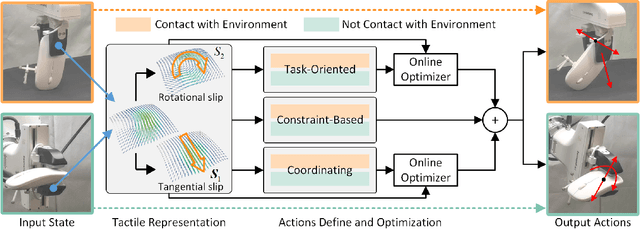
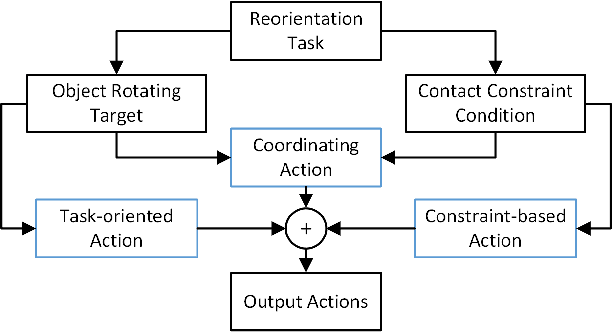
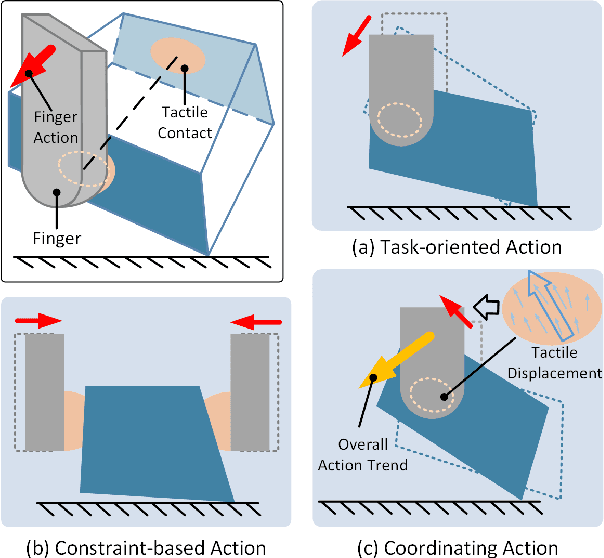
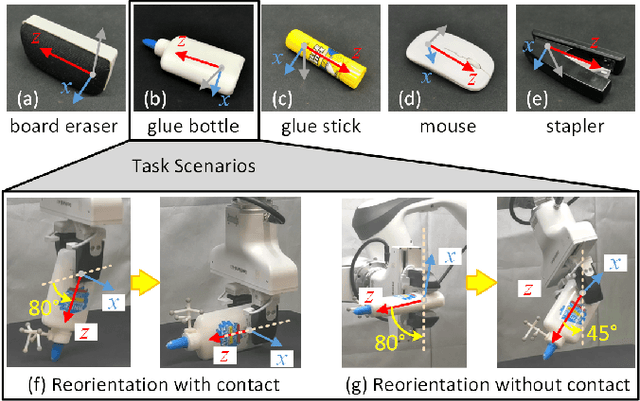
Object reorientation is a critical task for robotic grippers, especially when manipulating objects within constrained environments. The task poses significant challenges for motion planning due to the high-dimensional output actions with the complex input information, including unknown object properties and nonlinear contact forces. Traditional approaches simplify the problem by reducing degrees of freedom, limiting contact forms, or acquiring environment/object information in advance, which significantly compromises adaptability. To address these challenges, we deconstruct the complex output actions into three fundamental types based on tactile sensing: task-oriented actions, constraint-oriented actions, and coordinating actions. These actions are then optimized online using gradient optimization to enhance adaptability. Key contributions include simplifying contact state perception, decomposing complex gripper actions, and enabling online action optimization for handling unknown objects or environmental constraints. Experimental results demonstrate that the proposed method is effective across a range of everyday objects, regardless of environmental contact. Additionally, the method exhibits robust performance even in the presence of unknown contacts and nonlinear external disturbances.
Enhancing Regrasping Efficiency Using Prior Grasping Perceptions with Soft Fingertips
Mar 14, 2025
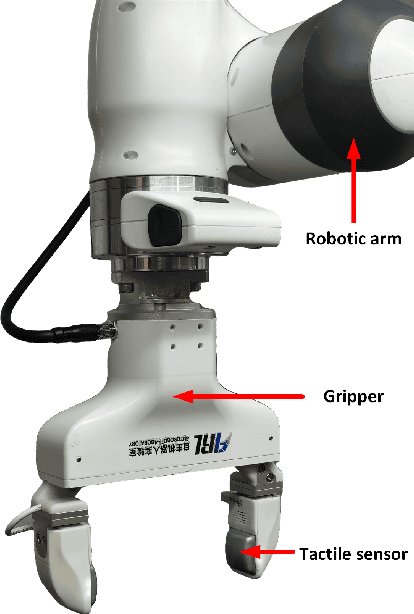

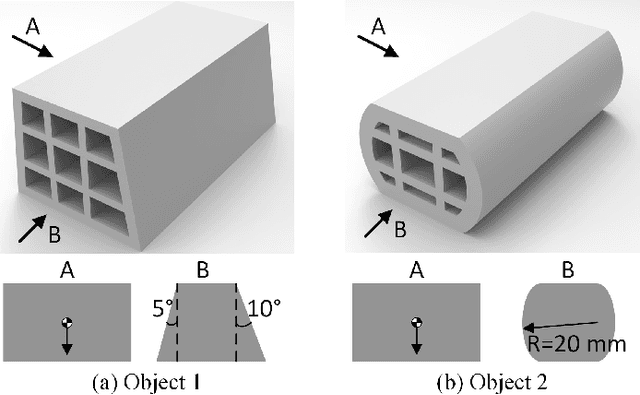
Grasping the same object in different postures is often necessary, especially when handling tools or stacked items. Due to unknown object properties and changes in grasping posture, the required grasping force is uncertain and variable. Traditional methods rely on real-time feedback to control the grasping force cautiously, aiming to prevent slipping or damage. However, they overlook reusable information from the initial grasp, treating subsequent regrasping attempts as if they were the first, which significantly reduces efficiency. To improve this, we propose a method that utilizes perception from prior grasping attempts to predict the required grasping force, even with changes in position. We also introduce a calculation method that accounts for fingertip softness and object asymmetry. Theoretical analyses demonstrate the feasibility of predicting grasping forces across various postures after a single grasp. Experimental verifications attest to the accuracy and adaptability of our prediction method. Furthermore, results show that incorporating the predicted grasping force into feedback-based approaches significantly enhances grasping efficiency across a range of everyday objects.
Modeling, Simulation, and Application of Spatio-Temporal Characteristics Detection in Incipient Slip
Feb 24, 2025Incipient slip detection provides critical feedback for robotic grasping and manipulation tasks. However, maintaining its adaptability under diverse object properties and complex working conditions remains challenging. This article highlights the importance of completely representing spatio-temporal features of slip, and proposes a novel approach for incipient slip modeling and detection. Based on the analysis of localized displacement phenomenon, we establish the relationship between the characteristic strain rate extreme events and the local slip state. This approach enables the detection of both the spatial distribution and temporal dynamics of stick-slip regions. Also, the proposed method can be applied to strain distribution sensing devices, such as vision-based tactile sensors. Simulations and prototype experiments validated the effectiveness of this approach under varying contact conditions, including different contact geometries, friction coefficients, and combined loads. Experiments demonstrated that this method not only accurately and reliably delineates incipient slip, but also facilitates friction parameter estimation and adaptive grasping control.
An Adaptive Grasping Force Tracking Strategy for Nonlinear and Time-Varying Object Behaviors
Dec 03, 2024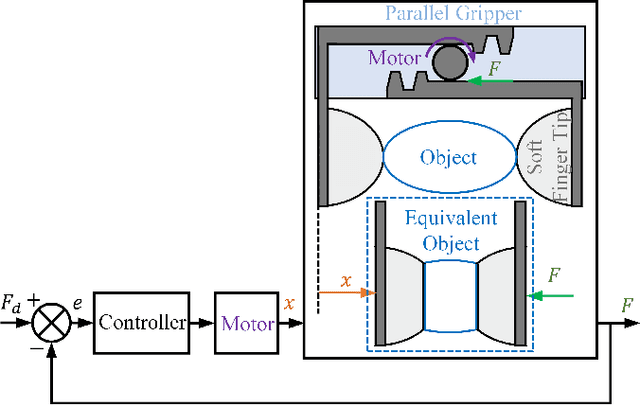
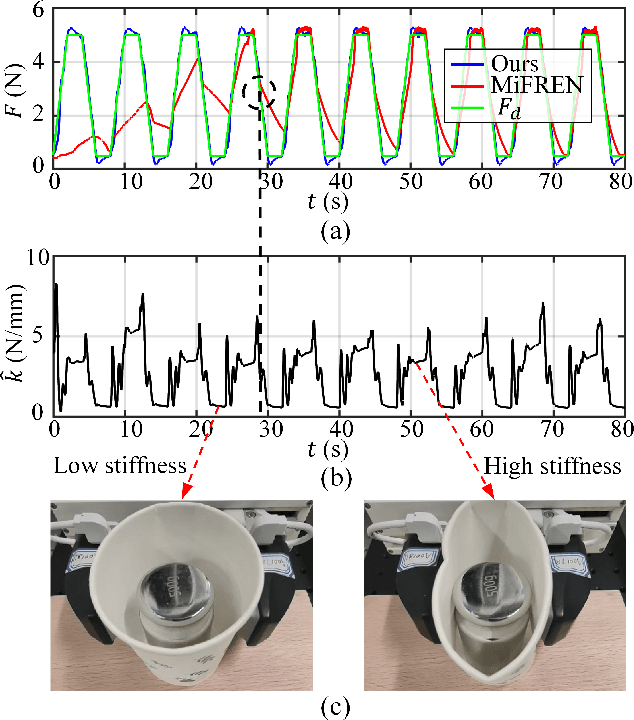
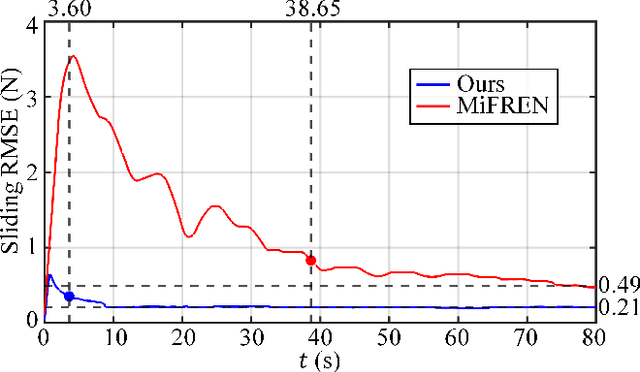
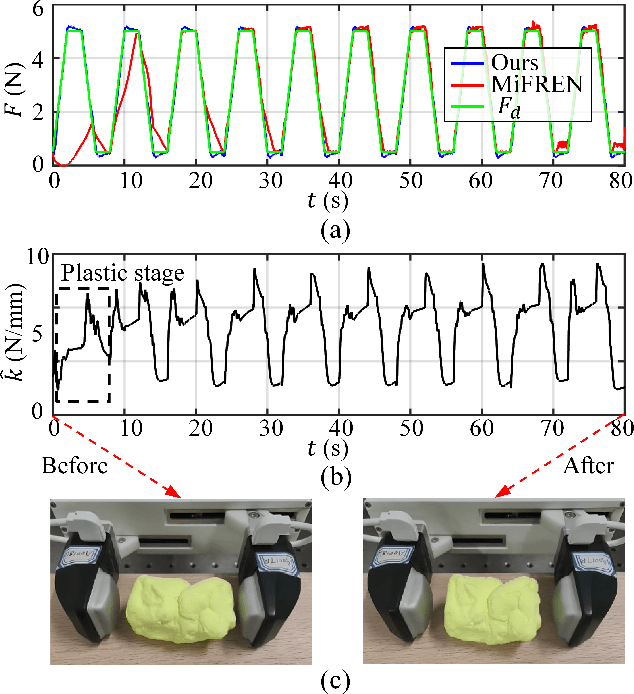
Accurate grasp force control is one of the key skills for ensuring successful and damage-free robotic grasping of objects. Although existing methods have conducted in-depth research on slip detection and grasping force planning, they often overlook the issue of adaptive tracking of the actual force to the target force when handling objects with different material properties. The optimal parameters of a force tracking controller are significantly influenced by the object's stiffness, and many adaptive force tracking algorithms rely on stiffness estimation. However, real-world objects often exhibit viscous, plastic, or other more complex nonlinear time-varying behaviors, and existing studies provide insufficient support for these materials in terms of stiffness definition and estimation. To address this, this paper introduces the concept of generalized stiffness, extending the definition of stiffness to nonlinear time-varying grasp system models, and proposes an online generalized stiffness estimator based on Long Short-Term Memory (LSTM) networks. Based on generalized stiffness, this paper proposes an adaptive parameter adjustment strategy using a PI controller as an example, enabling dynamic force tracking for objects with varying characteristics. Experimental results demonstrate that the proposed method achieves high precision and short probing time, while showing better adaptability to non-ideal objects compared to existing methods. The method effectively solves the problem of grasp force tracking in unknown, nonlinear, and time-varying grasp systems, enhancing the robotic grasping ability in unstructured environments.
Learning Gentle Grasping from Human-Free Force Control Demonstration
Sep 16, 2024Humans can steadily and gently grasp unfamiliar objects based on tactile perception. Robots still face challenges in achieving similar performance due to the difficulty of learning accurate grasp-force predictions and force control strategies that can be generalized from limited data. In this article, we propose an approach for learning grasping from ideal force control demonstrations, to achieve similar performance of human hands with limited data size. Our approach utilizes objects with known contact characteristics to automatically generate reference force curves without human demonstrations. In addition, we design the dual convolutional neural networks (Dual-CNN) architecture which incorporating a physics-based mechanics module for learning target grasping force predictions from demonstrations. The described method can be effectively applied in vision-based tactile sensors and enables gentle and stable grasping of objects from the ground. The described prediction model and grasping strategy were validated in offline evaluations and online experiments, and the accuracy and generalizability were demonstrated.
EasyCalib: Simple and Low-Cost In-Situ Calibration for Force Reconstruction with Vision-Based Tactile Sensors
Mar 15, 2024For elastomer-based tactile sensors, represented by visuotactile sensors, routine calibration of mechanical parameters (Young's modulus and Poisson's ratio) has been shown to be important for force reconstruction. However, the reliance on existing in-situ calibration methods for accurate force measurements limits their cost-effective and flexible applications. This article proposes a new in-situ calibration scheme that relies only on comparing contact deformation. Based on the detailed derivations of the normal contact and torsional contact theories, we designed a simple and low-cost calibration device, EasyCalib, and validated its effectiveness through extensive finite element analysis. We also explored the accuracy of EasyCalib in the practical application and demonstrated that accurate contact distributed force reconstruction can be realized based on the mechanical parameters obtained. EasyCalib balances low hardware cost, ease of operation, and low dependence on technical expertise and is expected to provide the necessary accuracy guarantees for wide applications of visuotactile sensors in the wild.