 Add to Chrome
 Add to Firefox
 Add to Edge
AdvTiles: Physical Adversarial Camouflage Clothing against Person Detectors via Learnable Tiles
Aug 07, 2026
Physical adversarial attacks against person detectors have evolved from localized patches to full-body textures. However, achieving both visual naturalness and strong attack effectiveness remains challenging. Existing natural-looking methods typically optimize camouflage textures as a whole, limiting the flexibility to refine local adversarial patterns and their spatial arrangement. To address this issue, we propose AdvTiles, a physical adversarial camouflage framework built from learnable tiles, enabling strong attack performance while preserving a natural camouflage appearance. Specifically, we use a Straight-through (ST) Gumbel-Softmax estimator for differentiable tile selection, enabling joint optimization of tile patterns and spatial layouts. This design provides fine-grained control over adversarial texture generation. To improve robustness in diverse physical conditions, we further optimize the camouflage through differentiable 3D Gaussian Splatting rendering with variations in viewpoints, scales, illuminations and backgrounds. Extensive experiments across multiple detectors demonstrate that AdvTiles achieves an average ASR of 86.2%, outperforming existing state-of-the-art attack methods. We further fabricate the optimized camouflage into wearable adversarial clothing, validating its effectiveness in real-world scenarios across diverse distances, angles and backgrounds.

Detectors Learn the Wrong Thing: Shortcut-Resistant Adversarial Training Against Physically Realizable Attacks
Jul 23, 2026AI-enabled visual perception systems are increasingly deployed in intelligent transportation infrastructure and autonomous vehicle related applications. However, physically realizable adversarial appearances pose a significant reliability challenge for these safety-critical systems. Adversarial training is effective, but repeated co-occurrence between adversarial texture and positive person instances can cause detectors to treat the texture itself as evidence of object presence, forming a patch texture shortcut. The detector may then treat texture as evidence for the target, causing false detections on texture-only inputs and weakening cross attack generalisation. We propose InsCAT, an instance-level contrastive adversarial training framework that prevents detectors from using adversarial texture as an independent decision cue. SICA aligns adversarial person features with matched clean features and separates them from texture-only negatives, while ROPO and Guard maintain online attack pressure and coordinate training. We evaluate eight independently generated attack textures on rendered nuScenes, INRIAPerson, printed garments, and three detector families. InsCAT achieves an average attack AP of 82.3% on rendered nuScenes, exceeding the strongest baseline by 11.1 points.Relative to AT-Mix, texture FPR decreases from 46.9% to 7.3%. Physical tests yield an F1 score of 96.6% and an FPR of 1.8%. Consistent gains across separately trained detectors demonstrate applicability across architectures with direct inference. The findings show that robust physical detection depends on preserving target related evidence while preventing adversarial texture from becoming an independent decision cu
AdvSerial: Physical Adversarial Attacks on Infrastructure-mounted Pedestrian Detectors via Semantic Feature Suppression
Jul 19, 2026AI-based visual perception systems are increasingly deployed in infrastructure surveillance, including roadside monitoring units, highway cameras, and smart-city pedestrian management systems. The security vulnerability of these systems to physical adversarial attacks poses a direct threat to the reliable operation of transportation infrastructure. We propose AdvSerial, a dynamic 2D--3D joint optimization framework for generating continuous high-angle physical adversarial patches against pedestrian detectors in infrastructure-based scenarios. We UV-map a boundary-aware quilted texture onto 3D garments, combine 2D digital attacks with 3D sparse- and continuous-frame rendering, and explicitly suppress person-specific semantic features while enforcing temporal continuity. A Feature Smooth Quilting strategy reduces visible patch boundaries and bounds cross-seam feature discontinuities. A serial-frame loss encourages long uninterrupted sequences of detection failures. In physical world experiments, AdvSerial achieves a 74.8% attack success rate on YOLO-v5 and degrades mean detection confidence from 84.30% to 39.38%. Experiments spanning eight detectors with different architectures demonstrate strong transferability. Notably, it achieves an $89.71%$ attack success rate on YOLO-v2 and resists both patch-detection defenses (NapGuard) and 3D-temporal perception (Sparse4D-v3). The results reveal persistent, temporally consistent failure modes under high-angle surveillance, and motivate the design of motion-aware and 3D-aware defenses for security-critical infrastructure deployments.
AdvReal: Adversarial Patch Generation Framework with Application to Adversarial Safety Evaluation of Object Detection Systems
May 22, 2025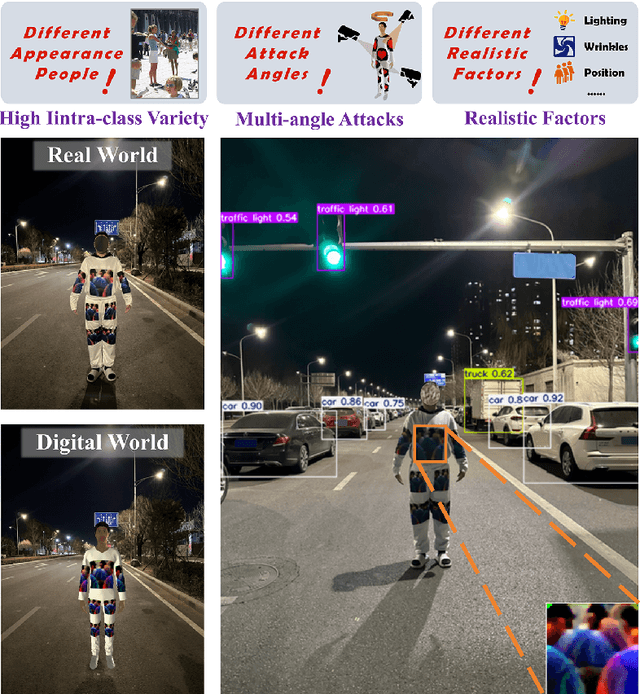
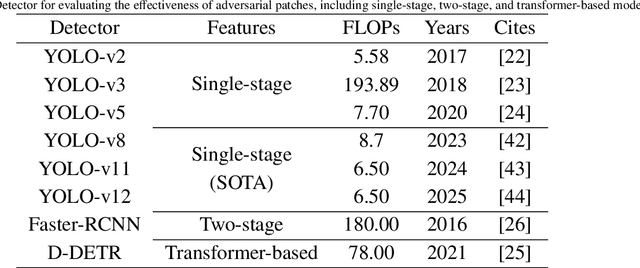
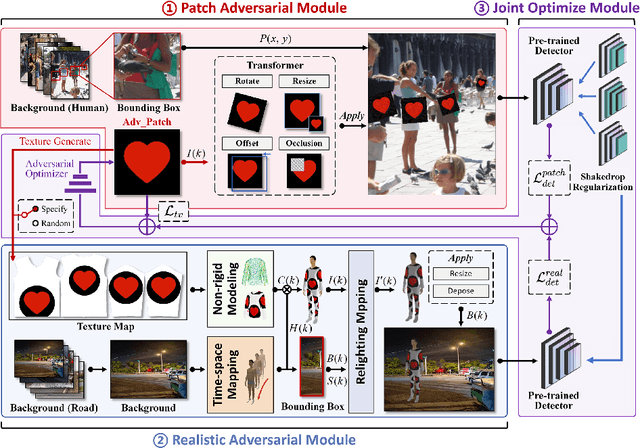
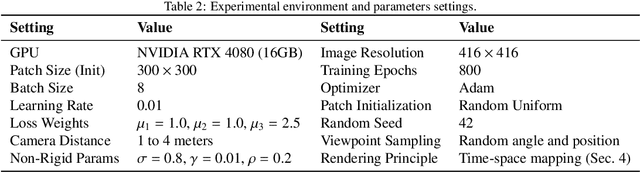
Autonomous vehicles are typical complex intelligent systems with artificial intelligence at their core. However, perception methods based on deep learning are extremely vulnerable to adversarial samples, resulting in safety accidents. How to generate effective adversarial examples in the physical world and evaluate object detection systems is a huge challenge. In this study, we propose a unified joint adversarial training framework for both 2D and 3D samples to address the challenges of intra-class diversity and environmental variations in real-world scenarios. Building upon this framework, we introduce an adversarial sample reality enhancement approach that incorporates non-rigid surface modeling and a realistic 3D matching mechanism. We compare with 5 advanced adversarial patches and evaluate their attack performance on 8 object detecotrs, including single-stage, two-stage, and transformer-based models. Extensive experiment results in digital and physical environments demonstrate that the adversarial textures generated by our method can effectively mislead the target detection model. Moreover, proposed method demonstrates excellent robustness and transferability under multi-angle attacks, varying lighting conditions, and different distance in the physical world. The demo video and code can be obtained at https://github.com/Huangyh98/AdvReal.git.
Biomedical Question Answering via Multi-Level Summarization on a Local Knowledge Graph
Apr 02, 2025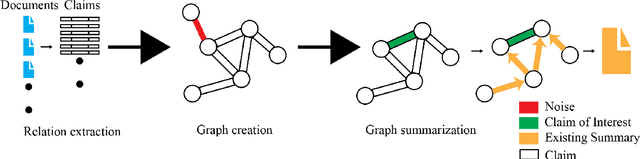
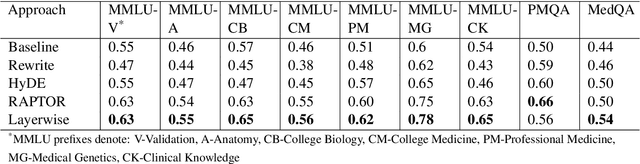

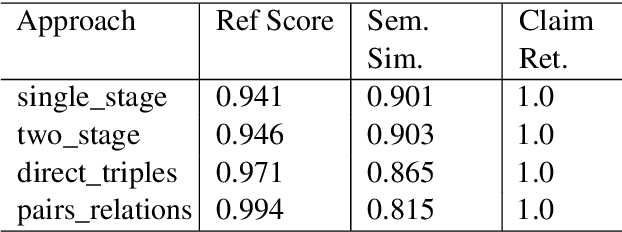
In Question Answering (QA), Retrieval Augmented Generation (RAG) has revolutionized performance in various domains. However, how to effectively capture multi-document relationships, particularly critical for biomedical tasks, remains an open question. In this work, we propose a novel method that utilizes propositional claims to construct a local knowledge graph from retrieved documents. Summaries are then derived via layerwise summarization from the knowledge graph to contextualize a small language model to perform QA. We achieved comparable or superior performance with our method over RAG baselines on several biomedical QA benchmarks. We also evaluated each individual step of our methodology over a targeted set of metrics, demonstrating its effectiveness.
AdvSwap: Covert Adversarial Perturbation with High Frequency Info-swapping for Autonomous Driving Perception
Feb 12, 2025Perception module of Autonomous vehicles (AVs) are increasingly susceptible to be attacked, which exploit vulnerabilities in neural networks through adversarial inputs, thereby compromising the AI safety. Some researches focus on creating covert adversarial samples, but existing global noise techniques are detectable and difficult to deceive the human visual system. This paper introduces a novel adversarial attack method, AdvSwap, which creatively utilizes wavelet-based high-frequency information swapping to generate covert adversarial samples and fool the camera. AdvSwap employs invertible neural network for selective high-frequency information swapping, preserving both forward propagation and data integrity. The scheme effectively removes the original label data and incorporates the guidance image data, producing concealed and robust adversarial samples. Experimental evaluations and comparisons on the GTSRB and nuScenes datasets demonstrate that AdvSwap can make concealed attacks on common traffic targets. The generates adversarial samples are also difficult to perceive by humans and algorithms. Meanwhile, the method has strong attacking robustness and attacking transferability.
Coupled Modeling and Fusion Control for a Multi-modal Deformable Land-air Robot
Nov 09, 2022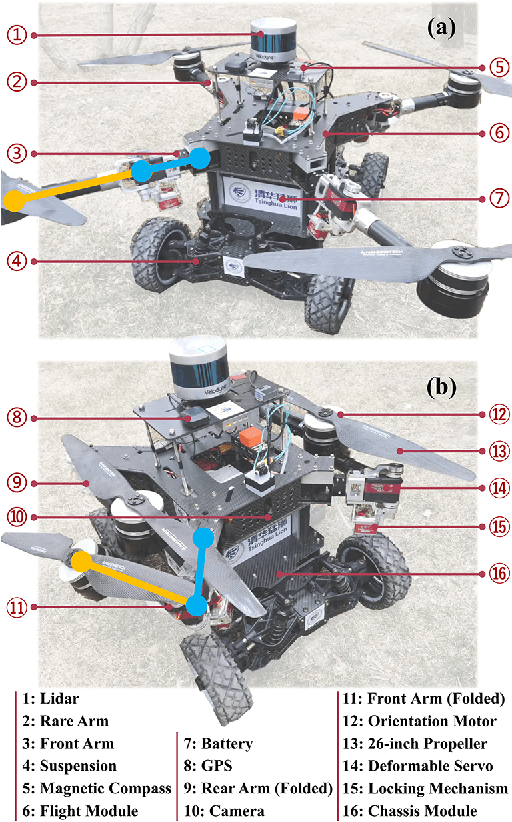
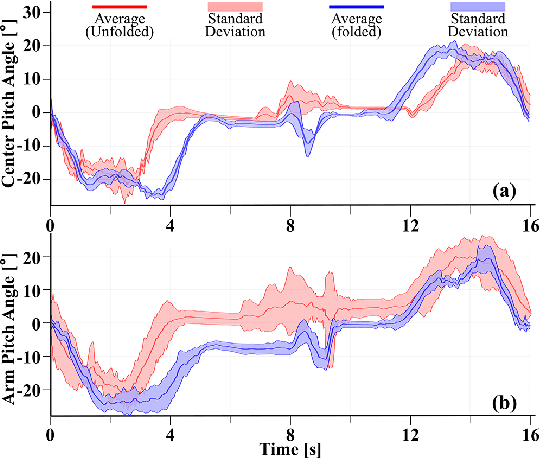
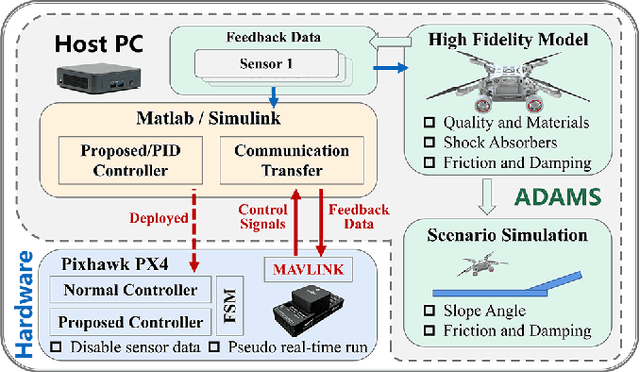
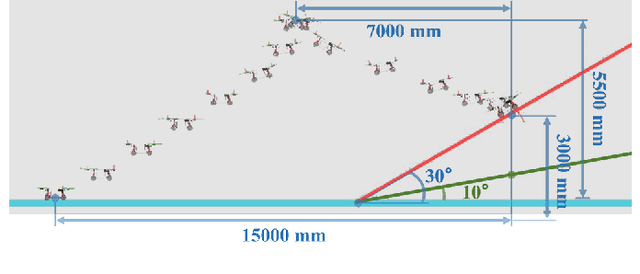
This paper introduces a structure-deformable land-air robot which possesses both excellent ground driving and flying ability, with smooth switching mechanism between two modes. The elaborate coupled dynamics model of the proposed robot is established, including rotors, chassis, especially the deformable structures. Furthermore, taking fusion locomotion and complex near-ground situations into consideration, a model based controller is designed for landing and mode switching under various harsh conditions, in which we realise the cooperation between fused two motion modes. The entire system is implemented in ADAMS/Simulink simulation and in practical. We conduct experiments under various complex scenarios. The results show our robot can accomplish land-air switching swiftly and smoothly, and the designed controller can effectively improve the landing flexibility and reliability.
A Multi-modal Deformable Land-air Robot for Complex Environments
Nov 01, 2022

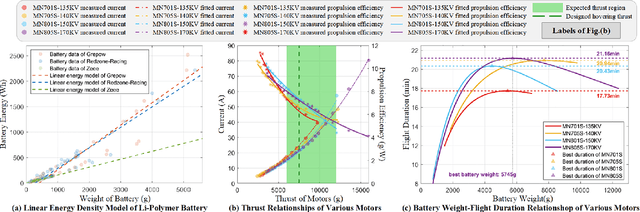
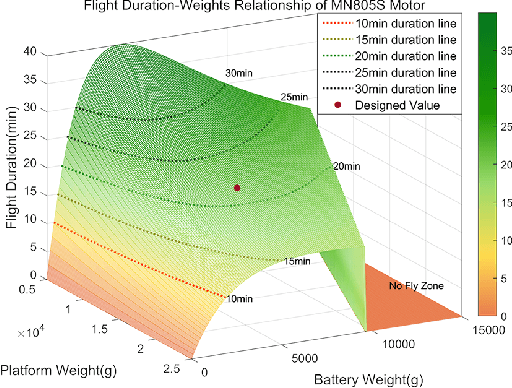
Single locomotion robots often struggle to adapt in highly variable or uncertain environments, especially in emergencies. In this paper, a multi-modal deformable robot is introduced that can both fly and drive. Compatibility issues with multi-modal locomotive fusion for this hybrid land-air robot are solved using proposed design conceptions, including power settings, energy selection, and designs of deformable structure. The robot can also automatically transform between land and air modes during 3D planning and tracking. Meanwhile, we proposed a algorithms for evaluation the performance of land-air robots. A series of comparisons and experiments were conducted to demonstrate the robustness and reliability of the proposed structure in complex field environments.
Intelligent Amphibious Ground-Aerial Vehicles: State of the Art Technology for Future Transportation
Jul 23, 2022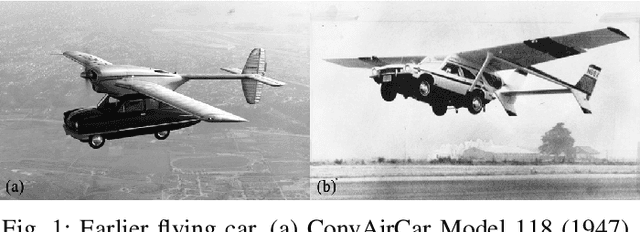
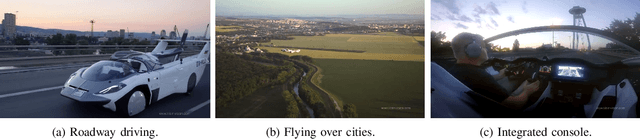
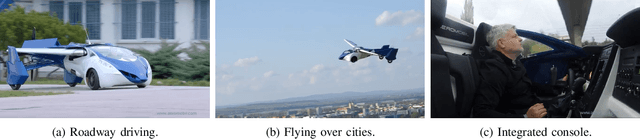
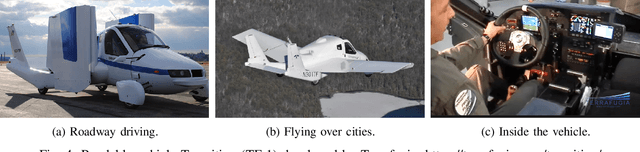
Amphibious ground-aerial vehicles fuse flying and driving modes to enable more flexible air-land mobility and have received growing attention recently. By analyzing the existing amphibious vehicles, we highlight the autonomous fly-driving functionality for the effective uses of amphibious vehicles in complex three-dimensional urban transportation systems. We review and summarize the key enabling technologies for intelligent flying-driving in existing amphibious vehicle designs, identify major technological barriers and propose potential solutions for future research and innovation. This paper aims to serve as a guide for research and development of intelligent amphibious vehicles for urban transportation toward the future.
Improved Context-Based Offline Meta-RL with Attention and Contrastive Learning
Feb 22, 2021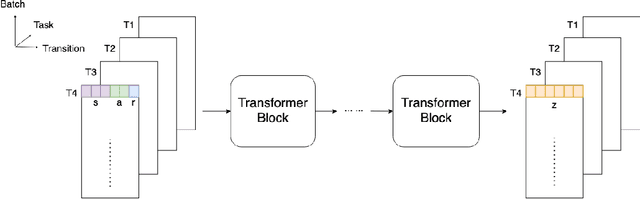
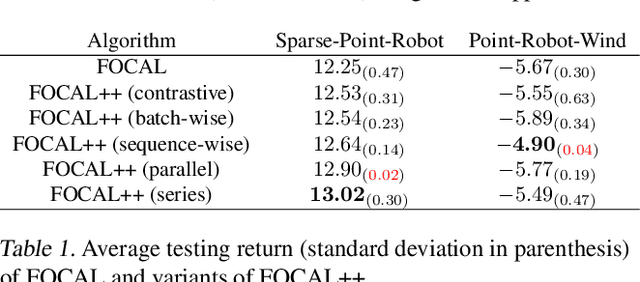
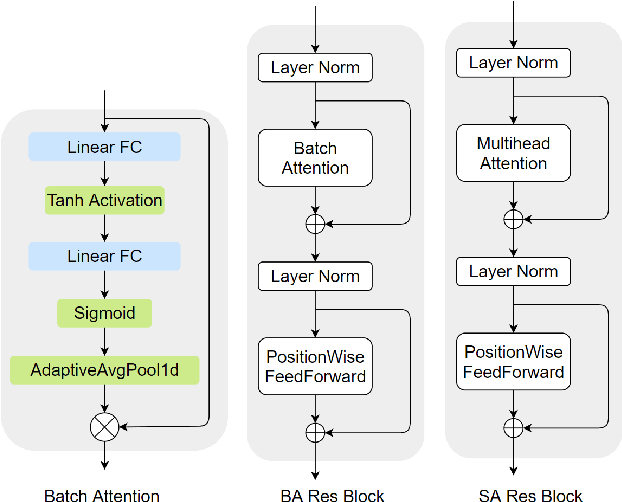
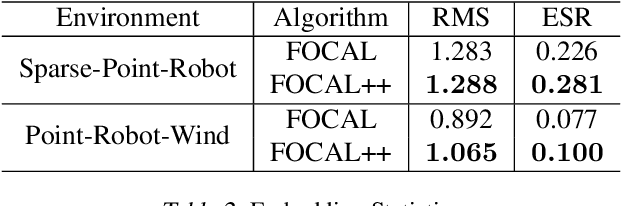
Meta-learning for offline reinforcement learning (OMRL) is an understudied problem with tremendous potential impact by enabling RL algorithms in many real-world applications. A popular solution to the problem is to infer task identity as augmented state using a context-based encoder, for which efficient learning of task representations remains an open challenge. In this work, we improve upon one of the SOTA OMRL algorithms, FOCAL, by incorporating intra-task attention mechanism and inter-task contrastive learning objectives for more effective task inference and learning of control. Theoretical analysis and experiments are presented to demonstrate the superior performance, efficiency and robustness of our end-to-end and model free method compared to prior algorithms across multiple meta-RL benchmarks.