 Add to Chrome
 Add to Firefox
 Add to Edge
Beyond Output Correctness: Benchmarking and Evaluating Large Language Model Reasoning in Coding Tasks
Apr 14, 2026
Large language models (LLMs) increasingly rely on explicit reasoning to solve coding tasks, yet evaluating the quality of this reasoning remains challenging. Existing reasoning evaluators are not designed for coding, and current benchmarks focus primarily on code generation, leaving other coding tasks largely unexplored. We introduce CodeRQ-Bench, the first benchmark for evaluating LLM reasoning quality across three coding task categories: generation, summarization, and classification. Using this benchmark, we analyze 1,069 mismatch cases from existing evaluators, identify five recurring limitations, and derive four design insights for reasoning evaluation in coding tasks. Guided by these insights, we propose VERA, a two-stage evaluator that combines evidence-grounded verification with ambiguity-aware score correction. Experiments on CodeRQ-Bench show that VERA consistently outperforms strong baselines across four datasets, improving AUCROC by up to 0.26 and AUPRC by up to 0.21. We release CodeRQ-Bench at https://github.com/MrLYG/CodeRQ-Bench, supporting future investigations.

A Deep Dive Into Large Language Model Code Generation Mistakes: What and Why?
Nov 03, 2024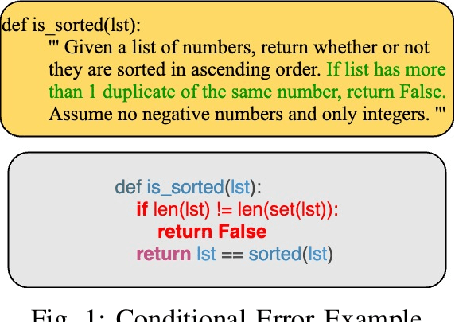
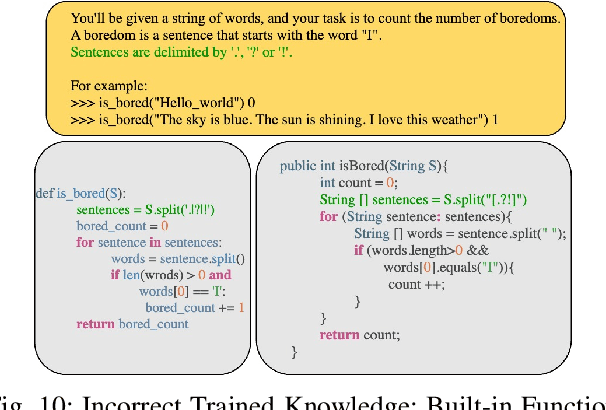
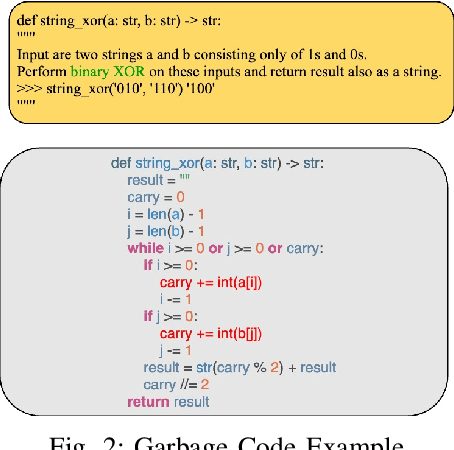
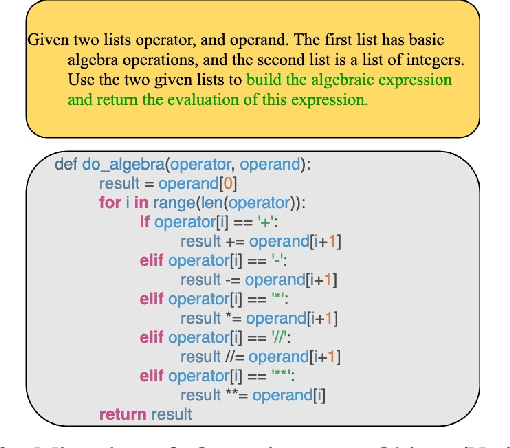
Recent advancements in Large Language Models (LLMs) have led to their widespread application in automated code generation. However, these models can still generate defective code that deviates from the specification. Previous research has mainly focused on the mistakes in LLM-generated standalone functions, overlooking real-world software development situations where the successful generation of the code requires software contexts such as external dependencies. In this paper, we considered both of these code generation situations and identified a range of \textit{non-syntactic mistakes} arising from LLMs' misunderstandings of coding question specifications. Seven categories of non-syntactic mistakes were identified through extensive manual analyses, four of which were missed by previous works. To better understand these mistakes, we proposed six reasons behind these mistakes from various perspectives. Moreover, we explored the effectiveness of LLMs in detecting mistakes and their reasons. Our evaluation demonstrated that GPT-4 with the ReAct prompting technique can achieve an F1 score of up to 0.65 when identifying reasons for LLM's mistakes, such as misleading function signatures. We believe that these findings offer valuable insights into enhancing the quality of LLM-generated code.
Enhanced Detection of Transdermal Alcohol Levels Using Hyperdimensional Computing on Embedded Devices
Mar 18, 2024Alcohol consumption has a significant impact on individuals' health, with even more pronounced consequences when consumption becomes excessive. One approach to promoting healthier drinking habits is implementing just-in-time interventions, where timely notifications indicating intoxication are sent during heavy drinking episodes. However, the complexity or invasiveness of an intervention mechanism may deter an individual from using them in practice. Previous research tackled this challenge using collected motion data and conventional Machine Learning (ML) algorithms to classify heavy drinking episodes, but with impractical accuracy and computational efficiency for mobile devices. Consequently, we have elected to use Hyperdimensional Computing (HDC) to design a just-in-time intervention approach that is practical for smartphones, smart wearables, and IoT deployment. HDC is a framework that has proven results in processing real-time sensor data efficiently. This approach offers several advantages, including low latency, minimal power consumption, and high parallelism. We explore various HDC encoding designs and combine them with various HDC learning models to create an optimal and feasible approach for mobile devices. Our findings indicate an accuracy rate of 89\%, which represents a substantial 12\% improvement over the current state-of-the-art.