 Add to Chrome
 Add to Firefox
 Add to Edge
Clusters are All You Need: Pre-Training the Tsetlin Machine with Semantic Clusters from Language Models for Interpretability
Jun 18, 2026
Pre-trained language models such as BERT achieve strong text classification performance but lack transparency, limiting their use in high-stakes settings. The Tsetlin Machine (TM) offers fully interpretable, clause-based reasoning but captures little semantic information, and prior attempts to bridge the two rely on static word embeddings that miss contextual meaning. We propose a semantic pre-training framework that transfers knowledge from a pre-trained language model into a TM without using embeddings. Text samples are grouped into semantically coherent clusters with K-means or Top2Vec, and the resulting cluster-sample pairs pre-train a non-negated TM with enhanced Type I feedback. The TM thereby learns interpretable semantic keywords that are fine-tuned on downstream tasks. Across five datasets, our method substantially outperforms vanilla and embedding-based TMs and reaches performance competitive with BERT while remaining interpretable.

LLM-Guided Semantic Bootstrapping for Interpretable Text Classification with Tsetlin Machines
Apr 14, 2026Pretrained language models (PLMs) like BERT provide strong semantic representations but are costly and opaque, while symbolic models such as the Tsetlin Machine (TM) offer transparency but lack semantic generalization. We propose a semantic bootstrapping framework that transfers LLM knowledge into symbolic form, combining interpretability with semantic capacity. Given a class label, an LLM generates sub-intents that guide synthetic data creation through a three-stage curriculum (seed, core, enriched), expanding semantic diversity. A Non-Negated TM (NTM) learns from these examples to extract high-confidence literals as interpretable semantic cues. Injecting these cues into real data enables a TM to align clause logic with LLM-inferred semantics. Our method requires no embeddings or runtime LLM calls, yet equips symbolic models with pretrained semantic priors. Across multiple text classification tasks, it improves interpretability and accuracy over vanilla TM, achieving performance comparable to BERT while remaining fully symbolic and efficient.
SemanticBridge - A Dataset for 3D Semantic Segmentation of Bridges and Domain Gap Analysis
Dec 18, 2025We propose a novel dataset that has been specifically designed for 3D semantic segmentation of bridges and the domain gap analysis caused by varying sensors. This addresses a critical need in the field of infrastructure inspection and maintenance, which is essential for modern society. The dataset comprises high-resolution 3D scans of a diverse range of bridge structures from various countries, with detailed semantic labels provided for each. Our initial objective is to facilitate accurate and automated segmentation of bridge components, thereby advancing the structural health monitoring practice. To evaluate the effectiveness of existing 3D deep learning models on this novel dataset, we conduct a comprehensive analysis of three distinct state-of-the-art architectures. Furthermore, we present data acquired through diverse sensors to quantify the domain gap resulting from sensor variations. Our findings indicate that all architectures demonstrate robust performance on the specified task. However, the domain gap can potentially lead to a decline in the performance of up to 11.4% mIoU.
Impact of color and mixing proportion of synthetic point clouds on semantic segmentation
Dec 26, 2024
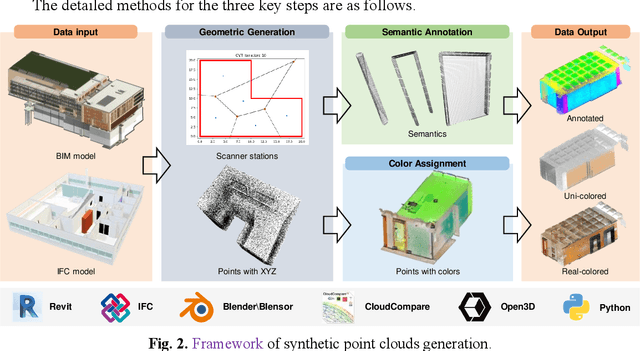
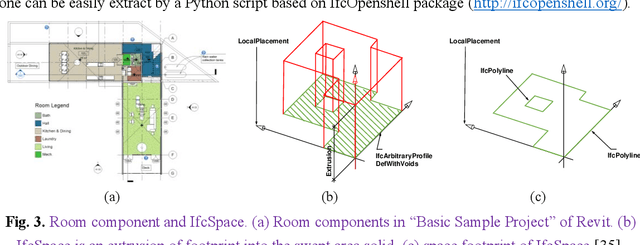
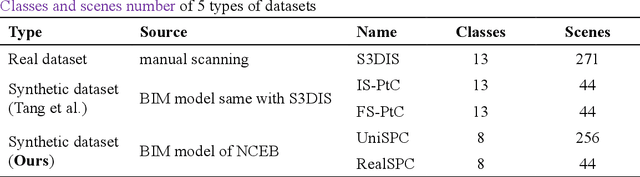
Semantic segmentation of point clouds is essential for understanding the built environment, and a large amount of high-quality data is required for training deep learning models. Despite synthetic point clouds (SPC) having the potential to compensate for the shortage of real data, how to exploit the benefits of SPC is still open. Therefore, this study systematically investigates how color and mixing proportion of SPC impact semantic segmentation for the first time. First, a new method to mimic the scanning process and generate SPC based on BIM is proposed, to create a synthetic dataset with consistent colors of BIM (UniSPC) and a synthetic dataset with real colors (RealSPC) respectively. Subsequently, by integrating with the S3DIS dataset, further experiments on PointNet, PointNet++, and DGCNN are conducted. Meanwhile, benchmark experiments and new evaluation metrics are introduced to better evaluate the performance of different models. Experiments show that synthetic color significantly impacts model performance, the performance for common components of the models trained with pure RealSPC is comparable to models with real data, and RealSPC contributes average improvements of 14.1% on overall accuracy and 7.3% on mIoU than UniSPC. Furthermore, the proportion of SPC also has a significant impact on the performance. In mixing training experiments, adding more than 70% SPC achieves an average of 3.9% on overall accuracy and 3.4% on mIoU better than benchmark on three models. It is also revealed that for large flat elements such as floors, ceilings, and walls, the SPC can even replace real point clouds without compromising model performance.