 Add to Chrome
 Add to Firefox
 Add to Edge
MTFusion: Reconstructing Any 3D Object from Single Image Using Multi-word Textual Inversion
Nov 19, 2024
Reconstructing 3D models from single-view images is a long-standing problem in computer vision. The latest advances for single-image 3D reconstruction extract a textual description from the input image and further utilize it to synthesize 3D models. However, existing methods focus on capturing a single key attribute of the image (e.g., object type, artistic style) and fail to consider the multi-perspective information required for accurate 3D reconstruction, such as object shape and material properties. Besides, the reliance on Neural Radiance Fields hinders their ability to reconstruct intricate surfaces and texture details. In this work, we propose MTFusion, which leverages both image data and textual descriptions for high-fidelity 3D reconstruction. Our approach consists of two stages. First, we adopt a novel multi-word textual inversion technique to extract a detailed text description capturing the image's characteristics. Then, we use this description and the image to generate a 3D model with FlexiCubes. Additionally, MTFusion enhances FlexiCubes by employing a special decoder network for Signed Distance Functions, leading to faster training and finer surface representation. Extensive evaluations demonstrate that our MTFusion surpasses existing image-to-3D methods on a wide range of synthetic and real-world images. Furthermore, the ablation study proves the effectiveness of our network designs.
* PRCV 2024

Infrared-Assisted Single-Stage Framework for Joint Restoration and Fusion of Visible and Infrared Images under Hazy Conditions
Nov 16, 2024Infrared and visible (IR-VIS) image fusion has gained significant attention for its broad application value. However, existing methods often neglect the complementary role of infrared image in restoring visible image features under hazy conditions. To address this, we propose a joint learning framework that utilizes infrared image for the restoration and fusion of hazy IR-VIS images. To mitigate the adverse effects of feature diversity between IR-VIS images, we introduce a prompt generation mechanism that regulates modality-specific feature incompatibility. This creates a prompt selection matrix from non-shared image information, followed by prompt embeddings generated from a prompt pool. These embeddings help generate candidate features for dehazing. We further design an infrared-assisted feature restoration mechanism that selects candidate features based on haze density, enabling simultaneous restoration and fusion within a single-stage framework. To enhance fusion quality, we construct a multi-stage prompt embedding fusion module that leverages feature supplementation from the prompt generation module. Our method effectively fuses IR-VIS images while removing haze, yielding clear, haze-free fusion results. In contrast to two-stage methods that dehaze and then fuse, our approach enables collaborative training in a single-stage framework, making the model relatively lightweight and suitable for practical deployment. Experimental results validate its effectiveness and demonstrate advantages over existing methods.
Instruction-Driven Fusion of Infrared-Visible Images: Tailoring for Diverse Downstream Tasks
Nov 14, 2024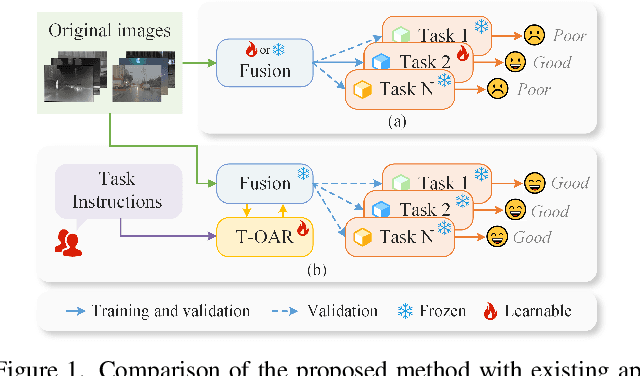
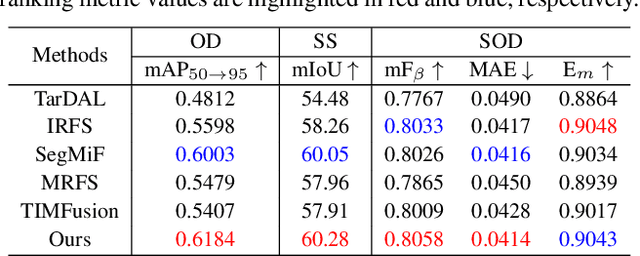
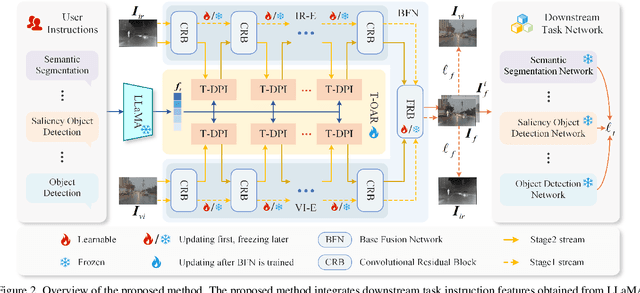
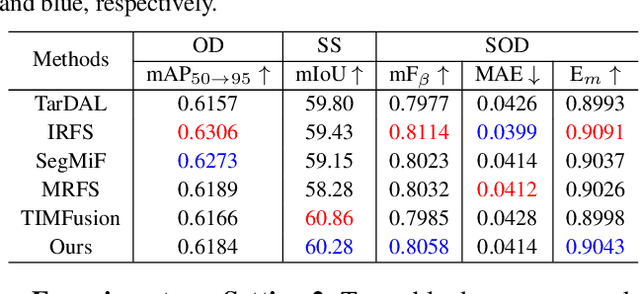
The primary value of infrared and visible image fusion technology lies in applying the fusion results to downstream tasks. However, existing methods face challenges such as increased training complexity and significantly compromised performance of individual tasks when addressing multiple downstream tasks simultaneously. To tackle this, we propose Task-Oriented Adaptive Regulation (T-OAR), an adaptive mechanism specifically designed for multi-task environments. Additionally, we introduce the Task-related Dynamic Prompt Injection (T-DPI) module, which generates task-specific dynamic prompts from user-input text instructions and integrates them into target representations. This guides the feature extraction module to produce representations that are more closely aligned with the specific requirements of downstream tasks. By incorporating the T-DPI module into the T-OAR framework, our approach generates fusion images tailored to task-specific requirements without the need for separate training or task-specific weights. This not only reduces computational costs but also enhances adaptability and performance across multiple tasks. Experimental results show that our method excels in object detection, semantic segmentation, and salient object detection, demonstrating its strong adaptability, flexibility, and task specificity. This provides an efficient solution for image fusion in multi-task environments, highlighting the technology's potential across diverse applications.
Improved Video VAE for Latent Video Diffusion Model
Nov 10, 2024


Variational Autoencoder (VAE) aims to compress pixel data into low-dimensional latent space, playing an important role in OpenAI's Sora and other latent video diffusion generation models. While most of existing video VAEs inflate a pretrained image VAE into the 3D causal structure for temporal-spatial compression, this paper presents two astonishing findings: (1) The initialization from a well-trained image VAE with the same latent dimensions suppresses the improvement of subsequent temporal compression capabilities. (2) The adoption of causal reasoning leads to unequal information interactions and unbalanced performance between frames. To alleviate these problems, we propose a keyframe-based temporal compression (KTC) architecture and a group causal convolution (GCConv) module to further improve video VAE (IV-VAE). Specifically, the KTC architecture divides the latent space into two branches, in which one half completely inherits the compression prior of keyframes from a lower-dimension image VAE while the other half involves temporal compression through 3D group causal convolution, reducing temporal-spatial conflicts and accelerating the convergence speed of video VAE. The GCConv in above 3D half uses standard convolution within each frame group to ensure inter-frame equivalence, and employs causal logical padding between groups to maintain flexibility in processing variable frame video. Extensive experiments on five benchmarks demonstrate the SOTA video reconstruction and generation capabilities of the proposed IV-VAE (https://wpy1999.github.io/IV-VAE/).
Generalizing Hyperedge Expansion for Hyper-relational Knowledge Graph Modeling
Nov 09, 2024By representing knowledge in a primary triple associated with additional attribute-value qualifiers, hyper-relational knowledge graph (HKG) that generalizes triple-based knowledge graph (KG) has been attracting research attention recently. Compared with KG, HKG is enriched with the semantic qualifiers as well as the hyper-relational graph structure. However, to model HKG, existing studies mainly focus on either semantic information or structural information therein, which however fail to capture both simultaneously. To tackle this issue, in this paper, we generalize the hyperedge expansion in hypergraph learning and propose an equivalent transformation for HKG modeling, referred to as TransEQ. Specifically, the equivalent transformation transforms a HKG to a KG, which considers both semantic and structural characteristics. Then an encoder-decoder framework is developed to bridge the modeling research between KG and HKG. In the encoder part, KG-based graph neural networks are leveraged for structural modeling; while in the decoder part, various HKG-based scoring functions are exploited for semantic modeling. Especially, we design the sharing embedding mechanism in the encoder-decoder framework with semantic relatedness captured. We further theoretically prove that TransEQ preserves complete information in the equivalent transformation, and also achieves full expressivity. Finally, extensive experiments on three benchmarks demonstrate the superior performance of TransEQ in terms of both effectiveness and efficiency. On the largest benchmark WikiPeople, TransEQ significantly improves the state-of-the-art models by 15\% on MRR.
Not Just Object, But State: Compositional Incremental Learning without Forgetting
Nov 05, 2024Most incremental learners excessively prioritize coarse classes of objects while neglecting various kinds of states (e.g. color and material) attached to the objects. As a result, they are limited in the ability to reason fine-grained compositionality of state-object pairs. To remedy this limitation, we propose a novel task called Compositional Incremental Learning (composition-IL), enabling the model to recognize state-object compositions as a whole in an incremental learning fashion. Since the lack of suitable benchmarks, we re-organize two existing datasets and make them tailored for composition-IL. Then, we propose a prompt-based Composition Incremental Learner (CompILer), to overcome the ambiguous composition boundary problem which challenges composition-IL largely. Specifically, we exploit multi-pool prompt learning, which is regularized by inter-pool prompt discrepancy and intra-pool prompt diversity. Besides, we devise object-injected state prompting by using object prompts to guide the selection of state prompts. Furthermore, we fuse the selected prompts by a generalized-mean strategy, to eliminate irrelevant information learned in the prompts. Extensive experiments on two datasets exhibit state-of-the-art performance achieved by CompILer.
In-Context LoRA for Diffusion Transformers
Oct 31, 2024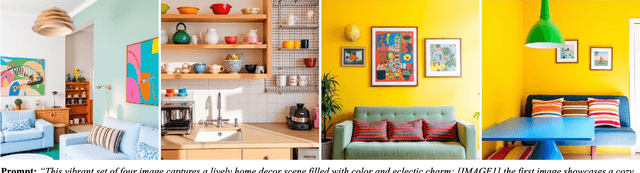

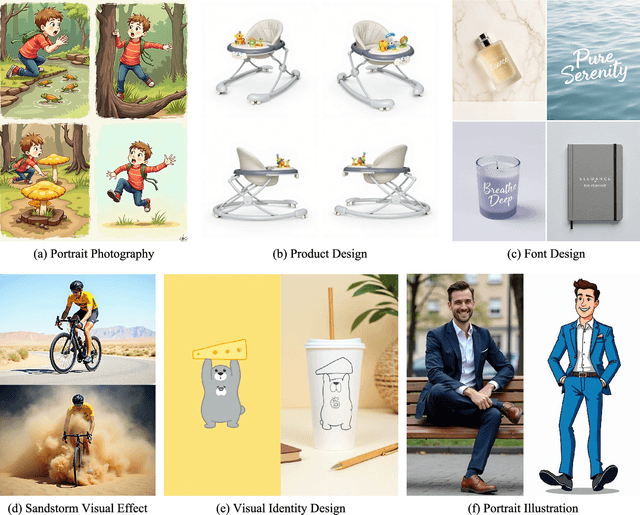
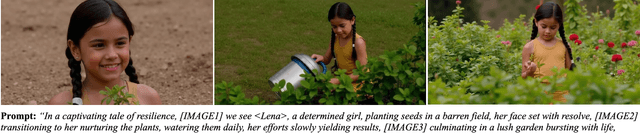
Recent research arXiv:2410.15027 has explored the use of diffusion transformers (DiTs) for task-agnostic image generation by simply concatenating attention tokens across images. However, despite substantial computational resources, the fidelity of the generated images remains suboptimal. In this study, we reevaluate and streamline this framework by hypothesizing that text-to-image DiTs inherently possess in-context generation capabilities, requiring only minimal tuning to activate them. Through diverse task experiments, we qualitatively demonstrate that existing text-to-image DiTs can effectively perform in-context generation without any tuning. Building on this insight, we propose a remarkably simple pipeline to leverage the in-context abilities of DiTs: (1) concatenate images instead of tokens, (2) perform joint captioning of multiple images, and (3) apply task-specific LoRA tuning using small datasets (e.g., $20\sim 100$ samples) instead of full-parameter tuning with large datasets. We name our models In-Context LoRA (IC-LoRA). This approach requires no modifications to the original DiT models, only changes to the training data. Remarkably, our pipeline generates high-fidelity image sets that better adhere to prompts. While task-specific in terms of tuning data, our framework remains task-agnostic in architecture and pipeline, offering a powerful tool for the community and providing valuable insights for further research on product-level task-agnostic generation systems. We release our code, data, and models at https://github.com/ali-vilab/In-Context-LoRA
Synergizing LLM Agents and Knowledge Graph for Socioeconomic Prediction in LBSN
Oct 29, 2024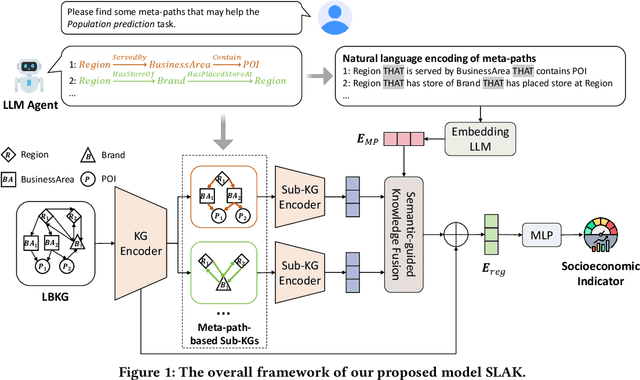
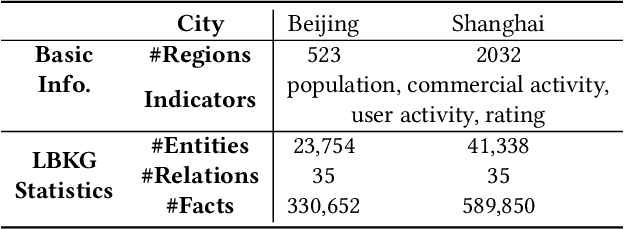
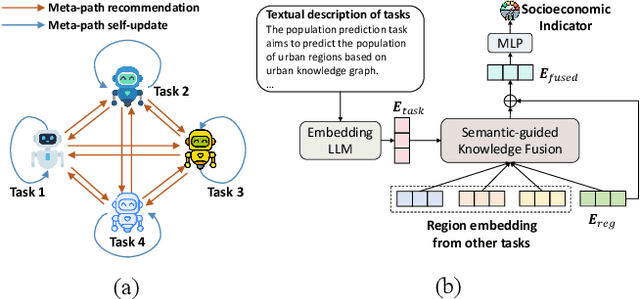
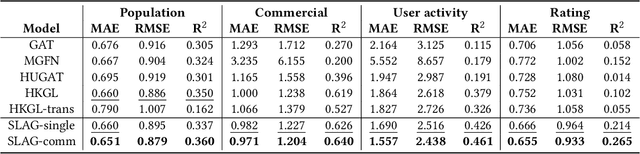
The fast development of location-based social networks (LBSNs) has led to significant changes in society, resulting in popular studies of using LBSN data for socioeconomic prediction, e.g., regional population and commercial activity estimation. Existing studies design various graphs to model heterogeneous LBSN data, and further apply graph representation learning methods for socioeconomic prediction. However, these approaches heavily rely on heuristic ideas and expertise to extract task-relevant knowledge from diverse data, which may not be optimal for specific tasks. Additionally, they tend to overlook the inherent relationships between different indicators, limiting the prediction accuracy. Motivated by the remarkable abilities of large language models (LLMs) in commonsense reasoning, embedding, and multi-agent collaboration, in this work, we synergize LLM agents and knowledge graph for socioeconomic prediction. We first construct a location-based knowledge graph (LBKG) to integrate multi-sourced LBSN data. Then we leverage the reasoning power of LLM agent to identify relevant meta-paths in the LBKG for each type of socioeconomic prediction task, and design a semantic-guided attention module for knowledge fusion with meta-paths. Moreover, we introduce a cross-task communication mechanism to further enhance performance by enabling knowledge sharing across tasks at both LLM agent and KG levels. On the one hand, the LLM agents for different tasks collaborate to generate more diverse and comprehensive meta-paths. On the other hand, the embeddings from different tasks are adaptively merged for better socioeconomic prediction. Experiments on two datasets demonstrate the effectiveness of the synergistic design between LLM and KG, providing insights for information sharing across socioeconomic prediction tasks.
Depth Attention for Robust RGB Tracking
Oct 27, 2024RGB video object tracking is a fundamental task in computer vision. Its effectiveness can be improved using depth information, particularly for handling motion-blurred target. However, depth information is often missing in commonly used tracking benchmarks. In this work, we propose a new framework that leverages monocular depth estimation to counter the challenges of tracking targets that are out of view or affected by motion blur in RGB video sequences. Specifically, our work introduces following contributions. To the best of our knowledge, we are the first to propose a depth attention mechanism and to formulate a simple framework that allows seamlessly integration of depth information with state of the art tracking algorithms, without RGB-D cameras, elevating accuracy and robustness. We provide extensive experiments on six challenging tracking benchmarks. Our results demonstrate that our approach provides consistent gains over several strong baselines and achieves new SOTA performance. We believe that our method will open up new possibilities for more sophisticated VOT solutions in real-world scenarios. Our code and models are publicly released: https://github.com/LiuYuML/Depth-Attention.
NT-VOT211: A Large-Scale Benchmark for Night-time Visual Object Tracking
Oct 27, 2024Many current visual object tracking benchmarks such as OTB100, NfS, UAV123, LaSOT, and GOT-10K, predominantly contain day-time scenarios while the challenges posed by the night-time has been less investigated. It is primarily because of the lack of a large-scale, well-annotated night-time benchmark for rigorously evaluating tracking algorithms. To this end, this paper presents NT-VOT211, a new benchmark tailored for evaluating visual object tracking algorithms in the challenging night-time conditions. NT-VOT211 consists of 211 diverse videos, offering 211,000 well-annotated frames with 8 attributes including camera motion, deformation, fast motion, motion blur, tiny target, distractors, occlusion and out-of-view. To the best of our knowledge, it is the largest night-time tracking benchmark to-date that is specifically designed to address unique challenges such as adverse visibility, image blur, and distractors inherent to night-time tracking scenarios. Through a comprehensive analysis of results obtained from 42 diverse tracking algorithms on NT-VOT211, we uncover the strengths and limitations of these algorithms, highlighting opportunities for enhancements in visual object tracking, particularly in environments with suboptimal lighting. Besides, a leaderboard for revealing performance rankings, annotation tools, comprehensive meta-information and all the necessary code for reproducibility of results is made publicly available. We believe that our NT-VOT211 benchmark will not only be instrumental in facilitating field deployment of VOT algorithms, but will also help VOT enhancements and it will unlock new real-world tracking applications. Our dataset and other assets can be found at: {https://github.com/LiuYuML/NV-VOT211.