 Add to Chrome
 Add to Firefox
 Add to Edge
Customized Fusion: A Closed-Loop Dynamic Network for Adaptive Multi-Task-Aware Infrared-Visible Image Fusion
Apr 10, 2026
Infrared-visible image fusion aims to integrate complementary information for robust visual understanding, but existing fusion methods struggle with simultaneously adapting to multiple downstream tasks. To address this issue, we propose a Closed-Loop Dynamic Network (CLDyN) that can adaptively respond to the semantic requirements of diverse downstream tasks for task-customized image fusion. Specifically, CLDyN introduces a closed-loop optimization mechanism that establishes a semantic transmission chain to achieve explicit feedback from downstream tasks to the fusion network through a Requirement-driven Semantic Compensation (RSC) module. The RSC module leverages a Basis Vector Bank (BVB) and an Architecture-Adaptive Semantic Injection (A2SI) block to customize the network architecture according to task requirements, thereby enabling task-specific semantic compensation and allowing the fusion network to actively adapt to diverse tasks without retraining. To promote semantic compensation, a reward-penalty strategy is introduced to reward or penalize the RSC module based on task performance variations. Experiments on the M3FD, FMB, and VT5000 datasets demonstrate that CLDyN not only maintains high fusion quality but also exhibits strong multi-task adaptability. The code is available at https://github.com/YR0211/CLDyN.

Instruction-Driven Fusion of Infrared-Visible Images: Tailoring for Diverse Downstream Tasks
Nov 14, 2024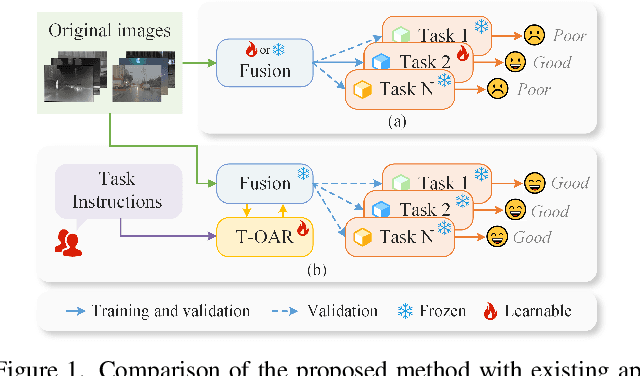
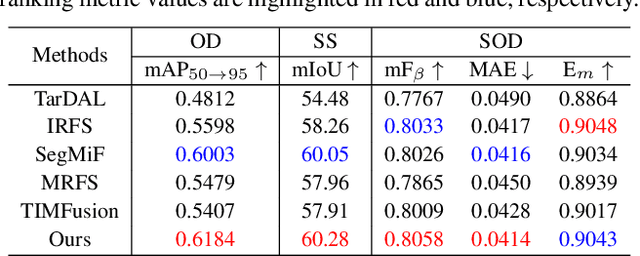
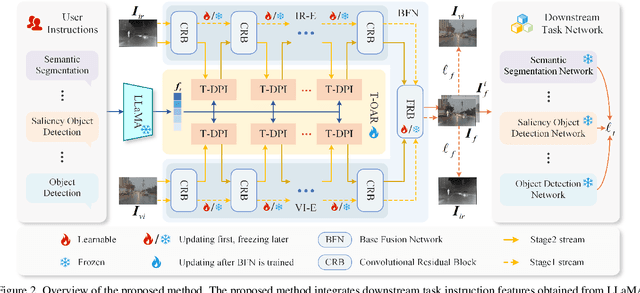
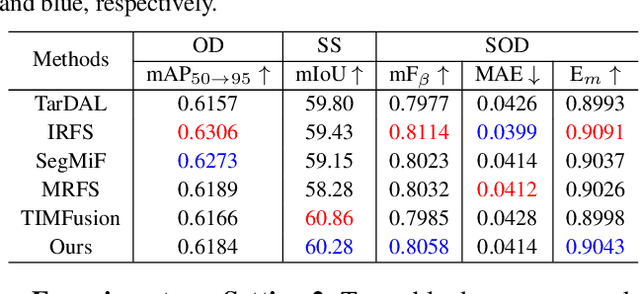
The primary value of infrared and visible image fusion technology lies in applying the fusion results to downstream tasks. However, existing methods face challenges such as increased training complexity and significantly compromised performance of individual tasks when addressing multiple downstream tasks simultaneously. To tackle this, we propose Task-Oriented Adaptive Regulation (T-OAR), an adaptive mechanism specifically designed for multi-task environments. Additionally, we introduce the Task-related Dynamic Prompt Injection (T-DPI) module, which generates task-specific dynamic prompts from user-input text instructions and integrates them into target representations. This guides the feature extraction module to produce representations that are more closely aligned with the specific requirements of downstream tasks. By incorporating the T-DPI module into the T-OAR framework, our approach generates fusion images tailored to task-specific requirements without the need for separate training or task-specific weights. This not only reduces computational costs but also enhances adaptability and performance across multiple tasks. Experimental results show that our method excels in object detection, semantic segmentation, and salient object detection, demonstrating its strong adaptability, flexibility, and task specificity. This provides an efficient solution for image fusion in multi-task environments, highlighting the technology's potential across diverse applications.