 Add to Chrome
 Add to Firefox
 Add to Edge
Qwen-RobotNav Technical Report: A Scalable Navigation Model Designed for an Agentic Navigation System
Jun 18, 2026
Agentic navigation systems require a base navigation model whose observation strategy can be externally reconfigured at inference time, because instruction following, object search, target tracking, and autonomous driving share the same perception-planning backbone yet demand fundamentally different strategies for consuming the visual stream. We present Qwen-RobotNav, a scalable navigation model built on Qwen-RobotNav that addresses it through a parameterised interface with two complementary dimensions: multiple task modes that select the navigation behaviour, and controllable observation parameters (e.g., token budget, per-camera weights) that govern how visual history is encoded. With training-time randomization over all parameters, Qwen-RobotNav is robust to any inference-time configuration requiring zero architectural modification to the Qwen-RobotNav backbone. We train Qwen-RobotNav on 15.6M samples; co-training with vision-language data prevents the collapse into reactive action-sequence mappers observed in trajectory-only training. The parameterised interface also makes Qwen-RobotNav a natural building block for agentic systems: for long-horizon scenarios, an upper-level planner decomposes goals into sub-tasks and dynamically switches Qwen-RobotNav's task mode and context strategy mid-episode, composing complex behaviours from repeated calls to the same model. Extensive experiments show that Qwen-RobotNav sets new state-of-the-art results across major navigation benchmarks. The model exhibits favourable scaling from 2B to 8B parameters, with joint multi-task training developing a shared spatial-planning substrate that transfers across task families, and demonstrates strong zero-shot generalisation to real-world robots across diverse environments.

Qwen-RobotManip Technical Report: Alignment Unlocks Scale for Robotic Manipulation Foundation Models
Jun 17, 2026Foundation models in language and multimodality achieve strong generalization by aligning heterogeneous data under a unified formulation and training at scale. In this report, we investigate whether this scaling recipe can be applied to robotic manipulation to achieve genuine generalization. This is challenging because, unlike text, manipulation data is heterogeneous by nature, expensive to collect, and narrow in diversity, making alignment and scale simultaneously difficult. We present Qwen-RobotManip, a generalizable Vision-Language-Action foundation model built on Qwen-VL. Qwen-RobotManip introduces a unified alignment framework across the representation, motion, and behavioral dimensions of manipulation, making large-scale multi-source training coherent rather than conflicting. This alignment capability in turn enables Qwen-RobotManip to absorb manipulation data at a scale that prior training regimes could not sustain. A human-to-robot synthesis pipeline converts egocentric hand demonstrations into robot trajectories across 15 platforms, and a rigorous curation pipeline harmonizes heterogeneous datasets. Using only open-source datasets and human videos without proprietary data collection, Qwen-RobotManip constructs a ~38,100-hour pretraining corpus and exhibits emergent generalization capabilities, including zero-shot instruction following, robustness to perturbations, reactive error recovery, and cross-embodiment transfer. We find that standard benchmarks fail to capture pretraining quality and instead adopt OOD settings including RoboCasa365, LIBERO-Plus, EBench, RoboTwin-Clean2Rand, RoboTwin-IF, and RoboTwin-XE. Qwen-RobotManip substantially outperforms prior state-of-the-art models, including $π$0.5, across all OOD settings, ranks 1st in RoboChallenge with a 20% relative improvement, and is validated on real-robot platforms including AgileX ALOHA, Franka, UR, and ARX.
Qwen-VLA: Unifying Vision-Language-Action Modeling across Tasks, Environments, and Robot Embodiments
May 28, 2026Embodied intelligence is often studied through specialized models for individual tasks such as manipulation or navigation, resulting in fragmented capabilities and limited generalization across tasks, environments, and robot embodiments. In this work, we study whether heterogeneous embodied decision-making problems can be unified within a single vision-language-action model. We present Qwen-VLA, a unified embodied foundation model that extends Qwen's vision-language modeling stack from perception, understanding, and reasoning to continuous action and trajectory generation through a DiT-based action decoder. Qwen-VLA is trained with a large-scale joint pretraining recipe over diverse data sources, including robotics manipulation trajectories, human egocentric demonstrations, synthetic simulation data, vision-and-language navigation data, trajectory-centric supervision, and auxiliary vision-language data. To support multiple robot platforms, we introduce embodiment-aware prompt conditioning, where robot-specific textual descriptions specify the current embodiment and control convention. We further cast manipulation, navigation, and trajectory prediction into a unified action-and-trajectory prediction framework, enabling transferable visual grounding, spatial reasoning, and continuous action generation across robot morphologies, task families, and environments. Experiments on manipulation, navigation, and trajectory-centric benchmarks show consistent multi-task performance and out-of-distribution generalization under variations in scene layout, background, lighting, object configuration, and robot embodiment. Qwen-VLA-Instruct achieves 97.9% on LIBERO, 73.7% on Simpler-WidowX, 86.1%/87.2% on RoboTwin-Easy/Hard, 69.0% OSR on R2R, 59.6% SR on RxR, 76.9% average OOD success in real-world ALOHA experiments, and 26.6% zero-shot success on DOMINO dynamic manipulation.
Synergizing LLM Agents and Knowledge Graph for Socioeconomic Prediction in LBSN
Oct 29, 2024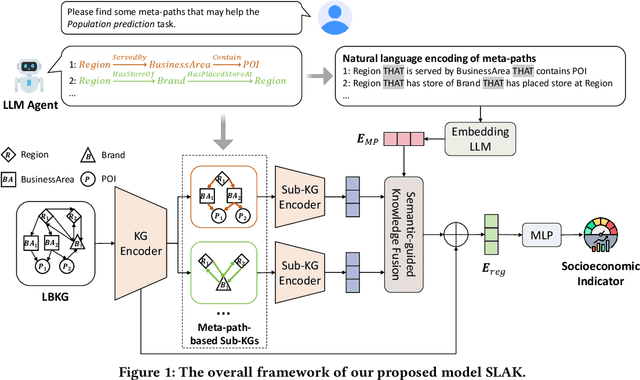
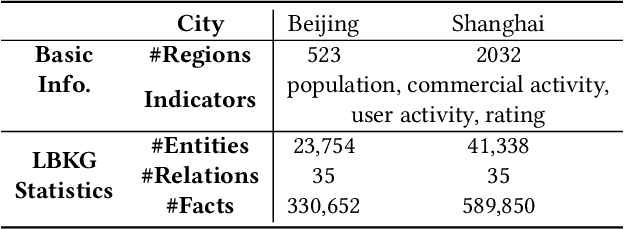
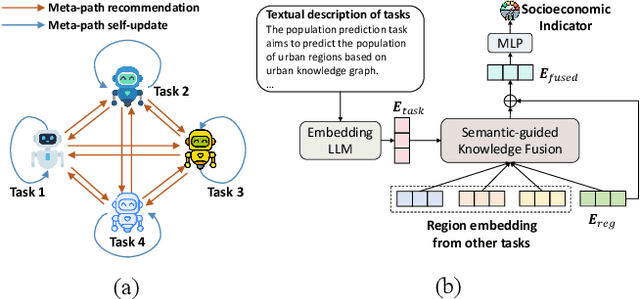
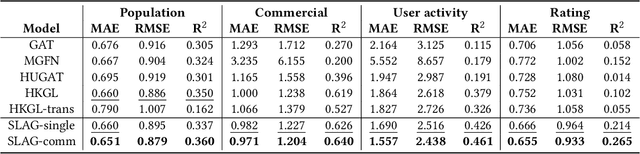
The fast development of location-based social networks (LBSNs) has led to significant changes in society, resulting in popular studies of using LBSN data for socioeconomic prediction, e.g., regional population and commercial activity estimation. Existing studies design various graphs to model heterogeneous LBSN data, and further apply graph representation learning methods for socioeconomic prediction. However, these approaches heavily rely on heuristic ideas and expertise to extract task-relevant knowledge from diverse data, which may not be optimal for specific tasks. Additionally, they tend to overlook the inherent relationships between different indicators, limiting the prediction accuracy. Motivated by the remarkable abilities of large language models (LLMs) in commonsense reasoning, embedding, and multi-agent collaboration, in this work, we synergize LLM agents and knowledge graph for socioeconomic prediction. We first construct a location-based knowledge graph (LBKG) to integrate multi-sourced LBSN data. Then we leverage the reasoning power of LLM agent to identify relevant meta-paths in the LBKG for each type of socioeconomic prediction task, and design a semantic-guided attention module for knowledge fusion with meta-paths. Moreover, we introduce a cross-task communication mechanism to further enhance performance by enabling knowledge sharing across tasks at both LLM agent and KG levels. On the one hand, the LLM agents for different tasks collaborate to generate more diverse and comprehensive meta-paths. On the other hand, the embeddings from different tasks are adaptively merged for better socioeconomic prediction. Experiments on two datasets demonstrate the effectiveness of the synergistic design between LLM and KG, providing insights for information sharing across socioeconomic prediction tasks.
HLM-Cite: Hybrid Language Model Workflow for Text-based Scientific Citation Prediction
Oct 10, 2024


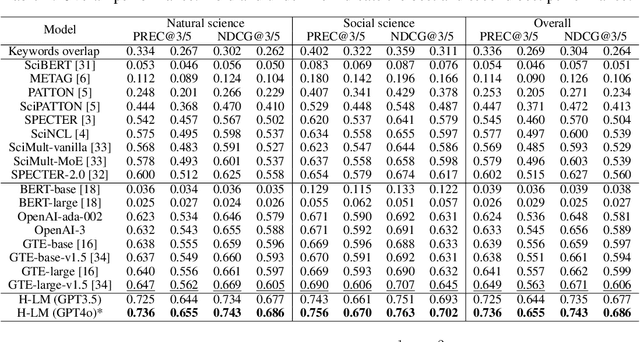
Citation networks are critical in modern science, and predicting which previous papers (candidates) will a new paper (query) cite is a critical problem. However, the roles of a paper's citations vary significantly, ranging from foundational knowledge basis to superficial contexts. Distinguishing these roles requires a deeper understanding of the logical relationships among papers, beyond simple edges in citation networks. The emergence of LLMs with textual reasoning capabilities offers new possibilities for discerning these relationships, but there are two major challenges. First, in practice, a new paper may select its citations from gigantic existing papers, where the texts exceed the context length of LLMs. Second, logical relationships between papers are implicit, and directly prompting an LLM to predict citations may result in surface-level textual similarities rather than the deeper logical reasoning. In this paper, we introduce the novel concept of core citation, which identifies the critical references that go beyond superficial mentions. Thereby, we elevate the citation prediction task from a simple binary classification to distinguishing core citations from both superficial citations and non-citations. To address this, we propose $\textbf{HLM-Cite}$, a $\textbf{H}$ybrid $\textbf{L}$anguage $\textbf{M}$odel workflow for citation prediction, which combines embedding and generative LMs. We design a curriculum finetune procedure to adapt a pretrained text embedding model to coarsely retrieve high-likelihood core citations from vast candidates and then design an LLM agentic workflow to rank the retrieved papers through one-shot reasoning, revealing the implicit relationships among papers. With the pipeline, we can scale the candidate sets to 100K papers. We evaluate HLM-Cite across 19 scientific fields, demonstrating a 17.6% performance improvement comparing SOTA methods.