 Add to Chrome
 Add to Firefox
 Add to Edge
A Unified Framework for Ambiguity Function Shaping and PAPR Control in AFDM Systems
Apr 24, 2026
Affine frequency division multiplexing (AFDM) has emerged as a promising integrated sensing and communication (ISAC) waveform due to its intrinsic chirp signalling nature. Nevertheless, practical AFDM-based ISAC still faces two key obstacles, namely, high ambiguity function (AF) sidelobes and high peak-to-average power ratio (PAPR). By leveraging the reserved chirp-subcarrier (RCS) symbols, we develop a unified AFDM waveform design framework for AF shaping and/or PAPR control. The proposed framework supports three modes: AF shaping via weighted integrated sidelobe level (ISL) minimization, PAPR minimization, and joint AF shaping and PAPR control under a prescribed PAPR constraint. To solve the formulated nonconvex problem and to accommodate the discrete-phase constraints on the optionally optimized pre-chirp parameters, a joint ISL-PAPR-discrete-phase majorization-minimization (JIPD-MM) algorithm is developed. Simulation results verify the effectiveness of the proposed framework under all three design modes. The joint mode further demonstrates that the prescribed PAPR constraint can be effectively satisfied while still achieving meaningful ISL reduction. These gains are also reflected in improved weak-target detectability under multitarget scenarios and lower bit error rate (BER) under power-amplifier (PA) nonlinearity.

Fluid Antennas Meet Rate-Splitting Multiple Access: A New Path Forward for 6G Networks
Apr 14, 2026Future sixth-generation (6G) networks require high spectral efficiency (SE), massive connectivity, and stringent reliability under imperfect channel state information at the transmitter. Rate-splitting multiple access (RSMA) addresses part of this challenge by flexibly managing interference through common and private message streams, while fluid antenna systems (FAS) offer low-cost spatial diversity by dynamically reconfiguring antenna positions within a compact aperture. In this paper, we first classify FAS-enabled multiple access systems from the perspectives of FAS deployment, objectives, and antenna configuration, along with some comparisons with benchmark schemes, thereby exhibiting the inherent efficiency of FAS-RSMA. Moreover, we reveal the mutually enhancing mechanism between FAS and RSMA: FAS strengthens the weakest effective link and improves the beamforming design in RSMA, whereas RSMA turns FAS-induced spatial diversity into robust interference management under diverse channel conditions. In addition, we identify representative 6G scenarios and highlight major research challenges in joint beamforming-antenna position design, channel estimation, and hardware design. Furthermore, case studies quantify the gains of FAS-RSMA over the fixed-position antenna (FPA) system with RSMA and NOMA baselines, which validates that FAS-RSMA is a strong candidate for interference-limited access in 6G systems.
Antenna Elements' Trajectory Optimization for Throughput Maximization in Continuous-Trajectory Fluid Antenna-Aided Wireless Communications
Mar 27, 2026Fluid antenna (FA) systems offer novel spatial degrees of freedom (DoFs) with the potential for significant performance gains. Compared to existing works focusing solely on optimizing FA positions at discrete time instants, we introduce the concept of continuous-trajectory fluid antenna (CTFA), which explicitly considers the antenna element's movement trajectory across continuous time intervals and incorporates the inherent kinematic constraints present in practical FA implementations. Accordingly, we formulate the total throughput maximization problem in CTFA-aided wireless communication systems, addressing the joint optimization of continuous antenna trajectories in conjunction with the transmit covariance matrices under kinematic constraints. To effectively solve this non-convex problem with highly coupled optimization variables, we develop an iterative algorithm based on block coordinate descent (BCD) and majorization-minimization (MM) principles with the aid of the weighted minimum mean square error (WMMSE) method. Finally, numerical results are presented to validate the efficacy of the proposed algorithms and to quantify the substantial total throughput advantages afforded by the conceived CTFA-aided system compared to conventional fixed-position antenna (FPA) benchmarks and alternative approaches employing simplified trajectories.
ComAgent: Multi-LLM based Agentic AI Empowered Intelligent Wireless Networks
Jan 27, 2026Emerging 6G networks rely on complex cross-layer optimization, yet manually translating high-level intents into mathematical formulations remains a bottleneck. While Large Language Models (LLMs) offer promise, monolithic approaches often lack sufficient domain grounding, constraint awareness, and verification capabilities. To address this, we present ComAgent, a multi-LLM agentic AI framework. ComAgent employs a closed-loop Perception-Planning-Action-Reflection cycle, coordinating specialized agents for literature search, coding, and scoring to autonomously generate solver-ready formulations and reproducible simulations. By iteratively decomposing problems and self-correcting errors, the framework effectively bridges the gap between user intent and execution. Evaluations demonstrate that ComAgent achieves expert-comparable performance in complex beamforming optimization and outperforms monolithic LLMs across diverse wireless tasks, highlighting its potential for automating design in emerging wireless networks.
Dual-Mapping Sparse Vector Transmission for Short Packet URLLC
Jan 22, 2026Sparse vector coding (SVC) is a promising short-packet transmission method for ultra reliable low latency communication (URLLC) in next generation communication systems. In this paper, a dual-mapping SVC (DM-SVC) based short packet transmission scheme is proposed to further enhance the transmission performance of SVC. The core idea behind the proposed scheme lies in mapping the transmitted information bits onto sparse vectors via block and single-element sparse mappings. The block sparse mapping pattern is able to concentrate the transmit power in a small number of non-zero blocks thus improving the decoding accuracy, while the single-element sparse mapping pattern ensures that the code length does not increase dramatically with the number of transmitted information bits. At the receiver, a two-stage decoding algorithm is proposed to sequentially identify non-zero block indexes and single-element non-zero indexes. Extensive simulation results verify that proposed DM-SVC scheme outperforms the existing SVC schemes in terms of block error rate and spectral efficiency.
MIMO-AFDM Outperforms MIMO-OFDM in the Face of Hardware Impairments
Jan 01, 2026The impact of both multiplicative and additive hardware impairments (HWIs) on multiple-input multiple-output affine frequency division multiplexing (MIMO-AFDM) systems is investigated. For small-scale MIMO-AFDM systems, a tight bit error rate (BER) upper bound associated with the maximum likelihood (ML) detector is derived. By contrast, for large-scale systems, a closed-form BER approximation associated with the linear minimum mean squared error (LMMSE) detector is presented, including realistic imperfect channel estimation scenarios. Our first key observation is that the full diversity order of a hardware-impaired AFDM system remains unaffected, which is a unique advantage. Furthermore, our analysis shows that 1) the BER results derived accurately predict the simulated ML performance in moderate-to-high signal-to-noise ratios (SNRs), while the theoretical BER curve of the LMMSE detector closely matches that of the Monte-Carlo based one. 2) MIMO-AFDM is more resilient to multiplicative distortions, such as phase noise and carrier frequency offset, compared to its orthogonal frequency division multiplexing (OFDM) counterparts. This is attributed to its inherent chirp signal characteristics; 3) MIMO-AFDM consistently achieves superior BER performance compared to conventional MIMO-OFDM systems under the same additive HWI conditions, as well as different velocity values. The latter is because MIMO-AFDM is also resilient to the additional inter-carrier interference (ICI) imposed by the nonlinear distortions of additive HWIs. In a nutshell, compared to OFDM, AFDM demonstrates stronger ICI resilience and achieves the maximum full diversity attainable gain even under HWIs, thanks to its intrinsic chirp signalling structure as well as to the beneficial spreading effect of the discrete affine Fourier transform.
Enhanced Information Security via Wave-Field Selectivity and Structured Wavefront Manipulation
Dec 11, 2025
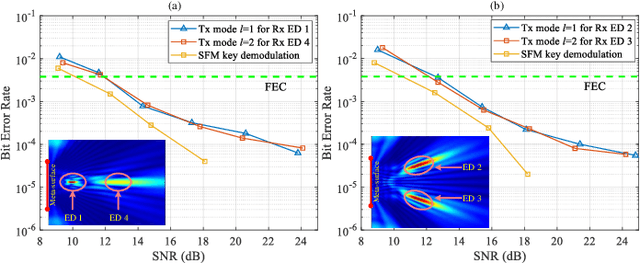
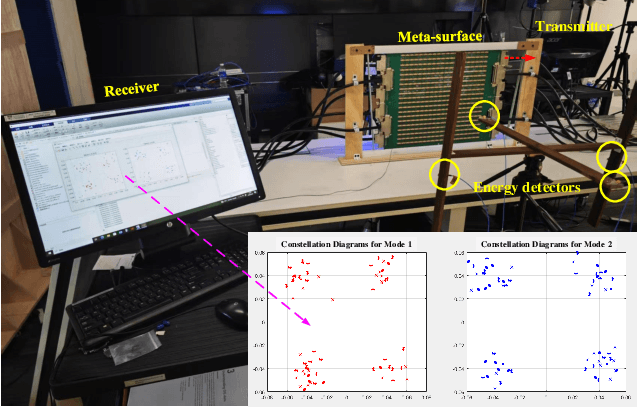

In this paper, we propose a novel secure wireless transmission architecture that enables the co-existence of spatial field modulation (SFM) and digital bandpass modulation (DBM), utilizing multi-mode vortex waves and programmable meta-surfaces (PMS). Distinct from conventional joint modulation schemes, our approach establishes two logically independent transmission channels--SFM and DBM--thereby eliminating the need for joint signal design or time synchronization. Specifically, the orthogonality of vortex wave modes is exploited to construct a high-capacity multi-mode DBM channel, in which each mode carries modulated symbols independently. As the composite waveform passes through the PMS, energy from different vortex modes is spatially focused onto distinct positions, dynamically determined by the PMS configuration. This spatial mapping forms a unique lookup table that encodes additional information in the electro-magnetic (EM) field distribution, effectively enabling a second, concurrent SFM channel. To enhance physical-layer security, the DBM channel transmits encrypted symbols transformed via dynamic symbol-domain mapping, while the corresponding mapping relations--or key information--are carried by the SFM channel. This lightweight dual-channel encryption strategy provides strong confidentiality without requiring complex joint decoding. To validate the feasibility of the proposed architecture, we design and implement a proof-of-concept prototype system, and conduct experimental demonstrations under real-world wireless communication conditions. The experimental results confirm the effectiveness of the co-existent DBM-SFM design in achieving reliable and secure transmission. The proposed architecture offers a scalable, low-complexity, and secure transmission solution for future IoT networks, especially in scenarios demanding both spectral efficiency and physical-layer confidentiality.
DFT-s-OFDM with Chirp Modulation
Aug 06, 2025
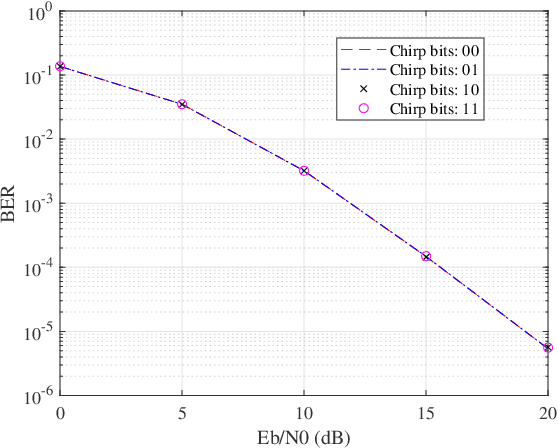

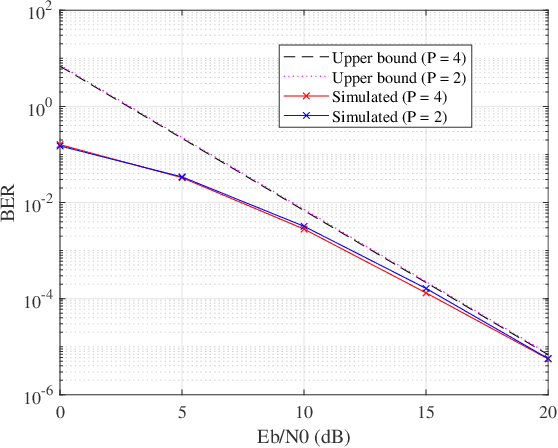
In this paper, a new waveform called discrete Fourier transform spread orthogonal frequency division multiplexing with chirp modulation (DFT-s-OFDM-CM) is proposed for the next generation of wireless communications. The information bits are conveyed by not only Q-ary constellation symbols but also the starting frequency of chirp signal. It could maintain the benefits provided by the chirped discrete Fourier transform spread orthogonal frequency division multiplexing (DFT-s-OFDM), e.g., low peak-to-average power ratio (PAPR), full frequency diversity exploitation, etc. Simulation results confirm that the proposed DFT-s-OFDM-CM could achieve higher spectral efficiency while keeping the similar bit error rate (BER) to that of chirped DFT-s-OFDM. In addition, when maintaining the same spectral efficiency, the proposed DFT-s-OFDM-CM with the splitting of information bits into two streams enables the use of lower-order constellation modulation and offers greater resilience to noise, resulting in a lower BER than the chirped DFT-s-OFDM.
Pinching-Antenna-Assisted Index Modulation: Channel Modeling, Transceiver Design, and Performance Analysis
Jul 03, 2025In this paper, a novel pinching-antenna assisted index modulation (PA-IM) scheme is proposed for improving the spectral efficiency without increasing the hardware complexity, where the information bits are conveyed not only by the conventional M-ary quadrature amplitude modulation (QAM) symbols but also by the indices of pinching antenna (PA) position patterns. To realize the full potential of this scheme, this paper focuses on the comprehensive transceiver design, addressing key challenges in signal detection at the receiver and performance optimization at thetransmitter. First, a comprehensive channel model is formulated for this architecture, which sophisticatedly integrates the deterministic in-waveguide propagation effects with the stochastic nature of wireless channels, including both largescale path loss and small-scale fading. Next, to overcome the prohibitive complexity of optimal maximum likelihood (ML) detection, a low-complexity box-optimized sphere decoding (BOSD) algorithm is designed, which adaptively prunes the search space whilst preserving optimal ML performance. Furthermore, an analytical upper bound on the bit error rate (BER) is derived and validated by the simulations. Moreover, a new transmit precoding method is designed using manifold optimization, which minimizes the BER by jointly optimizing the complex-valued precoding coefficients across the waveguides for the sake of maximizing the minimum Euclidean distance of all received signal points. Finally, the simulation results demonstrate that the proposed PA-IM scheme attains a significant performance gain over its conventional counterparts and that the overall BER of the pinching-antenna system is substantially improved by the proposed precoding design.
Basis Expansion Extrapolation based Long-Term Channel Prediction for Massive MIMO OTFS Systems
Jul 02, 2025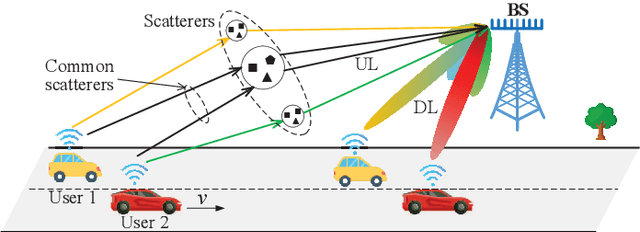
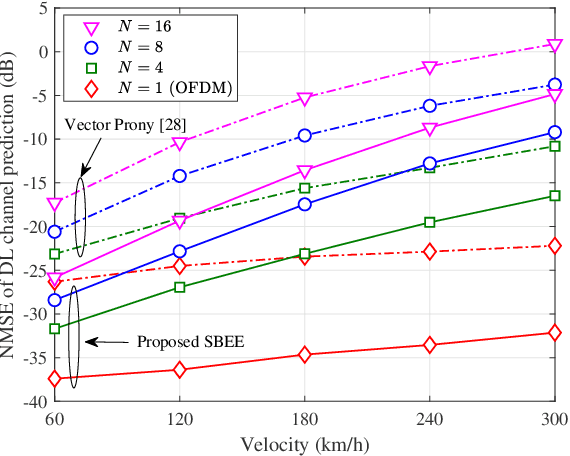
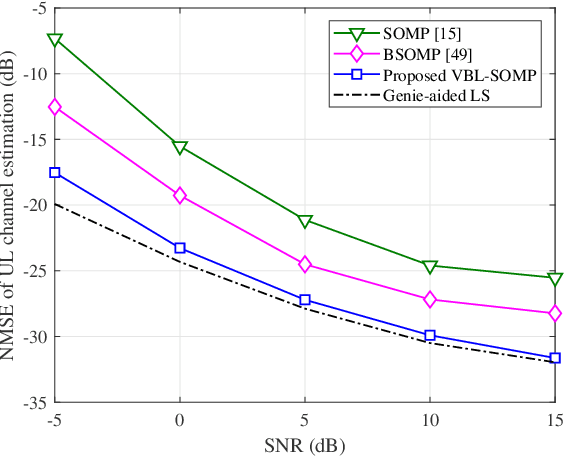
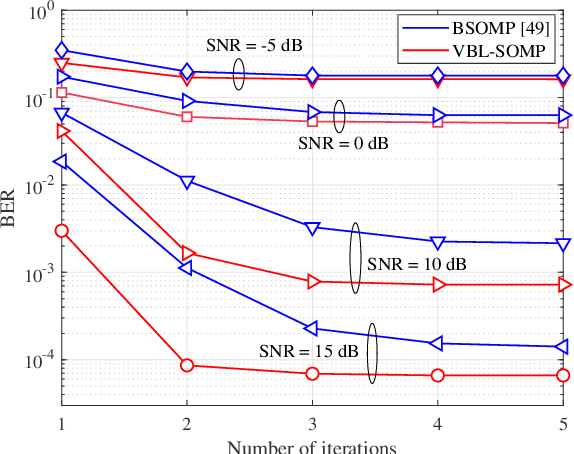
Massive multi-input multi-output (MIMO) combined with orthogonal time frequency space (OTFS) modulation has emerged as a promising technique for high-mobility scenarios. However, its performance could be severely degraded due to channel aging caused by user mobility and high processing latency. In this paper, an integrated scheme of uplink (UL) channel estimation and downlink (DL) channel prediction is proposed to alleviate channel aging in time division duplex (TDD) massive MIMO-OTFS systems. Specifically, first, an iterative basis expansion model (BEM) based UL channel estimation scheme is proposed to accurately estimate UL channels with the aid of carefully designed OTFS frame pattern. Then a set of Slepian sequences are used to model the estimated UL channels, and the dynamic Slepian coefficients are fitted by a set of orthogonal polynomials. A channel predictor is derived to predict DL channels by iteratively extrapolating the Slepian coefficients. Simulation results verify that the proposed UL channel estimation and DL channel prediction schemes outperform the existing schemes in terms of normalized mean square error of channel estimation/prediction and DL spectral efficiency, with less pilot overhead.