 Add to Chrome
 Add to Firefox
 Add to Edge
InteracVid: Building a Real Interactive Audio-Visual Response Dataset from Live-Chat Videos
Aug 02, 2026
Large language models have made text the default medium for human--AI interaction, buttext alone cannot express the full range of responses required by multimodal assistants,avatars, and embodied agents. While recent audio-video generative models can synthesizehigh-fidelity synchronized content, existing supervision is largely \emph{descriptive}:models are trained to render captions rather than to produce audio-visual responsescaused by external user interactions. We introduce \textbf{InteracVid}, \emph{the firstopen-source large-scale dataset that addresses this missing supervision}, so that everysample couples a preceding audio-visual context and an external stimulus with the realinteractive response that follows. We design a metadata-aware pipeline that extractsinteractive clips from long, noisy livestreams, yielding over \textbf{454K}context-query-response triplets from more than \textbf{59K} livestream videos andspanning conversation-centered, object-centric, procedural, embodied, and screen-basedscenarios. A ten-rater human study confirms that the extracted interactions are causal,natural, and temporally complete for both genuine and reconstructed queries. On aheld-out benchmark of \textbf{100} genuine live-chat queries, fine-tuning on InteracVidimproves both interaction planning and audio-video response generation, and anindependent human evaluation reproduces the system ranking and the conclusions obtainedwith our automatic judge. These results highlight interaction-structured data as acritical foundation for interactive multimodal generation.

Enhanced Information Security via Wave-Field Selectivity and Structured Wavefront Manipulation
Dec 11, 2025
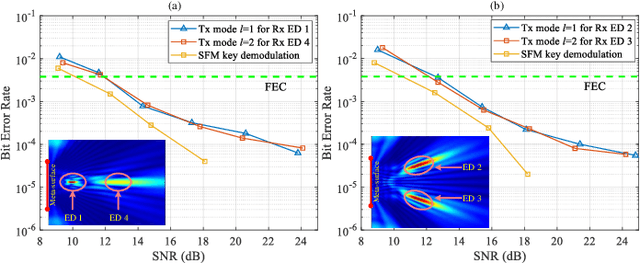
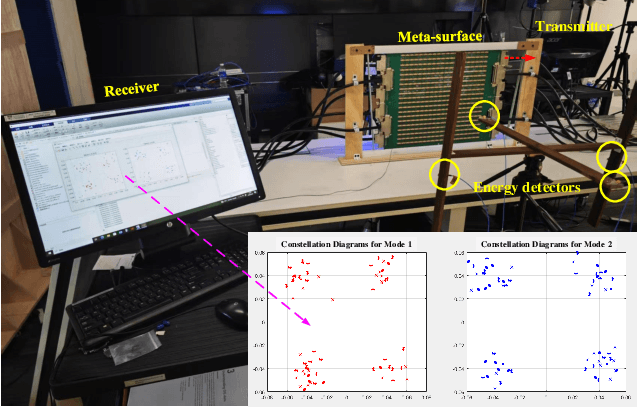

In this paper, we propose a novel secure wireless transmission architecture that enables the co-existence of spatial field modulation (SFM) and digital bandpass modulation (DBM), utilizing multi-mode vortex waves and programmable meta-surfaces (PMS). Distinct from conventional joint modulation schemes, our approach establishes two logically independent transmission channels--SFM and DBM--thereby eliminating the need for joint signal design or time synchronization. Specifically, the orthogonality of vortex wave modes is exploited to construct a high-capacity multi-mode DBM channel, in which each mode carries modulated symbols independently. As the composite waveform passes through the PMS, energy from different vortex modes is spatially focused onto distinct positions, dynamically determined by the PMS configuration. This spatial mapping forms a unique lookup table that encodes additional information in the electro-magnetic (EM) field distribution, effectively enabling a second, concurrent SFM channel. To enhance physical-layer security, the DBM channel transmits encrypted symbols transformed via dynamic symbol-domain mapping, while the corresponding mapping relations--or key information--are carried by the SFM channel. This lightweight dual-channel encryption strategy provides strong confidentiality without requiring complex joint decoding. To validate the feasibility of the proposed architecture, we design and implement a proof-of-concept prototype system, and conduct experimental demonstrations under real-world wireless communication conditions. The experimental results confirm the effectiveness of the co-existent DBM-SFM design in achieving reliable and secure transmission. The proposed architecture offers a scalable, low-complexity, and secure transmission solution for future IoT networks, especially in scenarios demanding both spectral efficiency and physical-layer confidentiality.