 Add to Chrome
 Add to Firefox
 Add to Edge
Enhanced Information Security via Wave-Field Selectivity and Structured Wavefront Manipulation
Dec 11, 2025

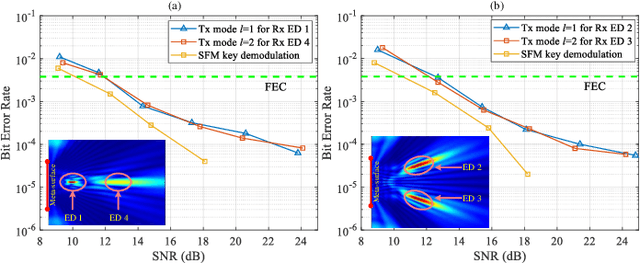
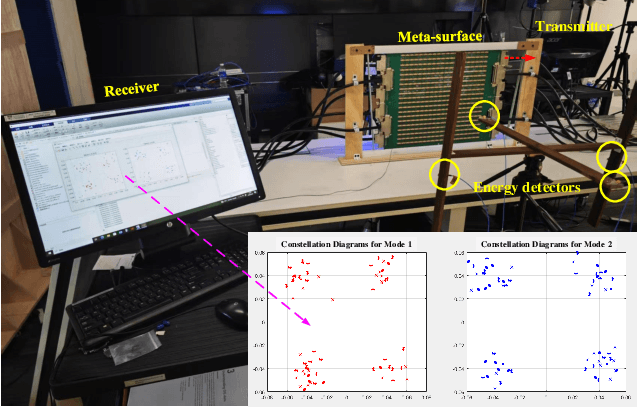

In this paper, we propose a novel secure wireless transmission architecture that enables the co-existence of spatial field modulation (SFM) and digital bandpass modulation (DBM), utilizing multi-mode vortex waves and programmable meta-surfaces (PMS). Distinct from conventional joint modulation schemes, our approach establishes two logically independent transmission channels--SFM and DBM--thereby eliminating the need for joint signal design or time synchronization. Specifically, the orthogonality of vortex wave modes is exploited to construct a high-capacity multi-mode DBM channel, in which each mode carries modulated symbols independently. As the composite waveform passes through the PMS, energy from different vortex modes is spatially focused onto distinct positions, dynamically determined by the PMS configuration. This spatial mapping forms a unique lookup table that encodes additional information in the electro-magnetic (EM) field distribution, effectively enabling a second, concurrent SFM channel. To enhance physical-layer security, the DBM channel transmits encrypted symbols transformed via dynamic symbol-domain mapping, while the corresponding mapping relations--or key information--are carried by the SFM channel. This lightweight dual-channel encryption strategy provides strong confidentiality without requiring complex joint decoding. To validate the feasibility of the proposed architecture, we design and implement a proof-of-concept prototype system, and conduct experimental demonstrations under real-world wireless communication conditions. The experimental results confirm the effectiveness of the co-existent DBM-SFM design in achieving reliable and secure transmission. The proposed architecture offers a scalable, low-complexity, and secure transmission solution for future IoT networks, especially in scenarios demanding both spectral efficiency and physical-layer confidentiality.

Low-Interference Near-Field Multi-User Communication Enabled by Spatially Converging Multi-Mode Vortex Waves
Feb 18, 2025
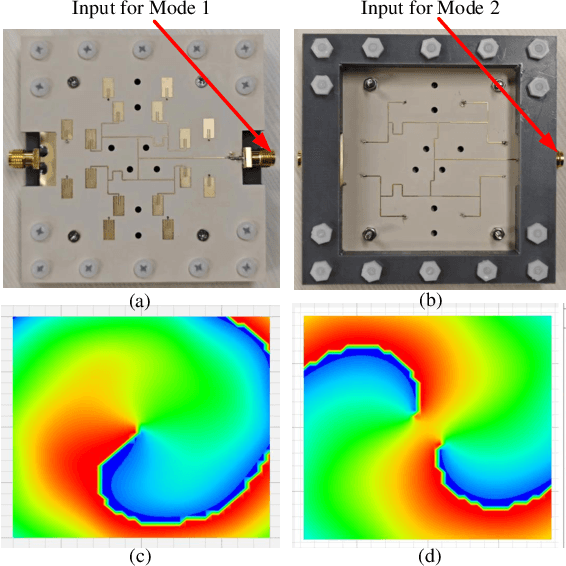
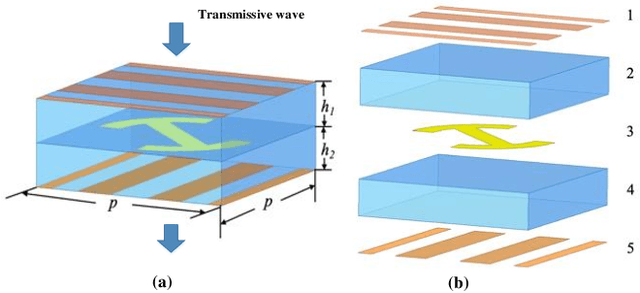
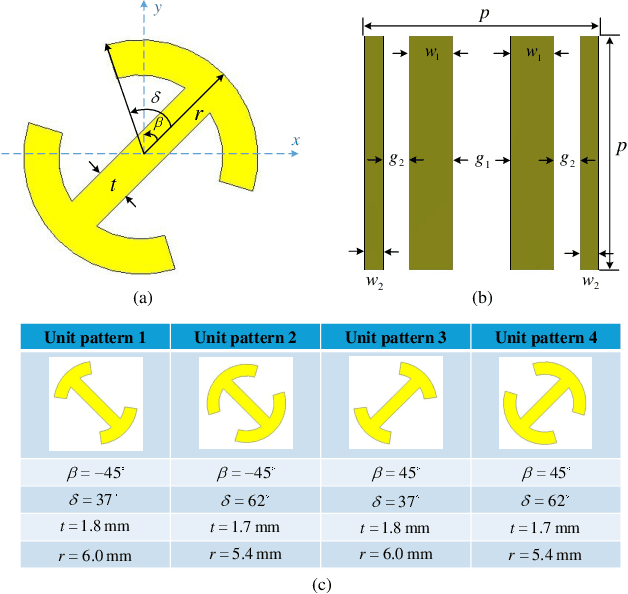
This paper proposes a multi-user Spatial Division Multiplexing (SDM) near-field access scheme, inspired by the orthogonal characteristics of multi-mode vortex waves. A Reconfigurable Meta-surface (RM) is ingeniously employed as the gateway for information transmission. This RM not only receives spatially overlapping multiplexed multi-mode vortex beams but also converts them into focused point beams in the near field. Specifically, a multi-port microstrip array method is utilized to generate multiple orthogonal vortex electromagnetic wave modes. Different ports serve as feeding points for baseband signals, allowing independent modulated data to be flexibly loaded onto different modes. After being adjusted by the RM, the vortex electromagnetic waves are converted into energy-focusing point beams, which can be directed to arbitrary 3D positions in the RM's near-field region and received by different users. Since the spatial positions of the point beams are non-overlapping, this approach not only ensures energy concentration but also significantly reduces inter-user interference. Near-field scanning results in a microwave anechoic chamber validate the effectiveness of this method, while real-time communication demonstrations confirm the system's capability for low-interference information multiplexing and transmission in practical scenarios.
Experimental Study of RCS Diversity with Novel No-divergent OAM Beams
Dec 25, 2024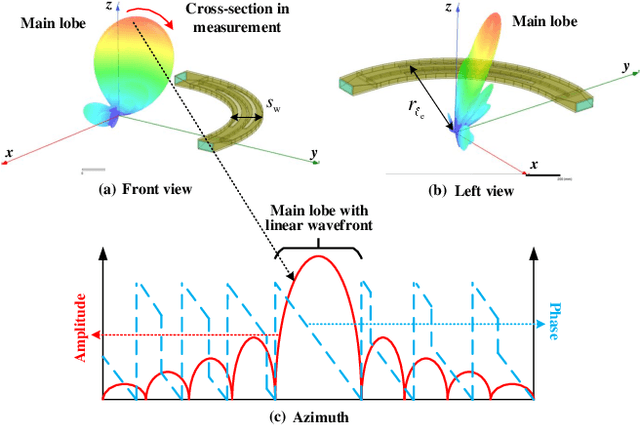


This research proposes a novel approach utilizing Orbital Angular Momentum (OAM) beams to enhance Radar Cross Section (RCS) diversity for target detection in future transportation systems. Unlike conventional OAM beams with hollow-shaped divergence patterns, the new proposed OAM beams provide uniform illumination across the target without a central energy void, but keep the inherent phase gradient of vortex property. We utilize waveguide slot antennas to generate four different modes of these novel OAM beams at X-band frequency. Furthermore, these different mode OAM beams are used to illuminate metal models, and the resulting RCS is compared with that obtained using plane waves. The findings reveal that the novel OAM beams produce significant azimuthal RCS diversity, providing a new approach for the detection of weak and small targets.This study not only reveals the RCS diversity phenomenon based on novel OAM beams of different modes but also addresses the issue of energy divergence that hinders traditional OAM beams in long-range detection applications.
Innovative RIS Prototyping Enhancing Wireless Communication with Real-Time Spot Beam Tracking and OAM Wavefront Manipulation
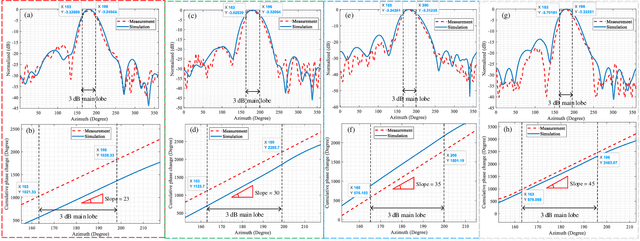
Jul 28, 2024This paper presents a sophisticated reconfigurable metasurface architecture that introduces an advanced concept of flexible full-array space-time wavefront manipulation with enhanced dynamic capabilities. The practical 2-bit phase-shifting unit cell on the RIS is distinguished by its ability to maintain four stable phase states, each with ${90^ \circ }$ differences, and features an insertion loss of less than 0.6 dB across a bandwidth of 200 MHz. All reconfigurable units are equipped with meticulously designed control circuits, governed by an intelligent core composed of multiple Micro-Controller Units (MCUs), enabling rapid control response across the entire RIS array. Owing to the capability of each unit cell on the metasurface to independently switch states, the entire RIS is not limited to controlling general beams with specific directional patterns, but also generates beams with more complex structures, including multi-focus 3D spot beams and vortex beams. This development substantially broadens its applicability across various industrial wireless transmission scenarios. Moreover, by leveraging the rapid-respond space-time coding and the full-array independent programmability of the RIS prototyping operating at 10.7 GHz, we have demonstrated that: 1) The implementation of 3D spot beams scanning facilitates dynamic beam tracking and real-time communication under the indoor near-field scenario; 2) The rapid wavefront rotation of vortex beams enables precise modulation of signals within the Doppler domain, showcasing an innovative approach to wireless signal manipulation; 3) The beam steering experiments for blocking users under outdoor far-field scenarios, verifying the beamforming capability of the RIS board.