 Add to Chrome
 Add to Firefox
 Add to Edge
GraphRareBench: An Auditable Graph-Evidence Benchmark for Phenotype-Driven Rare-Disease Diagnosis
Jul 27, 2026
Phenotype-driven diagnostic benchmarks usually report the rank of the reference disease, but they rarely reveal which plausible alternatives are ranked above it or what evidence a tool-using model examines before making its decision. We introduce GraphRareBench, a provenance-preserving benchmark containing 2,365 ontology-derived cases and 18,093 target-confounder pairs. Each case includes a coarsened HPO query, a fixed candidate pool, graph-defined hard confounders, and source-linked evidence records. On the 237-case gene-component-disjoint test split, supervised rankers using a shared 21-feature interface achieved MRRs ranging from 0.640 to 0.740 and case-averaged target-over-confounder accuracies ranging from 0.898 to 0.916. Agents instantiated with Agents-A1 and DeepSeek-V4-Flash achieved MRRs of 0.746 and 0.718, respectively. Their paired MRR difference was not statistically significant, whereas their target-evidence coverage differed by 0.561. Together with the observation that 22.1% to 43.7% of selected Hit@10 successes still ranked at least one graph-defined hard confounder above the target, these results indicate that full-pool retrieval, hard-confounder discrimination, and observable evidence access capture complementary aspects of model behavior. GraphRareBench therefore provides a foundation for more transparent and evidence-aware evaluation of phenotype-driven diagnostic systems. Code and data are available at https://github.com/GUI0609/GraphRareBench.

Beyond Demographics: Enhancing Cultural Value Survey Simulation with Multi-Stage Personality-Driven Cognitive Reasoning
Aug 25, 2025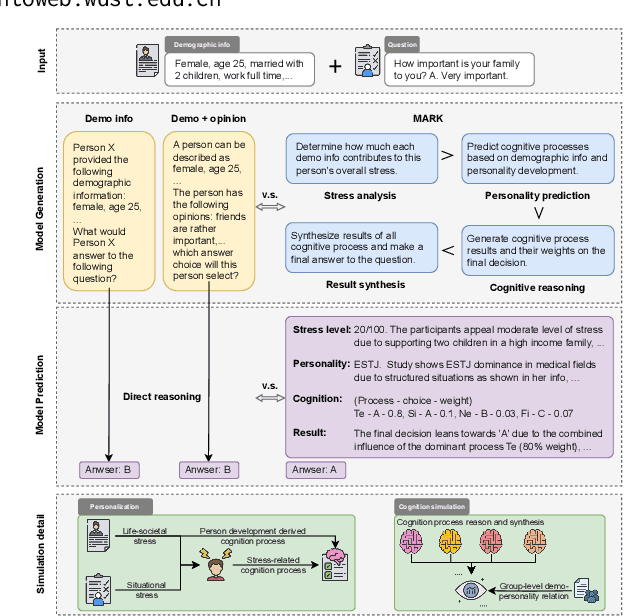

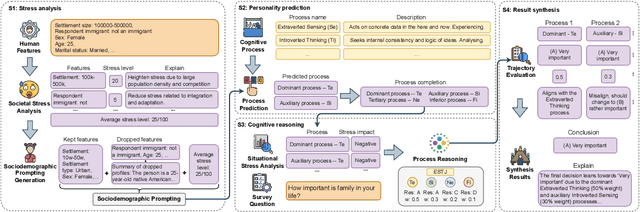
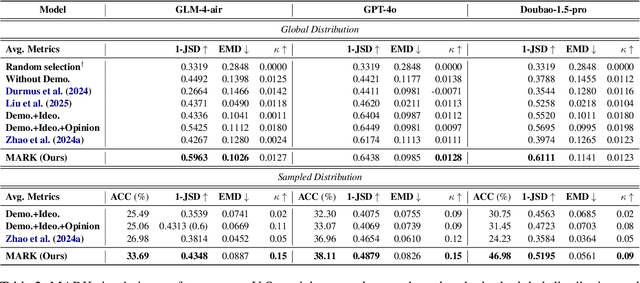
Introducing MARK, the Multi-stAge Reasoning frameworK for cultural value survey response simulation, designed to enhance the accuracy, steerability, and interpretability of large language models in this task. The system is inspired by the type dynamics theory in the MBTI psychological framework for personality research. It effectively predicts and utilizes human demographic information for simulation: life-situational stress analysis, group-level personality prediction, and self-weighted cognitive imitation. Experiments on the World Values Survey show that MARK outperforms existing baselines by 10% accuracy and reduces the divergence between model predictions and human preferences. This highlights the potential of our framework to improve zero-shot personalization and help social scientists interpret model predictions.
Merging Clinical Knowledge into Large Language Models for Medical Research and Applications: A Survey
Feb 28, 2025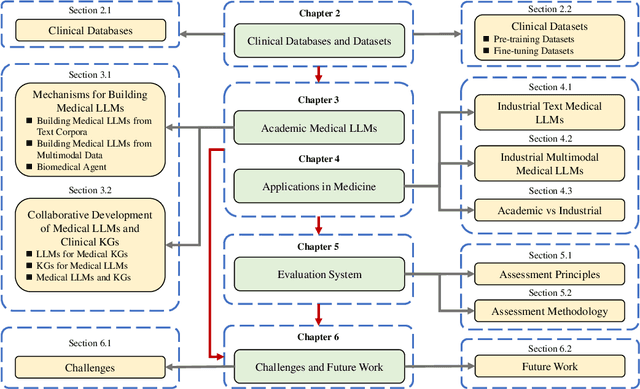
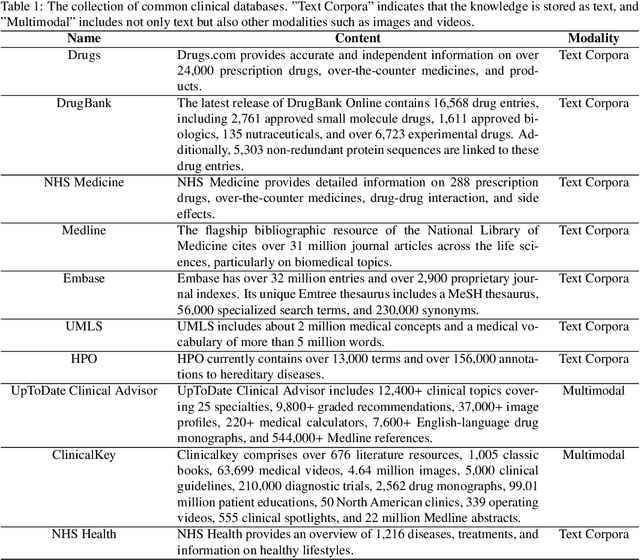
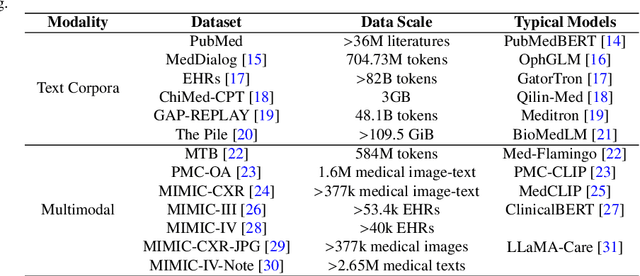
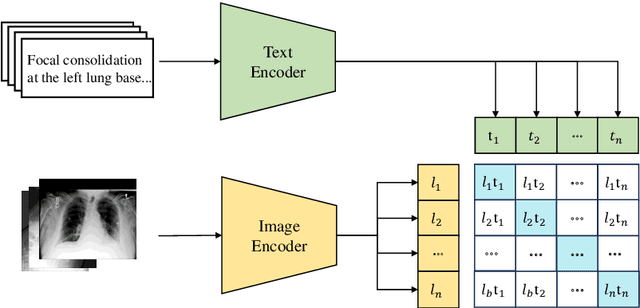
Clinical knowledge is the collection of information learned from studies on the causes, prognosis, diagnosis, and treatment of diseases. This type of knowledge can improve curing performances, and promote physical health. With the emergence of large language models (LLMs), medical artificial intelligence (medical AI), which aims to apply academic medical AI systems to real-world medical scenarios, has entered a new age of development, resulting in excellent works such as DoctorGPT and Pangu-Drug from academic and industrial researches. However, the field lacks a comprehensive compendium and comparison of building medical AI systems from academia and industry. Therefore, this survey focuses on the building paradigms of medical AI systems including the use of clinical databases, datasets, training pipelines, integrating medical knowledge graphs, system applications, and evaluation systems. We hope that this survey can help relevant practical researchers understand the current performance of academic models in various fields of healthcare, as well as the potential problems and future directions for implementing these scientific achievements.
An interpretable imbalanced semi-supervised deep learning framework for improving differential diagnosis of skin diseases
Nov 20, 2022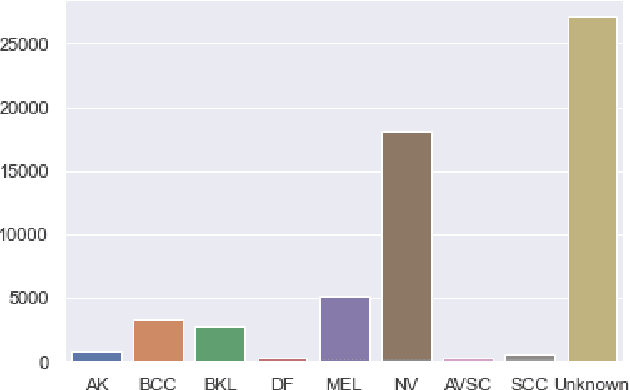
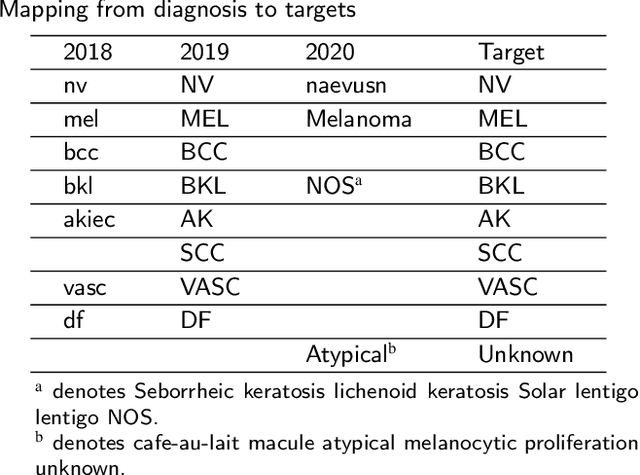
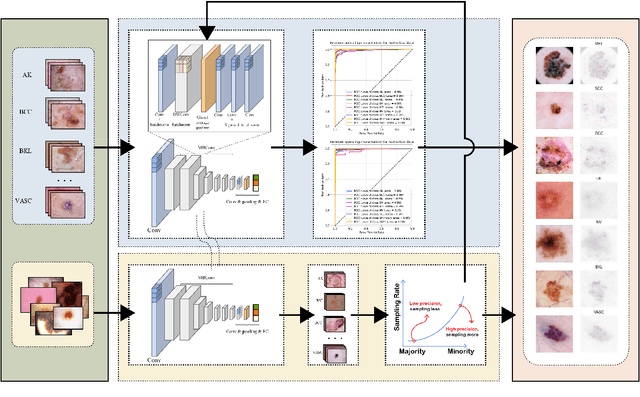
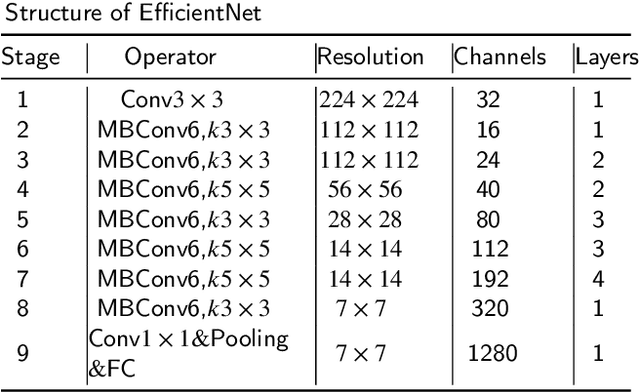
Dermatological diseases are among the most common disorders worldwide. This paper presents the first study of the interpretability and imbalanced semi-supervised learning of the multiclass intelligent skin diagnosis framework (ISDL) using 58,457 skin images with 10,857 unlabeled samples. Pseudo-labelled samples from minority classes have a higher probability at each iteration of class-rebalancing self-training, thereby promoting the utilization of unlabeled samples to solve the class imbalance problem. Our ISDL achieved a promising performance with an accuracy of 0.979, sensitivity of 0.975, specificity of 0.973, macro-F1 score of 0.974 and area under the receiver operating characteristic curve (AUC) of 0.999 for multi-label skin disease classification. The Shapley Additive explanation (SHAP) method is combined with our ISDL to explain how the deep learning model makes predictions. This finding is consistent with the clinical diagnosis. We also proposed a sampling distribution optimisation strategy to select pseudo-labelled samples in a more effective manner using ISDLplus. Furthermore, it has the potential to relieve the pressure placed on professional doctors, as well as help with practical issues associated with a shortage of such doctors in rural areas.