 Add to Chrome
 Add to Firefox
 Add to Edge
Improving Cross-Lingual Factual Recall via Consistency-Driven Reinforcement Learning
Jun 04, 2026
Large language models (LLMs) trained predominantly on English data encode substantial world knowledge, yet often fail to express it reliably in other languages, a phenomenon known as cross-lingual factual inconsistency. To study and address this, we introduce PolyFact, a large-scale parallel multilingual factual QA dataset containing 100K Wikidata-grounded facts across 12 typologically diverse languages. Using PolyFact, we compare light continual pretraining (CPT), supervised fine-tuning (SFT), and reinforcement learning via Group Relative Policy Optimization (GRPO) for improving cross-lingual factual recall in Qwen-2.5-7B and OLMo-2-1124-7B. We find that GRPO consistently outperforms SFT, improving both cross-lingual consistency and generalization to unseen languages, while CPT on parallel data yields limited additional gains. Mechanistic analyses further show that GRPO reorganizes multilingual routing by reducing language specialization in MLP layers and attention heads, thereby promoting more shared cross-lingual representations. We release our code, models, and dataset.

UniComp: A Unified Evaluation of Large Language Model Compression via Pruning, Quantization and Distillation
Feb 11, 2026Model compression is increasingly essential for deploying large language models (LLMs), yet existing evaluations are limited in method coverage and focus primarily on knowledge-centric benchmarks. Thus, we introduce UniComp, a unified evaluation framework for comparing pruning, quantization, and knowledge distillation. UniComp evaluates compressed models along three dimensions: performance, reliability, and efficiency, using a diverse set of capability- and safety-oriented benchmarks together with a hardware-aware efficiency analysis. Through extensive evaluation of six compression techniques on modern LLMs across more than 40 datasets, we find that (i) compression exhibits a consistent knowledge bias, where knowledge-intensive tasks are relatively preserved while reasoning, multilingual, and instruction-following capabilities degrade substantially; (ii) quantization provides the best overall trade-off between retained performance and efficiency, whereas distillation yields strong runtime acceleration gains at high computational cost; and (iii) task-specific calibration can significantly improve the reasoning ability of pruned models by up to 50%.
Investigating the Effect of Network Pruning on Performance and Interpretability
Sep 29, 2024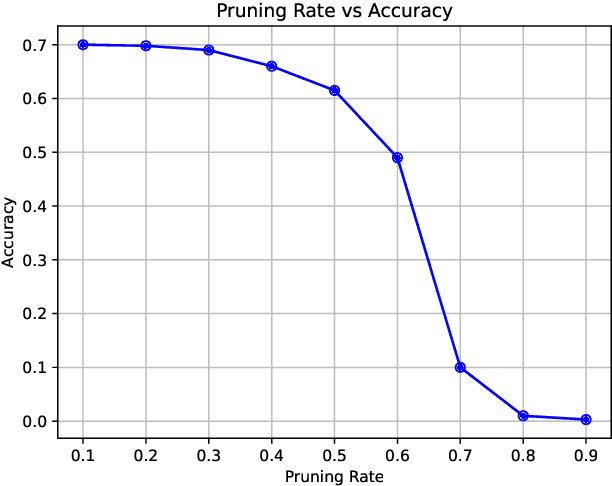

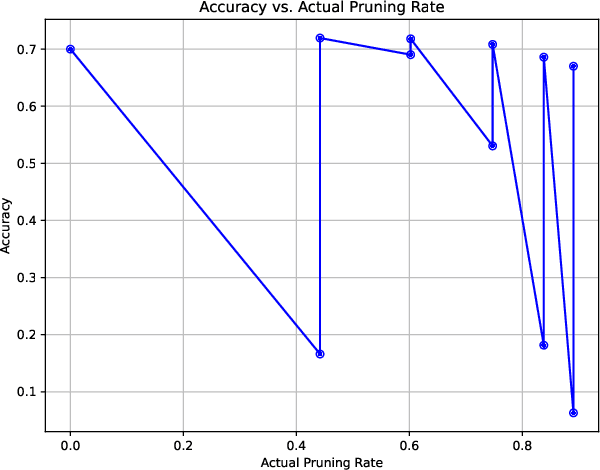
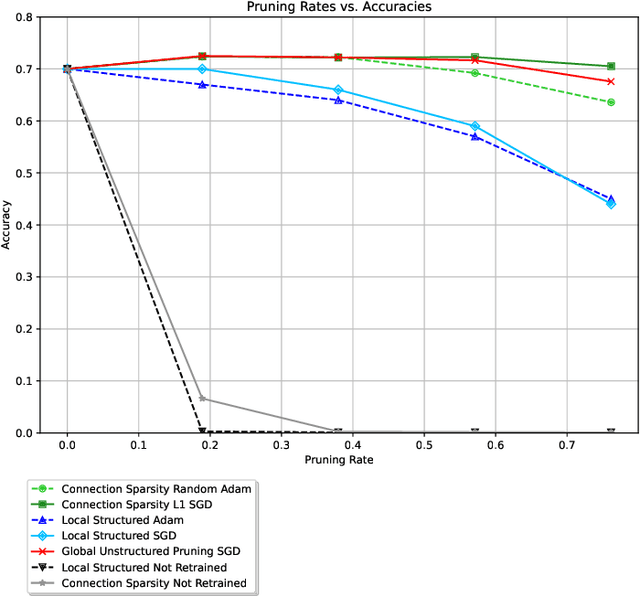
Deep Neural Networks (DNNs) are often over-parameterized for their tasks and can be compressed quite drastically by removing weights, a process called pruning. We investigate the impact of different pruning techniques on the classification performance and interpretability of GoogLeNet. We systematically apply unstructured and structured pruning, as well as connection sparsity (pruning of input weights) methods to the network and analyze the outcomes regarding the network's performance on the validation set of ImageNet. We also compare different retraining strategies, such as iterative pruning and one-shot pruning. We find that with sufficient retraining epochs, the performance of the networks can approximate the performance of the default GoogLeNet - and even surpass it in some cases. To assess interpretability, we employ the Mechanistic Interpretability Score (MIS) developed by Zimmermann et al. . Our experiments reveal that there is no significant relationship between interpretability and pruning rate when using MIS as a measure. Additionally, we observe that networks with extremely low accuracy can still achieve high MIS scores, suggesting that the MIS may not always align with intuitive notions of interpretability, such as understanding the basis of correct decisions.