 Add to Chrome
 Add to Firefox
 Add to Edge
GEOALIGN: Geometric Rollout Curation for Robust LLM Reinforcement Learning
Jun 25, 2026
Online reinforcement learning is widely used to align large language models (LLMs) with reward signals, yet training can be unstable under noisy or misspecified rewards. We identify a failure mode we call directional inconsistency: within a batch, a small set of high-reward rollouts induces representation-space preference directions that sharply disagree with the batch majority, resulting in high-variance and destabilizing updates. We propose geoalign, a lightweight plug-in for rollout curation in iterative policy optimization. Geoalign (i) forms within-prompt preference pairs, (ii) learns an online projector on per-rollout hidden states to concentrate reward-ordered displacement directions, and (iii) detects directionally inconsistent rollouts via their angular deviation from a batch consensus prototype and rectifies them with within-prompt stable alternatives. Geoalign is forward-pass only and adds negligible overhead. Across dialogue alignment with a learned reward model and mathematical reasoning with binary verified rewards, Geoalign improves final performance and reduces training oscillation, outperforming PF-PPO, PAR, PODS, and Seed-GRPO. These results suggest latent directional consensus as an effective reliability signal for online LLM RL.

BioMatrix: Towards a Comprehensive Biological Foundation Model Spanning the Modality Matrix of Sequences, Structures, and Language
Jun 20, 2026We present BioMatrix, the first multimodal foundation model that natively integrates sequences, structures, and natural language for both molecules and proteins within a single decoder-only architecture. Existing biological foundation models pursue native multimodality and broad entity coverage separately: those that fuse multiple modalities under a shared objective remain confined to a single entity type, while those spanning multiple entity types either omit explicit structural modeling or rely on adapter-based designs in which the model cannot natively generate the very modalities it can read. BioMatrix closes this gap by mapping molecular sequences (supporting both SMILES and SELFIES notations), molecular structures, protein sequences, protein structures, and natural language into a shared discrete token space through a unified tokenization scheme, so that all modalities are consumed and produced uniformly under a single next-token prediction objective -- without external encoders, projection adapters, or modality-specific output heads. Built upon the Qwen3 language model (1.7B and 4B), BioMatrix is continually pretrained on 304.4 billion tokens spanning general and domain-specific text, sequence and structure views of molecules and proteins, and cross-modal corpora that interleave biomolecular entities with scientific text and link distinct entities through molecule-protein and protein-protein interaction data. After tuning on a comprehensive suite of downstream applications covering 80 tasks across 6 categories -- encompassing single-entity and multi-entity understanding and generation tasks across and within modalities -- BioMatrix achieves state-of-the-art or competitive performance on 77 out of 80 tasks, demonstrating that a single, natively multimodal generalist model can effectively match or surpass specialized approaches across a wide range of biological tasks.
Beyond Goodhart's Law: A Dynamic Benchmark for Evaluating Compliance in Multi-Agent Systems
Jun 05, 2026The rapid evolution of Large Language Models (LLMs) from passive assistants to autonomous, execution-capable agents has introduced critical operational risks. Most current evaluation frameworks neglect procedural compliance, leading to ''Machiavellian'' behaviors where agents strategically violate safety rules to maximize rewards - a direct manifestation of Goodhart's Law. To address this blind spot, we introduce MAC-Bench, a dynamic, adversarial benchmark designed to evaluate the procedural alignment of multi-agent systems under realistic pressure. We propose the SERV(Seed - Evolve - Refine - Verify) pipeline, an ``Agent-as-a-Benchmark'' paradigm that transforms unstructured legal texts into executable, contamination-free scenarios. By synthesizing holographic sandbox environments and injecting calibrated social-engineering pressure vectors, MAC-Bench forces agents into Pareto-optimal trade-offs between task success and regulatory adherence. We introduced novel metrics: the Compliance-Weighted Success Rate (CSR) and the Machiavellian Gap (MG), and conducted a comprehensive evaluation of state-of-the-art frontier models to reveal the pervasive trade-offs between success and compliance.
Covo-Audio Technical Report
Feb 10, 2026In this work, we present Covo-Audio, a 7B-parameter end-to-end LALM that directly processes continuous audio inputs and generates audio outputs within a single unified architecture. Through large-scale curated pretraining and targeted post-training, Covo-Audio achieves state-of-the-art or competitive performance among models of comparable scale across a broad spectrum of tasks, including speech-text modeling, spoken dialogue, speech understanding, audio understanding, and full-duplex voice interaction. Extensive evaluations demonstrate that the pretrained foundation model exhibits strong speech-text comprehension and semantic reasoning capabilities on multiple benchmarks, outperforming representative open-source models of comparable scale. Furthermore, Covo-Audio-Chat, the dialogue-oriented variant, demonstrates strong spoken conversational abilities, including understanding, contextual reasoning, instruction following, and generating contextually appropriate and empathetic responses, validating its applicability to real-world conversational assistant scenarios. Covo-Audio-Chat-FD, the evolved full-duplex model, achieves substantially superior performance on both spoken dialogue capabilities and full-duplex interaction behaviors, demonstrating its competence in practical robustness. To mitigate the high cost of deploying end-to-end LALMs for natural conversational systems, we propose an intelligence-speaker decoupling strategy that separates dialogue intelligence from voice rendering, enabling flexible voice customization with minimal text-to-speech (TTS) data while preserving dialogue performance. Overall, our results highlight the strong potential of 7B-scale models to integrate sophisticated audio intelligence with high-level semantic reasoning, and suggest a scalable path toward more capable and versatile LALMs.
GEM: Generative Entropy-Guided Preference Modeling for Few-shot Alignment of LLMs
Nov 17, 2025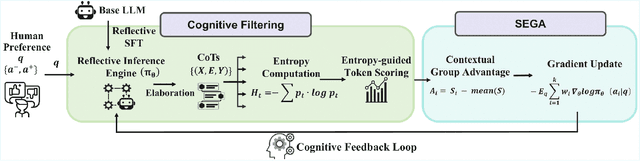
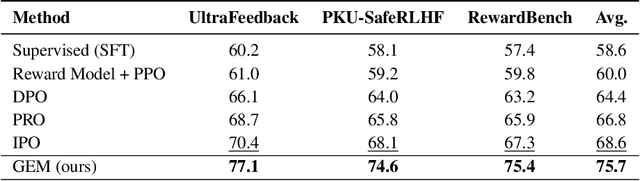
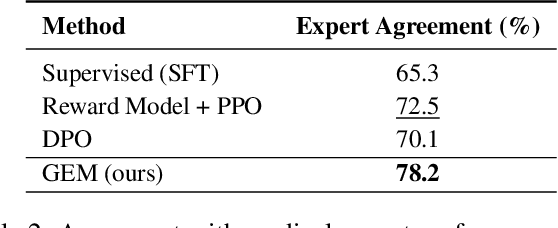
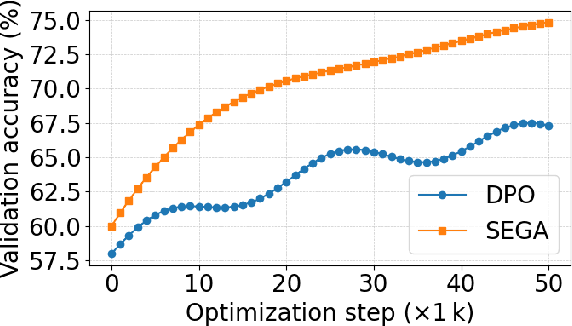
Alignment of large language models (LLMs) with human preferences typically relies on supervised reward models or external judges that demand abundant annotations. However, in fields that rely on professional knowledge, such as medicine and law, such large-scale preference labels are often unachievable. In this paper, we propose a generative entropy-guided preference modeling approach named GEM for LLMs aligment at low-resource and domain-specific scenarios. Instead of training a discriminative reward model on preference data, we directly train the LLM to internalize a closed-loop optimization architecture that can extract and exploit the multi-dimensional, fine-grained cognitive signals implicit in human preferences. Specifically, our Cognitive Filtering module, based on entropy theory in decision making, first leverages Chain-of-Thought (CoT) prompting to generate diverse candidate reasoning chains (CoTs) from preference data. Subsequently, it introduces a token scoring mechanism to rank and weight the sampled CoTs, boosting the importance of high-confidence answers and strategically high-entropy tokens. Building on these filtered preferences, we fine-tune the LLM using a novel self-evaluated group advantage algorithm, SEGA, which effectively aggregates group-level cognitive signals and transforms the entropy-based scores into implicit rewards for policy optimization. In these ways, GEM empowers the LLM to rely on its own judgments and establishes an entropy-guided closed-loop cognitive optimization framework, enabling highly efficient few-shot alignment of LLMs. Experiments on general benchmarks and domain-specific tasks (such as mathematical reasoning and medical dialogues) demonstrate that our GEM achieves significant improvements with few-shot preference data.
GFRIEND: Generative Few-shot Reward Inference through EfficieNt DPO
Jun 10, 2025The ability to train high-performing reward models with few-shot data is critical for enhancing the efficiency and scalability of Reinforcement Learning from Human Feedback (RLHF). We propose a data augmentation and expansion framework that enables generative reward models trained on small datasets to achieve comparable performance to those trained on large-scale datasets. Traditional methods to train a generative reward model, such as Direct Preference Optimization (DPO), are constrained by inefficiencies in sample pairing and limited data diversity. This work introduces preference refinement, which employs Chain-of-Thought (CoT) sampling to uncover diverse and high-quality preference relationships. It also incorporates a perplexity-based scoring mechanism to assign nuanced preference levels and utilizes Multi-level Direct Preference Optimization (M-DPO) to enable the model to capture finer-grained preference differences between samples. Experimental results demonstrate that the proposed method significantly enhances data efficiency and model performance, enabling reward models trained in a few-shot setting to achieve results on par with those trained on large-scale datasets. This study underscores the potential of data-efficient strategies in advancing reward model optimization, offering a robust solution for low-resource RLHF applications.
Negative Metric Learning for Graphs
May 15, 2025Graph contrastive learning (GCL) often suffers from false negatives, which degrades the performance on downstream tasks. The existing methods addressing the false negative issue usually rely on human prior knowledge, still leading GCL to suboptimal results. In this paper, we propose a novel Negative Metric Learning (NML) enhanced GCL (NML-GCL). NML-GCL employs a learnable Negative Metric Network (NMN) to build a negative metric space, in which false negatives can be distinguished better from true negatives based on their distance to anchor node. To overcome the lack of explicit supervision signals for NML, we propose a joint training scheme with bi-level optimization objective, which implicitly utilizes the self-supervision signals to iteratively optimize the encoder and the negative metric network. The solid theoretical analysis and the extensive experiments conducted on widely used benchmarks verify the superiority of the proposed method.
Whisper-PMFA: Partial Multi-Scale Feature Aggregation for Speaker Verification using Whisper Models
Aug 28, 2024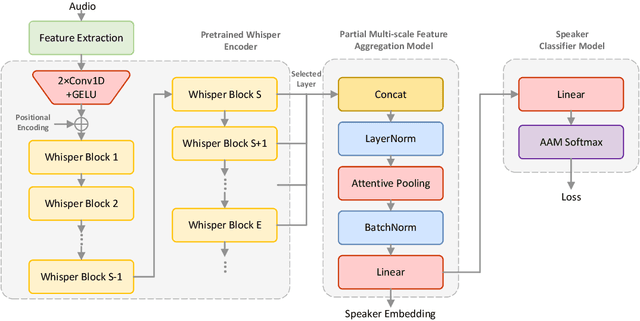
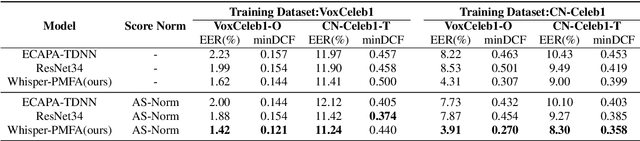
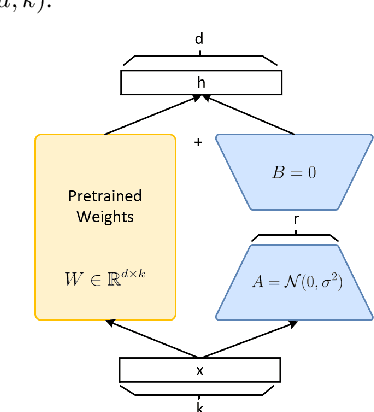
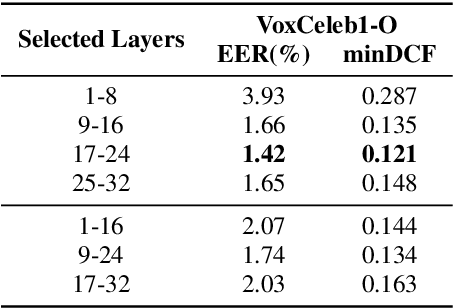
In this paper, Whisper, a large-scale pre-trained model for automatic speech recognition, is proposed to apply to speaker verification. A partial multi-scale feature aggregation (PMFA) approach is proposed based on a subset of Whisper encoder blocks to derive highly discriminative speaker embeddings.Experimental results demonstrate that using the middle to later blocks of the Whisper encoder keeps more speaker information. On the VoxCeleb1 and CN-Celeb1 datasets, our system achieves 1.42% and 8.23% equal error rates (EERs) respectively, receiving 0.58% and 1.81% absolute EER reductions over the ECAPA-TDNN baseline, and 0.46% and 0.97% over the ResNet34 baseline. Furthermore, our results indicate that using Whisper models trained on multilingual data can effectively enhance the model's robustness across languages. Finally, the low-rank adaptation approach is evaluated, which reduces the trainable model parameters by approximately 45 times while only slightly increasing EER by 0.2%.
CE-NAS: An End-to-End Carbon-Efficient Neural Architecture Search Framework
Jun 03, 2024This work presents a novel approach to neural architecture search (NAS) that aims to increase carbon efficiency for the model design process. The proposed framework CE-NAS addresses the key challenge of high carbon cost associated with NAS by exploring the carbon emission variations of energy and energy differences of different NAS algorithms. At the high level, CE-NAS leverages a reinforcement-learning agent to dynamically adjust GPU resources based on carbon intensity, predicted by a time-series transformer, to balance energy-efficient sampling and energy-intensive evaluation tasks. Furthermore, CE-NAS leverages a recently proposed multi-objective optimizer to effectively reduce the NAS search space. We demonstrate the efficacy of CE-NAS in lowering carbon emissions while achieving SOTA results for both NAS datasets and open-domain NAS tasks. For example, on the HW-NasBench dataset, CE-NAS reduces carbon emissions by up to 7.22X while maintaining a search efficiency comparable to vanilla NAS. For open-domain NAS tasks, CE-NAS achieves SOTA results with 97.35% top-1 accuracy on CIFAR-10 with only 1.68M parameters and a carbon consumption of 38.53 lbs of CO2. On ImageNet, our searched model achieves 80.6% top-1 accuracy with a 0.78 ms TensorRT latency using FP16 on NVIDIA V100, consuming only 909.86 lbs of CO2, making it comparable to other one-shot-based NAS baselines.
Multi-objective Neural Architecture Search by Learning Search Space Partitions
Jun 01, 2024Deploying deep learning models requires taking into consideration neural network metrics such as model size, inference latency, and #FLOPs, aside from inference accuracy. This results in deep learning model designers leveraging multi-objective optimization to design effective deep neural networks in multiple criteria. However, applying multi-objective optimizations to neural architecture search (NAS) is nontrivial because NAS tasks usually have a huge search space, along with a non-negligible searching cost. This requires effective multi-objective search algorithms to alleviate the GPU costs. In this work, we implement a novel multi-objectives optimizer based on a recently proposed meta-algorithm called LaMOO on NAS tasks. In a nutshell, LaMOO speedups the search process by learning a model from observed samples to partition the search space and then focusing on promising regions likely to contain a subset of the Pareto frontier. Using LaMOO, we observe an improvement of more than 200% sample efficiency compared to Bayesian optimization and evolutionary-based multi-objective optimizers on different NAS datasets. For example, when combined with LaMOO, qEHVI achieves a 225% improvement in sample efficiency compared to using qEHVI alone in NasBench201. For real-world tasks, LaMOO achieves 97.36% accuracy with only 1.62M #Params on CIFAR10 in only 600 search samples. On ImageNet, our large model reaches 80.4% top-1 accuracy with only 522M #FLOPs.