 Add to Chrome
 Add to Firefox
 Add to Edge
Failure-Informed Image Self-Augmentation for Multimodal Large Language Model Self-Improvement
Aug 04, 2026
Multimodal large language models (MLLMs) have achieved remarkable performance across vision-language tasks, but their progress depends heavily on large-scale, high-quality multimodal data that are costly to annotate. Self-augmentation offers a promising alternative by enabling models to expand their own training data without external supervision. However, existing MLLM self-augmentation methods are largely text-centric, while image augmentation remains underexplored and typically relies on generic or handcrafted transformations that are weakly aligned with the model's actual incapability. We propose Failure-informed Image Self-Augmentation (\textbf{FISA}), a framework for MLLM self-improvement that constructs augmented images from the model's own failure cases. Our method generates visually challenging yet answer-preserving image complications, verifies their utility through self-examination, and applies dual fidelity filtering to avoid semantic distortion. Experiments on visual question answering benchmarks show that the proposed method consistently improves performance across both in-distribution and out-of-distribution settings. Further experiments validate the compatibility of FISA with existing textual self-augmentation approaches, the superior data efficiency of the synthesized samples over generic image augmentation baselines, and the practical effectiveness of the proposed filtering strategy.

HOMIE: Human-object Centric Video Personalization via Multimodal Intelligent Enhancement
Jul 21, 2026Human-object centric video personalization (HOCVP) is a core task within subject-driven video generation. However, existing methods suffer from two key limitations. First, most approaches focusing on inter-subject personalization still struggle to strike a balance between high subject fidelity and accurate interaction patterns between humans and diverse objects, especially when objects represent abstract concepts such as logos. Second, while intra-subject references (e.g., OCR maps, multi-view inputs) are expected to enhance subject fidelity, most existing works lack mechanisms to understand such latent correspondence. To address both challenges, we propose HOMIE, an HOCVP framework that tackles both inter- and intra-subject input settings in a unified manner. Compared to previous approaches, HOMIE proposes a better MLLM integration strategy to extract knowledge of reference-level relationships without compromising the controllability of text encoders or incurring costly re-alignment. Specifically, we introduce global multimodal guidance within self-attention to better align MLLM-derived semantic features with VAE tokens. Furthermore, we propose modality-reference embedding to differentiate tokens from MLLM features and VAE tokens and associate intra-subject reference image tokens. Extensive experiments validate that our method achieves state-of-the-art performance across various HOCVP tasks. Project Page: https://yiyangcai.github.io/homie-page.github.io/
ReBind: Multi-Reference Video Editing via Structured Instructions with Explicit Reference Relationships
Jul 16, 2026Recent diffusion-based video generation models have made significant progress in multi-reference image-conditioned video editing. However, existing methods still struggle to coordinate information from multiple visual sources accurately. We identify a critical deficiency in existing approaches. Existing editing instructions lack explicit reference relationships, and most multimodal large language models (MLLMs) cannot generate them reliably. To address this problem, we propose ReBind, a systematic framework that introduces semantic instructions with embedded reference tokens as the intermediate representation for multi-reference image-conditioned video editing. Our key insight is embedding reference tokens at semantic positions to eliminate ambiguity and establish precise bindings between visual attributes and their sources. We develop ReBind-Instruct, a specialized MLLM that learns to establish explicit bindings between visual attributes and their reference sources through a two-stage progressive scheme for precise reference relationships. We further develop ReBind-Edit, which enables lightweight adaptation of text-to-video models to coordinate multiple references by binding visual attributes to their designated sources. Extensive experiments demonstrate that ReBind substantially outperforms general-purpose MLLMs in instruction quality and achieves state-of-the-art performance among open-source methods on reference image conditioned video editing. Our project webpage: https://rebind-mrv2v.github.io/.
DomainShuttle: Freeform Open Domain Subject-driven Text-to-video Generation
Jun 24, 2026Open domain subject-driven text-to-video (S2V) generation has drawn significant interest in academia and industry. Open domain S2V mainly involves two scenarios: in-domain, which requires retaining the reference subject features as much as possible, and cross-domain, which preserves the intrinsic features of the subject while allowing subject-irrelevant properties to vary flexibly according to the text prompt. Existing methods primarily focus on maximizing subject fidelity in in-domain scenarios, which limits their editability and adaptability in cross-domain scenarios, such as novel styles, semantic combinations, or domain attributes. In this study, we propose that an ideal S2V method should flexibly shuttle between different domains, achieving strong performance in both in-domain and cross-domain scenarios. To this end, we propose DomainShuttle, which could achieve high fidelity and generative flexibility for open domain video personalization. Specifically, we introduce Domain-MoT, which decouples videos and reference features and introduces the domain-aware AdaLN for domain-specific modeling of reference images. We then introduce the Video-Reference DualRoPE scheme, which places reference image tokens and video tokens in separate RoPE spaces to enable precise subject-level spatial modeling, and Cross-Pair Consistent Loss, which aims to extract intrinsic subject features unaffected by irrelevant features. Extensive experiments demonstrate that DomainShuttle achieves significant performance improvements over existing methods, exhibiting high subject fidelity and generative flexibility across diverse open domain application scenarios.
Windowed Fourier Propagator: A Frequency-Local Neural Operator for Wave Equations in Inhomogeneous Media
Mar 15, 2026Wave equations are fundamental to describing a vast array of physical phenomena, yet their simulation in inhomogeneous media poses a computational challenge due to the highly oscillatory nature of the solutions. To overcome the high costs of traditional solvers, we propose the Windowed Fourier Propagator (WFP), a novel neural operator that efficiently learns the solution operator. The WFP's design is rooted in the physical principle of frequency locality, where wave energy scatters primarily to adjacent frequencies. By learning a set of compact, localized propagators, each mapping an input frequency to a small window of outputs, our method avoids the complexity of dense interaction models and achieves computational efficiency. Another key feature is the explicit preservation of superposition, which enables remarkable generalization from simple training data (e.g., plane waves) to arbitrary, complex wave states. We demonstrate that the WFP provides an explainable, efficient and accurate framework for data-driven wave modeling in complex media.
Graceful Forgetting in Generative Language Models
May 26, 2025Recently, the pretrain-finetune paradigm has become a cornerstone in various deep learning areas. While in general the pre-trained model would promote both effectiveness and efficiency of downstream tasks fine-tuning, studies have shown that not all knowledge acquired during pre-training is beneficial. Some of the knowledge may actually bring detrimental effects to the fine-tuning tasks, which is also known as negative transfer. To address this problem, graceful forgetting has emerged as a promising approach. The core principle of graceful forgetting is to enhance the learning plasticity of the target task by selectively discarding irrelevant knowledge. However, this approach remains underexplored in the context of generative language models, and it is often challenging to migrate existing forgetting algorithms to these models due to architecture incompatibility. To bridge this gap, in this paper we propose a novel framework, Learning With Forgetting (LWF), to achieve graceful forgetting in generative language models. With Fisher Information Matrix weighting the intended parameter updates, LWF computes forgetting confidence to evaluate self-generated knowledge regarding the forgetting task, and consequently, knowledge with high confidence is periodically unlearned during fine-tuning. Our experiments demonstrate that, although thoroughly uncovering the mechanisms of knowledge interaction remains challenging in pre-trained language models, applying graceful forgetting can contribute to enhanced fine-tuning performance.
Foundation Cures Personalization: Recovering Facial Personalized Models' Prompt Consistency
Nov 22, 2024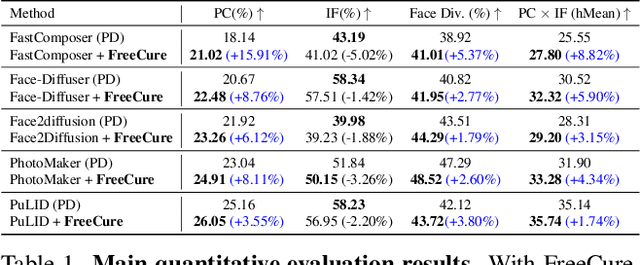
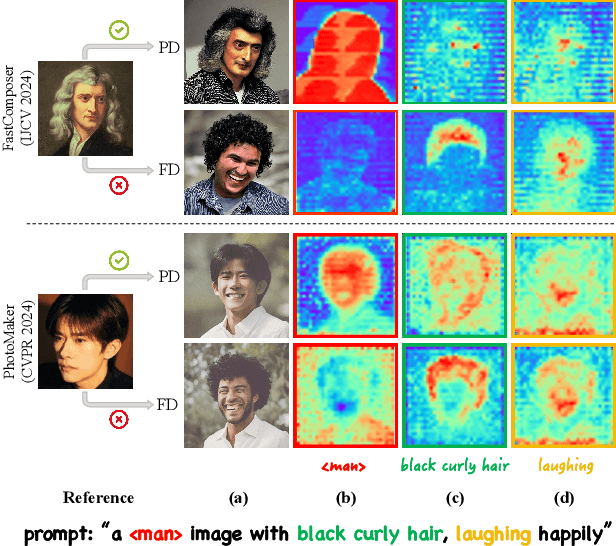
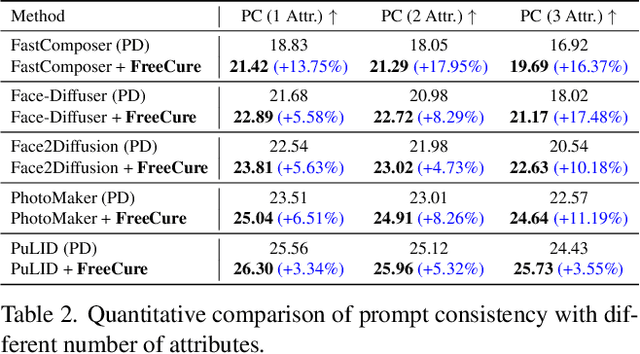
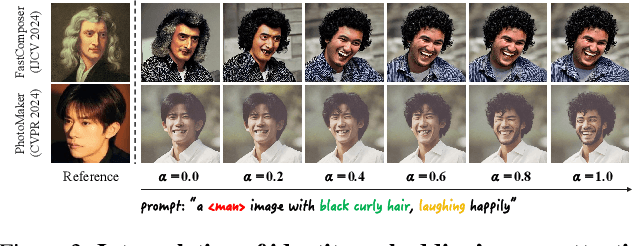
Facial personalization represents a crucial downstream task in the domain of text-to-image generation. To preserve identity fidelity while ensuring alignment with user-defined prompts, current mainstream frameworks for facial personalization predominantly employ identity embedding mechanisms to associate identity information with textual embeddings. However, our experiments show that identity embeddings compromise the effectiveness of other tokens within the prompt, thereby hindering high prompt consistency, particularly when prompts involve multiple facial attributes. Moreover, previous works overlook the fact that their corresponding foundation models hold great potential to generate faces aligning to prompts well and can be easily leveraged to cure these ill-aligned attributes in personalized models. Building upon these insights, we propose FreeCure, a training-free framework that harnesses the intrinsic knowledge from the foundation models themselves to improve the prompt consistency of personalization models. First, by extracting cross-attention and semantic maps from the denoising process of foundation models, we identify easily localized attributes (e.g., hair, accessories, etc). Second, we enhance multiple attributes in the outputs of personalization models through a novel noise-blending strategy coupled with an inversion-based process. Our approach offers several advantages: it eliminates the need for training; it effectively facilitates the enhancement for a wide array of facial attributes in a non-intrusive manner; and it can be seamlessly integrated into existing popular personalization models. FreeCure has demonstrated significant improvements in prompt consistency across a diverse set of state-of-the-art facial personalization models while maintaining the integrity of original identity fidelity.
TEQ: Trainable Equivalent Transformation for Quantization of LLMs
Oct 17, 2023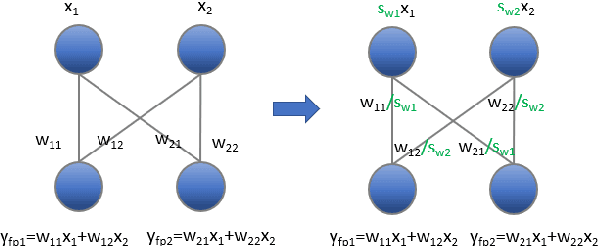
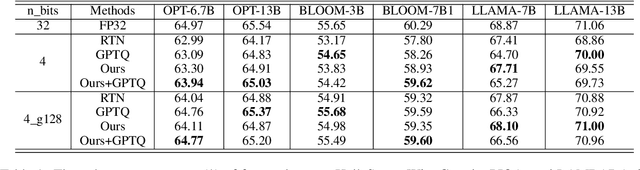
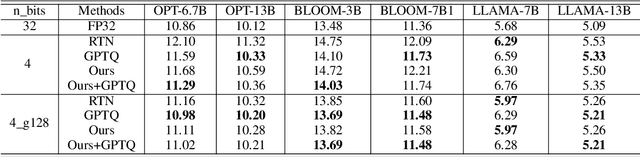
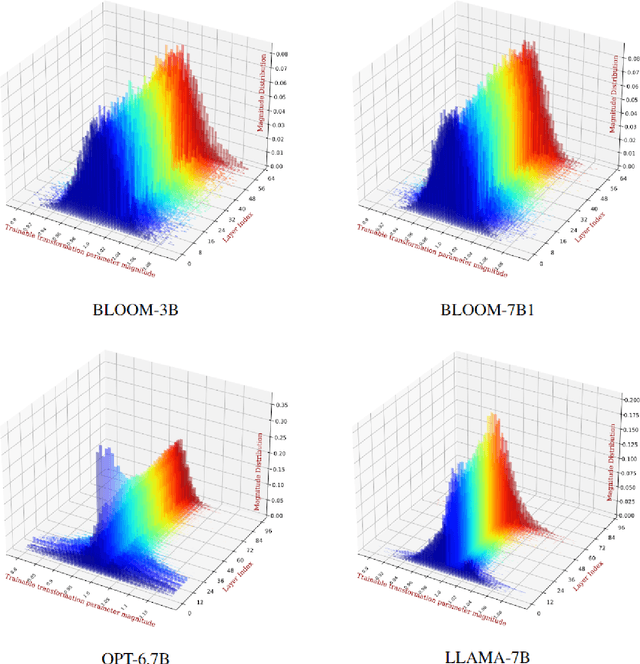
As large language models (LLMs) become more prevalent, there is a growing need for new and improved quantization methods that can meet the computationalast layer demands of these modern architectures while maintaining the accuracy. In this paper, we present TEQ, a trainable equivalent transformation that preserves the FP32 precision of the model output while taking advantage of low-precision quantization, especially 3 and 4 bits weight-only quantization. The training process is lightweight, requiring only 1K steps and fewer than 0.1 percent of the original model's trainable parameters. Furthermore, the transformation does not add any computational overhead during inference. Our results are on-par with the state-of-the-art (SOTA) methods on typical LLMs. Our approach can be combined with other methods to achieve even better performance. The code is available at https://github.com/intel/neural-compressor.
Optimize Weight Rounding via Signed Gradient Descent for the Quantization of LLMs
Sep 28, 2023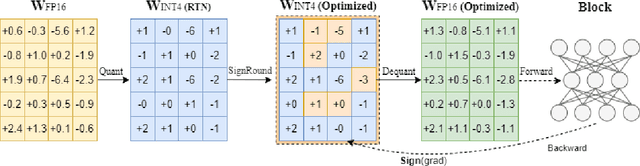
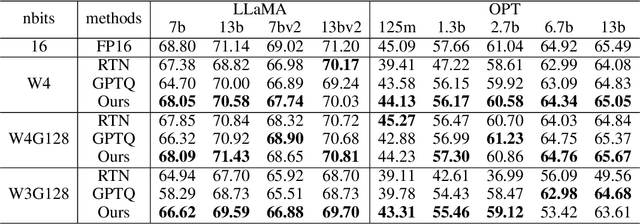

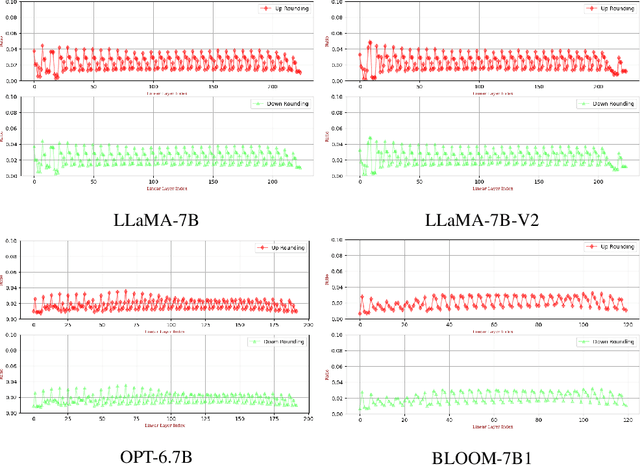
Large Language Models (LLMs) have proven their exceptional capabilities in performing language-related tasks. However, their deployment poses significant challenges due to their considerable memory and storage requirements. In response to this issue, weight-only quantization, particularly 3 and 4-bit weight-only quantization, has emerged as one of the most viable solutions. As the number of bits decreases, the quantization grid broadens, thus emphasizing the importance of up and down rounding. While previous studies have demonstrated that fine-tuning up and down rounding with the addition of perturbations can enhance accuracy in some scenarios, our study is driven by the precise and limited boundary of these perturbations, where only the threshold for altering the rounding value is of significance. Consequently, we propose a concise and highly effective approach for optimizing the weight rounding task. Our method, named SignRound, involves lightweight block-wise tuning using signed gradient descent, enabling us to achieve outstanding results within 400 steps. SignRound competes impressively against recent methods without introducing additional inference overhead. The source code will be publicly available at \url{https://github.com/intel/neural-compressor} soon.
Uncertainty-Aware Cross-Modal Transfer Network for Sketch-Based 3D Shape Retrieval
Aug 11, 2023In recent years, sketch-based 3D shape retrieval has attracted growing attention. While many previous studies have focused on cross-modal matching between hand-drawn sketches and 3D shapes, the critical issue of how to handle low-quality and noisy samples in sketch data has been largely neglected. This paper presents an uncertainty-aware cross-modal transfer network (UACTN) that addresses this issue. UACTN decouples the representation learning of sketches and 3D shapes into two separate tasks: classification-based sketch uncertainty learning and 3D shape feature transfer. We first introduce an end-to-end classification-based approach that simultaneously learns sketch features and uncertainty, allowing uncertainty to prevent overfitting noisy sketches by assigning different levels of importance to clean and noisy sketches. Then, 3D shape features are mapped into the pre-learned sketch embedding space for feature alignment. Extensive experiments and ablation studies on two benchmarks demonstrate the superiority of our proposed method compared to state-of-the-art methods.