 Add to Chrome
 Add to Firefox
 Add to Edge
EventHDR: from Event to High-Speed HDR Videos and Beyond
Sep 25, 2024


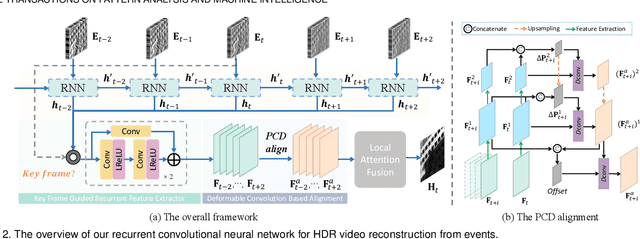

Event cameras are innovative neuromorphic sensors that asynchronously capture the scene dynamics. Due to the event-triggering mechanism, such cameras record event streams with much shorter response latency and higher intensity sensitivity compared to conventional cameras. On the basis of these features, previous works have attempted to reconstruct high dynamic range (HDR) videos from events, but have either suffered from unrealistic artifacts or failed to provide sufficiently high frame rates. In this paper, we present a recurrent convolutional neural network that reconstruct high-speed HDR videos from event sequences, with a key frame guidance to prevent potential error accumulation caused by the sparse event data. Additionally, to address the problem of severely limited real dataset, we develop a new optical system to collect a real-world dataset with paired high-speed HDR videos and event streams, facilitating future research in this field. Our dataset provides the first real paired dataset for event-to-HDR reconstruction, avoiding potential inaccuracies from simulation strategies. Experimental results demonstrate that our method can generate high-quality, high-speed HDR videos. We further explore the potential of our work in cross-camera reconstruction and downstream computer vision tasks, including object detection, panoramic segmentation, optical flow estimation, and monocular depth estimation under HDR scenarios.

KFD-NeRF: Rethinking Dynamic NeRF with Kalman Filter
Jul 18, 2024
We introduce KFD-NeRF, a novel dynamic neural radiance field integrated with an efficient and high-quality motion reconstruction framework based on Kalman filtering. Our key idea is to model the dynamic radiance field as a dynamic system whose temporally varying states are estimated based on two sources of knowledge: observations and predictions. We introduce a novel plug-in Kalman filter guided deformation field that enables accurate deformation estimation from scene observations and predictions. We use a shallow Multi-Layer Perceptron (MLP) for observations and model the motion as locally linear to calculate predictions with motion equations. To further enhance the performance of the observation MLP, we introduce regularization in the canonical space to facilitate the network's ability to learn warping for different frames. Additionally, we employ an efficient tri-plane representation for encoding the canonical space, which has been experimentally demonstrated to converge quickly with high quality. This enables us to use a shallower observation MLP, consisting of just two layers in our implementation. We conduct experiments on synthetic and real data and compare with past dynamic NeRF methods. Our KFD-NeRF demonstrates similar or even superior rendering performance within comparable computational time and achieves state-of-the-art view synthesis performance with thorough training.
RS-NeRF: Neural Radiance Fields from Rolling Shutter Images
Jul 14, 2024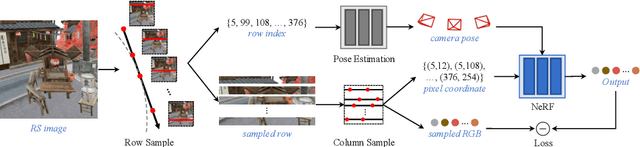

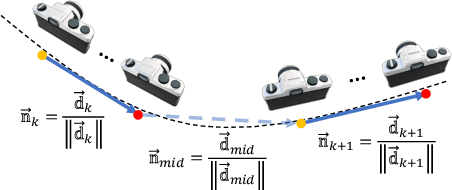
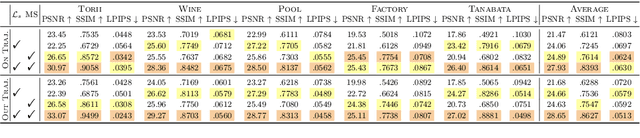
Neural Radiance Fields (NeRFs) have become increasingly popular because of their impressive ability for novel view synthesis. However, their effectiveness is hindered by the Rolling Shutter (RS) effects commonly found in most camera systems. To solve this, we present RS-NeRF, a method designed to synthesize normal images from novel views using input with RS distortions. This involves a physical model that replicates the image formation process under RS conditions and jointly optimizes NeRF parameters and camera extrinsic for each image row. We further address the inherent shortcomings of the basic RS-NeRF model by delving into the RS characteristics and developing algorithms to enhance its functionality. First, we impose a smoothness regularization to better estimate trajectories and improve the synthesis quality, in line with the camera movement prior. We also identify and address a fundamental flaw in the vanilla RS model by introducing a multi-sampling algorithm. This new approach improves the model's performance by comprehensively exploiting the RGB data across different rows for each intermediate camera pose. Through rigorous experimentation, we demonstrate that RS-NeRF surpasses previous methods in both synthetic and real-world scenarios, proving its ability to correct RS-related distortions effectively. Codes and data available: https://github.com/MyNiuuu/RS-NeRF
ResMaster: Mastering High-Resolution Image Generation via Structural and Fine-Grained Guidance
Jun 24, 2024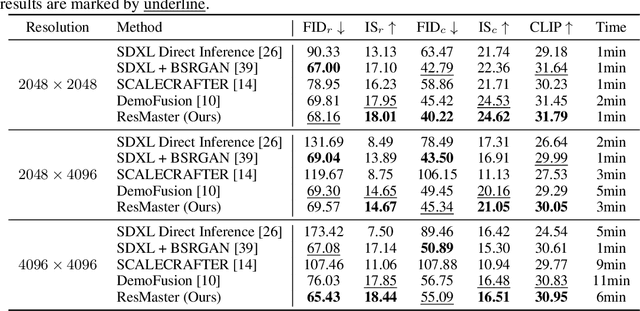


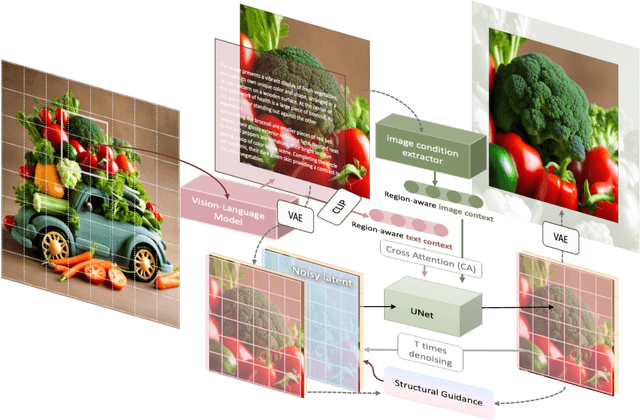
Diffusion models excel at producing high-quality images; however, scaling to higher resolutions, such as 4K, often results in over-smoothed content, structural distortions, and repetitive patterns. To this end, we introduce ResMaster, a novel, training-free method that empowers resolution-limited diffusion models to generate high-quality images beyond resolution restrictions. Specifically, ResMaster leverages a low-resolution reference image created by a pre-trained diffusion model to provide structural and fine-grained guidance for crafting high-resolution images on a patch-by-patch basis. To ensure a coherent global structure, ResMaster meticulously aligns the low-frequency components of high-resolution patches with the low-resolution reference at each denoising step. For fine-grained guidance, tailored image prompts based on the low-resolution reference and enriched textual prompts produced by a vision-language model are incorporated. This approach could significantly mitigate local pattern distortions and improve detail refinement. Extensive experiments validate that ResMaster sets a new benchmark for high-resolution image generation and demonstrates promising efficiency. The project page is https://shuweis.github.io/ResMaster .
MOFA-Video: Controllable Image Animation via Generative Motion Field Adaptions in Frozen Image-to-Video Diffusion Model
Jun 02, 2024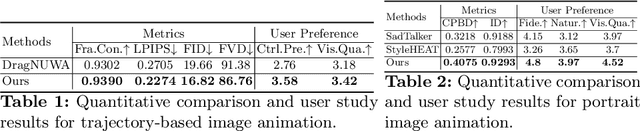
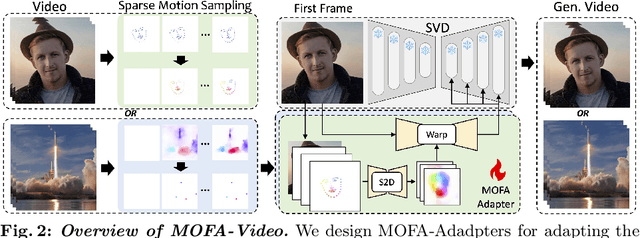
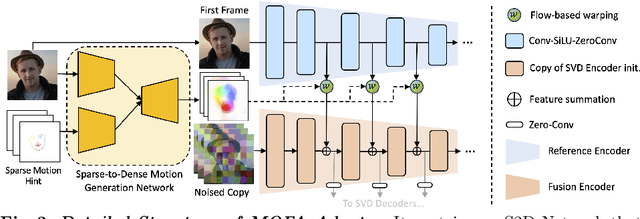
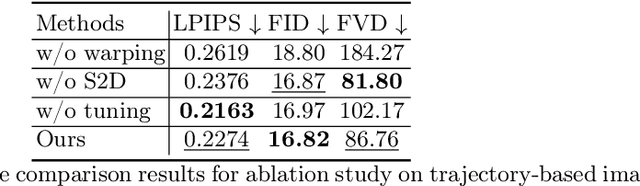
We present MOFA-Video, an advanced controllable image animation method that generates video from the given image using various additional controllable signals (such as human landmarks reference, manual trajectories, and another even provided video) or their combinations. This is different from previous methods which only can work on a specific motion domain or show weak control abilities with diffusion prior. To achieve our goal, we design several domain-aware motion field adapters (\ie, MOFA-Adapters) to control the generated motions in the video generation pipeline. For MOFA-Adapters, we consider the temporal motion consistency of the video and generate the dense motion flow from the given sparse control conditions first, and then, the multi-scale features of the given image are wrapped as a guided feature for stable video diffusion generation. We naively train two motion adapters for the manual trajectories and the human landmarks individually since they both contain sparse information about the control. After training, the MOFA-Adapters in different domains can also work together for more controllable video generation. Project Page: https://myniuuu.github.io/MOFA_Video/
RPBG: Towards Robust Neural Point-based Graphics in the Wild
May 09, 2024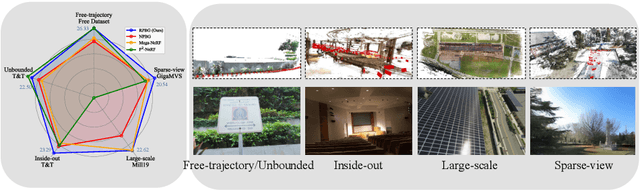


Point-based representations have recently gained popularity in novel view synthesis, for their unique advantages, e.g., intuitive geometric representation, simple manipulation, and faster convergence. However, based on our observation, these point-based neural re-rendering methods are only expected to perform well under ideal conditions and suffer from noisy, patchy points and unbounded scenes, which are challenging to handle but defacto common in real applications. To this end, we revisit one such influential method, known as Neural Point-based Graphics (NPBG), as our baseline, and propose Robust Point-based Graphics (RPBG). We in-depth analyze the factors that prevent NPBG from achieving satisfactory renderings on generic datasets, and accordingly reform the pipeline to make it more robust to varying datasets in-the-wild. Inspired by the practices in image restoration, we greatly enhance the neural renderer to enable the attention-based correction of point visibility and the inpainting of incomplete rasterization, with only acceptable overheads. We also seek for a simple and lightweight alternative for environment modeling and an iterative method to alleviate the problem of poor geometry. By thorough evaluation on a wide range of datasets with different shooting conditions and camera trajectories, RPBG stably outperforms the baseline by a large margin, and exhibits its great robustness over state-of-the-art NeRF-based variants. Code available at https://github.com/QT-Zhu/RPBG.
Rolling Shutter Correction with Intermediate Distortion Flow Estimation
Apr 09, 2024


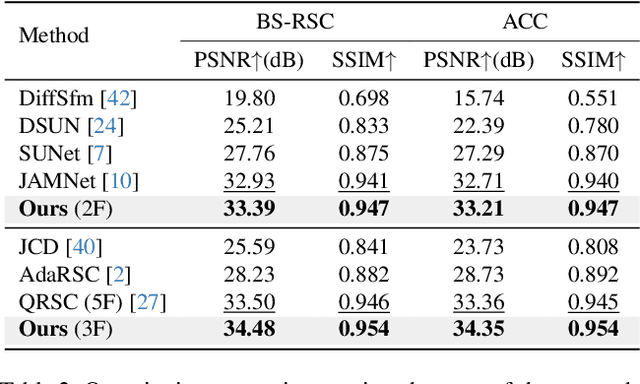
This paper proposes to correct the rolling shutter (RS) distorted images by estimating the distortion flow from the global shutter (GS) to RS directly. Existing methods usually perform correction using the undistortion flow from the RS to GS. They initially predict the flow from consecutive RS frames, subsequently rescaling it as the displacement fields from the RS frame to the underlying GS image using time-dependent scaling factors. Following this, RS-aware forward warping is employed to convert the RS image into its GS counterpart. Nevertheless, this strategy is prone to two shortcomings. First, the undistortion flow estimation is rendered inaccurate by merely linear scaling the flow, due to the complex non-linear motion nature. Second, RS-aware forward warping often results in unavoidable artifacts. To address these limitations, we introduce a new framework that directly estimates the distortion flow and rectifies the RS image with the backward warping operation. More specifically, we first propose a global correlation-based flow attention mechanism to estimate the initial distortion flow and GS feature jointly, which are then refined by the following coarse-to-fine decoder layers. Additionally, a multi-distortion flow prediction strategy is integrated to mitigate the issue of inaccurate flow estimation further. Experimental results validate the effectiveness of the proposed method, which outperforms state-of-the-art approaches on various benchmarks while maintaining high efficiency. The project is available at \url{https://github.com/ljzycmd/DFRSC}.
Motion Blur Decomposition with Cross-shutter Guidance
Apr 01, 2024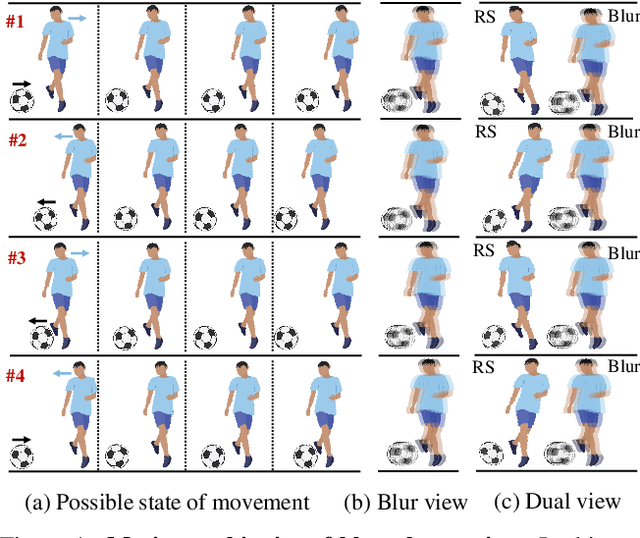
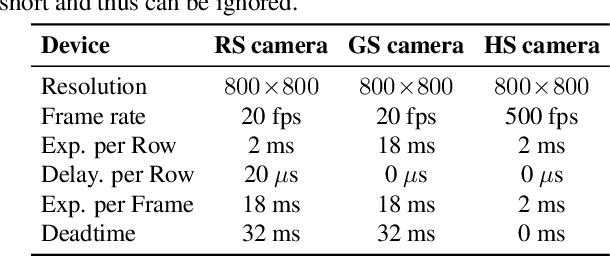
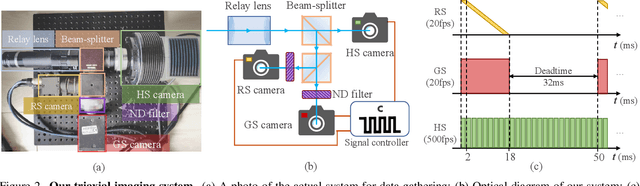
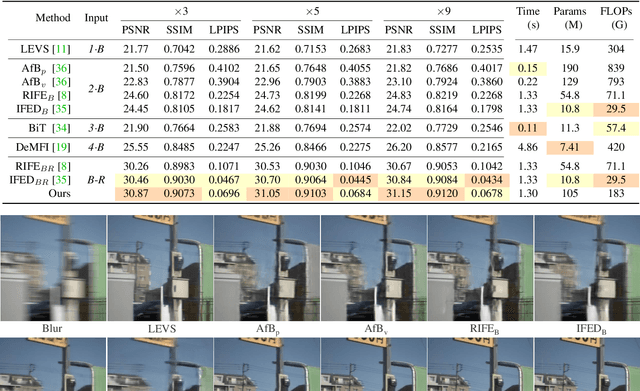
Motion blur is a frequently observed image artifact, especially under insufficient illumination where exposure time has to be prolonged so as to collect more photons for a bright enough image. Rather than simply removing such blurring effects, recent researches have aimed at decomposing a blurry image into multiple sharp images with spatial and temporal coherence. Since motion blur decomposition itself is highly ambiguous, priors from neighbouring frames or human annotation are usually needed for motion disambiguation. In this paper, inspired by the complementary exposure characteristics of a global shutter (GS) camera and a rolling shutter (RS) camera, we propose to utilize the ordered scanline-wise delay in a rolling shutter image to robustify motion decomposition of a single blurry image. To evaluate this novel dual imaging setting, we construct a triaxial system to collect realistic data, as well as a deep network architecture that explicitly addresses temporal and contextual information through reciprocal branches for cross-shutter motion blur decomposition. Experiment results have verified the effectiveness of our proposed algorithm, as well as the validity of our dual imaging setting.
Within the Dynamic Context: Inertia-aware 3D Human Modeling with Pose Sequence
Mar 28, 2024Neural rendering techniques have significantly advanced 3D human body modeling. However, previous approaches often overlook dynamics induced by factors such as motion inertia, leading to challenges in scenarios like abrupt stops after rotation, where the pose remains static while the appearance changes. This limitation arises from reliance on a single pose as conditional input, resulting in ambiguity in mapping one pose to multiple appearances. In this study, we elucidate that variations in human appearance depend not only on the current frame's pose condition but also on past pose states. Therefore, we introduce Dyco, a novel method utilizing the delta pose sequence representation for non-rigid deformations and canonical space to effectively model temporal appearance variations. To prevent a decrease in the model's generalization ability to novel poses, we further propose low-dimensional global context to reduce unnecessary inter-body part dependencies and a quantization operation to mitigate overfitting of the delta pose sequence by the model. To validate the effectiveness of our approach, we collected a novel dataset named I3D-Human, with a focus on capturing temporal changes in clothing appearance under approximate poses. Through extensive experiments on both I3D-Human and existing datasets, our approach demonstrates superior qualitative and quantitative performance. In addition, our inertia-aware 3D human method can unprecedentedly simulate appearance changes caused by inertia at different velocities.
Navigating Beyond Dropout: An Intriguing Solution Towards Generalizable Image Super Resolution
Mar 01, 2024Deep learning has led to a dramatic leap on Single Image Super-Resolution (SISR) performances in recent years. %Despite the substantial advancement% While most existing work assumes a simple and fixed degradation model (e.g., bicubic downsampling), the research of Blind SR seeks to improve model generalization ability with unknown degradation. Recently, Kong et al pioneer the investigation of a more suitable training strategy for Blind SR using Dropout. Although such method indeed brings substantial generalization improvements via mitigating overfitting, we argue that Dropout simultaneously introduces undesirable side-effect that compromises model's capacity to faithfully reconstruct fine details. We show both the theoretical and experimental analyses in our paper, and furthermore, we present another easy yet effective training strategy that enhances the generalization ability of the model by simply modulating its first and second-order features statistics. Experimental results have shown that our method could serve as a model-agnostic regularization and outperforms Dropout on seven benchmark datasets including both synthetic and real-world scenarios.