 Add to Chrome
 Add to Firefox
 Add to Edge
HorizonDrive: Self-Corrective Autoregressive World Model for Long-horizon Driving Simulation
May 12, 2026
Closed-loop driving simulation requires real-time interaction beyond short offline clips, pushing current driving world models toward autoregressive (AR) rollout. Existing AR distillation approaches typically rely on frame sinks or student-side degradation training. The former transfers poorly to driving due to fast ego-motion and rapid scene changes, while the latter remains bounded by the teacher's single-pass output length and thus provides only a limited supervision horizon. A natural question is: can the teacher itself be extended via AR rollout to provide unbounded-horizon supervision at bounded memory cost? The key difficulty is that a standard teacher drifts under its own predictions, contaminating the supervision it provides. Our key insight is to make the teacher rollout-capable, ensuring reliable supervision from its own AR rollouts. This is instantiated as HorizonDrive, an anti-drifting training-and-distillation framework for AR driving simulation. First, scheduled rollout recovery (SRR) trains the base model to reconstruct ground-truth future clips from prediction-corrupted histories, yielding a teacher that remains stable across long AR rollouts. Second, the rollout-capable teacher is extended via AR rollout, providing long-horizon distribution-matching supervision under bounded memory, while a short-window student aligns to it with teacher rollout DMD (TRD) for efficient real-time deployment. HorizonDrive natively supports minute-scale AR rollout under bounded memory; on nuScenes, HorizonDrive reduces FID by 52% and FVD by 37%, and lowers ARE and DTW by 21% and 9% relative to the strongest long-horizon streaming baselines, while remaining competitive with single-pass driving video generators.

RAWild: Sensor-Agnostic RAW Object Detection via Physics-Guided Curve and Grid Modeling
May 07, 2026Camera sensor RAW data offers intrinsic advantages for object detection, including deeper bit depth, preserved physical information, and freedom from image signal processor (ISP) distortions. However, varying exposure conditions, spectral sensitivities, and bit depths across devices introduce substantially larger domain gaps than sRGB, making sensor-agnostic generalization a fundamental challenge. In this study, we present \textbf{RAWild}, a physics-guided global-local tone mapping framework for sensor-agnostic RAW object detection. By factoring sensor-induced variations into a global tonal correction and a spatially adaptive local color adjustment, both driven by RAW distribution priors, our framework enables a single network to train jointly across heterogeneous sensors. To further support cross-sensor generalization, we construct a physics-based RAW simulation pipeline that synthesizes realistic sensor outputs spanning diverse spectral sensitivities, illuminants, and sensor non-idealities. Extensive experiments across multiple RAW benchmarks covering bit depths from 10 to 24 demonstrate state-of-the-art (SOTA) performance under single-dataset, mixed-dataset, and challenging robustness settings.
Composing Driving Worlds through Disentangled Control for Adversarial Scenario Generation
Mar 13, 2026A major challenge in autonomous driving is the "long tail" of safety-critical edge cases, which often emerge from unusual combinations of common traffic elements. Synthesizing these scenarios is crucial, yet current controllable generative models provide incomplete or entangled guidance, preventing the independent manipulation of scene structure, object identity, and ego actions. We introduce CompoSIA, a compositional driving video simulator that disentangles these traffic factors, enabling fine-grained control over diverse adversarial driving scenarios. To support controllable identity replacement of scene elements, we propose a noise-level identity injection, allowing pose-agnostic identity generation across diverse element poses, all from a single reference image. Furthermore, a hierarchical dual-branch action control mechanism is introduced to improve action controllability. Such disentangled control enables adversarial scenario synthesis-systematically combining safe elements into dangerous configurations that entangled generators cannot produce. Extensive comparisons demonstrate superior controllable generation quality over state-of-the-art baselines, with a 17% improvement in FVD for identity editing and reductions of 30% and 47% in rotation and translation errors for action control. Furthermore, downstream stress-testing reveals substantial planner failures: across editing modalities, the average collision rate of 3s increases by 173%.
KaoLRM: Repurposing Pre-trained Large Reconstruction Models for Parametric 3D Face Reconstruction
Jan 19, 2026We propose KaoLRM to re-target the learned prior of the Large Reconstruction Model (LRM) for parametric 3D face reconstruction from single-view images. Parametric 3D Morphable Models (3DMMs) have been widely used for facial reconstruction due to their compact and interpretable parameterization, yet existing 3DMM regressors often exhibit poor consistency across varying viewpoints. To address this, we harness the pre-trained 3D prior of LRM and incorporate FLAME-based 2D Gaussian Splatting into LRM's rendering pipeline. Specifically, KaoLRM projects LRM's pre-trained triplane features into the FLAME parameter space to recover geometry, and models appearance via 2D Gaussian primitives that are tightly coupled to the FLAME mesh. The rich prior enables the FLAME regressor to be aware of the 3D structure, leading to accurate and robust reconstructions under self-occlusions and diverse viewpoints. Experiments on both controlled and in-the-wild benchmarks demonstrate that KaoLRM achieves superior reconstruction accuracy and cross-view consistency, while existing methods remain sensitive to viewpoint variations. The code is released at https://github.com/CyberAgentAILab/KaoLRM.
Visionary: The World Model Carrier Built on WebGPU-Powered Gaussian Splatting Platform
Dec 09, 2025Neural rendering, particularly 3D Gaussian Splatting (3DGS), has evolved rapidly and become a key component for building world models. However, existing viewer solutions remain fragmented, heavy, or constrained by legacy pipelines, resulting in high deployment friction and limited support for dynamic content and generative models. In this work, we present Visionary, an open, web-native platform for real-time various Gaussian Splatting and meshes rendering. Built on an efficient WebGPU renderer with per-frame ONNX inference, Visionary enables dynamic neural processing while maintaining a lightweight, "click-to-run" browser experience. It introduces a standardized Gaussian Generator contract, which not only supports standard 3DGS rendering but also allows plug-and-play algorithms to generate or update Gaussians each frame. Such inference also enables us to apply feedforward generative post-processing. The platform further offers a plug in three.js library with a concise TypeScript API for seamless integration into existing web applications. Experiments show that, under identical 3DGS assets, Visionary achieves superior rendering efficiency compared to current Web viewers due to GPU-based primitive sorting. It already supports multiple variants, including MLP-based 3DGS, 4DGS, neural avatars, and style transformation or enhancement networks. By unifying inference and rendering directly in the browser, Visionary significantly lowers the barrier to reproduction, comparison, and deployment of 3DGS-family methods, serving as a unified World Model Carrier for both reconstructive and generative paradigms.
HarmoQ: Harmonized Post-Training Quantization for High-Fidelity Image
Nov 11, 2025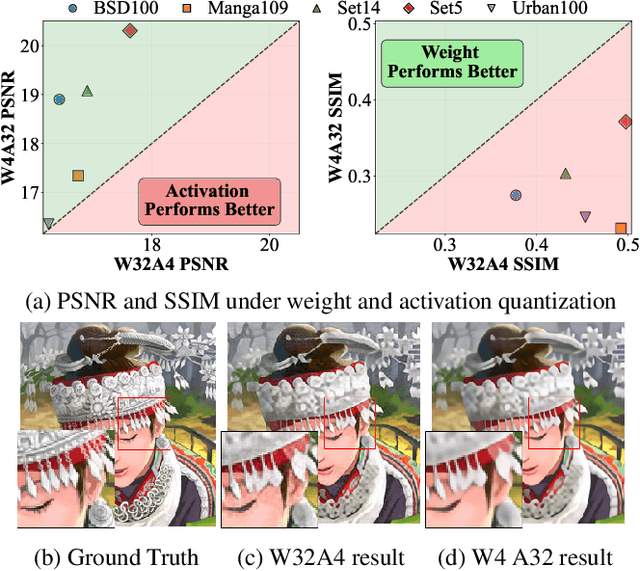
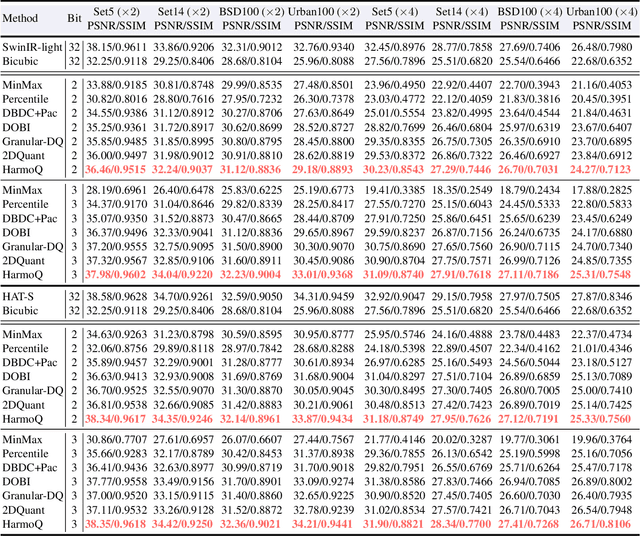
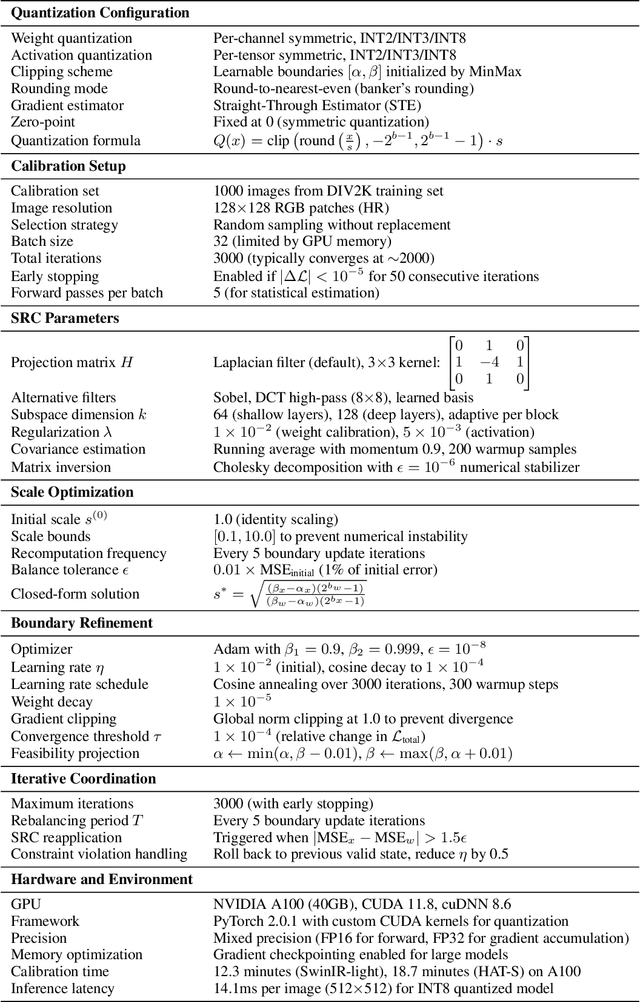
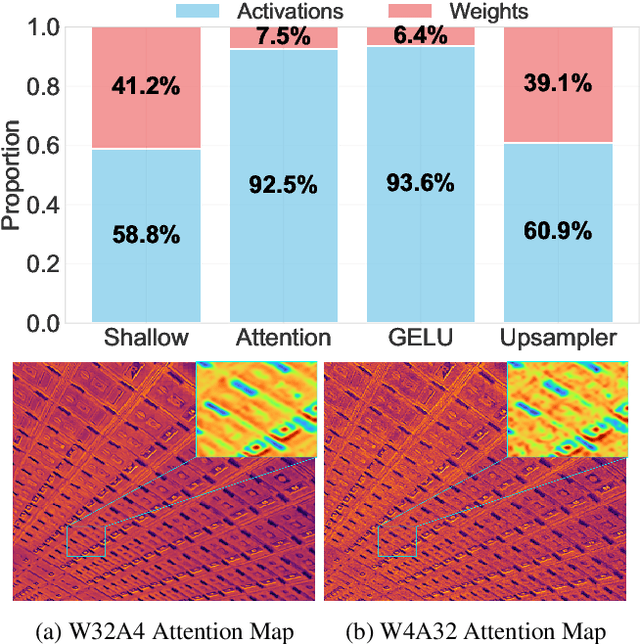
Post-training quantization offers an efficient pathway to deploy super-resolution models, yet existing methods treat weight and activation quantization independently, missing their critical interplay. Through controlled experiments on SwinIR, we uncover a striking asymmetry: weight quantization primarily degrades structural similarity, while activation quantization disproportionately affects pixel-level accuracy. This stems from their distinct roles--weights encode learned restoration priors for textures and edges, whereas activations carry input-specific intensity information. Building on this insight, we propose HarmoQ, a unified framework that harmonizes quantization across components through three synergistic steps: structural residual calibration proactively adjusts weights to compensate for activation-induced detail loss, harmonized scale optimization analytically balances quantization difficulty via closed-form solutions, and adaptive boundary refinement iteratively maintains this balance during optimization. Experiments show HarmoQ achieves substantial gains under aggressive compression, outperforming prior art by 0.46 dB on Set5 at 2-bit while delivering 3.2x speedup and 4x memory reduction on A100 GPUs. This work provides the first systematic analysis of weight-activation coupling in super-resolution quantization and establishes a principled solution for efficient high-quality image restoration.
Not All Degradations Are Equal: A Targeted Feature Denoising Framework for Generalizable Image Super-Resolution
Sep 18, 2025Generalizable Image Super-Resolution aims to enhance model generalization capabilities under unknown degradations. To achieve this goal, the models are expected to focus only on image content-related features instead of overfitting degradations. Recently, numerous approaches such as Dropout and Feature Alignment have been proposed to suppress models' natural tendency to overfit degradations and yield promising results. Nevertheless, these works have assumed that models overfit to all degradation types (e.g., blur, noise, JPEG), while through careful investigations in this paper, we discover that models predominantly overfit to noise, largely attributable to its distinct degradation pattern compared to other degradation types. In this paper, we propose a targeted feature denoising framework, comprising noise detection and denoising modules. Our approach presents a general solution that can be seamlessly integrated with existing super-resolution models without requiring architectural modifications. Our framework demonstrates superior performance compared to previous regularization-based methods across five traditional benchmarks and datasets, encompassing both synthetic and real-world scenarios.
SafeWork-R1: Coevolving Safety and Intelligence under the AI-45$^{\circ}$ Law
Jul 24, 2025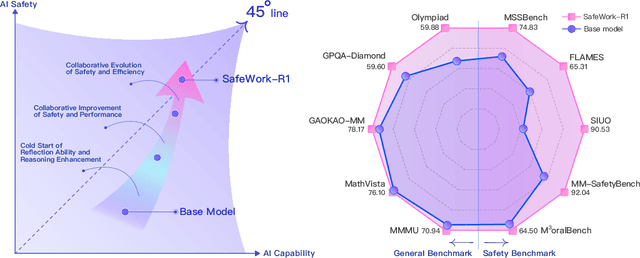
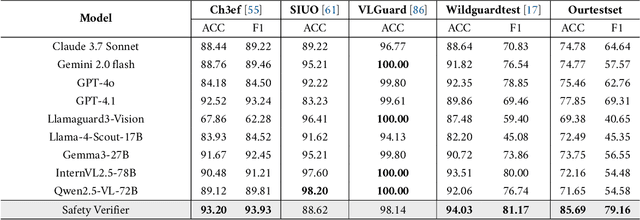
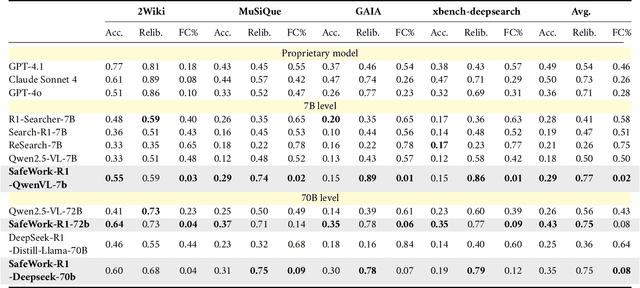

We introduce SafeWork-R1, a cutting-edge multimodal reasoning model that demonstrates the coevolution of capabilities and safety. It is developed by our proposed SafeLadder framework, which incorporates large-scale, progressive, safety-oriented reinforcement learning post-training, supported by a suite of multi-principled verifiers. Unlike previous alignment methods such as RLHF that simply learn human preferences, SafeLadder enables SafeWork-R1 to develop intrinsic safety reasoning and self-reflection abilities, giving rise to safety `aha' moments. Notably, SafeWork-R1 achieves an average improvement of $46.54\%$ over its base model Qwen2.5-VL-72B on safety-related benchmarks without compromising general capabilities, and delivers state-of-the-art safety performance compared to leading proprietary models such as GPT-4.1 and Claude Opus 4. To further bolster its reliability, we implement two distinct inference-time intervention methods and a deliberative search mechanism, enforcing step-level verification. Finally, we further develop SafeWork-R1-InternVL3-78B, SafeWork-R1-DeepSeek-70B, and SafeWork-R1-Qwen2.5VL-7B. All resulting models demonstrate that safety and capability can co-evolve synergistically, highlighting the generalizability of our framework in building robust, reliable, and trustworthy general-purpose AI.
AniCrafter: Customizing Realistic Human-Centric Animation via Avatar-Background Conditioning in Video Diffusion Models
May 26, 2025Recent advances in video diffusion models have significantly improved character animation techniques. However, current approaches rely on basic structural conditions such as DWPose or SMPL-X to animate character images, limiting their effectiveness in open-domain scenarios with dynamic backgrounds or challenging human poses. In this paper, we introduce $\textbf{AniCrafter}$, a diffusion-based human-centric animation model that can seamlessly integrate and animate a given character into open-domain dynamic backgrounds while following given human motion sequences. Built on cutting-edge Image-to-Video (I2V) diffusion architectures, our model incorporates an innovative "avatar-background" conditioning mechanism that reframes open-domain human-centric animation as a restoration task, enabling more stable and versatile animation outputs. Experimental results demonstrate the superior performance of our method. Codes will be available at https://github.com/MyNiuuu/AniCrafter.
All-in-One Transferring Image Compression from Human Perception to Multi-Machine Perception
Apr 17, 2025Efficiently transferring Learned Image Compression (LIC) model from human perception to machine perception is an emerging challenge in vision-centric representation learning. Existing approaches typically adapt LIC to downstream tasks in a single-task manner, which is inefficient, lacks task interaction, and results in multiple task-specific bitstreams. To address these limitations, we propose an asymmetric adaptor framework that supports multi-task adaptation within a single model. Our method introduces a shared adaptor to learn general semantic features and task-specific adaptors to preserve task-level distinctions. With only lightweight plug-in modules and a frozen base codec, our method achieves strong performance across multiple tasks while maintaining compression efficiency. Experiments on the PASCAL-Context benchmark demonstrate that our method outperforms both Fully Fine-Tuned and other Parameter Efficient Fine-Tuned (PEFT) baselines, and validating the effectiveness of multi-vision transferring.