 Add to Chrome
 Add to Firefox
 Add to Edge
Surflo: Consistent 3D Surface Flow Model with Global State
Jun 11, 2026
Geometry is invariant to viewpoint, which makes any collection of images a redundant encoding of a single 3D state. Existing feed-forward reconstruction models fail to exploit this: per-view methods emit overlapping, unaligned pointmaps that grow linearly with input count, while global-latent methods commit to a fixed, low-resolution output. We introduce Surflo, which compresses a variable number of unposed RGB views into K latent tokens-one global state-and decodes oriented 3D surface points by independently transporting them from noise onto the surface via flow matching. This frees the output from any fixed grid or token budget: the same latent yields from a few thousand to a million points in a single forward pass. To suppress the local inconsistencies inherent to independent per-point decoding, an inference-time guidance term correlates nearby points by injecting a photometric gradient during ODE integration. Surflo matches or surpasses feed-forward baselines on surface metrics, runs an order of magnitude faster than optimization-based methods that require hundreds of views, and is the only feed-forward approach to combine a global latent with arbitrary-resolution decoding.

REACH: Hand Pose Estimation from Room Corners
May 21, 2026We introduce a novel 3D hand pose estimator that can accurately recover the shape and pose of people's hands in a room from afar, typically from fixed cameras at room corners, in extremely low-resolution and frequently occluded views. Our key idea is to fully leverage hand-body coordination, its temporal progression, and multiview observations. We achieve this with a novel Transformer-based model, in which hand and body configurations are modeled through correlations between their visual features expressed as per-view tokens, and their temporal coordination is exploited in an autoregressive manner. We introduce a novel dataset, which we refer to as REACH, Room-Environment dataset Annotated with Chest cameras for Hand pose estimation, to train and test our method. REACH is a first-of-its-kind large-scale hand pose dataset that captures accurate hand movements of 50 participants across a wide variety of daily activities. In order to avoid interfering with natural movements while annotating the hands with accurate shape and pose, we leverage concealed chest cameras. Through extensive experiments, including comparative studies with existing methods, we show that our model, REACH-Net, achieves highly accurate 3D hand pose estimation from afar. These results broaden the horizon of 3D hand pose estimation, especially towards "in-the-wild" continuous human behavior analysis.
Detailed Geometry and Appearance from Opportunistic Motion
Mar 27, 2026Reconstructing 3D geometry and appearance from a sparse set of fixed cameras is a foundational task with broad applications, yet it remains fundamentally constrained by the limited viewpoints. We show that this bound can be broken by exploiting opportunistic object motion: as a person manipulates an object~(e.g., moving a chair or lifting a mug), the static cameras effectively ``orbit'' the object in its local coordinate frame, providing additional virtual viewpoints. Harnessing this object motion, however, poses two challenges: the tight coupling of object pose and geometry estimation and the complex appearance variations of a moving object under static illumination. We address these by formulating a joint pose and shape optimization using 2D Gaussian splatting with alternating minimization of 6DoF trajectories and primitive parameters, and by introducing a novel appearance model that factorizes diffuse and specular components with reflected directional probing within the spherical harmonics space. Extensive experiments on synthetic and real-world datasets with extremely sparse viewpoints demonstrate that our method recovers significantly more accurate geometry and appearance than state-of-the-art baselines.
How good was my shot? Quantifying Player Skill Level in Table Tennis
Mar 26, 2026Gauging an individual's skill level is crucial, as it inherently shapes their behavior. Quantifying skill, however, is challenging because it is latent to the observed actions. To explore skill understanding in human behavior, we focus on dyadic sports -- specifically table tennis -- where skill manifests not just in complex movements, but in the subtle nuances of execution conditioned on game context. Our key idea is to learn a generative model of each player's tactical racket strokes and jointly embed them in a common latent space that encodes individual characteristics, including those pertaining to skill levels. By training these player models on a large-scale dataset of 3D-reconstructed professional matches and conditioning them on comprehensive game context -- including player positioning and opponent behaviors -- the models capture individual tactical identities within their latent space. We probe this learned player space and find that it reflects distinct play styles and attributes that collectively represent skill. By training a simple relative ranking network on these embeddings, we demonstrate that both relative and absolute skill predictions can be achieved. These results demonstrate that the learned player space effectively quantifies skill levels, providing a foundation for automated skill assessment in complex, interactive behaviors.
Under One Sun: Multi-Object Generative Perception of Materials and Illumination
Mar 19, 2026We introduce Multi-Object Generative Perception (MultiGP), a generative inverse rendering method for stochastic sampling of all radiometric constituents -- reflectance, texture, and illumination -- underlying object appearance from a single image. Our key idea to solve this inherently ambiguous radiometric disentanglement is to leverage the fact that while their texture and reflectance may differ, objects in the same scene are all lit by the same illumination. MultiGP exploits this consensus to produce samples of reflectance, texture, and illumination from a single image of known shapes based on four key technical contributions: a cascaded end-to-end architecture that combines image-space and angular-space disentanglement; Coordinated Guidance for diffusion convergence to a single consistent illumination estimate; Axial Attention applied to facilitate ``cross-talk'' between objects of different reflectance; and a Texture Extraction ControlNet to preserve high-frequency texture details while ensuring decoupling from estimated lighting. Experimental results demonstrate that MultiGP effectively leverages the complementary spatial and frequency characteristics of multiple object appearances to recover individual texture and reflectance as well as the common illumination.
M-PhyGs: Multi-Material Object Dynamics from Video
Dec 18, 2025Knowledge of the physical material properties governing the dynamics of a real-world object becomes necessary to accurately anticipate its response to unseen interactions. Existing methods for estimating such physical material parameters from visual data assume homogeneous single-material objects, pre-learned dynamics, or simplistic topologies. Real-world objects, however, are often complex in material composition and geometry lying outside the realm of these assumptions. In this paper, we particularly focus on flowers as a representative common object. We introduce Multi-material Physical Gaussians (M-PhyGs) to estimate the material composition and parameters of such multi-material complex natural objects from video. From a short video captured in a natural setting, M-PhyGs jointly segments the object into similar materials and recovers their continuum mechanical parameters while accounting for gravity. M-PhyGs achieves this efficiently with newly introduced cascaded 3D and 2D losses, and by leveraging temporal mini-batching. We introduce a dataset, Phlowers, of people interacting with flowers as a novel platform to evaluate the accuracy of this challenging task of multi-material physical parameter estimation. Experimental results on Phlowers dataset demonstrate the accuracy and effectiveness of M-PhyGs and its components.
Single-Shot Shape and Reflectance with Spatial Polarization Multiplexing
Apr 17, 2025


We propose spatial polarization multiplexing (SPM) for reconstructing object shape and reflectance from a single polarimetric image and demonstrate its application to dynamic surface recovery. Although single-pattern structured light enables single-shot shape reconstruction, the reflectance is challenging to recover due to the lack of angular sampling of incident light and the entanglement of the projected pattern and the surface color texture. We design a spatially multiplexed pattern of polarization that can be robustly and uniquely decoded for shape reconstruction by quantizing the AoLP values. At the same time, our spatial-multiplexing enables single-shot ellipsometry of linear polarization by projecting differently polarized light within a local region, which separates the specular and diffuse reflections for BRDF estimation. We achieve this spatial polarization multiplexing with a constrained de Bruijn sequence. Unlike single-pattern structured light with intensity and color, our polarization pattern is invisible to the naked eye and retains the natural surface appearance which is essential for accurate appearance modeling and also interaction with people. We experimentally validate our method on real data. The results show that our method can recover the shape, the Mueller matrix, and the BRDF from a single-shot polarimetric image. We also demonstrate the application of our method to dynamic surfaces.
SHeaP: Self-Supervised Head Geometry Predictor Learned via 2D Gaussians
Apr 16, 2025Accurate, real-time 3D reconstruction of human heads from monocular images and videos underlies numerous visual applications. As 3D ground truth data is hard to come by at scale, previous methods have sought to learn from abundant 2D videos in a self-supervised manner. Typically, this involves the use of differentiable mesh rendering, which is effective but faces limitations. To improve on this, we propose SHeaP (Self-supervised Head Geometry Predictor Learned via 2D Gaussians). Given a source image, we predict a 3DMM mesh and a set of Gaussians that are rigged to this mesh. We then reanimate this rigged head avatar to match a target frame, and backpropagate photometric losses to both the 3DMM and Gaussian prediction networks. We find that using Gaussians for rendering substantially improves the effectiveness of this self-supervised approach. Training solely on 2D data, our method surpasses existing self-supervised approaches in geometric evaluations on the NoW benchmark for neutral faces and a new benchmark for non-neutral expressions. Our method also produces highly expressive meshes, outperforming state-of-the-art in emotion classification.
Spatiotemporal Multi-Camera Calibration using Freely Moving People
Feb 18, 2025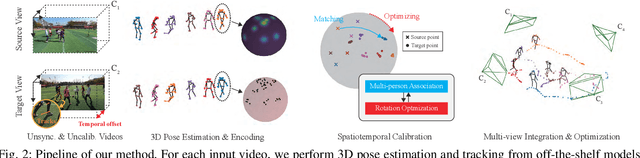
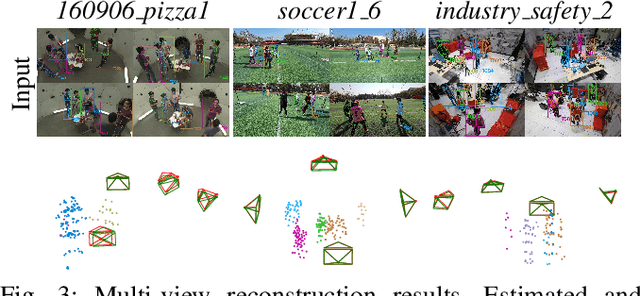
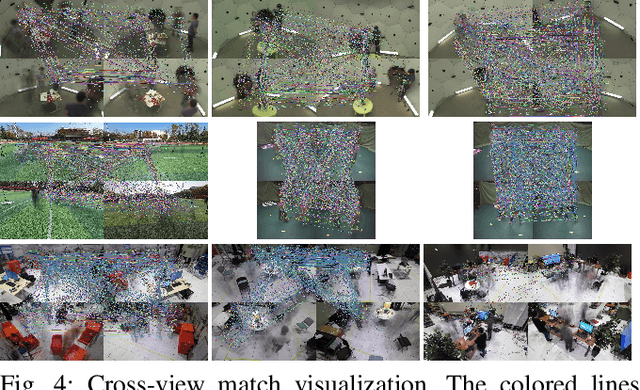
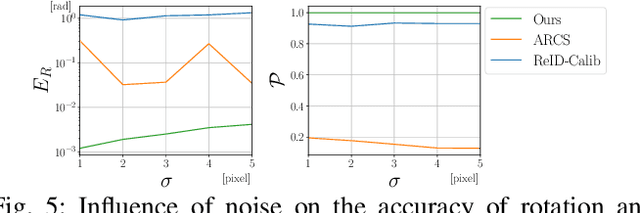
We propose a novel method for spatiotemporal multi-camera calibration using freely moving people in multiview videos. Since calibrating multiple cameras and finding matches across their views are inherently interdependent, performing both in a unified framework poses a significant challenge. We address these issues as a single registration problem of matching two sets of 3D points, leveraging human motion in dynamic multi-person scenes. To this end, we utilize 3D human poses obtained from an off-the-shelf monocular 3D human pose estimator and transform them into 3D points on a unit sphere, to solve the rotation, time offset, and the association alternatingly. We employ a probabilistic approach that can jointly solve both problems of aligning spatiotemporal data and establishing correspondences through soft assignment between two views. The translation is determined by applying coplanarity constraints. The pairwise registration results are integrated into a multiview setup, and then a nonlinear optimization method is used to improve the accuracy of the camera poses, temporal offsets, and multi-person associations. Extensive experiments on synthetic and real data demonstrate the effectiveness and flexibility of the proposed method as a practical marker-free calibration tool.
RatBodyFormer: Rodent Body Surface from Keypoints
Dec 12, 2024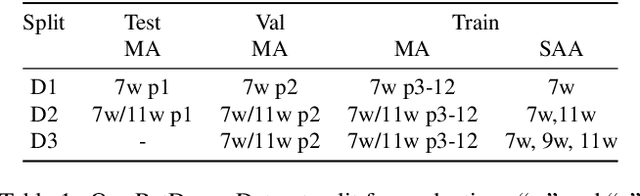
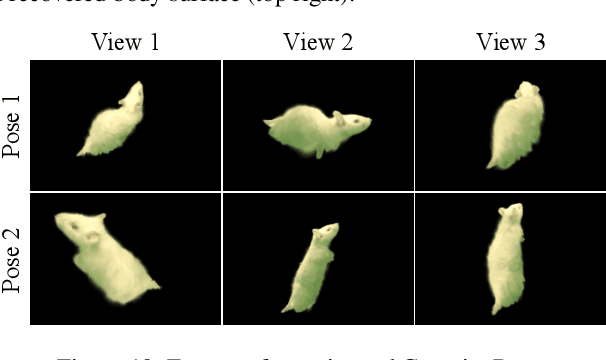
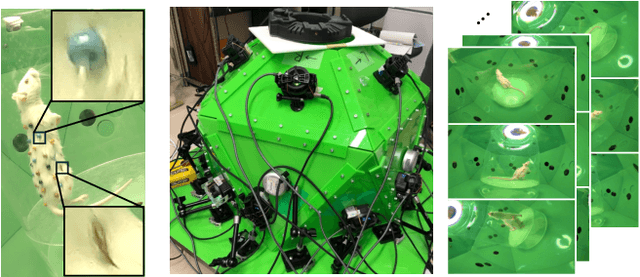
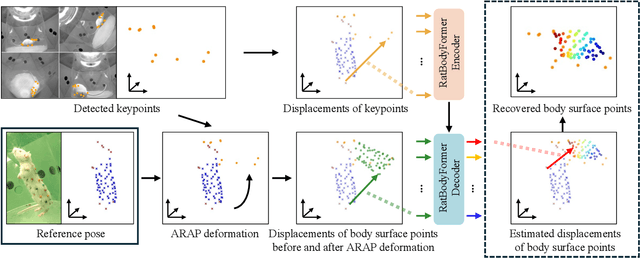
Rat behavior modeling goes to the heart of many scientific studies, yet the textureless body surface evades automatic analysis as it literally has no keypoints that detectors can find. The movement of the body surface, however, is a rich source of information for deciphering the rat behavior. We introduce two key contributions to automatically recover densely 3D sampled rat body surface points, passively. The first is RatDome, a novel multi-camera system for rat behavior capture, and a large-scale dataset captured with it that consists of pairs of 3D keypoints and 3D body surface points. The second is RatBodyFormer, a novel network to transform detected keypoints to 3D body surface points. RatBodyFormer is agnostic to the exact locations of the 3D body surface points in the training data and is trained with masked-learning. We experimentally validate our framework with a number of real-world experiments. Our results collectively serve as a novel foundation for automated rat behavior analysis and will likely have far-reaching implications for biomedical and neuroscientific research.