 Add to Chrome
 Add to Firefox
 Add to Edge
TIDE: A Physically Diverse 3D Turbulence Benchmark Dataset for Advancing Scientific Machine Learning
Aug 04, 2026
Turbulence is a central testbed for machine learning on physical dynamics because its governing laws are known exactly. However, most existing studies remain in 2D, while 3D turbulence has fundamentally different physics and is far more costly to simulate. Existing 3D resources also typically provide only one realization per configuration, making it difficult to distinguish learning the dynamics from fitting the statistics of a single flow. In this paper, we introduce TIDE (Turbulent Incompressible DNS Ensembles), a 256^3 DNS corpus and benchmark for 3D incompressible turbulence, with 15 configurations on eight controlled axes, independent ensembles, pressure fields, and equation-level verification. The benchmark includes five tasks, standardized learned baselines, controlled generalization splits, and physical-fidelity metrics alongside pointwise error. Across the main forecasting configurations, current learned models barely outperform persistence and still make about twice the error of a spectral solver given the true equations. Moreover, lower pointwise error can coincide with severely distorted small-scale dynamics, showing that accuracy alone does not ensure physical fidelity. Generalization results further show that most regime shifts reflect limited training coverage, whereas forced-to-decay transfer exposes a missing conditioning variable: operators trained under forcing continue to predict driven evolution when the external drive is removed. Closing these accuracy, fidelity, and conditioning gaps is the central open problem made measurable by TIDE.

Physics-Preserving Latent Compression for Zero-Shot Resolution Transfer in 3D Turbulence
Jun 19, 2026High-resolution turbulence modeling is essential for scientific computing, but remains constrained by the cost of direct numerical simulation and the scarcity of full-resolution data. Existing scientific compressors reduce storage but typically operate on per-frame representations, whereas learned compressors yield compact latents that are often resolution-dependent and weakly aligned with the physics of turbulence. This raises the need for a compression framework that reduces data size, preserves physical diagnostics, and transfers from low-resolution training fields to high-resolution test fields without retraining. In this paper, we propose Physics-Preserving Latent Compression (PPLC), a patch-local latent compressor for three-dimensional turbulence. Motivated by inertial-range scale similarity, PPLC treats fixed-size patches as transferable units and applies a shared variational autoencoder independently of the global grid size. It combines exact mean preservation, zero-mean fluctuation encoding, an invertible Haar wavelet front-end, shift-consistency regularization, and overlap-aware reconstruction. Instantiated on forced isotropic turbulence, PPLC is trained only on stride-downsampled 256^3 fields and transfers zero-shot to 1024^3 fields. Experiments show that PPLC improves the balance between reconstruction accuracy and physical fidelity over classical and learned baselines, keeping diagnostics such as dissipation, enstrophy, energy spectra, and incompressibility closer to the ground truth. Beyond turbulence compression, PPLC offers a general strategy for physics-preserving latent representations that support data-efficient scientific surrogate modeling.
FU-MPC: Frontier- and Uncertainty-Aware Model Predictive Control for Efficient and Accurate UAV Exploration with Motorized LiDAR
May 14, 2026Efficient UAV exploration in unknown environments requires rapid coverage expansion while maintaining accurate and reliable localization, since safe navigation in complex scenes depends on consistent mapping and pose estimation. However, for conventional LiDAR-equipped UAVs, the observable region is tightly coupled with the UAV pose and motion. Expanding coverage often requires additional translational or rotational maneuvers, which can reduce exploration efficiency and increase the risk of localization degradation in geometrically challenging environments. Motorized rotating LiDARs provide a promising solution by actively adjusting the sensor viewing direction without changing the UAV motion, thereby introducing an additional sensing degree of freedom. Nevertheless, existing exploration systems rarely exploit this scanning freedom as an explicit decision variable linked to both exploration progress and localization quality. To address this gap, we develop a UAV platform equipped with an independently actuated rotating LiDAR and propose a hierarchical exploration framework. The global planner organizes frontiers into representative viewpoints and sequences them using topology-aware transition costs. Built upon this planner, FU-MPC serves as a local receding-horizon scan controller that optimizes LiDAR rotation along the predicted flight trajectory. The controller jointly considers frontier-aware exploration utility and direction-dependent localization uncertainty, while lightweight surrogate evaluation enables real-time onboard execution. Experiments in complex environments demonstrate that the proposed system improves exploration efficiency while maintaining robust localization performance compared with fixed-pattern scanning and uncertainty-only baselines. The project page can be found at https://kafeiyin00.github.io/FU-MPC/.
Learning Transferable Time Series Classifier with Cross-Domain Pre-training from Language Model
Mar 19, 2024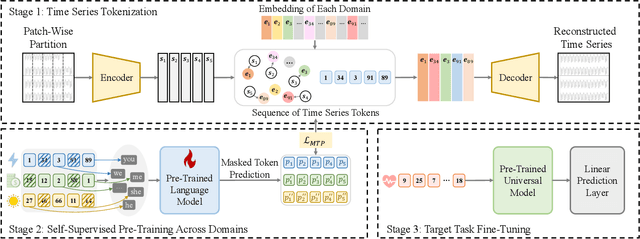



Advancements in self-supervised pre-training (SSL) have significantly advanced the field of learning transferable time series representations, which can be very useful in enhancing the downstream task. Despite being effective, most existing works struggle to achieve cross-domain SSL pre-training, missing valuable opportunities to integrate patterns and features from different domains. The main challenge lies in the significant differences in the characteristics of time-series data across different domains, such as variations in the number of channels and temporal resolution scales. To address this challenge, we propose CrossTimeNet, a novel cross-domain SSL learning framework to learn transferable knowledge from various domains to largely benefit the target downstream task. One of the key characteristics of CrossTimeNet is the newly designed time series tokenization module, which could effectively convert the raw time series into a sequence of discrete tokens based on a reconstruction optimization process. Besides, we highlight that predicting a high proportion of corrupted tokens can be very helpful for extracting informative patterns across different domains during SSL pre-training, which has been largely overlooked in past years. Furthermore, unlike previous works, our work treats the pre-training language model (PLM) as the initialization of the encoder network, investigating the feasibility of transferring the knowledge learned by the PLM to the time series area. Through these efforts, the path to cross-domain pre-training of a generic time series model can be effectively paved. We conduct extensive experiments in a real-world scenario across various time series classification domains. The experimental results clearly confirm CrossTimeNet's superior performance.
Advancing Time Series Classification with Multimodal Language Modeling
Mar 19, 2024


For the advancements of time series classification, scrutinizing previous studies, most existing methods adopt a common learning-to-classify paradigm - a time series classifier model tries to learn the relation between sequence inputs and target label encoded by one-hot distribution. Although effective, this paradigm conceals two inherent limitations: (1) encoding target categories with one-hot distribution fails to reflect the comparability and similarity between labels, and (2) it is very difficult to learn transferable model across domains, which greatly hinder the development of universal serving paradigm. In this work, we propose InstructTime, a novel attempt to reshape time series classification as a learning-to-generate paradigm. Relying on the powerful generative capacity of the pre-trained language model, the core idea is to formulate the classification of time series as a multimodal understanding task, in which both task-specific instructions and raw time series are treated as multimodal inputs while the label information is represented by texts. To accomplish this goal, three distinct designs are developed in the InstructTime. Firstly, a time series discretization module is designed to convert continuous time series into a sequence of hard tokens to solve the inconsistency issue across modal inputs. To solve the modality representation gap issue, for one thing, we introduce an alignment projected layer before feeding the transformed token of time series into language models. For another, we highlight the necessity of auto-regressive pre-training across domains, which can facilitate the transferability of the language model and boost the generalization performance. Extensive experiments are conducted over benchmark datasets, whose results uncover the superior performance of InstructTime and the potential for a universal foundation model in time series classification.