 Add to Chrome
 Add to Firefox
 Add to Edge
Learning from Environmental Feedback: Credit Assignment across Multiple Timescales for Agentic Reinforcement Learning
Aug 08, 2026
Agentic reinforcement learning (RL) often suffers from delayed and sparse rewards in real-world environments. A promising solution to this challenge is credit assignment, which aims to decompose trajectory-level rewards and provide more fine-grained supervision for intermediate decisions. However, existing credit assignment approaches ignore the rich process information naturally generated during environment interaction, e.g., interaction history. We argue that such information provides valuable supervision for identifying the contribution of individual actions. To this end, we propose Environmental Feedback-based Credit Assignment (EFCA), a multi-timescale credit assignment approach for long-horizon agentic RL. EFCA complements the long-term outcome signal with two environment-grounded process signals: a short-term feedback signal that captures the immediate effect of the current action and a medium-term state-history signal that identifies ineffective patterns from recent interactions. Both signals are directly extracted from environment feedback and integrated through a return reweighting mechanism. Experiments on ALFWorld and WebShop demonstrate that EFCA consistently improves both task success and task quality over strong baselines, highlighting the effectiveness of environment-grounded multi-timescale credit assignment for long-horizon agentic RL.

RRC: Unlocking Generative Reward Models in LLM Reinforcement Learning via Ranking-Based Reward Construction
Aug 06, 2026Recent advances in reward modeling show a paradigm shift from discriminative reward models to generative reward models. However, despite their strong capabilities in response ranking, generative reward models have not realized their potential in reinforcement learning (RL). Our analysis reveals that this limitation arises from a mismatch between the comparative nature of generative reward modeling and the scalar scoring paradigm adopted by existing RL algorithms. To bridge this gap, we propose a Ranking-based Reward Construction (RRC) approach, which enables generative reward models to provide more effective RL learning signals by deriving rewards from relative preference rankings. RRC introduces two complementary strategies: self-competitive ranking, which exploits comparisons among sampled responses, and anchor-guided ranking, which enables scalable ranking-based reward construction with a small set of reference responses. Experiments across open-ended chat and reasoning benchmarks demonstrate that RRC substantially improves RL training with generative reward models, achieving consistent gains over existing reward construction approaches. Our code can be found at https://github.com/wangclnlp/RRC.
MSRL: Scaling Generative Multimodal Reward Modeling via Multi-Stage Reinforcement Learning
Mar 26, 2026Recent advances in multimodal reward modeling have been largely driven by a paradigm shift from discriminative to generative approaches. Building on this progress, recent studies have further employed reinforcement learning from verifiable rewards (RLVR) to enhance multimodal reward models (MRMs). Despite their success, RLVR-based training typically relies on labeled multimodal preference data, which are costly and labor-intensive to obtain, making it difficult to scale MRM training. To overcome this limitation, we propose a Multi-Stage Reinforcement Learning (MSRL) approach, which can achieve scalable RL for MRMs with limited multimodal data. MSRL replaces the conventional RLVR-based training paradigm by first learning a generalizable reward reasoning capability from large-scale textual preference data, and then progressively transferring this capability to multimodal tasks through caption-based and fully multimodal reinforcement-learning stages. Furthermore, we introduce a cross-modal knowledge distillation approach to improve preference generalization within MSRL. Extensive experiments demonstrate that MSRL effectively scales the RLVR-based training of generative MRMs and substantially improves their performance across both visual understanding and visual generation tasks (e.g., from 66.6% to 75.9% on VL-RewardBench and from 70.2% to 75.7% on GenAI-Bench), without requiring additional multimodal preference annotations. Our code is available at: https://github.com/wangclnlp/MSRL.
When Scaling Fails: Mitigating Audio Perception Decay of LALMs via Multi-Step Perception-Aware Reasoning
Feb 28, 2026Test-Time Scaling has shown notable efficacy in addressing complex problems through scaling inference compute. However, within Large Audio-Language Models (LALMs), an unintuitive phenomenon exists: post-training models for structured reasoning trajectories results in marginal or even negative gains compared to post-training for direct answering. To investigate it, we introduce CAFE, an evaluation framework designed to precisely quantify audio reasoning errors. Evaluation results reveal LALMs struggle with perception during reasoning and encounter a critical bottleneck: reasoning performance suffers from audio perception decay as reasoning length extends. To address it, we propose MPAR$^2$, a paradigm that encourages dynamic perceptual reasoning and decomposes complex questions into perception-rich sub-problems. Leveraging reinforcement learning, MPAR$^2$ improves perception performance on CAFE from 31.74% to 63.51% and effectively mitigates perception decay, concurrently enhancing reasoning capabilities to achieve a significant 74.59% accuracy on the MMAU benchmark. Further analysis demonstrates that MPAR$^2$ reinforces LALMs to attend to audio input and dynamically adapts reasoning budget to match task complexity.
APR: Penalizing Structural Redundancy in Large Reasoning Models via Anchor-based Process Rewards
Jan 31, 2026Test-Time Scaling (TTS) has significantly enhanced the capabilities of Large Reasoning Models (LRMs) but introduces a critical side-effect known as Overthinking. We conduct a preliminary study to rethink this phenomenon from a fine-grained perspective. We observe that LRMs frequently conduct repetitive self-verification without revision even after obtaining the final answer during the reasoning process. We formally define this specific position where the answer first stabilizes as the Reasoning Anchor. By analyzing pre- and post-anchor reasoning behaviors, we uncover the structural redundancy fixed in LRMs: the meaningless repetitive verification after deriving the first complete answer, which we term the Answer-Stable Tail (AST). Motivated by this observation, we propose Anchor-based Process Reward (APR), a structure-aware reward shaping method that localizes the reasoning anchor and penalizes exclusively the post-anchor AST. Leveraging the policy optimization algorithm suitable for length penalties, our APR models achieved the performance-efficiency Pareto frontier at 1.5B and 7B scales averaged across five mathematical reasoning datasets while requiring significantly fewer computational resources for RL training.
SERM: Self-Evolving Relevance Model with Agent-Driven Learning from Massive Query Streams
Jan 14, 2026Due to the dynamically evolving nature of real-world query streams, relevance models struggle to generalize to practical search scenarios. A sophisticated solution is self-evolution techniques. However, in large-scale industrial settings with massive query streams, this technique faces two challenges: (1) informative samples are often sparse and difficult to identify, and (2) pseudo-labels generated by the current model could be unreliable. To address these challenges, in this work, we propose a Self-Evolving Relevance Model approach (SERM), which comprises two complementary multi-agent modules: a multi-agent sample miner, designed to detect distributional shifts and identify informative training samples, and a multi-agent relevance annotator, which provides reliable labels through a two-level agreement framework. We evaluate SERM in a large-scale industrial setting, which serves billions of user requests daily. Experimental results demonstrate that SERM can achieve significant performance gains through iterative self-evolution, as validated by extensive offline multilingual evaluations and online testing.
Probing Preference Representations: A Multi-Dimensional Evaluation and Analysis Method for Reward Models
Nov 16, 2025Previous methods evaluate reward models by testing them on a fixed pairwise ranking test set, but they typically do not provide performance information on each preference dimension. In this work, we address the evaluation challenge of reward models by probing preference representations. To confirm the effectiveness of this evaluation method, we construct a Multi-dimensional Reward Model Benchmark (MRMBench), a collection of six probing tasks for different preference dimensions. We design it to favor and encourage reward models that better capture preferences across different dimensions. Furthermore, we introduce an analysis method, inference-time probing, which identifies the dimensions used during the reward prediction and enhances its interpretability. Through extensive experiments, we find that MRMBench strongly correlates with the alignment performance of large language models (LLMs), making it a reliable reference for developing advanced reward models. Our analysis of MRMBench evaluation results reveals that reward models often struggle to capture preferences across multiple dimensions, highlighting the potential of multi-objective optimization in reward modeling. Additionally, our findings show that the proposed inference-time probing method offers a reliable metric for assessing the confidence of reward predictions, which ultimately improves the alignment of LLMs.
HEAL: A Hypothesis-Based Preference-Aware Analysis Framework
Aug 27, 2025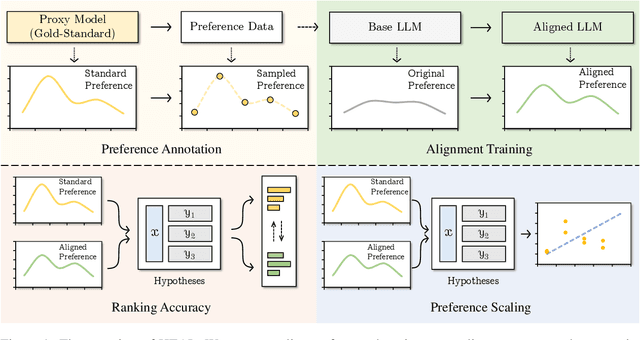
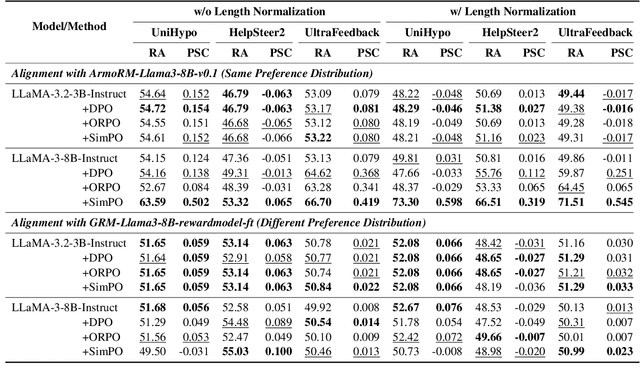
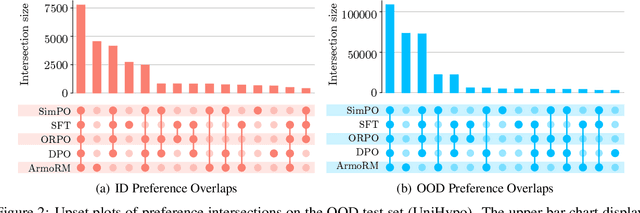
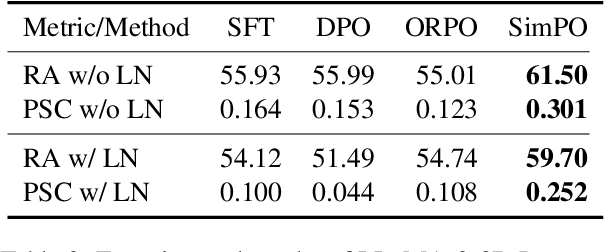
Preference optimization methods like DPO have achieved remarkable performance in LLM alignment. However, the evaluation for these methods relies on a single response and overlooks other potential outputs, which could also be generated in real-world applications within this hypothetical space. To address this issue, this paper presents a \textbf{H}ypothesis-based Pr\textbf{E}ference-aware \textbf{A}na\textbf{L}ysis Framework (HEAL), a novel evaluation paradigm that formulates preference alignment as a re-ranking process within hypothesis spaces. The framework incorporates two complementary metrics: ranking accuracy for evaluating ordinal consistency and preference strength correlation for assessing continuous alignment. To facilitate this framework, we develop UniHypoBench, a unified hypothesis benchmark constructed from diverse instruction-response pairs. Through extensive experiments based on HEAL, with a particular focus on the intrinsic mechanisms of preference learning, we demonstrate that current preference learning methods can effectively capture preferences provided by proxy models while simultaneously suppressing negative samples. These findings contribute to preference learning research through two significant avenues. Theoretically, we introduce hypothesis space analysis as an innovative paradigm for understanding preference alignment. Practically, HEAL offers researchers robust diagnostic tools for refining preference optimization methods, while our empirical results identify promising directions for developing more advanced alignment algorithms capable of comprehensive preference capture.
LaTeXTrans: Structured LaTeX Translation with Multi-Agent Coordination
Aug 26, 2025Despite the remarkable progress of modern machine translation (MT) systems on general-domain texts, translating structured LaTeX-formatted documents remains a significant challenge. These documents typically interleave natural language with domain-specific syntax, such as mathematical equations, tables, figures, and cross-references, all of which must be accurately preserved to maintain semantic integrity and compilability. In this paper, we introduce LaTeXTrans, a collaborative multi-agent system designed to address this challenge. LaTeXTrans ensures format preservation, structural fidelity, and terminology consistency through six specialized agents: 1) a Parser that decomposes LaTeX into translation-friendly units via placeholder substitution and syntax filtering; 2) a Translator, Validator, Summarizer, and Terminology Extractor that work collaboratively to ensure context-aware, self-correcting, and terminology-consistent translations; 3) a Generator that reconstructs the translated content into well-structured LaTeX documents. Experimental results demonstrate that LaTeXTrans can outperform mainstream MT systems in both translation accuracy and structural fidelity, offering an effective and practical solution for translating LaTeX-formatted documents.
GRAM: A Generative Foundation Reward Model for Reward Generalization
Jun 18, 2025In aligning large language models (LLMs), reward models have played an important role, but are standardly trained as discriminative models and rely only on labeled human preference data. In this paper, we explore methods that train reward models using both unlabeled and labeled data. Building on the generative models in LLMs, we develop a generative reward model that is first trained via large-scale unsupervised learning and then fine-tuned via supervised learning. We also show that by using label smoothing, we are in fact optimizing a regularized pairwise ranking loss. This result, in turn, provides a new view of training reward models, which links generative models and discriminative models under the same class of training objectives. The outcome of these techniques is a foundation reward model, which can be applied to a wide range of tasks with little or no further fine-tuning effort. Extensive experiments show that this model generalizes well across several tasks, including response ranking, reinforcement learning from human feedback, and task adaptation with fine-tuning, achieving significant performance improvements over several strong baseline models.