 Add to Chrome
 Add to Firefox
 Add to Edge
Learning from Environmental Feedback: Credit Assignment across Multiple Timescales for Agentic Reinforcement Learning
Aug 08, 2026
Agentic reinforcement learning (RL) often suffers from delayed and sparse rewards in real-world environments. A promising solution to this challenge is credit assignment, which aims to decompose trajectory-level rewards and provide more fine-grained supervision for intermediate decisions. However, existing credit assignment approaches ignore the rich process information naturally generated during environment interaction, e.g., interaction history. We argue that such information provides valuable supervision for identifying the contribution of individual actions. To this end, we propose Environmental Feedback-based Credit Assignment (EFCA), a multi-timescale credit assignment approach for long-horizon agentic RL. EFCA complements the long-term outcome signal with two environment-grounded process signals: a short-term feedback signal that captures the immediate effect of the current action and a medium-term state-history signal that identifies ineffective patterns from recent interactions. Both signals are directly extracted from environment feedback and integrated through a return reweighting mechanism. Experiments on ALFWorld and WebShop demonstrate that EFCA consistently improves both task success and task quality over strong baselines, highlighting the effectiveness of environment-grounded multi-timescale credit assignment for long-horizon agentic RL.

HEAL: A Hypothesis-Based Preference-Aware Analysis Framework
Aug 27, 2025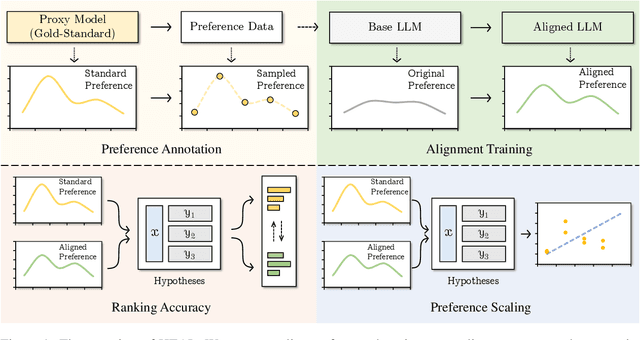
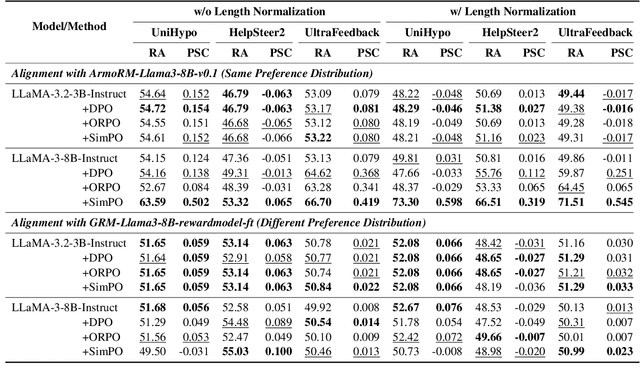
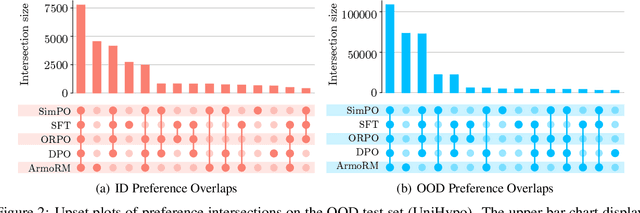
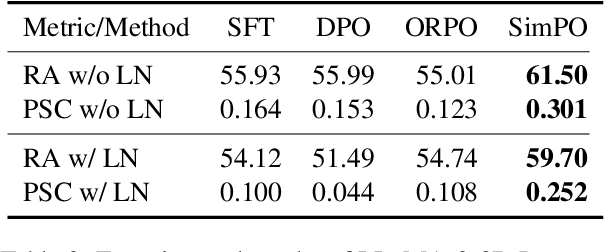
Preference optimization methods like DPO have achieved remarkable performance in LLM alignment. However, the evaluation for these methods relies on a single response and overlooks other potential outputs, which could also be generated in real-world applications within this hypothetical space. To address this issue, this paper presents a \textbf{H}ypothesis-based Pr\textbf{E}ference-aware \textbf{A}na\textbf{L}ysis Framework (HEAL), a novel evaluation paradigm that formulates preference alignment as a re-ranking process within hypothesis spaces. The framework incorporates two complementary metrics: ranking accuracy for evaluating ordinal consistency and preference strength correlation for assessing continuous alignment. To facilitate this framework, we develop UniHypoBench, a unified hypothesis benchmark constructed from diverse instruction-response pairs. Through extensive experiments based on HEAL, with a particular focus on the intrinsic mechanisms of preference learning, we demonstrate that current preference learning methods can effectively capture preferences provided by proxy models while simultaneously suppressing negative samples. These findings contribute to preference learning research through two significant avenues. Theoretically, we introduce hypothesis space analysis as an innovative paradigm for understanding preference alignment. Practically, HEAL offers researchers robust diagnostic tools for refining preference optimization methods, while our empirical results identify promising directions for developing more advanced alignment algorithms capable of comprehensive preference capture.
LaTeXTrans: Structured LaTeX Translation with Multi-Agent Coordination
Aug 26, 2025Despite the remarkable progress of modern machine translation (MT) systems on general-domain texts, translating structured LaTeX-formatted documents remains a significant challenge. These documents typically interleave natural language with domain-specific syntax, such as mathematical equations, tables, figures, and cross-references, all of which must be accurately preserved to maintain semantic integrity and compilability. In this paper, we introduce LaTeXTrans, a collaborative multi-agent system designed to address this challenge. LaTeXTrans ensures format preservation, structural fidelity, and terminology consistency through six specialized agents: 1) a Parser that decomposes LaTeX into translation-friendly units via placeholder substitution and syntax filtering; 2) a Translator, Validator, Summarizer, and Terminology Extractor that work collaboratively to ensure context-aware, self-correcting, and terminology-consistent translations; 3) a Generator that reconstructs the translated content into well-structured LaTeX documents. Experimental results demonstrate that LaTeXTrans can outperform mainstream MT systems in both translation accuracy and structural fidelity, offering an effective and practical solution for translating LaTeX-formatted documents.