 Add to Chrome
 Add to Firefox
 Add to Edge
Learning from Environmental Feedback: Credit Assignment across Multiple Timescales for Agentic Reinforcement Learning
Aug 08, 2026
Agentic reinforcement learning (RL) often suffers from delayed and sparse rewards in real-world environments. A promising solution to this challenge is credit assignment, which aims to decompose trajectory-level rewards and provide more fine-grained supervision for intermediate decisions. However, existing credit assignment approaches ignore the rich process information naturally generated during environment interaction, e.g., interaction history. We argue that such information provides valuable supervision for identifying the contribution of individual actions. To this end, we propose Environmental Feedback-based Credit Assignment (EFCA), a multi-timescale credit assignment approach for long-horizon agentic RL. EFCA complements the long-term outcome signal with two environment-grounded process signals: a short-term feedback signal that captures the immediate effect of the current action and a medium-term state-history signal that identifies ineffective patterns from recent interactions. Both signals are directly extracted from environment feedback and integrated through a return reweighting mechanism. Experiments on ALFWorld and WebShop demonstrate that EFCA consistently improves both task success and task quality over strong baselines, highlighting the effectiveness of environment-grounded multi-timescale credit assignment for long-horizon agentic RL.

RRC: Unlocking Generative Reward Models in LLM Reinforcement Learning via Ranking-Based Reward Construction
Aug 06, 2026Recent advances in reward modeling show a paradigm shift from discriminative reward models to generative reward models. However, despite their strong capabilities in response ranking, generative reward models have not realized their potential in reinforcement learning (RL). Our analysis reveals that this limitation arises from a mismatch between the comparative nature of generative reward modeling and the scalar scoring paradigm adopted by existing RL algorithms. To bridge this gap, we propose a Ranking-based Reward Construction (RRC) approach, which enables generative reward models to provide more effective RL learning signals by deriving rewards from relative preference rankings. RRC introduces two complementary strategies: self-competitive ranking, which exploits comparisons among sampled responses, and anchor-guided ranking, which enables scalable ranking-based reward construction with a small set of reference responses. Experiments across open-ended chat and reasoning benchmarks demonstrate that RRC substantially improves RL training with generative reward models, achieving consistent gains over existing reward construction approaches. Our code can be found at https://github.com/wangclnlp/RRC.
Probing Preference Representations: A Multi-Dimensional Evaluation and Analysis Method for Reward Models
Nov 16, 2025Previous methods evaluate reward models by testing them on a fixed pairwise ranking test set, but they typically do not provide performance information on each preference dimension. In this work, we address the evaluation challenge of reward models by probing preference representations. To confirm the effectiveness of this evaluation method, we construct a Multi-dimensional Reward Model Benchmark (MRMBench), a collection of six probing tasks for different preference dimensions. We design it to favor and encourage reward models that better capture preferences across different dimensions. Furthermore, we introduce an analysis method, inference-time probing, which identifies the dimensions used during the reward prediction and enhances its interpretability. Through extensive experiments, we find that MRMBench strongly correlates with the alignment performance of large language models (LLMs), making it a reliable reference for developing advanced reward models. Our analysis of MRMBench evaluation results reveals that reward models often struggle to capture preferences across multiple dimensions, highlighting the potential of multi-objective optimization in reward modeling. Additionally, our findings show that the proposed inference-time probing method offers a reliable metric for assessing the confidence of reward predictions, which ultimately improves the alignment of LLMs.
MRO: Enhancing Reasoning in Diffusion Language Models via Multi-Reward Optimization
Oct 24, 2025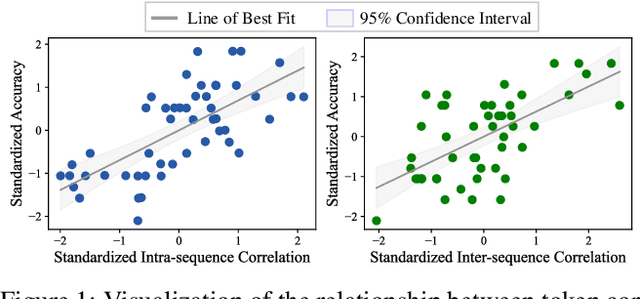
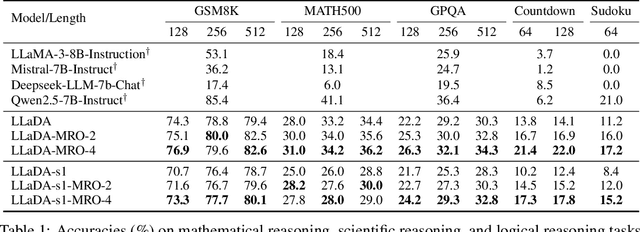
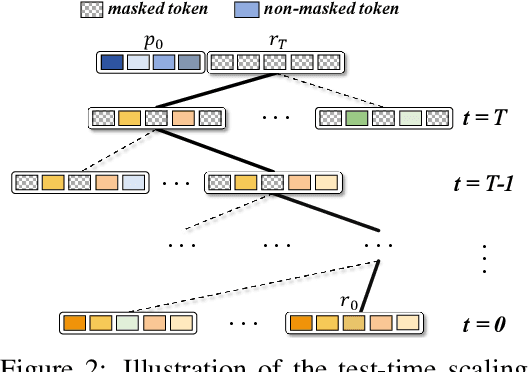
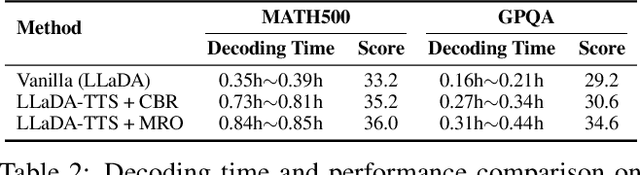
Recent advances in diffusion language models (DLMs) have presented a promising alternative to traditional autoregressive large language models (LLMs). However, DLMs still lag behind LLMs in reasoning performance, especially as the number of denoising steps decreases. Our analysis reveals that this shortcoming arises primarily from the independent generation of masked tokens across denoising steps, which fails to capture the token correlation. In this paper, we define two types of token correlation: intra-sequence correlation and inter-sequence correlation, and demonstrate that enhancing these correlations improves reasoning performance. To this end, we propose a Multi-Reward Optimization (MRO) approach, which encourages DLMs to consider the token correlation during the denoising process. More specifically, our MRO approach leverages test-time scaling, reject sampling, and reinforcement learning to directly optimize the token correlation with multiple elaborate rewards. Additionally, we introduce group step and importance sampling strategies to mitigate reward variance and enhance sampling efficiency. Through extensive experiments, we demonstrate that MRO not only improves reasoning performance but also achieves significant sampling speedups while maintaining high performance on reasoning benchmarks.
HEAL: A Hypothesis-Based Preference-Aware Analysis Framework
Aug 27, 2025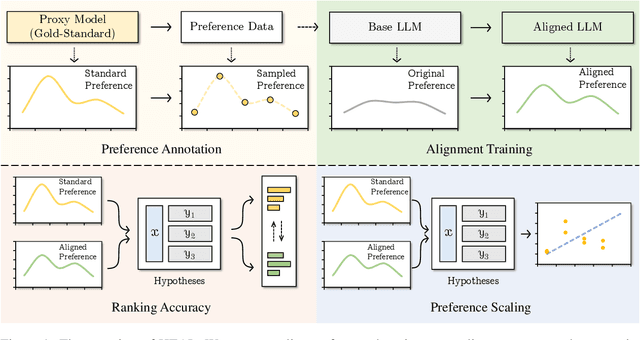
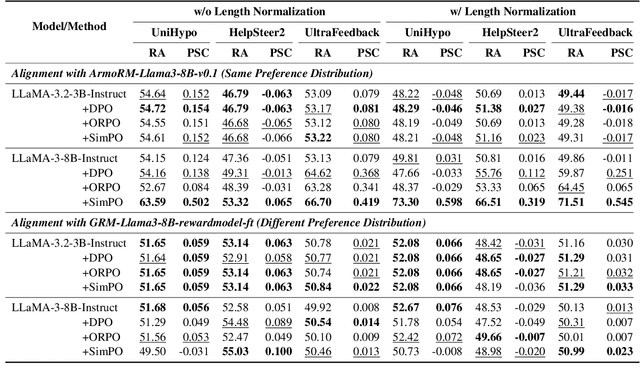
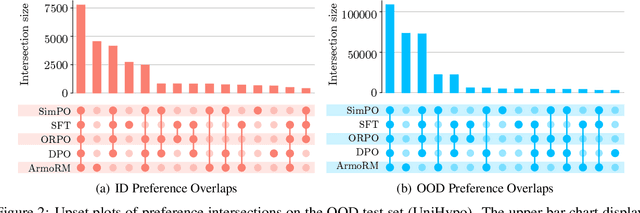
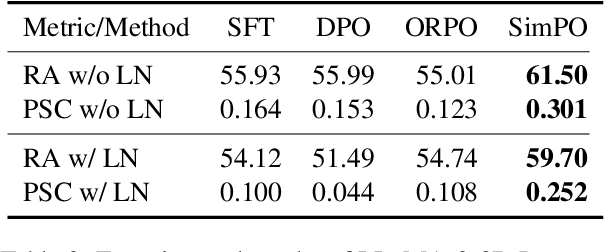
Preference optimization methods like DPO have achieved remarkable performance in LLM alignment. However, the evaluation for these methods relies on a single response and overlooks other potential outputs, which could also be generated in real-world applications within this hypothetical space. To address this issue, this paper presents a \textbf{H}ypothesis-based Pr\textbf{E}ference-aware \textbf{A}na\textbf{L}ysis Framework (HEAL), a novel evaluation paradigm that formulates preference alignment as a re-ranking process within hypothesis spaces. The framework incorporates two complementary metrics: ranking accuracy for evaluating ordinal consistency and preference strength correlation for assessing continuous alignment. To facilitate this framework, we develop UniHypoBench, a unified hypothesis benchmark constructed from diverse instruction-response pairs. Through extensive experiments based on HEAL, with a particular focus on the intrinsic mechanisms of preference learning, we demonstrate that current preference learning methods can effectively capture preferences provided by proxy models while simultaneously suppressing negative samples. These findings contribute to preference learning research through two significant avenues. Theoretically, we introduce hypothesis space analysis as an innovative paradigm for understanding preference alignment. Practically, HEAL offers researchers robust diagnostic tools for refining preference optimization methods, while our empirical results identify promising directions for developing more advanced alignment algorithms capable of comprehensive preference capture.
GRAM: A Generative Foundation Reward Model for Reward Generalization
Jun 18, 2025In aligning large language models (LLMs), reward models have played an important role, but are standardly trained as discriminative models and rely only on labeled human preference data. In this paper, we explore methods that train reward models using both unlabeled and labeled data. Building on the generative models in LLMs, we develop a generative reward model that is first trained via large-scale unsupervised learning and then fine-tuned via supervised learning. We also show that by using label smoothing, we are in fact optimizing a regularized pairwise ranking loss. This result, in turn, provides a new view of training reward models, which links generative models and discriminative models under the same class of training objectives. The outcome of these techniques is a foundation reward model, which can be applied to a wide range of tasks with little or no further fine-tuning effort. Extensive experiments show that this model generalizes well across several tasks, including response ranking, reinforcement learning from human feedback, and task adaptation with fine-tuning, achieving significant performance improvements over several strong baseline models.
LRHP: Learning Representations for Human Preferences via Preference Pairs
Oct 06, 2024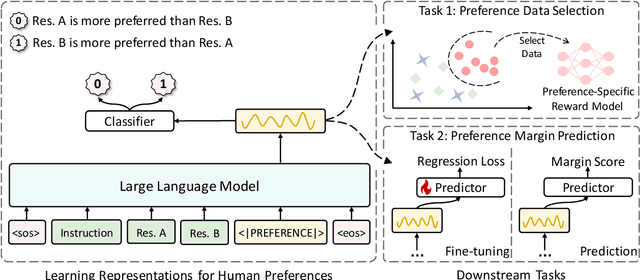
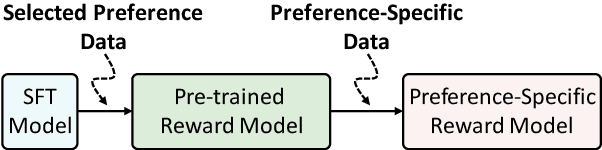
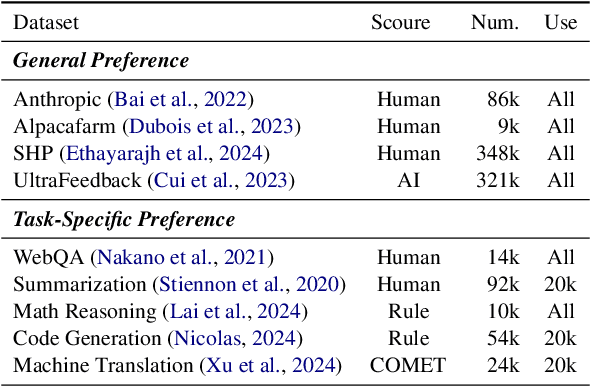
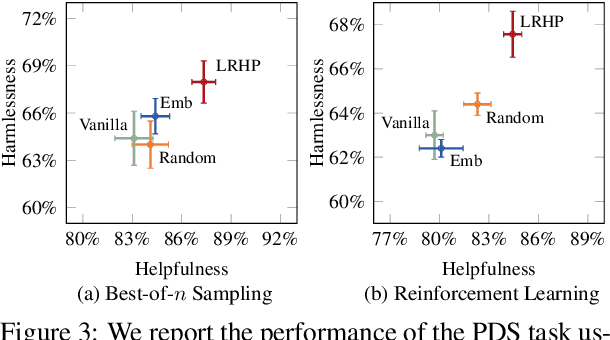
To improve human-preference alignment training, current research has developed numerous preference datasets consisting of preference pairs labeled as "preferred" or "dispreferred". These preference pairs are typically used to encode human preferences into a single numerical value through reward modeling, which acts as a reward signal during reinforcement learning from human feedback (RLHF). However, representing these human preferences as a numerical value complicates the analysis of these preferences and restricts their broader applications other than RLHF. In contrast, in this work, we introduce a preference representation learning task that aims to construct a richer and more structured representation of human preferences. We further develop a more generalizable framework, Learning Representations for Human Preferences via preference pairs (namely LRHP), which extends beyond traditional reward modeling to tackle this task. We verify the utility of preference representations in two downstream tasks: preference data selection and preference margin prediction. Building upon the human preferences in representations, we achieve strong performance in both tasks, significantly outperforming baselines.
RoVRM: A Robust Visual Reward Model Optimized via Auxiliary Textual Preference Data
Aug 22, 2024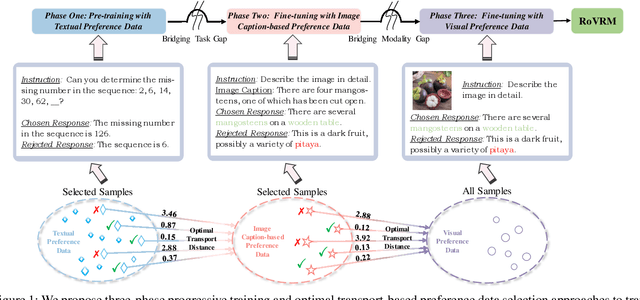
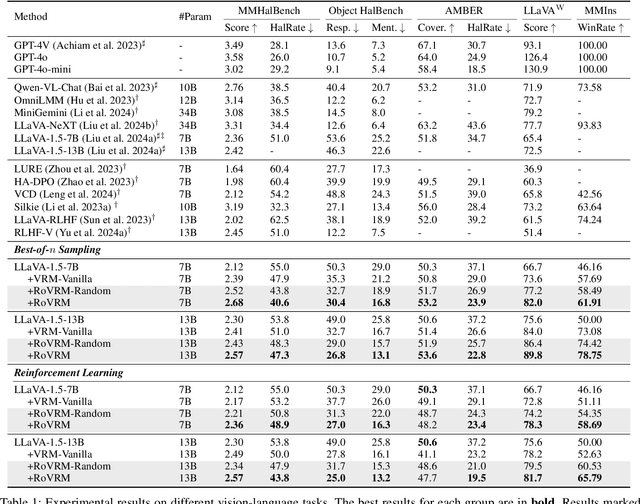
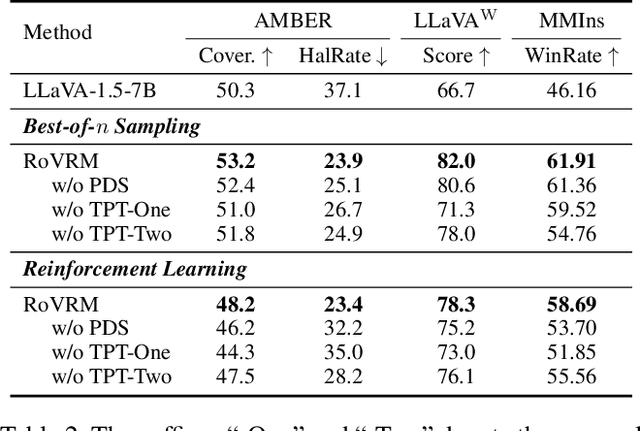
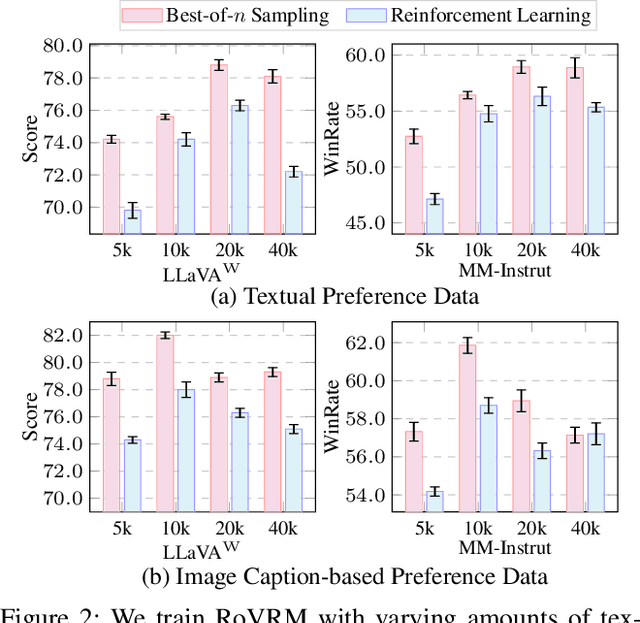
Large vision-language models (LVLMs) often fail to align with human preferences, leading to issues like generating misleading content without proper visual context (also known as hallucination). A promising solution to this problem is using human-preference alignment techniques, such as best-of-n sampling and reinforcement learning. However, these techniques face the difficulty arising from the scarcity of visual preference data, which is required to train a visual reward model (VRM). In this work, we continue the line of research. We present a Robust Visual Reward Model (RoVRM) which improves human-preference alignment for LVLMs. RoVRM leverages auxiliary textual preference data through a three-phase progressive training and optimal transport-based preference data selection to effectively mitigate the scarcity of visual preference data. We experiment with RoVRM on the commonly used vision-language tasks based on the LLaVA-1.5-7B and -13B models. Experimental results demonstrate that RoVRM consistently outperforms traditional VRMs. Furthermore, our three-phase progressive training and preference data selection approaches can yield consistent performance gains over ranking-based alignment techniques, such as direct preference optimization.
Hybrid Alignment Training for Large Language Models
Jun 21, 2024
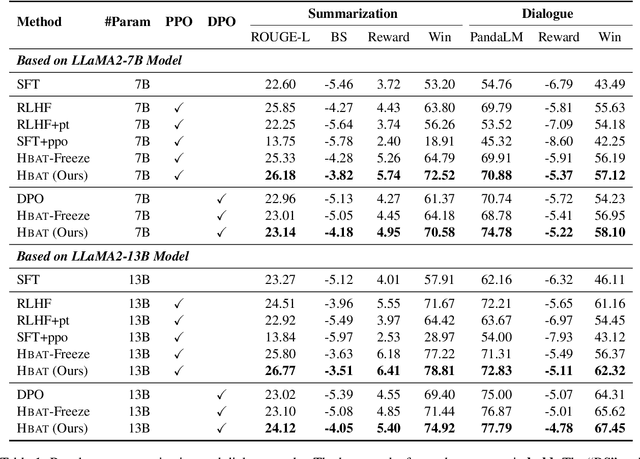
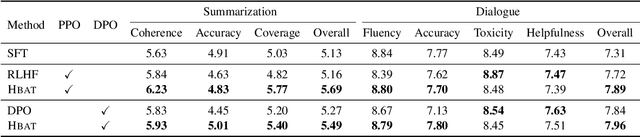
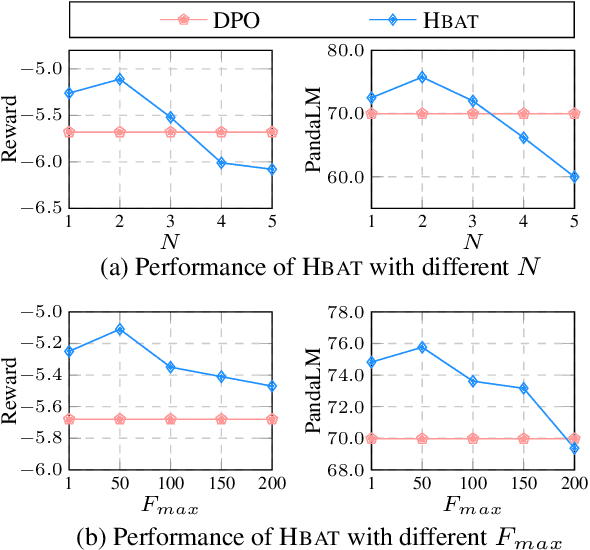
Alignment training is crucial for enabling large language models (LLMs) to cater to human intentions and preferences. It is typically performed based on two stages with different objectives: instruction-following alignment and human-preference alignment. However, aligning LLMs with these objectives in sequence suffers from an inherent problem: the objectives may conflict, and the LLMs cannot guarantee to simultaneously align with the instructions and human preferences well. To response to these, in this work, we propose a Hybrid Alignment Training (Hbat) approach, based on alternating alignment and modified elastic weight consolidation methods. The basic idea is to alternate between different objectives during alignment training, so that better collaboration can be achieved between the two alignment tasks.We experiment with Hbat on summarization and dialogue tasks. Experimental results show that the proposed \textsc{Hbat} can significantly outperform all baselines. Notably, Hbat yields consistent performance gains over the traditional two-stage alignment training when using both proximal policy optimization and direct preference optimization.
Large Language Models are Parallel Multilingual Learners
Mar 14, 2024In this study, we reveal an in-context learning (ICL) capability of multilingual large language models (LLMs): by translating the input to several languages, we provide Parallel Input in Multiple Languages (PiM) to LLMs, which significantly enhances their comprehension abilities. To test this capability, we design extensive experiments encompassing 8 typical datasets, 7 languages and 8 state-of-the-art multilingual LLMs. Experimental results show that (1) incorporating more languages help PiM surpass the conventional ICL further; (2) even combining with the translations that are inferior to baseline performance can also help. Moreover, by examining the activated neurons in LLMs, we discover a counterintuitive but interesting phenomenon. Contrary to the common thought that PiM would activate more neurons than monolingual input to leverage knowledge learned from diverse languages, PiM actually inhibits neurons and promotes more precise neuron activation especially when more languages are added. This phenomenon aligns with the neuroscience insight about synaptic pruning, which removes less used neural connections, strengthens remainders, and then enhances brain intelligence.