 Add to Chrome
 Add to Firefox
 Add to Edge
RoboNaldo: Accurate, Stable and Powerful Humanoid Soccer Shooting via Motion-Guided Curriculum Reinforcement Learning
Jun 09, 2026
Elite humanoid soccer shooting requires whole-body stability, high-impulse whole-body interactions, and accuracy to targets. Motion tracking-driven reinforcement learning (RL) provides stability in whole-body movement coordination, but a fixed reference makes it hard to adapt to varied ball positions and strike timings; in contrast, task reward-driven RL struggles to explore and discover valid kicks from scratch. We therefore introduce RoboNaldo, a three-stage motion-guided curriculum RL framework for high-impulse humanoid interaction. A single human-kick reference is used as a scaffold and progressively shifts optimization towards shooting performance. The curriculum first learns a stable whole-body kicking prior, then adapts the kick to free-kick settings where the ball is stationary at random positions, and finally extends it to moving-ball shooting through a locomotion-command and kick-trigger interface. A high-level heuristic planner controls this interface during training, while alternative high-level controllers can drive the same low-level policy at inference. In simulation, RoboNaldo demonstrates free-kick shot error 48.6% lower and shoot velocity 2.96x than prior work baselines. In real world on a Unitree G1 with onboard perception, RoboNaldo attains 0.73 m and 0.86 m average target shooting error from 3 m away in free-kick and moving-ball cases, accordingly. And the post-contact ball velocity reaches 13.10 m/s, which is 59-71% of reported professional open-play shot speed. Project page: $\href{https://opendrivelab.com/RoboNaldo}{\text{opendrivelab.com/RoboNaldo}}$.

Unified Walking, Running, and Recovery for Humanoids via State-Dependent Adversarial Motion Priors
May 18, 2026We propose a unified reinforcement learning framework that enables a single policy to perform walking, running, and fall recovery on the Unitree G1 humanoid robot, validated on physical hardware without any explicit mode-switching command at deployment. The framework extends Adversarial Motion Priors (AMP) by replacing the conventional global reference distribution with a state-dependent gate that routes each training transition to one of two discriminators: a dedicated recovery discriminator and a velocity-conditioned locomotion discriminator that jointly covers walking and running. The gate is defined by a single fixed threshold on projected gravity: the recovery discriminator is activated when body tilt exceeds approximately $37^\circ$ from vertical ($|g_z+1|>0.6$); otherwise the locomotion discriminator is used, with the normalized commanded velocity serving as a condition that selects the appropriate reference trajectory between walk and run clips. Only three LAFAN1 reference clips are required to regularize the complete behavior set. At deployment, a single frozen ONNX policy executes at 50\,Hz with no runtime mode logic; hardware experiments demonstrate successful recovery from both prone and supine falls and smooth walk-to-run transitions under the same controller.
Hyperbolic Hierarchical Alignment Reasoning Network for Text-3D Retrieval
Nov 14, 2025With the daily influx of 3D data on the internet, text-3D retrieval has gained increasing attention. However, current methods face two major challenges: Hierarchy Representation Collapse (HRC) and Redundancy-Induced Saliency Dilution (RISD). HRC compresses abstract-to-specific and whole-to-part hierarchies in Euclidean embeddings, while RISD averages noisy fragments, obscuring critical semantic cues and diminishing the model's ability to distinguish hard negatives. To address these challenges, we introduce the Hyperbolic Hierarchical Alignment Reasoning Network (H$^{2}$ARN) for text-3D retrieval. H$^{2}$ARN embeds both text and 3D data in a Lorentz-model hyperbolic space, where exponential volume growth inherently preserves hierarchical distances. A hierarchical ordering loss constructs a shrinking entailment cone around each text vector, ensuring that the matched 3D instance falls within the cone, while an instance-level contrastive loss jointly enforces separation from non-matching samples. To tackle RISD, we propose a contribution-aware hyperbolic aggregation module that leverages Lorentzian distance to assess the relevance of each local feature and applies contribution-weighted aggregation guided by hyperbolic geometry, enhancing discriminative regions while suppressing redundancy without additional supervision. We also release the expanded T3DR-HIT v2 benchmark, which contains 8,935 text-to-3D pairs, 2.6 times the original size, covering both fine-grained cultural artefacts and complex indoor scenes. Our codes are available at https://github.com/liwrui/H2ARN.
Learning an Adaptive Fall Recovery Controller for Quadrupeds on Complex Terrains
Dec 22, 2024Legged robots have shown promise in locomotion complex environments, but recovery from falls on challenging terrains remains a significant hurdle. This paper presents an Adaptive Fall Recovery (AFR) controller for quadrupedal robots on challenging terrains such as rocky, breams, steep slopes, and irregular stones. We leverage deep reinforcement learning to train the AFR, which can adapt to a wide range of terrain geometries and physical properties. Our method demonstrates improvements over existing approaches, showing promising results in recovery scenarios on challenging terrains. We trained our method in Isaac Gym using the Go1 and directly transferred it to several mainstream quadrupedal platforms, such as Spot and ANYmal. Additionally, we validated the controller's effectiveness in Gazebo. Our results indicate that the AFR controller generalizes well to complex terrains and outperforms baseline methods in terms of success rate and recovery speed.
Digging into Intrinsic Contextual Information for High-fidelity 3D Point Cloud Completion
Dec 11, 2024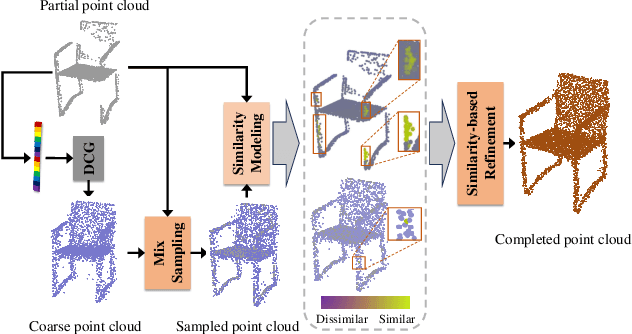
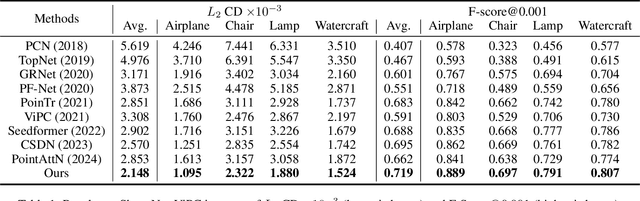
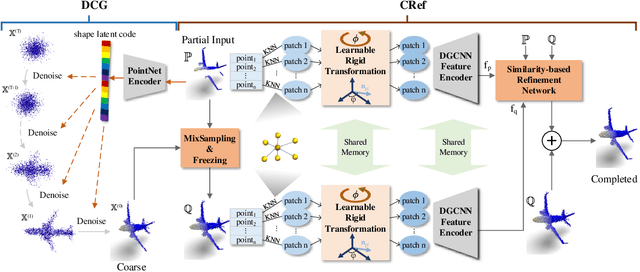
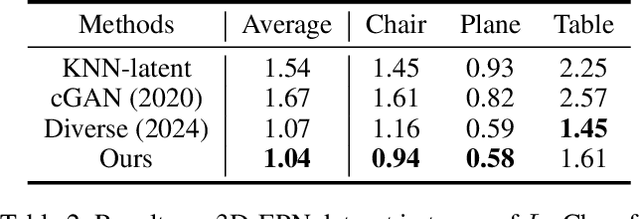
The common occurrence of occlusion-induced incompleteness in point clouds has made point cloud completion (PCC) a highly-concerned task in the field of geometric processing. Existing PCC methods typically produce complete point clouds from partial point clouds in a coarse-to-fine paradigm, with the coarse stage generating entire shapes and the fine stage improving texture details. Though diffusion models have demonstrated effectiveness in the coarse stage, the fine stage still faces challenges in producing high-fidelity results due to the ill-posed nature of PCC. The intrinsic contextual information for texture details in partial point clouds is the key to solving the challenge. In this paper, we propose a high-fidelity PCC method that digs into both short and long-range contextual information from the partial point cloud in the fine stage. Specifically, after generating the coarse point cloud via a diffusion-based coarse generator, a mixed sampling module introduces short-range contextual information from partial point clouds into the fine stage. A surface freezing modules safeguards points from noise-free partial point clouds against disruption. As for the long-range contextual information, we design a similarity modeling module to derive similarity with rigid transformation invariance between points, conducting effective matching of geometric manifold features globally. In this way, the high-quality components present in the partial point cloud serve as valuable references for refining the coarse point cloud with high fidelity. Extensive experiments have demonstrated the superiority of the proposed method over SOTA competitors. Our code is available at https://github.com/JS-CHU/ContextualCompletion.
Riemann-based Multi-scale Attention Reasoning Network for Text-3D Retrieval
Aug 25, 2024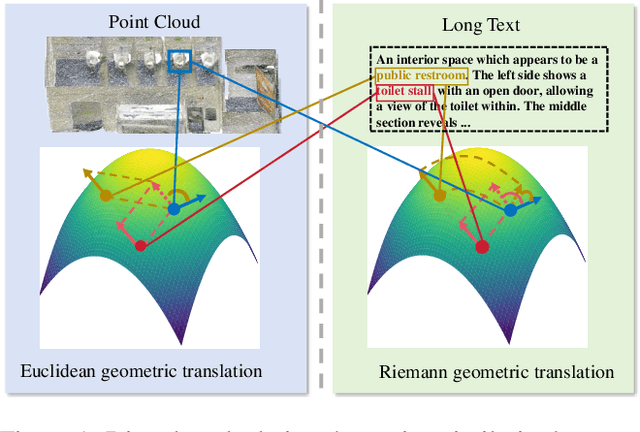
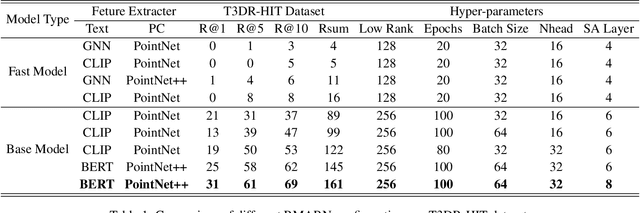
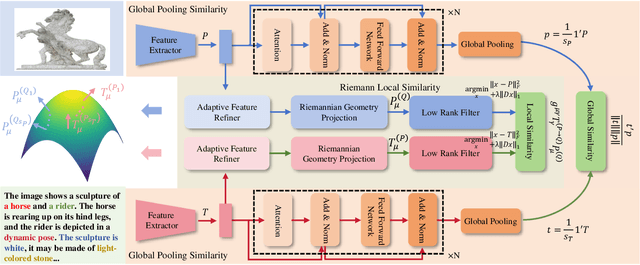

Due to the challenges in acquiring paired Text-3D data and the inherent irregularity of 3D data structures, combined representation learning of 3D point clouds and text remains unexplored. In this paper, we propose a novel Riemann-based Multi-scale Attention Reasoning Network (RMARN) for text-3D retrieval. Specifically, the extracted text and point cloud features are refined by their respective Adaptive Feature Refiner (AFR). Furthermore, we introduce the innovative Riemann Local Similarity (RLS) module and the Global Pooling Similarity (GPS) module. However, as 3D point cloud data and text data often possess complex geometric structures in high-dimensional space, the proposed RLS employs a novel Riemann Attention Mechanism to reflect the intrinsic geometric relationships of the data. Without explicitly defining the manifold, RMARN learns the manifold parameters to better represent the distances between text-point cloud samples. To address the challenges of lacking paired text-3D data, we have created the large-scale Text-3D Retrieval dataset T3DR-HIT, which comprises over 3,380 pairs of text and point cloud data. T3DR-HIT contains coarse-grained indoor 3D scenes and fine-grained Chinese artifact scenes, consisting of 1,380 and over 2,000 text-3D pairs, respectively. Experiments on our custom datasets demonstrate the superior performance of the proposed method. Our code and proposed datasets are available at \url{https://github.com/liwrui/RMARN}.