 Add to Chrome
 Add to Firefox
 Add to Edge
LiteraryTaste: A Preference Dataset for Creative Writing Personalization
Nov 12, 2025
People have different creative writing preferences, and large language models (LLMs) for these tasks can benefit from adapting to each user's preferences. However, these models are often trained over a dataset that considers varying personal tastes as a monolith. To facilitate developing personalized creative writing LLMs, we introduce LiteraryTaste, a dataset of reading preferences from 60 people, where each person: 1) self-reported their reading habits and tastes (stated preference), and 2) annotated their preferences over 100 pairs of short creative writing texts (revealed preference). With our dataset, we found that: 1) people diverge on creative writing preferences, 2) finetuning a transformer encoder could achieve 75.8% and 67.7% accuracy when modeling personal and collective revealed preferences, and 3) stated preferences had limited utility in modeling revealed preferences. With an LLM-driven interpretability pipeline, we analyzed how people's preferences vary. We hope our work serves as a cornerstone for personalizing creative writing technologies.

SSTODE: Ocean-Atmosphere Physics-Informed Neural ODEs for Sea Surface Temperature Prediction
Nov 07, 2025Sea Surface Temperature (SST) is crucial for understanding upper-ocean thermal dynamics and ocean-atmosphere interactions, which have profound economic and social impacts. While data-driven models show promise in SST prediction, their black-box nature often limits interpretability and overlooks key physical processes. Recently, physics-informed neural networks have been gaining momentum but struggle with complex ocean-atmosphere dynamics due to 1) inadequate characterization of seawater movement (e.g., coastal upwelling) and 2) insufficient integration of external SST drivers (e.g., turbulent heat fluxes). To address these challenges, we propose SSTODE, a physics-informed Neural Ordinary Differential Equations (Neural ODEs) framework for SST prediction. First, we derive ODEs from fluid transport principles, incorporating both advection and diffusion to model ocean spatiotemporal dynamics. Through variational optimization, we recover a latent velocity field that explicitly governs the temporal dynamics of SST. Building upon ODE, we introduce an Energy Exchanges Integrator (EEI)-inspired by ocean heat budget equations-to account for external forcing factors. Thus, the variations in the components of these factors provide deeper insights into SST dynamics. Extensive experiments demonstrate that SSTODE achieves state-of-the-art performances in global and regional SST forecasting benchmarks. Furthermore, SSTODE visually reveals the impact of advection dynamics, thermal diffusion patterns, and diurnal heating-cooling cycles on SST evolution. These findings demonstrate the model's interpretability and physical consistency.
EigenScore: OOD Detection using Covariance in Diffusion Models
Oct 08, 2025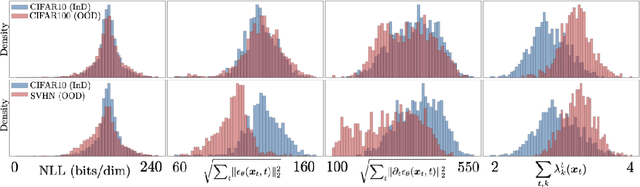
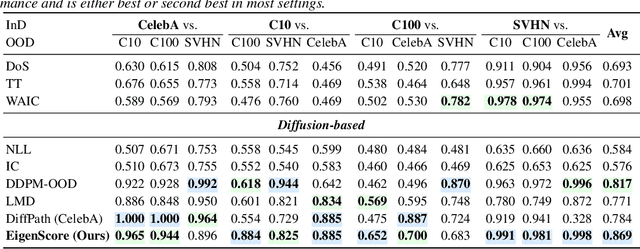
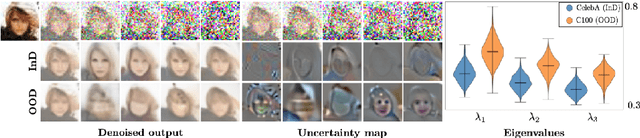
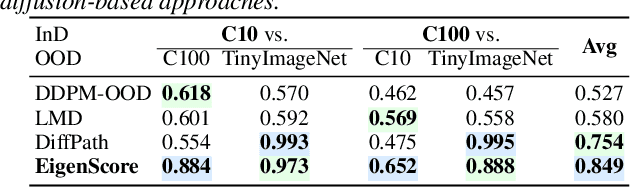
Out-of-distribution (OOD) detection is critical for the safe deployment of machine learning systems in safety-sensitive domains. Diffusion models have recently emerged as powerful generative models, capable of capturing complex data distributions through iterative denoising. Building on this progress, recent work has explored their potential for OOD detection. We propose EigenScore, a new OOD detection method that leverages the eigenvalue spectrum of the posterior covariance induced by a diffusion model. We argue that posterior covariance provides a consistent signal of distribution shift, leading to larger trace and leading eigenvalues on OOD inputs, yielding a clear spectral signature. We further provide analysis explicitly linking posterior covariance to distribution mismatch, establishing it as a reliable signal for OOD detection. To ensure tractability, we adopt a Jacobian-free subspace iteration method to estimate the leading eigenvalues using only forward evaluations of the denoiser. Empirically, EigenScore achieves SOTA performance, with up to 5% AUROC improvement over the best baseline. Notably, it remains robust in near-OOD settings such as CIFAR-10 vs CIFAR-100, where existing diffusion-based methods often fail.
Learning Generalized Hamiltonian Dynamics with Stability from Noisy Trajectory Data
Sep 08, 2025We introduce a robust framework for learning various generalized Hamiltonian dynamics from noisy, sparse phase-space data and in an unsupervised manner based on variational Bayesian inference. Although conservative, dissipative, and port-Hamiltonian systems might share the same initial total energy of a closed system, it is challenging for a single Hamiltonian network model to capture the distinctive and varying motion dynamics and physics of a phase space, from sampled observational phase space trajectories. To address this complicated Hamiltonian manifold learning challenge, we extend sparse symplectic, random Fourier Gaussian processes learning with predictive successive numerical estimations of the Hamiltonian landscape, using a generalized form of state and conjugate momentum Hamiltonian dynamics, appropriate to different classes of conservative, dissipative and port-Hamiltonian physical systems. In addition to the kernelized evidence lower bound (ELBO) loss for data fidelity, we incorporate stability and conservation constraints as additional hyper-parameter balanced loss terms to regularize the model's multi-gradients, enforcing physics correctness for improved prediction accuracy with bounded uncertainty.
OneRec-V2 Technical Report
Aug 28, 2025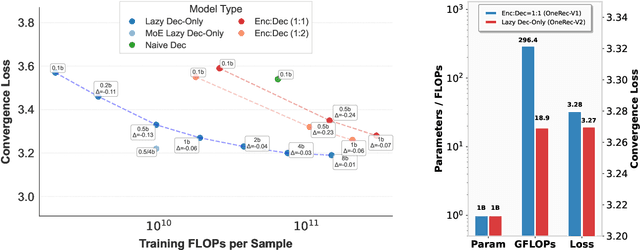
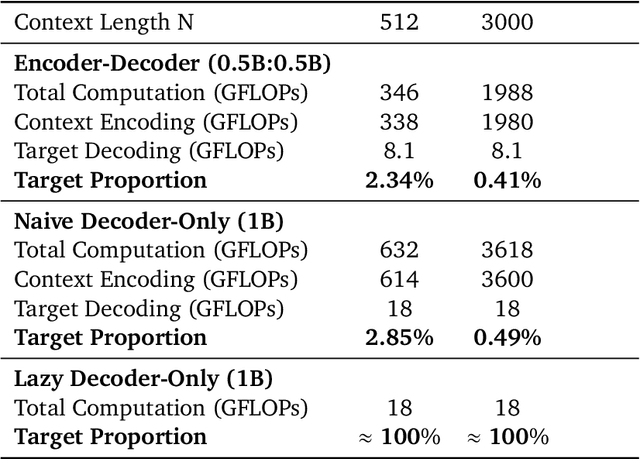

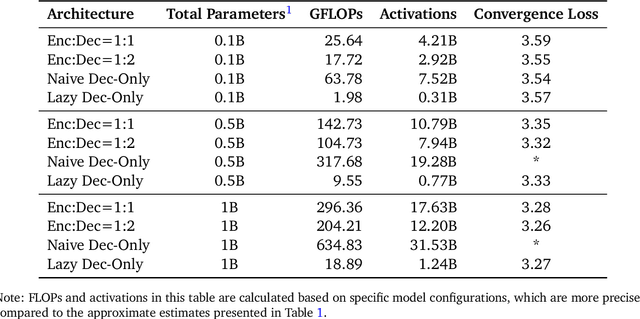
Recent breakthroughs in generative AI have transformed recommender systems through end-to-end generation. OneRec reformulates recommendation as an autoregressive generation task, achieving high Model FLOPs Utilization. While OneRec-V1 has shown significant empirical success in real-world deployment, two critical challenges hinder its scalability and performance: (1) inefficient computational allocation where 97.66% of resources are consumed by sequence encoding rather than generation, and (2) limitations in reinforcement learning relying solely on reward models. To address these challenges, we propose OneRec-V2, featuring: (1) Lazy Decoder-Only Architecture: Eliminates encoder bottlenecks, reducing total computation by 94% and training resources by 90%, enabling successful scaling to 8B parameters. (2) Preference Alignment with Real-World User Interactions: Incorporates Duration-Aware Reward Shaping and Adaptive Ratio Clipping to better align with user preferences using real-world feedback. Extensive A/B tests on Kuaishou demonstrate OneRec-V2's effectiveness, improving App Stay Time by 0.467%/0.741% while balancing multi-objective recommendations. This work advances generative recommendation scalability and alignment with real-world feedback, representing a step forward in the development of end-to-end recommender systems.
InternVL3.5: Advancing Open-Source Multimodal Models in Versatility, Reasoning, and Efficiency
Aug 25, 2025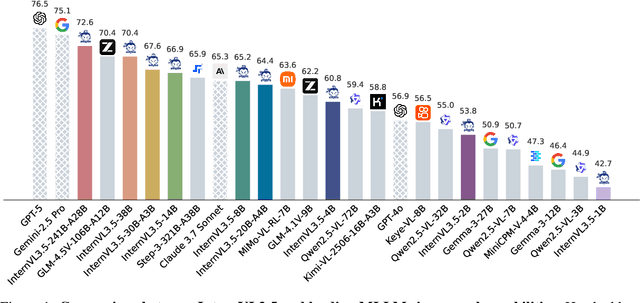
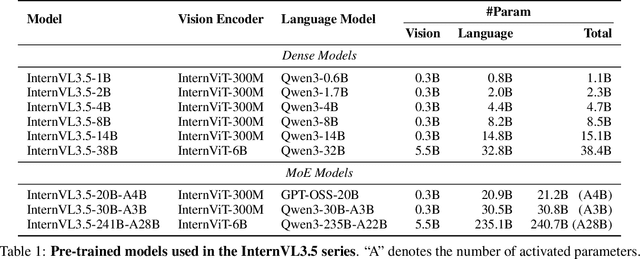
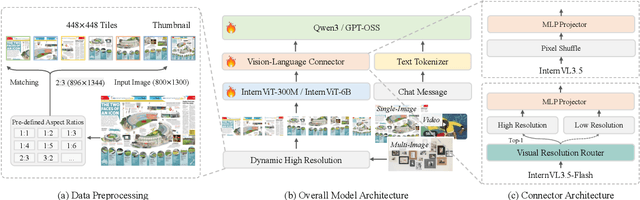
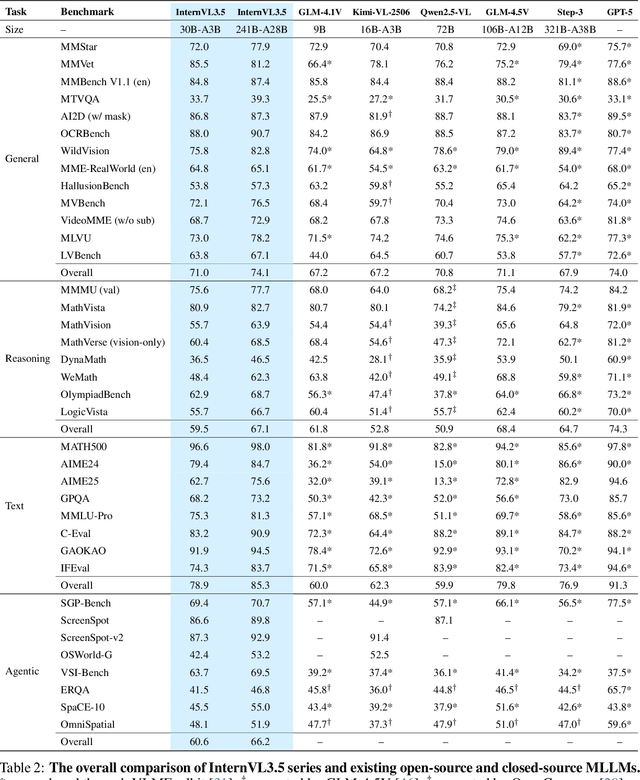
We introduce InternVL 3.5, a new family of open-source multimodal models that significantly advances versatility, reasoning capability, and inference efficiency along the InternVL series. A key innovation is the Cascade Reinforcement Learning (Cascade RL) framework, which enhances reasoning through a two-stage process: offline RL for stable convergence and online RL for refined alignment. This coarse-to-fine training strategy leads to substantial improvements on downstream reasoning tasks, e.g., MMMU and MathVista. To optimize efficiency, we propose a Visual Resolution Router (ViR) that dynamically adjusts the resolution of visual tokens without compromising performance. Coupled with ViR, our Decoupled Vision-Language Deployment (DvD) strategy separates the vision encoder and language model across different GPUs, effectively balancing computational load. These contributions collectively enable InternVL3.5 to achieve up to a +16.0\% gain in overall reasoning performance and a 4.05$\times$ inference speedup compared to its predecessor, i.e., InternVL3. In addition, InternVL3.5 supports novel capabilities such as GUI interaction and embodied agency. Notably, our largest model, i.e., InternVL3.5-241B-A28B, attains state-of-the-art results among open-source MLLMs across general multimodal, reasoning, text, and agentic tasks -- narrowing the performance gap with leading commercial models like GPT-5. All models and code are publicly released.
Robustness Feature Adapter for Efficient Adversarial Training
Aug 25, 2025Adversarial training (AT) with projected gradient descent is the most popular method to improve model robustness under adversarial attacks. However, computational overheads become prohibitively large when AT is applied to large backbone models. AT is also known to have the issue of robust overfitting. This paper contributes to solving both problems simultaneously towards building more trustworthy foundation models. In particular, we propose a new adapter-based approach for efficient AT directly in the feature space. We show that the proposed adapter-based approach can improve the inner-loop convergence quality by eliminating robust overfitting. As a result, it significantly increases computational efficiency and improves model accuracy by generalizing adversarial robustness to unseen attacks. We demonstrate the effectiveness of the new adapter-based approach in different backbone architectures and in AT at scale.
SSFO: Self-Supervised Faithfulness Optimization for Retrieval-Augmented Generation
Aug 24, 2025Retrieval-Augmented Generation (RAG) systems require Large Language Models (LLMs) to generate responses that are faithful to the retrieved context. However, faithfulness hallucination remains a critical challenge, as existing methods often require costly supervision and post-training or significant inference burdens. To overcome these limitations, we introduce Self-Supervised Faithfulness Optimization (SSFO), the first self-supervised alignment approach for enhancing RAG faithfulness. SSFO constructs preference data pairs by contrasting the model's outputs generated with and without the context. Leveraging Direct Preference Optimization (DPO), SSFO aligns model faithfulness without incurring labeling costs or additional inference burden. We theoretically and empirically demonstrate that SSFO leverages a benign form of \emph{likelihood displacement}, transferring probability mass from parametric-based tokens to context-aligned tokens. Based on this insight, we propose a modified DPO loss function to encourage likelihood displacement. Comprehensive evaluations show that SSFO significantly outperforms existing methods, achieving state-of-the-art faithfulness on multiple context-based question-answering datasets. Notably, SSFO exhibits strong generalization, improving cross-lingual faithfulness and preserving general instruction-following capabilities. We release our code and model at the anonymous link: https://github.com/chkwy/SSFO
Towards Blind Bitstream-corrupted Video Recovery via a Visual Foundation Model-driven Framework
Jul 30, 2025Video signals are vulnerable in multimedia communication and storage systems, as even slight bitstream-domain corruption can lead to significant pixel-domain degradation. To recover faithful spatio-temporal content from corrupted inputs, bitstream-corrupted video recovery has recently emerged as a challenging and understudied task. However, existing methods require time-consuming and labor-intensive annotation of corrupted regions for each corrupted video frame, resulting in a large workload in practice. In addition, high-quality recovery remains difficult as part of the local residual information in corrupted frames may mislead feature completion and successive content recovery. In this paper, we propose the first blind bitstream-corrupted video recovery framework that integrates visual foundation models with a recovery model, which is adapted to different types of corruption and bitstream-level prompts. Within the framework, the proposed Detect Any Corruption (DAC) model leverages the rich priors of the visual foundation model while incorporating bitstream and corruption knowledge to enhance corruption localization and blind recovery. Additionally, we introduce a novel Corruption-aware Feature Completion (CFC) module, which adaptively processes residual contributions based on high-level corruption understanding. With VFM-guided hierarchical feature augmentation and high-level coordination in a mixture-of-residual-experts (MoRE) structure, our method suppresses artifacts and enhances informative residuals. Comprehensive evaluations show that the proposed method achieves outstanding performance in bitstream-corrupted video recovery without requiring a manually labeled mask sequence. The demonstrated effectiveness will help to realize improved user experience, wider application scenarios, and more reliable multimedia communication and storage systems.
A Deep Learning-Driven Autonomous System for Retinal Vein Cannulation: Validation Using a Chicken Embryo Model
Jul 29, 2025Retinal vein cannulation (RVC) is a minimally invasive microsurgical procedure for treating retinal vein occlusion (RVO), a leading cause of vision impairment. However, the small size and fragility of retinal veins, coupled with the need for high-precision, tremor-free needle manipulation, create significant technical challenges. These limitations highlight the need for robotic assistance to improve accuracy and stability. This study presents an automated robotic system with a top-down microscope and B-scan optical coherence tomography (OCT) imaging for precise depth sensing. Deep learning-based models enable real-time needle navigation, contact detection, and vein puncture recognition, using a chicken embryo model as a surrogate for human retinal veins. The system autonomously detects needle position and puncture events with 85% accuracy. The experiments demonstrate notable reductions in navigation and puncture times compared to manual methods. Our results demonstrate the potential of integrating advanced imaging and deep learning to automate microsurgical tasks, providing a pathway for safer and more reliable RVC procedures with enhanced precision and reproducibility.