 Add to Chrome
 Add to Firefox
 Add to Edge
DeceptionX: Explainable Deception Detection with Multimodal Large Language Models
Jun 09, 2026
Deception detection is a critical and highly challenging task within affective computing and behavioral analysis. Existing deep learning methods typically treat this task as a straightforward classification problem; however, this black-box approach lacks interpretability and fails to capture the complex logical deduction processes utilized by human experts when identifying lies. While Multimodal Large Language Models (MLLMs) have shown potential, applying them effectively requires a bridge between low-level audiovisual cues and high-level logical reasoning. In this paper, we propose DeceptionX, a novel MLLM framework that shifts the paradigm of deception detection from black-box classification to an interpretable Observe-Think-Summarize reasoning process. To address the scarcity of high-quality reasoning data, we first constructed DeceptChain, a high-quality dataset developed through a human-in-the-loop process. This dataset synthesizes fine-grained visual and auditory evidence (such as micro-expressions and vocal tremors) into structured chain-of-thought reasoning data. Furthermore, we propose a three-stage training pipeline and a Discrepancy-Aware Redundancy Elimination~(DARE) strategy for DeceptionX to further enhance the model's generalization capabilities. Extensive experiments demonstrate that DeceptionX not only outperforms existing MLLM baselines and state-of-the-art methods on standard real-world benchmarks but also provides transparent, expert-level reasoning paths, bridging the critical gap between accuracy and interpretability in multimodal deception detection.

Non-Forgetting Knowledge Allocation with Bi-level Competition for Class-Incremental Learning
May 28, 2026Class-Incremental Learning (CIL) with pre-trained models (PTMs) aims to sequentially adapt PTMs to new categories without forgetting old knowledge. Built upon PTMs, existing adapter-based methods mainly train models via distinct task-specific adapters, and present a uniform knowledge allocation for each adapter during inference. However, this allocation mechanism ignores the nature of task discrepancy and leads to suboptimal utilization of adapters. Also, under CIL constraint, an allocator is prone to forgetting when tasks evolve. To address these issues, we propose a Non-Forgetting Allocation with Bi-Level Competition (NoFA-BC). NoFA-BC constructs a non-forgetting allocator (NFA) by transforming the allocator training into a recursive least-squares problem and achieves an allocator equivalent to that trained with all data. Based on the NFA, a Bi-Level Competition (BLC) including an intra-task level Winner-Takes-All (WTA) mechanism and inter-task Last-Ones-Fall (LOF) elimination is proposed to provide better allocation of adapter knowledge. WTA extracts the most significant logit within a task to represent the adapter's contribution and LOF suppresses the irrelevant adapters. With BLC, participation ratio of each adapter can be tailored for each input. Moreover, a Stability Enhancement (SE) process is incorporated to further improve the performance of old tasks.
SP-MoMamba: Superpixel-driven Mixture of State Space Experts for Efficient Image Super-Resolution
May 25, 2026State space models (SSMs) have emerged as a powerful paradigm for efficient single-image super-resolution (SR) due to their linear complexity and long-range modeling capabilities. However, existing Mamba-based methods typically rely on data-agnostic rigid scanning, which reshapes 2D images into 1D sequences over a fixed grid, inevitably disrupting spatial-semantic topology and introducing artifacts. Inspired by the \textbf{Gestalt perceptual grouping theory}, we propose \textbf{SP-MoMamba}, a superpixel-driven mixture of state space experts designed for content-aware SR. Our core idea is to transform the traditional rigid scanning into a \textbf{semantic-level interaction} by treating superpixels as fundamental units. Specifically, we introduce the \textbf{Superpixel-driven State Space Model (SP-SSM)}, which compresses semantically homogeneous regions into high-order tokens to preserve global topological consistency. To address the conflict between fixed scanning scales and diverse semantic granularities, we develop the \textbf{Multi-Scale Superpixel Mixture of State Space Experts (MSS-MoE)}. This module utilizes a dynamic routing mechanism to adaptively assign scale-specific experts, effectively capturing multi-scale textures while reducing computational redundancy. Furthermore, to prevent the loss of high-frequency details during global abstraction, we introduce a \textbf{Local Spatial Modulation Expert (LSME)} to complement the global modeling, ensuring a precise reconstruction of sharp edges and fine structures. Extensive experiments on standard benchmarks demonstrate that SP-MoMamba achieves superior reconstruction fidelity and a more favorable efficiency-performance trade-off compared to state-of-the-art efficient SR methods.
HVG-3D: Bridging Real and Simulation Domains for 3D-Conditional Hand-Object Interaction Video Synthesis
Mar 31, 2026Recent methods have made notable progress in the visual quality of hand-object interaction video synthesis. However, most approaches rely on 2D control signals that lack spatial expressiveness and limit the utilization of synthetic 3D conditional data. To address these limitations, we propose HVG-3D, a unified framework for 3D-aware hand-object interaction (HOI) video synthesis conditioned on explicit 3D representations. Specifically, we develop a diffusion-based architecture augmented with a 3D ControlNet, which encodes geometric and motion cues from 3D inputs to enable explicit 3D reasoning during video synthesis. To achieve high-quality synthesis, HVG-3D is designed with two core components: (i) a 3D-aware HOI video generation diffusion architecture that encodes geometric and motion cues from 3D inputs for explicit 3D reasoning; and (ii) a hybrid pipeline for constructing input and condition signals, enabling flexible and precise control during both training and inference. During inference, given a single real image and a 3D control signal from either simulation or real data, HVG-3D generates high-fidelity, temporally consistent videos with precise spatial and temporal control. Experiments on the TASTE-Rob dataset demonstrate that HVG-3D achieves state-of-the-art spatial fidelity, temporal coherence, and controllability, while enabling effective utilization of both real and simulated data.
Interaction-aware Representation Modeling with Co-occurrence Consistency for Egocentric Hand-Object Parsing
Feb 24, 2026A fine-grained understanding of egocentric human-environment interactions is crucial for developing next-generation embodied agents. One fundamental challenge in this area involves accurately parsing hands and active objects. While transformer-based architectures have demonstrated considerable potential for such tasks, several key limitations remain unaddressed: 1) existing query initialization mechanisms rely primarily on semantic cues or learnable parameters, demonstrating limited adaptability to changing active objects across varying input scenes; 2) previous transformer-based methods utilize pixel-level semantic features to iteratively refine queries during mask generation, which may introduce interaction-irrelevant content into the final embeddings; and 3) prevailing models are susceptible to "interaction illusion", producing physically inconsistent predictions. To address these issues, we propose an end-to-end Interaction-aware Transformer (InterFormer), which integrates three key components, i.e., a Dynamic Query Generator (DQG), a Dual-context Feature Selector (DFS), and the Conditional Co-occurrence (CoCo) loss. The DQG explicitly grounds query initialization in the spatial dynamics of hand-object contact, enabling targeted generation of interaction-aware queries for hands and various active objects. The DFS fuses coarse interactive cues with semantic features, thereby suppressing interaction-irrelevant noise and emphasizing the learning of interactive relationships. The CoCo loss incorporates hand-object relationship constraints to enhance physical consistency in prediction. Our model achieves state-of-the-art performance on both the EgoHOS and the challenging out-of-distribution mini-HOI4D datasets, demonstrating its effectiveness and strong generalization ability. Code and models are publicly available at https://github.com/yuggiehk/InterFormer.
LaSSM: Efficient Semantic-Spatial Query Decoding via Local Aggregation and State Space Models for 3D Instance Segmentation
Feb 11, 2026Query-based 3D scene instance segmentation from point clouds has attained notable performance. However, existing methods suffer from the query initialization dilemma due to the sparse nature of point clouds and rely on computationally intensive attention mechanisms in query decoders. We accordingly introduce LaSSM, prioritizing simplicity and efficiency while maintaining competitive performance. Specifically, we propose a hierarchical semantic-spatial query initializer to derive the query set from superpoints by considering both semantic cues and spatial distribution, achieving comprehensive scene coverage and accelerated convergence. We further present a coordinate-guided state space model (SSM) decoder that progressively refines queries. The novel decoder features a local aggregation scheme that restricts the model to focus on geometrically coherent regions and a spatial dual-path SSM block to capture underlying dependencies within the query set by integrating associated coordinates information. Our design enables efficient instance prediction, avoiding the incorporation of noisy information and reducing redundant computation. LaSSM ranks first place on the latest ScanNet++ V2 leaderboard, outperforming the previous best method by 2.5% mAP with only 1/3 FLOPs, demonstrating its superiority in challenging large-scale scene instance segmentation. LaSSM also achieves competitive performance on ScanNet, ScanNet200, S3DIS and ScanNet++ V1 benchmarks with less computational cost. Extensive ablation studies and qualitative results validate the effectiveness of our design. The code and weights are available at https://github.com/RayYoh/LaSSM.
3DGeoDet: General-purpose Geometry-aware Image-based 3D Object Detection
Jun 11, 2025This paper proposes 3DGeoDet, a novel geometry-aware 3D object detection approach that effectively handles single- and multi-view RGB images in indoor and outdoor environments, showcasing its general-purpose applicability. The key challenge for image-based 3D object detection tasks is the lack of 3D geometric cues, which leads to ambiguity in establishing correspondences between images and 3D representations. To tackle this problem, 3DGeoDet generates efficient 3D geometric representations in both explicit and implicit manners based on predicted depth information. Specifically, we utilize the predicted depth to learn voxel occupancy and optimize the voxelized 3D feature volume explicitly through the proposed voxel occupancy attention. To further enhance 3D awareness, the feature volume is integrated with an implicit 3D representation, the truncated signed distance function (TSDF). Without requiring supervision from 3D signals, we significantly improve the model's comprehension of 3D geometry by leveraging intermediate 3D representations and achieve end-to-end training. Our approach surpasses the performance of state-of-the-art image-based methods on both single- and multi-view benchmark datasets across diverse environments, achieving a 9.3 mAP@0.5 improvement on the SUN RGB-D dataset, a 3.3 mAP@0.5 improvement on the ScanNetV2 dataset, and a 0.19 AP3D@0.7 improvement on the KITTI dataset. The project page is available at: https://cindy0725.github.io/3DGeoDet/.
Analytic Subspace Routing: How Recursive Least Squares Works in Continual Learning of Large Language Model
Mar 17, 2025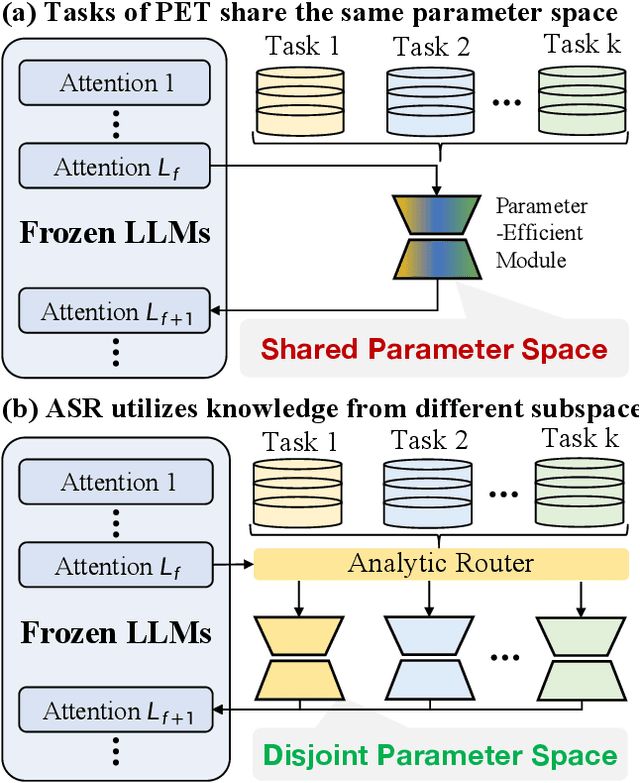
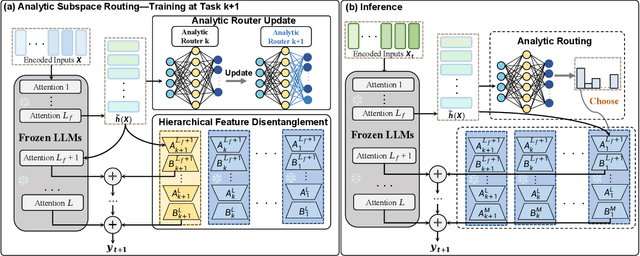
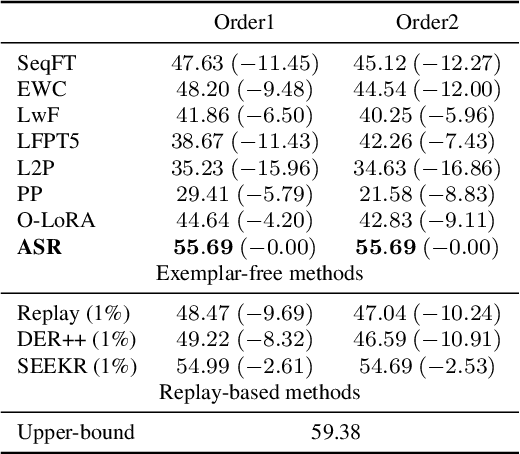
Large Language Models (LLMs) possess encompassing capabilities that can process diverse language-related tasks. However, finetuning on LLMs will diminish this general skills and continual finetuning will further cause severe degradation on accumulated knowledge. Recently, Continual Learning (CL) in Large Language Models (LLMs) arises which aims to continually adapt the LLMs to new tasks while maintaining previously learned knowledge and inheriting general skills. Existing techniques either leverage previous data to replay, leading to extra computational costs, or utilize a single parameter-efficient module to learn the downstream task, constraining new knowledge absorption with interference between different tasks. Toward these issues, this paper proposes Analytic Subspace Routing(ASR) to address these challenges. For each task, we isolate the learning within a subspace of deep layers' features via low-rank adaptation, eliminating knowledge interference between different tasks. Additionally, we propose an analytic routing mechanism to properly utilize knowledge learned in different subspaces. Our approach employs Recursive Least Squares to train a multi-task router model, allowing the router to dynamically adapt to incoming data without requiring access to historical data. Also, the router effectively assigns the current task to an appropriate subspace and has a non-forgetting property of previously learned tasks with a solid theoretical guarantee. Experimental results demonstrate that our method achieves near-perfect retention of prior knowledge while seamlessly integrating new information, effectively overcoming the core limitations of existing methods. Our code will be released after acceptance.
Semantic Shift Estimation via Dual-Projection and Classifier Reconstruction for Exemplar-Free Class-Incremental Learning
Mar 07, 2025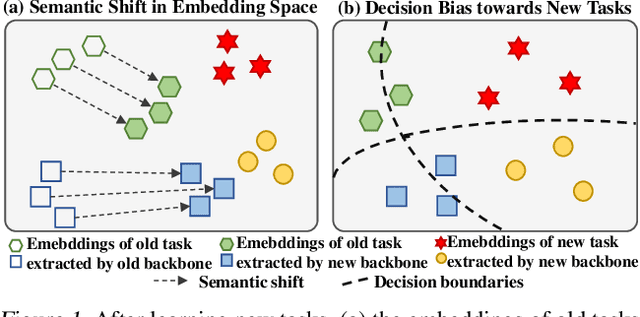
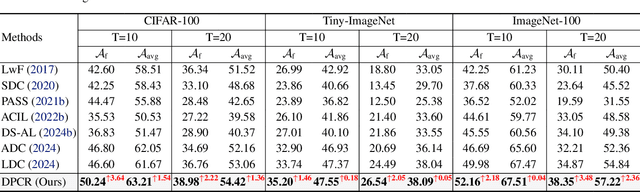
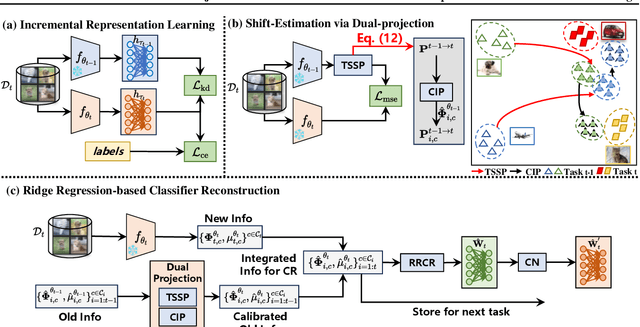
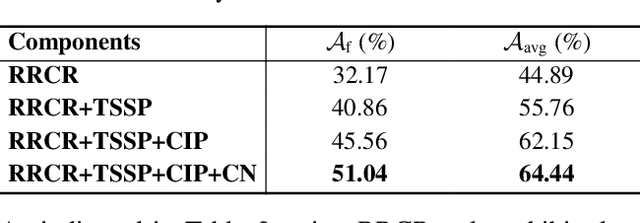
Exemplar-Free Class-Incremental Learning (EFCIL) aims to sequentially learn from distinct categories without retaining exemplars but easily suffers from catastrophic forgetting of learned knowledge. While existing EFCIL methods leverage knowledge distillation to alleviate forgetting, they still face two critical challenges: semantic shift and decision bias. Specifically, the embeddings of old tasks shift in the embedding space after learning new tasks, and the classifier becomes biased towards new tasks due to training solely with new data, thereby hindering the balance between old and new knowledge. To address these issues, we propose the Dual-Projection Shift Estimation and Classifier Reconstruction (DPCR) approach for EFCIL. DPCR effectively estimates semantic shift through a dual-projection, which combines a learnable transformation with a row-space projection to capture both task-wise and category-wise shifts. Furthermore, to mitigate decision bias, DPCR employs ridge regression to reformulate classifier training as a reconstruction process. This reconstruction exploits previous information encoded in covariance and prototype of each class after calibration with estimated shift, thereby reducing decision bias. Extensive experiments demonstrate that, across various datasets, DPCR effectively balances old and new tasks, outperforming state-of-the-art EFCIL methods.
EPE-P: Evidence-based Parameter-efficient Prompting for Multimodal Learning with Missing Modalities
Dec 23, 2024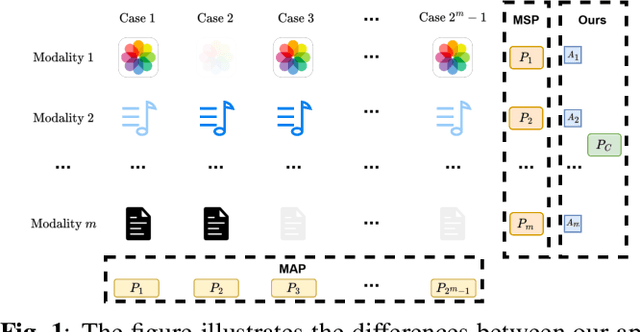
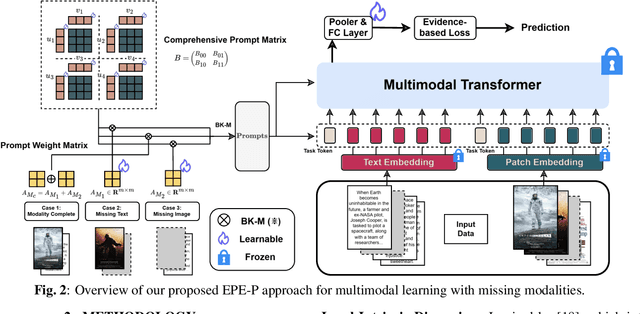
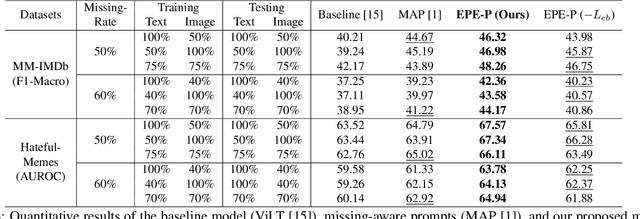
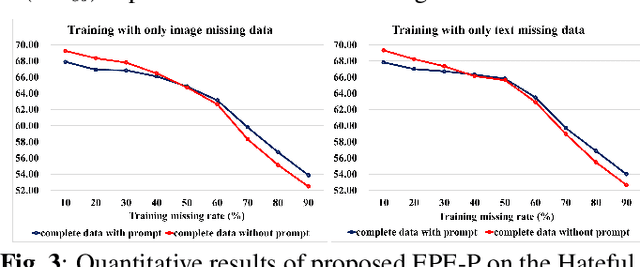
Missing modalities are a common challenge in real-world multimodal learning scenarios, occurring during both training and testing. Existing methods for managing missing modalities often require the design of separate prompts for each modality or missing case, leading to complex designs and a substantial increase in the number of parameters to be learned. As the number of modalities grows, these methods become increasingly inefficient due to parameter redundancy. To address these issues, we propose Evidence-based Parameter-Efficient Prompting (EPE-P), a novel and parameter-efficient method for pretrained multimodal networks. Our approach introduces a streamlined design that integrates prompting information across different modalities, reducing complexity and mitigating redundant parameters. Furthermore, we propose an Evidence-based Loss function to better handle the uncertainty associated with missing modalities, improving the model's decision-making. Our experiments demonstrate that EPE-P outperforms existing prompting-based methods in terms of both effectiveness and efficiency. The code is released at https://github.com/Boris-Jobs/EPE-P_MLLMs-Robustness.