 Add to Chrome
 Add to Firefox
 Add to Edge
Agogic: Performance-Timed Music Tokens for LLM-Native Text-to-Symbolic-Music Generation
Aug 04, 2026
Text-to-music language models begin with a choice usually made by default: how to tokenize music. Normally entangled with backbone, data, and recipe, its effect has never been measured in isolation. We fix pretrained Qwen3.5 (0.8B-27B), data, budget, and decoding, and swap only the representation across seven tokenizations, anchoring texture metrics to each representation's model-free ceiling. The ordering is clean and surprising: representation, not model size, is the binding variable for distributional fidelity. Scaling the backbone 34x barely moves Frechet Music Distance (FMD), whereas switching representation halves it. PMT, a performance-resolution stream we release (10 ms timing, per-note velocity, multi-track texture; 609 symbols), reaches FMD 159 at 0.8B against 272-286 for beat grids (1.7-1.8x lower, up to 2.8x elsewhere; non-overlapping bootstrap CIs), so a 0.8B performance-resolution model beats a 27B beat grid. It reappears on a 26M from-scratch backbone and a second performance-resolution tokenizer: a property of the class, not one lucky vocabulary. Nor is it a finer-lattice artifact: snapping PMT's onsets to the beat grids' resolution still leaves it 67-129 FMD ahead of both (n=500). The effect is distributional; whether it is audible is a separate question, left open by our probe, with a human study pre-registered. Native caption adherence is weak but separable: a lightweight decode-time constraint doubles instrument-F1 (.28 to .60) and Correct-Key (.16 to .35) at no distributional cost. We release the harness, 25+ checkpoints, two corpora (86.6k aligned across caption/MIDI/ABC/audio; 6.25M captioned, the largest for music), and an imprinting diagnostic: published text-to-MIDI systems reproduce their training distribution near-invariant to the caption (72% vs. 71% chord-time on disjoint domains). The field's next representation claim can now be measured, not asserted.

Video Models as Native 4D Renderers: World-Grounded Conditioning from Animated Mesh
Jul 30, 2026Pretrained video diffusion models can act as renderers when the desired scene state is already specified by an animated mesh, a camera trajectory, and a reference image. This 4D generative rendering setting raises a representation question: what image-format condition lets a video backbone obey both camera motion and scene-internal animation? We propose DAR, a reference-guided renderer that extends Wan2.2 camera control from Plücker rays alone to a joint camera-plus-geometry interface. DAR projects a neural 4D G-buffer (tracking, world position, and normal) from the animated mesh and injects it through a widened control adapter while preserving the pretrained image-to-video prior. The central design choice is the pair of tracking and world position. Tracking identifies the persistent surface element that should carry appearance; world position gives its current scene-coordinate state; normal supplies local shape. Depth plus calibrated rays can recover 3D in principle, but depth is a camera-dependent chart in which camera and object motion are mixed. On the 68-case DAR-4D benchmark, LoRA DAR reaches PSNR 23.22, SSIM 0.895, and LPIPS 0.134, improving over off-the-shelf Wan2.2-Depth by 1.54 dB PSNR; a full fine-tune reaches PSNR 25.36 and SSIM 0.917. Matched ablations show that replacing world position by depth reduces PSNR by 1.26--1.55 dB at every checkpoint, supporting tracking+world-position correspondence as a practical 4D rendering condition.
PairCoder++: Pair Programming as a Universal Paradigm for Verified Code-Driven Multimodal and Structured-Artifact Generation
Jul 02, 2026Code is the medium through which large language models generate structured artifacts: charts, scientific figures, vector graphics, CAD models, 3D scenes, and hardware designs are all produced by writing programs. In this regime single pass inference is brittle, because the compiler, renderer, or simulator that decides whether the artifact exists is invisible to the model. We present PairCoder, which grounds review in the toolchain and realizes it as two agent pair programming: a Driver agent writes the program, a Navigator agent reviews it against verification evidence (diagnostics, execution results, and renderings of the current artifact beside the target), and the two switch roles when errors persist. Across 17 public benchmarks and seven models from three vendors, PairCoder improves essentially every benchmark whose artifact is verifiable, on full official metric suites rather than execution alone (for example, Blender scene executability 0.20 to 0.78; TikZ compile rate up 10 to 30 points on every model), at 2.9 to 9.2 times single model cost (about 7 times overall). The improvements concentrate where the toolchain provides an informative oracle and the baseline leaves headroom, and the method ties or mildly regresses where the oracle is weak; we frame pair programming as a reliable recipe for verified code driven generation.
One Video, One World: Turning Monocular Video into Physical 4D Scenes
Jun 30, 2026We introduce \textbf{OVOW}, the first training-free system that reconstructs \emph{instance-level, simulation-ready} 4D mesh scenes from a single monocular video. Recent 4D reconstruction achieves impressive rendering quality, but its outputs (\eg, implicit fields, Gaussian primitives, or point clouds) lack the watertight topology, instance separation, and standardized physical interfaces required by physics simulators and embodied AI. OVOW closes this gap with a four-stage pipeline: a vision-language model discovers, labels, and motion-classifies all instances; category-aware reconstruction yields per-instance meshes for rigid objects and topology-consistent mesh sequences for deformable ones; an iterative render-match-optimize procedure recovers metric scale and 6-DoF pose trajectories; and physics-grounded assembly enforces ground contact and inter-object support. Crucially, we model all motion, rigid and non-rigid, through direct vertex deformation without category-specific priors or skeleton rigging, producing watertight mesh scenes ready for downstream physics simulation and editing. We further establish the first benchmark for \emph{structured Video-to-4D} evaluation, with metrics for geometric correctness, instance separation, and physical plausibility beyond visual fidelity; the same pipeline doubles as a scalable engine for \emph{synthesizing} paired video-to-4D simulation data for future 4D world models and embodied AI. Across two synthetic benchmarks (static and 4D), OVOW attains the best overall layout and geometry accuracy and the lowest photometric and semantic error among all baselines, and on monocular video runs one to two orders of magnitude faster than the baselines, while downstream physics simulation confirms its physical stability.
LottieGPT: Tokenizing Vector Animation for Autoregressive Generation
Apr 13, 2026Despite rapid progress in video generation, existing models are incapable of producing vector animation, a dominant and highly expressive form of multimedia on the Internet. Vector animations offer resolution-independence, compactness, semantic structure, and editable parametric motion representations, yet current generative models operate exclusively in raster space and thus cannot synthesize them. Meanwhile, recent advances in large multimodal models demonstrate strong capabilities in generating structured data such as slides, 3D meshes, LEGO sequences, and indoor layouts, suggesting that native vector animation generation may be achievable. In this work, we present the first framework for tokenizing and autoregressively generating vector animations. We adopt Lottie, a widely deployed JSON-based animation standard, and design a tailored Lottie Tokenizer that encodes layered geometric primitives, transforms, and keyframe-based motion into a compact and semantically aligned token sequence. To support large-scale training, we also construct LottieAnimation-660K, the largest and most diverse vector animation dataset to date, consisting of 660k real-world Lottie animation and 15M static Lottie image files curated from broad Internet sources. Building upon these components, we finetune Qwen-VL to create LottieGPT, a native multimodal model capable of generating coherent, editable vector animations directly from natural language or visual prompts. Experiments show that our tokenizer dramatically reduces sequence length while preserving structural fidelity, enabling effective autoregressive learning of dynamic vector content. LottieGPT exhibits strong generalization across diverse animation styles and outperforms previous state-of-the-art models on SVG generation (a special case of single-frame vector animation).
HVG-3D: Bridging Real and Simulation Domains for 3D-Conditional Hand-Object Interaction Video Synthesis
Mar 31, 2026Recent methods have made notable progress in the visual quality of hand-object interaction video synthesis. However, most approaches rely on 2D control signals that lack spatial expressiveness and limit the utilization of synthetic 3D conditional data. To address these limitations, we propose HVG-3D, a unified framework for 3D-aware hand-object interaction (HOI) video synthesis conditioned on explicit 3D representations. Specifically, we develop a diffusion-based architecture augmented with a 3D ControlNet, which encodes geometric and motion cues from 3D inputs to enable explicit 3D reasoning during video synthesis. To achieve high-quality synthesis, HVG-3D is designed with two core components: (i) a 3D-aware HOI video generation diffusion architecture that encodes geometric and motion cues from 3D inputs for explicit 3D reasoning; and (ii) a hybrid pipeline for constructing input and condition signals, enabling flexible and precise control during both training and inference. During inference, given a single real image and a 3D control signal from either simulation or real data, HVG-3D generates high-fidelity, temporally consistent videos with precise spatial and temporal control. Experiments on the TASTE-Rob dataset demonstrate that HVG-3D achieves state-of-the-art spatial fidelity, temporal coherence, and controllability, while enabling effective utilization of both real and simulated data.
DanceTogether! Identity-Preserving Multi-Person Interactive Video Generation
May 23, 2025Controllable video generation (CVG) has advanced rapidly, yet current systems falter when more than one actor must move, interact, and exchange positions under noisy control signals. We address this gap with DanceTogether, the first end-to-end diffusion framework that turns a single reference image plus independent pose-mask streams into long, photorealistic videos while strictly preserving every identity. A novel MaskPoseAdapter binds "who" and "how" at every denoising step by fusing robust tracking masks with semantically rich-but noisy-pose heat-maps, eliminating the identity drift and appearance bleeding that plague frame-wise pipelines. To train and evaluate at scale, we introduce (i) PairFS-4K, 26 hours of dual-skater footage with 7,000+ distinct IDs, (ii) HumanRob-300, a one-hour humanoid-robot interaction set for rapid cross-domain transfer, and (iii) TogetherVideoBench, a three-track benchmark centered on the DanceTogEval-100 test suite covering dance, boxing, wrestling, yoga, and figure skating. On TogetherVideoBench, DanceTogether outperforms the prior arts by a significant margin. Moreover, we show that a one-hour fine-tune yields convincing human-robot videos, underscoring broad generalization to embodied-AI and HRI tasks. Extensive ablations confirm that persistent identity-action binding is critical to these gains. Together, our model, datasets, and benchmark lift CVG from single-subject choreography to compositionally controllable, multi-actor interaction, opening new avenues for digital production, simulation, and embodied intelligence. Our video demos and code are available at https://DanceTog.github.io/.
Ultraman: Single Image 3D Human Reconstruction with Ultra Speed and Detail
Mar 18, 2024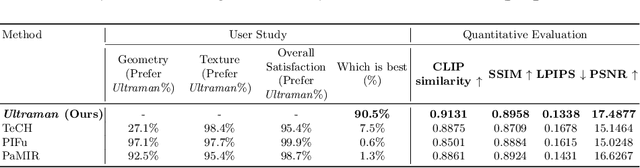
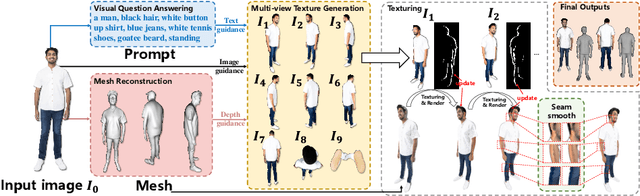
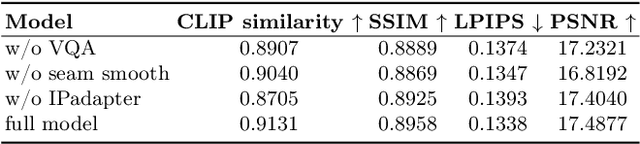
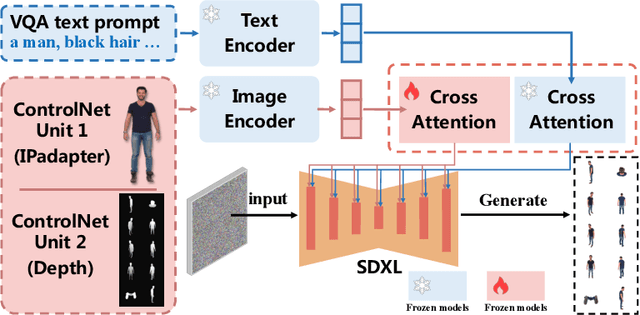
3D human body reconstruction has been a challenge in the field of computer vision. Previous methods are often time-consuming and difficult to capture the detailed appearance of the human body. In this paper, we propose a new method called \emph{Ultraman} for fast reconstruction of textured 3D human models from a single image. Compared to existing techniques, \emph{Ultraman} greatly improves the reconstruction speed and accuracy while preserving high-quality texture details. We present a set of new frameworks for human reconstruction consisting of three parts, geometric reconstruction, texture generation and texture mapping. Firstly, a mesh reconstruction framework is used, which accurately extracts 3D human shapes from a single image. At the same time, we propose a method to generate a multi-view consistent image of the human body based on a single image. This is finally combined with a novel texture mapping method to optimize texture details and ensure color consistency during reconstruction. Through extensive experiments and evaluations, we demonstrate the superior performance of \emph{Ultraman} on various standard datasets. In addition, \emph{Ultraman} outperforms state-of-the-art methods in terms of human rendering quality and speed. Upon acceptance of the article, we will make the code and data publicly available.
Abdominal multi-organ segmentation in CT using Swinunter
Sep 28, 2023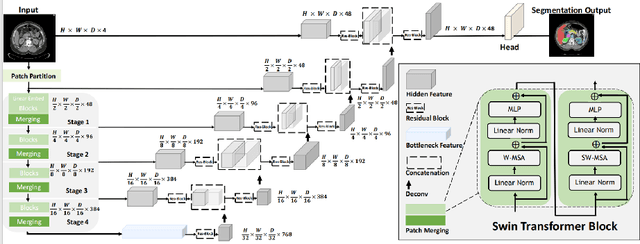
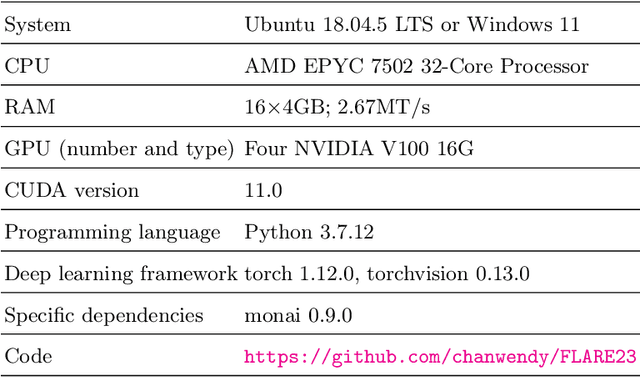
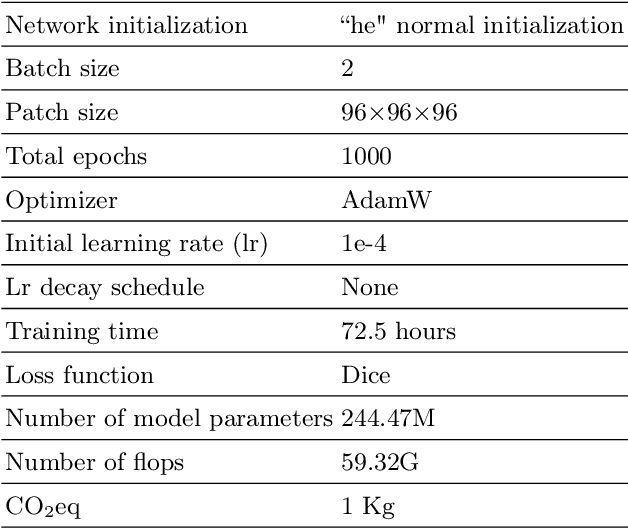
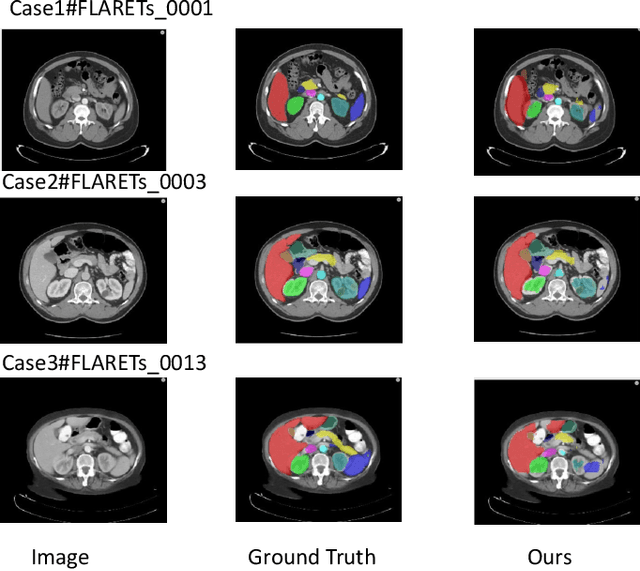
Abdominal multi-organ segmentation in computed tomography (CT) is crucial for many clinical applications including disease detection and treatment planning. Deep learning methods have shown unprecedented performance in this perspective. However, it is still quite challenging to accurately segment different organs utilizing a single network due to the vague boundaries of organs, the complex background, and the substantially different organ size scales. In this work we used make transformer-based model for training. It was found through previous years' competitions that basically all of the top 5 methods used CNN-based methods, which is likely due to the lack of data volume that prevents transformer-based methods from taking full advantage. The thousands of samples in this competition may enable the transformer-based model to have more excellent results. The results on the public validation set also show that the transformer-based model can achieve an acceptable result and inference time.
Learning to In-paint: Domain Adaptive Shape Completion for 3D Organ Segmentation
Aug 17, 2023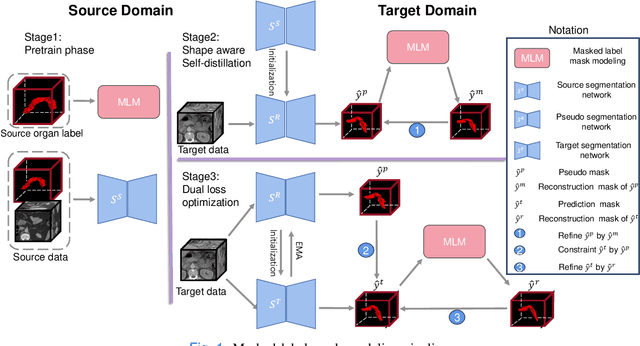
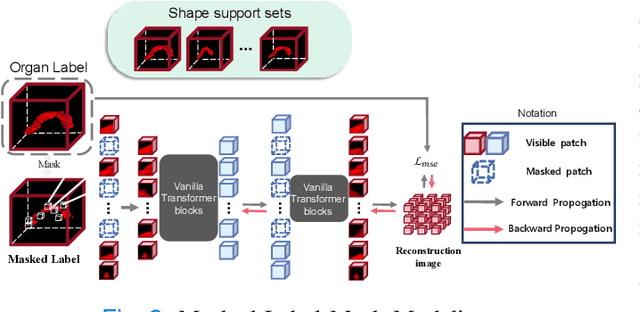
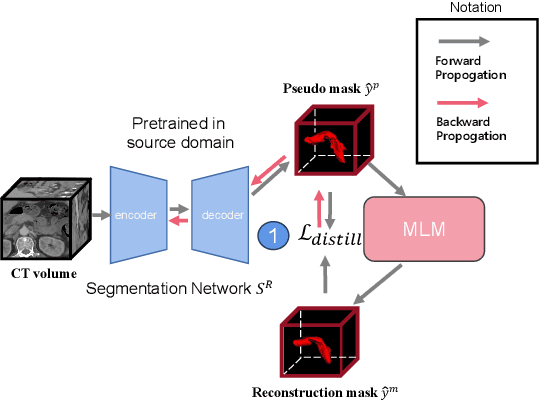
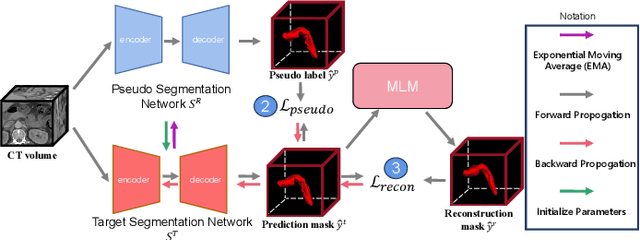
We aim at incorporating explicit shape information into current 3D organ segmentation models. Different from previous works, we formulate shape learning as an in-painting task, which is named Masked Label Mask Modeling (MLM). Through MLM, learnable mask tokens are fed into transformer blocks to complete the label mask of organ. To transfer MLM shape knowledge to target, we further propose a novel shape-aware self-distillation with both in-painting reconstruction loss and pseudo loss. Extensive experiments on five public organ segmentation datasets show consistent improvements over prior arts with at least 1.2 points gain in the Dice score, demonstrating the effectiveness of our method in challenging unsupervised domain adaptation scenarios including: (1) In-domain organ segmentation; (2) Unseen domain segmentation and (3) Unseen organ segmentation. We hope this work will advance shape analysis and geometric learning in medical imaging.