 Add to Chrome
 Add to Firefox
 Add to Edge
WIN-U: Woodbury-Informed Newton-Unlearning as a retain-free Machine Unlearning Framework
Apr 15, 2026
Privacy concerns in LLMs have led to the rapidly growing need to enforce a data's "right to be forgotten". Machine unlearning addresses precisely this task, namely the removal of the influence of some specific data, i.e., the forget set, from a trained model. The gold standard for unlearning is to produce the model that would have been learned on only the rest of the training data, i.e., the retain set. Most existing unlearning methods rely on direct access to the retained data, which may not be practical due to privacy or cost constraints. We propose WIN-U, a retained-data free unlearning framework that requires only second order information for the originally trained model on the full data. The unlearning is performed using a single Newton-style step. Using the Woodbury matrix identity and a generalized Gauss-Newton approximation for the forget set curvature, the WIN-U update recovers the closed-form linear solution and serves as a local second-order approximation to the gold-standard retraining optimum. Extensive experiments on various vision and language benchmarks demonstrate that WIN-U achieves SOTA performance in terms of unlearning efficacy and utility preservation, while being more robust against relearning attacks compared to existing methods. Importantly, WIN-U does not require access to the retained data.

Interactive ASR: Towards Human-Like Interaction and Semantic Coherence Evaluation for Agentic Speech Recognition
Apr 14, 2026Recent years have witnessed remarkable progress in automatic speech recognition (ASR), driven by advances in model architectures and large-scale training data. However, two important aspects remain underexplored. First, Word Error Rate (WER), the dominant evaluation metric for decades, treats all words equally and often fails to reflect the semantic correctness of an utterance at the sentence level. Second, interactive correction-an essential component of human communication-has rarely been systematically studied in ASR research. In this paper, we integrate these two perspectives under an agentic framework for interactive ASR. We propose leveraging LLM-as-a-Judge as a semantic-aware evaluation metric to assess recognition quality beyond token-level accuracy. Furthermore, we design an LLM-driven agent framework to simulate human-like multi-turn interaction, enabling iterative refinement of recognition outputs through semantic feedback. Extensive experiments are conducted on standard benchmarks, including GigaSpeech (English), WenetSpeech (Chinese), the ASRU 2019 code-switching test set. Both objective and subjective evaluations demonstrate the effectiveness of the proposed framework in improving semantic fidelity and interactive correction capability. We will release the code to facilitate future research in interactive and agentic ASR.
MOSS-Speech: Towards True Speech-to-Speech Models Without Text Guidance
Oct 02, 2025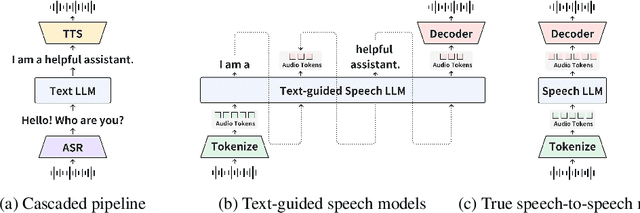
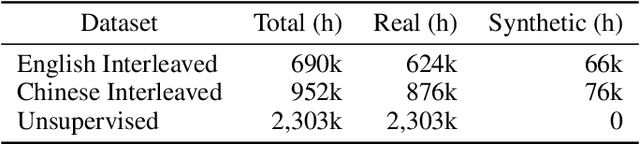
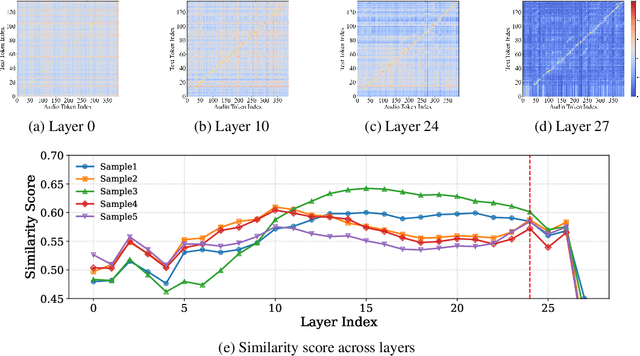
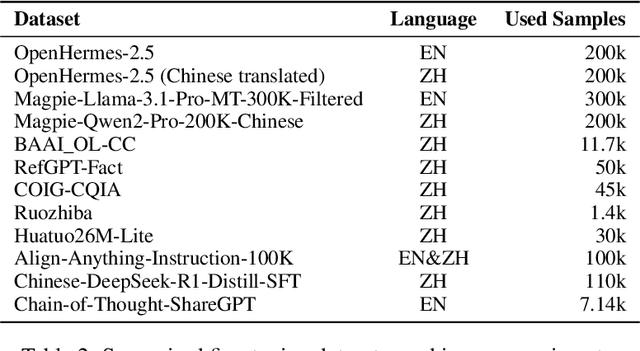
Spoken dialogue systems often rely on cascaded pipelines that transcribe, process, and resynthesize speech. While effective, this design discards paralinguistic cues and limits expressivity. Recent end-to-end methods reduce latency and better preserve these cues, yet still rely on text intermediates, creating a fundamental bottleneck. We present MOSS-Speech, a true speech-to-speech large language model that directly understands and generates speech without relying on text guidance. Our approach combines a modality-based layer-splitting architecture with a frozen pre-training strategy, preserving the reasoning and knowledge of pretrained text LLMs while adding native speech capabilities. Experiments show that our model achieves state-of-the-art results in spoken question answering and delivers comparable speech-to-speech performance relative to existing text-guided systems, while still maintaining competitive text performance. By narrowing the gap between text-guided and direct speech generation, our work establishes a new paradigm for expressive and efficient end-to-end speech interaction.
Reinforcement Learning for Quantum Circuit Design: Using Matrix Representations
Jan 27, 2025Quantum computing promises advantages over classical computing. The manufacturing of quantum hardware is in the infancy stage, called the Noisy Intermediate-Scale Quantum (NISQ) era. A major challenge is automated quantum circuit design that map a quantum circuit to gates in a universal gate set. In this paper, we present a generic MDP modeling and employ Q-learning and DQN algorithms for quantum circuit design. By leveraging the power of deep reinforcement learning, we aim to provide an automatic and scalable approach over traditional hand-crafted heuristic methods.
FinLoRA: Finetuning Quantized Financial Large Language Models Using Low-Rank Adaptation
Dec 16, 2024



Finetuned large language models (LLMs) have shown remarkable performance in financial tasks, such as sentiment analysis and information retrieval. Due to privacy concerns, finetuning and deploying Financial LLMs (FinLLMs) locally are crucial for institutions. However, finetuning FinLLMs poses challenges including GPU memory constraints and long input sequences. In this paper, we employ quantized low-rank adaptation (QLoRA) to finetune FinLLMs, which leverage low-rank matrix decomposition and quantization techniques to significantly reduce computational requirements while maintaining high model performance. We also employ data and pipeline parallelism to enable local finetuning using cost-effective, widely accessible GPUs. Experiments on financial datasets demonstrate that our method achieves substantial improvements in accuracy, GPU memory usage, and time efficiency, underscoring the potential of lowrank methods for scalable and resource-efficient LLM finetuning.